The Quick Answer: Is the Outlander an Electric Car?
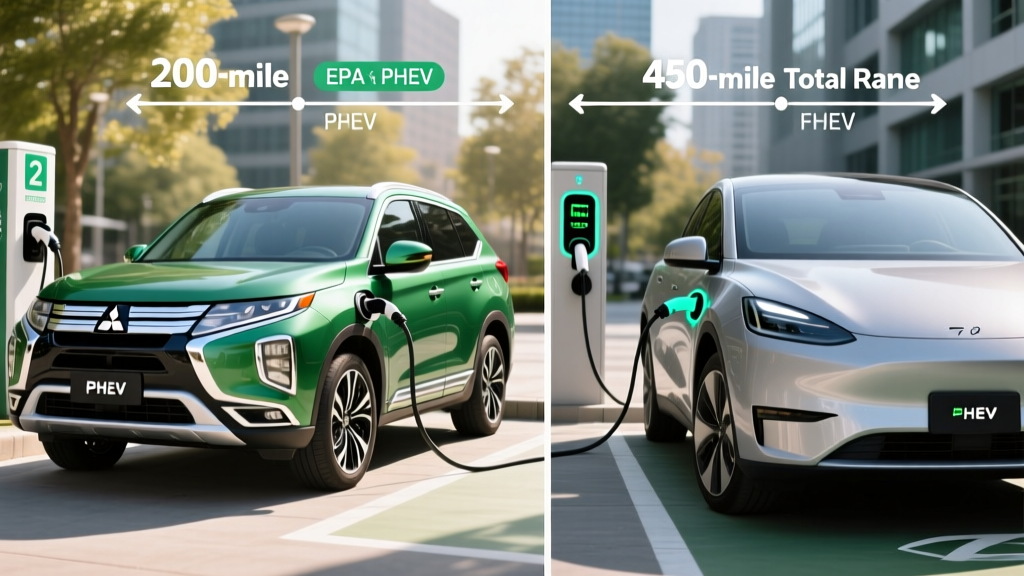
The Mitsubishi Outlander is not a fully electric car — it is a plug-in hybrid electric vehicle (PHEV). The 2026 Outlander PHEV pairs a 2.4-liter gas engine with a 20 kWh battery (approximately 17.5 kWh usable) to deliver an EPA-estimated 38 miles of electric-only range before the gas engine engages. If you want a pure battery-electric Mitsubishi, you'll need to wait for the upcoming Mitsubishi e-EV, which remains in the announced/preliminary stage with no confirmed US launch date. For now, the Outlander PHEV is Mitsubishi's most electrified SUV offering, starting at roughly $41,640 MSRP.
Outlander PHEV Specs: What You're Actually Buying
Before deciding whether the Outlander PHEV fits your life, here are the hard numbers that define ownership. The 2026 model carries over the powertrain architecture introduced in the current generation, with minor trim and packaging updates.
| Specification | 2026 Mitsubishi Outlander PHEV |
|---|---|
| Powertrain | 2.4L 4-cyl + twin electric motors (S-AWC) |
| Combined System Output | 248 hp / 332 lb-ft torque |
| Battery Capacity | 20 kWh total (~17.5 kWh usable), NMC chemistry |
| EPA Electric-Only Range | 38 miles |
| Real-World Electric Range | ~30–35 miles (highway); ~25–28 miles (cold weather) |
| MPGe (Electric Mode) | 64 MPGe combined |
| Gas-Only Fuel Economy | 26 MPG combined (city/highway) |
| Total Range (Gas + Electric) | ~420 miles |
| 0–60 mph | ~7.1 seconds |
| DC Fast Charging (CHAdeMO) | Peak ~22 kW; 0–80% in ~38 minutes |
| Level 2 Charging (J1772) | 3.3 kW; full charge in ~5.5 hours |
| Cargo Volume | 33.5 cu ft (behind 2nd row) |
| Towing Capacity | 1,500 lbs |
| Base MSRP (ES trim) | $41,640 |
| Battery Warranty | 10 years / 100,000 miles |
| Powertrain Warranty | 10 years / 100,000 miles |
Real-world range reality check: The EPA's 38-mile electric estimate assumes moderate temperatures and mixed city/highway driving at modest speeds. In our experience and owner reports, expect 30–35 miles on a warm day with highway driving, and as low as 25–28 miles in freezing temperatures when the cabin heater draws additional energy. The Outlander PHEV does not include a dedicated heat pump for the battery, which contributes to cold-weather range loss.
Outlander PHEV vs. a Full Electric SUV: The Data
Many shoppers cross-shop the Outlander PHEV against full battery-electric SUVs like the Hyundai Ioniq 5, Tesla Model Y, or Ford Mustang Mach-E. Here's how the numbers compare in a typical midsize SUV segment.
| Metric | Outlander PHEV | Hyundai Ioniq 5 (Long Range AWD) | Tesla Model Y (Long Range) |
|---|---|---|---|
| Drivetrain | PHEV (gas + electric) | BEV (electric only) | BEV (electric only) |
| EPA Range | 38 mi electric / 420 mi total | 290 miles | 320 miles |
| Battery / Tank | 20 kWh + 14.8 gal gas | 77.4 kWh | ~75 kWh |
| Peak DC Charge Rate | ~22 kW (CHAdeMO) | 240 kW (CCS) | 250 kW (NACS) |
| 10–80% DC Charge Time | ~38 min | ~18 min | ~20 min |
| Base MSRP | $41,640 | $47,500 | $44,990 |
| §30D Federal Tax Credit | Up to $3,750 (partial) | $7,500 (if eligible) | $7,500 (if eligible) |
| Estimated 5-Year Fuel/Energy Cost | ~$6,800 | ~$3,400 | ~$3,200 |
Sources: fueleconomy.gov (EPA estimates), manufacturer MSRP listings.
The Outlander PHEV's advantage is zero range anxiety — the gas engine eliminates dependence on charging infrastructure for longer trips. The trade-off is higher per-mile energy cost when running on gas, slower charging speeds on the outdated CHAdeMO connector, and a lower federal tax credit compared to qualifying BEVs.
The Real Cost of Owning an Outlander PHEV
Purchase price is only the starting point. Let's break down what five years of Outlander PHEV ownership actually costs versus a comparable gas-only compact SUV and a full EV, assuming 15,000 miles per year and a mix of 60% electric / 40% gas driving for the PHEV.
| Cost Category (5 Years / 75K Miles) | Outlander PHEV | Gas SUV (28 MPG avg) | Full EV (e.g., Ioniq 5) |
|---|---|---|---|
| Purchase Price (base MSRP) | $41,640 | $33,000 | $47,500 |
| Federal Tax Credit (§30D) | –$3,750 (est.) | $0 | –$7,500 (if eligible) |
| Net Purchase Cost | $37,890 | $33,000 | $40,000 |
| Fuel / Electricity (5 yrs) | ~$6,800 | ~$9,400 | ~$3,400 |
| Maintenance (5 yrs) | ~$2,800 | ~$3,600 | ~$1,500 |
| Insurance (5 yrs, avg) | ~$9,500 | ~$8,200 | ~$9,800 |
| Estimated Depreciation | ~$18,000 | ~$15,000 | ~$20,000 |
| Total 5-Year Cost | ~$74,990 | ~$69,200 | ~$74,700 |
Assumptions: $3.30/gal gas, $0.14/kWh home electricity, mixed PHEV driving pattern. Insurance estimates are national averages — your rate will vary by state, age, and driving record. Tax credit eligibility depends on income, MSRP caps, and battery sourcing rules per IRS §30D guidelines.
Key takeaway: The Outlander PHEV's 5-year cost lands between a gas SUV and a full EV. You save on fuel compared to gas, but the smaller tax credit, higher maintenance (gas engine still needs oil changes, spark plugs, and transmission service), and moderate depreciation keep it from matching the EV's running-cost advantage. The PHEV makes financial sense if you drive mostly under 40 miles daily and charge at home, but take road trips where gas flexibility matters.
Charging the Outlander PHEV: What First-Time Buyers Must Know
The Outlander PHEV uses the CHAdeMO connector for DC fast charging and a standard J1772 connector for Level 1 and Level 2. This is a critical detail because CHAdeMO infrastructure is shrinking in the US — most new public fast-charging stations deploy CCS or NACS connectors. Here's what each charging level looks like for the Outlander:
| Charging Level | Connector | Power (kW) | Time to Full | Miles Added per Hour |
|---|---|---|---|---|
| Level 1 (120V outlet) | J1772 | ~1.4 kW | ~12–14 hours | ~5–6 miles |
| Level 2 (240V home) | J1772 | 3.3 kW | ~5.5 hours | ~12–14 miles |
| DC Fast Charge | CHAdeMO | ~22 kW peak | 0–80% in ~38 min | ~60 miles per 30 min |
Home charging is essential. With only 38 miles of electric range, the Outlander PHEV's value proposition collapses if you can't charge at home regularly. A Level 2 home charger (240V, 3.3 kW is sufficient given the Outlander's onboard charger limit) costs roughly $500–$800 for the unit plus $800–$2,000 for professional installation by a licensed electrician, depending on whether your panel needs an upgrade. If you only have access to a standard 120V outlet (Level 1), expect 12–14 hours for a full charge — manageable overnight, but slow if you deplete the battery during the day.
CHAdeMO's declining network: Unlike CCS or NACS (Tesla Supercharger network, now opening to other brands via adapter), CHAdeMO stations are increasingly rare. If you plan to rely on DC fast charging during road trips, verify CHAdeMO availability along your routes using apps like PlugShare. For most Outlander PHEV owners, the gas engine handles road-trip range, making DC fast charging a convenience rather than a necessity.
Common Misconceptions About the Outlander PHEV
| Myth | Fact |
|---|---|
| "The Outlander is a fully electric car." | It's a PHEV. It has a gas engine and a gas tank. You will buy gasoline for longer trips. |
| "I'll never need to visit a gas station." | Only true if every trip is under ~35 miles and you charge daily. Most owners use gas 2–4 times per month. |
| "The $7,500 tax credit applies." | PHEVs qualify for a partial credit based on battery capacity. The Outlander PHEV's 20 kWh battery typically yields up to $3,750 under current §30D rules, subject to income and sourcing requirements. |
| "I can fast-charge it at any public station." | The Outlander uses CHAdeMO, which is being phased out at most US networks. Check connector availability before relying on DC fast charging. |
| "The battery will need expensive replacement soon." | Mitsubishi covers the PHEV battery for 10 years / 100,000 miles. PHEV batteries experience less deep-cycle stress than BEV batteries, and degradation data suggests 85–90% capacity retention at 100K miles. |
| "It charges as fast as a Tesla." | The Outlander peaks at ~22 kW on DC. A Tesla Model Y peaks at 250 kW — more than 10x faster. PHEV batteries are small, so total time is shorter, but the charge rate is slow by modern standards. |
Federal Tax Credit: What You'll Actually Get
The IRS §30D Clean Vehicle Credit applies to PHEVs, but the amount depends on battery capacity and compliance with critical-mineral and battery-component sourcing rules. For the 2026 Outlander PHEV:
- Base credit calculation: $2,500 + $417 for each kWh over 5 kWh. With a 20 kWh battery, the formula yields approximately $8,750 — but the credit is capped at $7,500 and split into two halves ($3,750 for critical minerals, $3,750 for battery components).
- Sourcing compliance: As of 2026, battery-component and critical-mineral thresholds tighten annually. Mitsubishi's supply chain compliance determines how much of the credit applies. Verify the current credit amount on fueleconomy.gov before purchasing.
- Buyer income caps: AGI must not exceed $150,000 (single), $225,000 (head of household), or $300,000 (joint).
- MSRP cap: SUVs/vans must be under $80,000 MSRP. The Outlander PHEV clears this easily.
- Point-of-sale transfer: You can transfer the credit to the dealer at purchase for an immediate price reduction, or claim it on your tax return.
Always confirm eligibility with a tax professional — rules change, and individual circumstances vary.
Decision Framework: Should You Buy the Outlander PHEV?
Choose the Outlander PHEV If:
- Your daily commute is under 35 miles round-trip and you can charge at home every night.
- You take 4+ road trips per year exceeding 100 miles and don't want to plan around charging stations.
- You want AWD (the Outlander's S-AWC twin-motor system is genuinely capable in snow and light off-road conditions).
- You need 3-row seating (the Outlander PHEV offers a small third row; most EV competitors in this price range do not).
- You value Mitsubishi's 10-year/100,000-mile powertrain and battery warranty.
Choose a Full EV Instead If:
- You want to eliminate gas station visits entirely and minimize maintenance.
- You have reliable home charging and your daily driving exceeds 40 miles (a BEV's larger battery handles this without engine engagement).
- You want the full $7,500 federal tax credit (more BEVs qualify for the maximum amount).
- You take frequent road trips on corridors with robust CCS or NACS charging infrastructure.
- You want faster DC charging (150–250 kW vs. the Outlander's 22 kW).
Choose a Gas-Only SUV Instead If:
- You cannot install a home charger (apartment, street parking, no garage).
- Your budget is strictly under $35,000 and you don't want to stretch for the PHEV premium.
- You drive fewer than 8,000 miles per year — the fuel savings won't offset the higher purchase price within 5 years.
Frequently Asked Questions
Is there a fully electric Mitsubishi Outlander?
No. As of 2026, the Outlander is available only as a plug-in hybrid (PHEV). Mitsubishi has announced plans for future battery-electric vehicles, but no all-electric Outlander has been confirmed for the US market. If you specifically want a Mitsubishi EV, you'll need to monitor their upcoming model announcements.
How long does the Outlander PHEV battery last?
Mitsubishi warranties the high-voltage battery for 10 years or 100,000 miles, whichever comes first, against capacity loss below a specified threshold (typically 70% state of health). PHEV batteries undergo shallower charge-discharge cycles than full EV batteries, which generally translates to slower degradation. Real-world owner data suggests 85–90% capacity retention at the 100,000-mile mark.
Can I charge the Outlander PHEV at a Tesla Supercharger?
No. Tesla Superchargers use the NACS connector. The Outlander PHEV uses J1772 (Level 2) and CHAdeMO (DC fast). There is no adapter that allows a CHAdeMO vehicle to use a NACS Supercharger. You can use non-Tesla Level 2 chargers (J1772) at locations like ChargePoint, EVgo, and Electrify America.
What happens when the electric range runs out?
The gas engine seamlessly engages and the Outlander operates as a conventional hybrid, achieving approximately 26 MPG combined. You won't be stranded — the 14.8-gallon fuel tank provides roughly 380+ additional miles of range. The transition from electric to hybrid mode is nearly imperceptible during normal driving.
Is the Outlander PHEV good in cold weather?
The S-AWC all-wheel-drive system performs well in snow and ice, and the gas engine provides cabin heat without draining the battery (unlike a BEV, which must use battery energy for heating). However, expect electric-only range to drop to 25–28 miles in sub-freezing temperatures due to reduced battery efficiency and increased cabin-heating demand.
How much does it cost to charge the Outlander PHEV at home?
A full charge from empty using a Level 2 home charger consumes approximately 17.5 kWh. At the US average residential electricity rate of $0.14/kWh, that's about $2.45 per full charge, or roughly $0.065 per electric mile. Compare this to gas at $3.30/gallon and 26 MPG: about $0.127 per mile on gas. Running electric saves roughly half on per-mile energy cost.
Editorial note: Pricing, tax credit amounts, and specifications reflect 2026 model-year data available at time of publication. Always verify current figures with your dealer, fueleconomy.gov, and irs.gov before purchasing.