The Quick Answer: Which Mercedes-Benz Electric SUV Fits You?
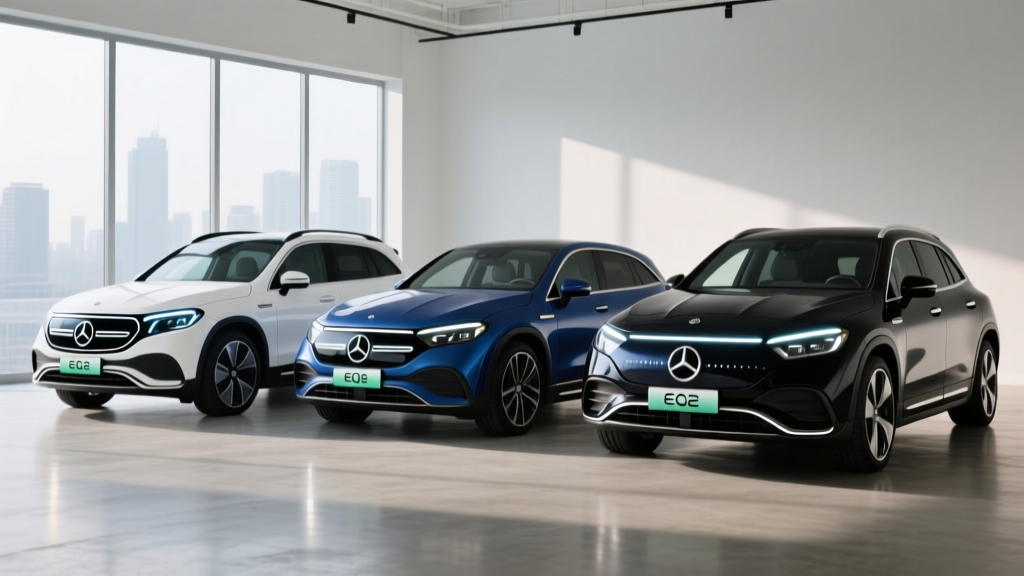
If you're researching a Mercedes-Benz electric SUV in 2026, the brand offers three battery-electric options: the compact EQB (EPA est. ~245 mi, ~$54,500), the midsize EQE SUV (EPA est. ~279 mi, ~$78,950), and the full-size luxury EQS SUV (EPA est. ~305 mi, ~$105,550). The EQB suits urban commuters who want a third row and lower entry cost. The EQE SUV balances range, space, and performance for most families. The EQS SUV is for buyers who prioritize flagship luxury and maximum cabin volume. None currently qualify for the full federal §30D tax credit due to battery-sourcing rules — a critical cost factor we break down below.
The 2026 Mercedes-Benz Electric SUV Lineup at a Glance
Mercedes-Benz has committed to its EQ sub-brand as the electric counterpart to its core lineup. For SUV shoppers, three models span from compact crossover to full-size luxury hauler. All three ride on dedicated EV or adapted platforms with NMC (nickel-manganese-cobalt) battery chemistry, CCS1 charging connectors (with NACS adapter availability expanding through Mercedes' partnership with Tesla Supercharger access), and Mercedes' latest MBUX infotainment with EV-specific route planning and preconditioning.
| Spec | 2026 EQB 300 4MATIC | 2026 EQE 350 4MATIC SUV | 2026 EQS 450 4MATIC SUV |
|---|---|---|---|
| EPA Range (est.) | 245 mi | 279 mi | 305 mi |
| Battery (usable, kWh) | 66.5 kWh (NMC) | 90.6 kWh (NMC) | 108.4 kWh (NMC) |
| Peak DC Fast Charge | 100 kW | 170 kW | 200 kW |
| 10–80% DCFC Time | ~32 min | ~32 min | ~31 min |
| Level 2 Charge Rate | 9.6 kW | 9.6 kW | 9.6 kW |
| Horsepower | 225 hp | 288 hp | 355 hp |
| 0–60 mph | 7.7 sec | 6.4 sec | 5.3 sec |
| MPGe (combined) | 90 MPGe | 84 MPGe | 82 MPGe |
| Seating | 5–7 (optional 3rd row) | 5 | 5 (optional 3rd row) |
| Cargo (rear seats up) | 22.0 cu ft | 27.0 cu ft | 28.0 cu ft |
| Base MSRP | $54,500 | $78,950 | $105,550 |
| Battery Warranty | 8 yr / 100,000 mi | 8 yr / 100,000 mi | 8 yr / 100,000 mi |
Sources: fueleconomy.gov, Mercedes-Benz USA press specifications. EPA range figures are estimates; real-world results vary with temperature, terrain, and driving style.
Real-World Range: What the EPA Sticker Doesn't Tell You
EPA vs. Reality for the Mercedes-Benz Electric SUV Lineup:
- EQB 300: EPA 245 mi → Expect ~200–215 mi sustained highway driving at 70+ mph; ~170–185 mi in sub-30°F winter conditions.
- EQE 350 SUV: EPA 279 mi → Expect ~240–255 mi highway; ~200–220 mi in cold weather.
- EQS 450 SUV: EPA 305 mi → Expect ~260–280 mi highway; ~220–240 mi in cold weather.
Mercedes' EQ models use NMC battery chemistry, which offers higher energy density than LFP but suffers greater cold-weather capacity reduction — typically 20–30% range loss in freezing temperatures. The EQS SUV's larger 108.4 kWh pack provides a bigger absolute buffer, but its heavier curb weight and less aerodynamic SUV profile erode efficiency at highway speeds compared to the EQS sedan.
All three models include battery preconditioning — the car warms or cools the battery pack to optimal temperature when you navigate to a DC fast charger. This is critical: without preconditioning, a cold battery at a 170 kW charger might only accept 50–70 kW initially, adding 15+ minutes to your stop. Always use the built-in navigation for charging stops to activate preconditioning automatically.
Charging Speeds and Infrastructure: What You'll Actually Experience
One common misconception is that peak DC fast-charge kW is sustained throughout the session. In reality, all lithium-ion batteries follow a charge curve — the rate peaks at low state of charge (SoC) and tapers significantly above 80% to protect cell longevity. Here's what that means for Mercedes' EQ lineup:
| Charging Level | Power | Miles Added per Hour (EQE SUV) | Best For |
|---|---|---|---|
| Level 1 (120V household) | 1.4 kW | ~4 mi/hr | Overnight trickle, emergencies |
| Level 2 (240V home/public) | 9.6 kW | ~28 mi/hr | Daily home charging, full overnight refill |
| DC Fast Charge (CCS1) | Up to 170 kW (EQE) | ~490 mi/hr (peak) | Road trips, 10–80% in ~32 min |
| Tesla Supercharger (via NACS adapter) | Up to 150 kW | ~430 mi/hr (peak) | Expanded road-trip network access |
The EQB's 100 kW peak charge rate is the lineup's weak point — it means longer road-trip stops compared to rivals like the Hyundai Ioniq 5 (peak 240 kW) or BMW iX (peak 200 kW). For buyers who road-trip frequently, the EQE and EQS SUVs' faster charging is a tangible advantage.
Home charging setup: A Level 2 home charger (hardwired 48A circuit) delivers a full overnight charge for all three models. Expect $800–$2,500 for a professional Level 2 installation depending on your electrical panel capacity and run distance. If your home has a 100A panel, a panel upgrade to 200A may add $1,500–$3,000 — a real cost first-time EV buyers often overlook. Consult a licensed electrician for your specific situation.
Mercedes-Benz Electric SUV vs. Gas Counterparts: Cost Comparison
How do Mercedes' EVs stack up against their internal-combustion siblings on total cost? Here's a 5-year comparison assuming 15,000 miles/year, $3.50/gallon premium fuel, and $0.14/kWh home electricity (national average):
| Cost Factor (5 yr / 75,000 mi) | EQE 350 4MATIC SUV | GLE 350 4MATIC (Gas) |
|---|---|---|
| Purchase Price (base MSRP) | $78,950 | $63,550 |
| Federal Tax Credit (§30D) | $0 (sourcing rules)* | $0 |
| Fuel / Electricity Cost | ~$3,940 (home charging) | ~$13,125 (22 MPG combined, premium) |
| Maintenance (est.) | ~$1,800 | ~$4,200 |
| Insurance (est. avg.) | ~$14,500 | ~$11,250 |
| Estimated Depreciation | ~$38,000 | ~$28,500 |
| Total 5-Year Cost | ~$137,190 | ~$120,625 |
*As of 2026, Mercedes-Benz EQ vehicles do not meet the §30D critical-mineral and battery-component sourcing requirements for the federal credit. Check IRS §30D guidelines for the latest eligibility rules, as these change annually.
Key takeaway: The EQE SUV saves roughly $9,185 in fuel and $2,400 in maintenance over 5 years, but the higher purchase price, steeper depreciation, and elevated insurance premiums erase the savings — resulting in a ~$16,500 premium over the gas GLE. The math improves if you have access to cheap solar-powered home charging (~$0.06/kWh effective) or if your state offers additional rebates, but buyers should enter with eyes open about the upfront gap.
Common Misconceptions About Mercedes-Benz Electric SUVs
| Myth | Fact |
|---|---|
| "I'll get the full $7,500 federal tax credit." | As of 2026, no Mercedes-Benz EQ model qualifies for the full §30D credit due to battery-sourcing and critical-mineral requirements. State incentives may still apply — check your state's energy office. |
| "The battery will need expensive replacement within a few years." | Mercedes warrants the traction battery for 8 years/100,000 miles against defects and capacity loss below 70%. NMC batteries in thermally managed packs (all EQ models) typically retain 85–90% capacity after 100,000 miles based on industry-wide degradation data. |
| "I can use Tesla Superchargers directly." | Mercedes EQ vehicles use CCS1 connectors. A NACS adapter enables Tesla Supercharger access, but at reduced peak speeds (~150 kW vs. Tesla-native 250 kW). The adapter is available through Mercedes dealers. |
| "Electric means zero maintenance." | EVs eliminate oil changes and transmission service, but you still need tire rotations (EVs wear tires faster due to instant torque and heavier weight), cabin air filter replacement, brake fluid checks, and wiper/coolant service. |
| "Range is the same year-round." | NMC chemistry in cold climates (below 30°F) can lose 20–30% of rated range. Preconditioning and using seat/steering wheel heaters instead of cabin heat can mitigate this. |
Ownership Realities: What First-Time EV Buyers Must Know
Home Charging Access Is Non-Negotiable for Convenience
If you cannot install a Level 2 charger at home (renters, street-parkers, HOA restrictions), owning any Mercedes-Benz electric SUV becomes significantly less practical. Public DC fast-charging at $0.35–$0.50/kWh costs nearly as much as gas per mile and requires 30–45 minutes of your time per session. Before purchasing, confirm you can install a 240V/48A circuit at your residence — or budget for frequent public charging time and cost.
Insurance Premiums Run 20–35% Higher
EV insurance costs more due to higher repair costs (specialized high-voltage training, battery-pack replacement risk, aluminum-intensive construction). Get quotes from your insurer before committing. Some insurers offer EV-specific discounts; comparison-shop aggressively.
Depreciation Is Currently Steeper for Luxury EVs
The used luxury EV market has seen aggressive price drops since 2023, driven by Tesla price cuts, new model proliferation, and rapid tech advancement. Expect a Mercedes-Benz electric SUV to retain roughly 45–50% of its value after 5 years, compared to ~55% for a gas GLE. If you lease, this is the manufacturer's problem; if you buy and plan to keep the car 8+ years, depreciation matters less.
Tire Costs Are Higher
EV-specific tires (optimized for low rolling resistance and noise reduction) cost $250–$400 per corner for these models, and the instant torque plus 5,000+ lb curb weights accelerate wear. Budget for tire replacement every 25,000–35,000 miles instead of the 40,000–50,000 miles typical for gas SUVs.
Decision Framework: Which Mercedes-Benz Electric SUV Is Right for You?
Choose the EQB 300 4MATIC if:
- Your daily commute is under 60 miles round-trip
- You want a compact luxury EV with an occasional-use third row
- You want the lowest entry price in the Mercedes EV SUV lineup
- Road trips are infrequent (the 100 kW charge rate and 245-mi range require more stops)
Choose the EQE 350 4MATIC SUV if:
- You need a midsize family SUV with 279 mi of range and faster DC charging
- You road-trip 3+ times per year and want 10–80% stops under 35 minutes
- You value the balance of performance (288 hp), space, and technology
- You're cross-shopping the BMW iX, Audi Q8 e-tron, or Genesis Electrified GV70
Choose the EQS 450 4MATIC SUV if:
- Budget is above $100,000 and you want flagship luxury with maximum range (305 mi EPA)
- You need an optional third row in a full-electric luxury SUV
- You prioritize cabin quietness, air suspension, and the latest MBUX Hyperscreen technology
- You're cross-shopping the BMW iX M60, Tesla Model X, or Rivian R1S
Consider a Mercedes PHEV (e.g., GLE 350e) instead if:
- You lack reliable home charging access
- You frequently drive 400+ mile routes through charging-desert regions
- You want to reduce fuel consumption without committing to full EV ownership
- You want to qualify for potential PHEV incentives with fewer range/charging concerns
Frequently Asked Questions
Does any Mercedes-Benz electric SUV qualify for the $7,500 federal tax credit in 2026?
No. As of 2026, Mercedes-Benz EQ models do not meet the IRS §30D battery-component and critical-mineral sourcing requirements. The rules mandate that increasing percentages of battery components be manufactured or assembled in North America and that critical minerals be sourced from the U.S. or free-trade-agreement partners. State-level incentives (e.g., California, Colorado, New York) may still apply — check your state's energy office for current programs.
How long does it take to charge a Mercedes-Benz electric SUV at home?
On a Level 2 (240V, 9.6 kW) home charger: the EQB charges from 0–100% in approximately 7 hours, the EQE SUV in ~9.5 hours, and the EQS SUV in ~11.5 hours. Most owners plug in nightly and wake to a full battery — the practical experience is like charging a phone. Level 1 (120V) adds only ~4 miles per hour and is impractical as a primary charging method for these battery sizes.
Is the Mercedes-Benz electric SUV reliable compared to gas models?
EVs have fewer moving parts (no engine, transmission, exhaust system, or fuel pump), which reduces mechanical failure points. However, early EQ models have had reported issues with software glitches, 12V auxiliary battery drain, and MBUX infotainment bugs. The NHTSA and IIHS have not flagged major safety concerns. Long-term reliability data for the EQ lineup is still maturing — the battery and powertrain carry an 8-year/100,000-mile warranty.
Can I tow with a Mercedes-Benz electric SUV?
Yes, but with significant range penalties. The EQE SUV is rated to tow up to 3,500 lbs and the EQS SUV up to 3,500 lbs (with factory tow package). Expect range to drop 30–50% when towing a loaded trailer due to aerodynamic drag and weight. The EQB is not rated for significant towing. If towing is a priority, consider the Rivian R1S (7,700 lb capacity) or a PHEV/gas SUV.
What happens if the battery degrades significantly?
Mercedes-Benz warranties the high-voltage battery for 8 years or 100,000 miles against defects and capacity loss below 70% of original. If capacity drops below this threshold within the warranty period, Mercedes will repair or replace modules to restore capacity above 70%. Out-of-warranty battery replacement costs are estimated at $15,000–$25,000 depending on the model, though real-world data shows most NMC packs with active thermal management retain 85–90% capacity at 100,000 miles.
How does the Mercedes-Benz electric SUV compare to Tesla Model X or BMW iX?
The Tesla Model X offers longer range (~335 mi EPA), faster charging (peak 250 kW), and access to the Supercharger network natively — but its interior quality and panel-gap consistency lag behind Mercedes. The BMW iX (EPA ~324 mi, peak 200 kW, ~$87,250) is the closest rival to the EQE SUV and offers slightly better range and efficiency. The Mercedes advantage is cabin luxury, ride comfort (especially with AIRMATIC air suspension), and brand prestige. Test-drive all three before deciding.
Always verify current pricing, specifications, and incentive eligibility directly with Mercedes-Benz USA, the IRS, and your state's energy office before purchasing. Specifications and rules are subject to change.