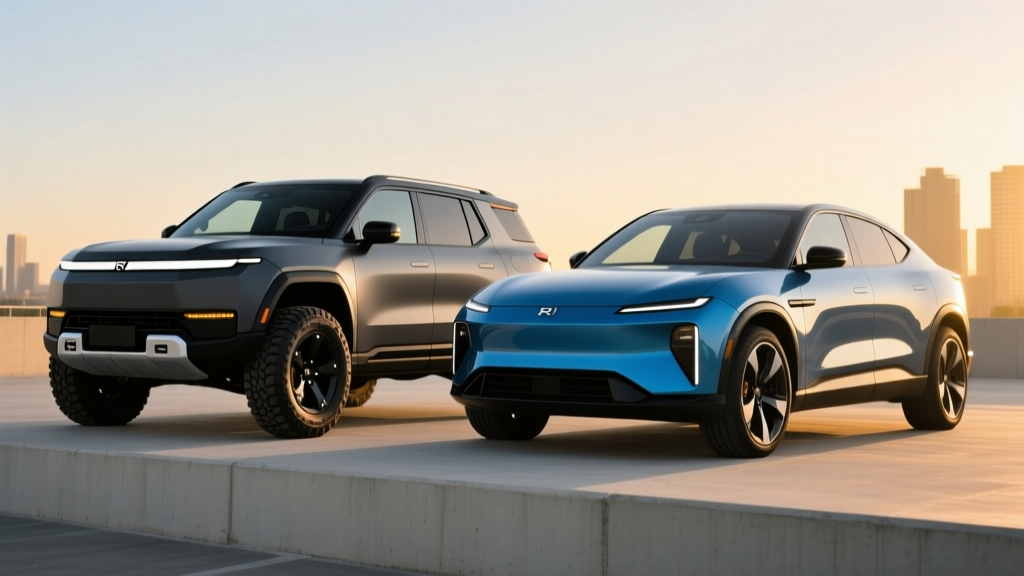
Rivian now fields two three-row-capable electric SUVs that, on paper, look deceptively similar. The flagship R1S—redesigned on the Gen 2 platform for 2025 and carried into 2026—sits at the premium end of the market with up to 837 horsepower and a 141 kWh Max Pack option. The smaller, more affordable R2, which began deliveries in early 2026, targets mainstream buyers with a starting price roughly $25,000 lower and a footprint closer to a Tesla Model Y. But specs only tell half the story. This head-to-head breaks down real-world range, charging behavior, federal tax credit eligibility under current IRS §30D rules, and five-year ownership costs so you can match the right Rivian to your actual driving life.
Rivian R1S vs R2: Side-by-Side Spec Table
Numbers first. The table below uses 2026 model-year data for the R1S Dual-Motor Standard Pack and the R2 Dual-Motor Standard—the most directly comparable trims. Where R2 specs are preliminary (the model launched in early 2026 and Rivian has been rolling out additional battery configurations), they are marked accordingly.
| Specification | 2026 Rivian R1S Dual-Motor (Standard) | 2026 Rivian R2 Dual-Motor (Standard) |
|---|---|---|
| EPA Range (est.) | ~270 mi (Standard) / ~410 mi (Max Pack) | ~300 mi (announced target) |
| Battery Capacity (usable) | ~92 kWh (Standard) / ~141 kWh (Max) | ~85 kWh (estimated, NMC) |
| Battery Chemistry | NMC (Samsung SDI 2170 cells) | NMC (2170 cylindrical, new supplier) |
| Peak DC Fast Charge | ~220 kW | ~200 kW (estimated) |
| 10–80% DCFC Time | ~28 min (Standard) / ~42 min (Max) | ~30 min (estimated) |
| Level 2 Charge Rate | 11.5 kW (48A) | 11.5 kW (48A) |
| Horsepower | 533 hp (Dual-Motor) | ~450 hp (estimated, Dual-Motor) |
| 0–60 mph | 4.5 sec (Dual-Motor) | ~5.0 sec (estimated) |
| EPA Efficiency (MPGe) | ~73 MPGe combined | ~90 MPGe combined (estimated) |
| Cargo Volume (behind 3rd row) | ~10.4 cu ft / 91.6 cu ft max | ~14 cu ft / ~65 cu ft max (est.) |
| Towing Capacity | 7,700 lbs | ~4,500 lbs (estimated) |
| Base MSRP | $79,900 (before destination) | $54,900 (before destination) |
| Battery / Powertrain Warranty | 8 yr / 120,000 mi | 8 yr / 120,000 mi |
Note: R2 figures marked "estimated" reflect Rivian's announced targets and early EPA filings as of early 2026. Final certified numbers may shift slightly. The R1S carries over its 2025 Gen 2 refresh specs into the 2026 model year.
Range & Efficiency: Real-World Expectations vs. EPA Stickers
R1S Standard Pack: EPA ~270 mi → expect ~220–240 mi at sustained 75 mph highway speeds, ~190–210 mi in sub-freezing weather.
R2 Standard: EPA ~300 mi (target) → expect ~250–270 mi highway, ~215–235 mi in cold conditions.
R1S Max Pack: EPA ~410 mi → expect ~340–360 mi highway; this is the range king if budget allows.
The R1S is a 6,800-pound vehicle pushing a large frontal area, and physics doesn't care about marketing. Its ~73 MPGe combined rating means it consumes roughly 46 kWh per 100 miles on the EPA cycle—and closer to 50–55 kWh/100mi at highway speeds. The R2, riding on a shorter wheelbase and weighing an estimated 5,200 pounds, should land near 90 MPGe combined, consuming about 37 kWh/100mi. That efficiency gap is the single biggest reason the R2's smaller battery still targets more EPA miles than the R1S Standard Pack.
For context, on a 300-mile road trip in 40°F weather with the heater running, the R1S Standard Pack will require at least one DC fast-charge stop (and you'll want to plan it carefully around the charge curve taper above 80%), while the R2 should complete the same trip with a shorter top-up or, for careful drivers, potentially no stop at all if you leave at 100% SoC. The R1S Max Pack is a different story entirely—410 EPA miles means real-world 340+ even in tough conditions, making it one of the longest-range EVs sold in 2026.
Charging Speed & Network Access
Both vehicles use the NACS (Tesla-style) charge port natively, which in 2026 is the dominant connector in North America. That means direct access to Tesla Supercharger stalls (now open to non-Tesla EVs via the NACS standard), Electrify America, and other networks without adapters.
| Charging Level | R1S Dual-Motor | R2 Dual-Motor | Miles Added per Hour (approx.) |
|---|---|---|---|
| Level 1 (120V, 12A) | 1.4 kW | 1.4 kW | ~3–4 mi/hr |
| Level 2 (240V, 48A) | 11.5 kW | 11.5 kW | ~28–34 mi/hr (R2) / ~24–28 mi/hr (R1S) |
| DC Fast Charge (peak) | ~220 kW | ~200 kW (est.) | N/A — see 10–80% times below |
Charge curve reality check: The R1S peaks at ~220 kW only between roughly 10–35% SoC on a 350 kW-capable charger. By 60% SoC, it drops to ~120 kW, and above 80% it tapers sharply to ~50 kW or less. That 10–80% time of ~28 minutes for the Standard Pack assumes optimal battery preconditioning—skip the nav-to-charger precondition and you'll add 5–8 minutes in cold weather. The R2's slightly smaller battery and ~200 kW peak should yield a similar 10–80% time of ~30 minutes, though Rivian's new cell supplier for the R2 means the charge curve shape may differ from the R1S. We'll update this section once independent testing data is available.
On the Rivian Adventure Network—the company's proprietary DC fast-charging corridor near national parks and adventure destinations—both vehicles are fully supported. As of early 2026, Rivian has deployed chargers at key locations in the western U.S., though coverage remains limited compared to Tesla's 6,000+ Supercharger stalls nationally.
Price, Tax Credits, and Value Comparison
- MSRP cap: SUVs/vans/pickups must be ≤ $80,000
- Buyer income cap: AGI ≤ $150K single / $300K married filing jointly / $225K head of household
- Battery sourcing: Critical minerals and battery components must meet escalating domestic-content thresholds (phased in annually through 2029)
- Point-of-sale transfer: Eligible buyers can apply the credit as a dealer discount at purchase
- FEOC restriction: Vehicles with battery components from "foreign entities of concern" (primarily Chinese supply chains) may be disqualified
Source: IRS.gov — Clean Vehicle Credits. Eligibility varies by VIN and build date. Consult a tax professional.
| Cost Factor | R1S Dual-Motor Standard | R2 Dual-Motor Standard |
|---|---|---|
| Base MSRP | $79,900 | $54,900 |
| Destination Fee | ~$1,800 | ~$1,800 |
| As-Tested (well-equipped) | $87,000–$95,000+ | $58,000–$65,000 |
| §30D Tax Credit Eligibility | Partial — Standard/Max trims near or above $80K MSRP cap; some configs qualify, many do not | Strong — well under $80K cap; eligible for up to $7,500 if sourcing/battery requirements met |
| Effective Price (with max credit) | $79,900–$87,000+ (credit may not apply to higher trims) | ~$47,400–$57,500 |
The tax credit situation is where this comparison gets nuanced. The R1S's base MSRP of $79,900 sits just under the §30D $80,000 SUV cap—but add any options package, paint upgrade, or the Max Pack battery and you blow past the ceiling. Most real-world R1S builds in 2026 will not qualify for the full $7,500 credit unless you stick to a stripped-down Standard Pack configuration. The R2, by contrast, has massive headroom under the cap. Even a fully loaded R2 at ~$65,000 qualifies on MSRP grounds, and if Rivian's R2 battery supply chain meets the 2026 critical-minerals and component thresholds (which the company has indicated it is engineering toward), buyers can expect the full $7,500 either as a point-of-sale reduction or on their tax return.
This makes the effective price gap between the two vehicles even wider than the sticker suggests: potentially $30,000+ after incentives.
Category-by-Category Verdicts
If you spec the R1S Max Pack (~$10K+ premium), nothing in this comparison touches 410 EPA miles. But dollar-for-dollar, the R2's ~300 miles from a smaller, lighter battery is the efficiency play. For most buyers not opting for the Max Pack, the R2 wins range-per-dollar.
The R1S's ~220 kW peak vs. the R2's ~200 kW gives it a slight edge, but the larger battery in the Max Pack means longer absolute charge times. The R2's smaller pack charges 10–80% in a comparable ~30 minutes. For Standard-to-Standard, it's effectively a tie.
533 hp, 4.5-second 0–60, and available Tri-Motor (837 hp, ~3.0 sec) make the R1S the clear performance choice. The R2 is quick at ~5.0 seconds but isn't trying to be a sports SUV.
$25,000 less to start, better tax credit odds, lower running costs. The R2 delivers 90% of the Rivian experience at 65% of the price.
7,700-lb towing, 91.6 cu ft max cargo, and a genuine three-row layout with adult-capable third-row space. The R2's third row (if equipped) is child-only, and towing drops to ~4,500 lbs.
~90 MPGe combined vs. ~73 MPGe. The R2 costs roughly $0.04–0.05 per mile to charge at home (at $0.14/kWh national average) vs. $0.06–0.07 for the R1S. Over 15,000 miles/year, that's a ~$225 annual savings.
Both run Rivian's latest software stack with the Driver+ ADAS suite (Level 2 SAE automation — driver must remain engaged). The R2 benefits from a newer electrical architecture with potentially faster OTA updates, but the R1S Gen 2 refresh is current and well-regarded.
Quad-motor option, 14.9 inches of ground clearance, and Rivian's tank-turn feature make the R1S a serious off-road platform. The R2 is capable but oriented toward pavement and light trails.
Five-Year Ownership Cost Breakdown
Beyond the purchase price, these two vehicles diverge meaningfully in running costs. Below is an estimated five-year / 75,000-mile ownership comparison assuming home Level 2 charging at the national average electricity rate ($0.14/kWh) and no major out-of-warranty repairs.
| Cost Category (5 yr / 75K mi) | R1S Dual-Motor Standard | R2 Dual-Motor Standard |
|---|---|---|
| Energy (home charging) | ~$5,100 | ~$4,100 |
| Insurance (avg. annual) | ~$2,400/yr ($12,000 total) | ~$1,800/yr ($9,000 total) |
| Maintenance (tires, cabin filter, fluid top-offs) | ~$2,200 | ~$1,800 |
| Estimated Depreciation | ~$35,000–$40,000 | ~$20,000–$25,000 |
| Total 5-Year Running Cost (excl. purchase) | ~$54,000–$59,000 | ~$35,000–$40,000 |
Insurance is a notable gap. The R1S's higher repair costs, greater weight, and premium positioning push annual premiums roughly $600 higher than the R2, based on 2026 insurer quoting patterns for comparable vehicles. Depreciation is harder to predict for the newer R2, but the R1S's steeper depreciation curve (typical of $80K+ luxury EVs) means you'll absorb more equity loss over five years. The R2's lower starting price and mainstream positioning should hold value better in percentage terms.
Neither vehicle requires oil changes, transmission fluid, or spark plugs. Both use regenerative braking heavily, which extends brake pad life well beyond 80,000 miles in typical driving. Tire costs are the main consumable surprise: the R1S's heavier weight and available 22-inch wheels can mean $1,200+ per set of replacement tires vs. ~$900 for the R2.
Decision Framework: Which Rivian Fits Your Life?
Choose the R1S if:
- You regularly carry adults in a third row or need maximum cargo volume (91.6 cu ft)
- You tow a boat, camper, or horse trailer (7,700-lb capacity)
- Off-road capability is a priority (Quad-Motor, tank turns, 14.9" clearance)
- You want the Max Pack for 410-mile road-trip range and budget isn't the primary constraint
- You value flagship build quality, premium materials, and the adventure-brand cachet
Choose the R2 if:
- Your budget is $55K–$65K and you want to maximize the $7,500 federal tax credit
- You commute daily and need a more efficient, lighter vehicle (~90 MPGe)
- Third-row use is occasional and for children only (or not needed at all)
- You want a Rivian but find the R1S's $80K+ entry price prohibitive
- Parking in urban environments where a smaller footprint matters
- You prioritize lower insurance premiums and running costs
Frequently Asked Questions
Does the Rivian R2 qualify for the $7,500 federal EV tax credit?
The R2 is well under the $80,000 MSRP cap for SUVs under §30D rules. Eligibility for the full $7,500 depends on your income (AGI ≤ $300K joint / $150K single), the battery's critical-mineral and component sourcing meeting 2026 thresholds, and the absence of FEOC-sourced materials. Rivian has stated it is engineering the R2 supply chain for credit eligibility, but buyers should verify VIN-specific eligibility at the point of sale or via the IRS portal. The credit can be transferred to the dealer as a point-of-sale discount.
Is the Rivian R1S too expensive to justify over the R2?
For a family that needs genuine three-row seating, 7,700-lb towing, and off-road capability, the R1S is the only Rivian that delivers. But if your needs are a two-row daily driver with occasional extra space, the R2 offers similar software, design language, and brand experience for $25,000+ less—and with better tax credit odds. The R1S makes sense when you need what it uniquely offers; it's harder to justify on spec-sheet comparisons alone.
Can I charge a Rivian R1S or R2 at Tesla Superchargers?
Yes. Both the R1S and R2 come with a native NACS charge port. As of 2026, Tesla's Supercharger network is open to all NACS-equipped vehicles. You'll use the Rivian app or Tesla app to initiate sessions at non-Tesla-compatible stalls. Rivian also provides an adapter for CCS-equipped chargers if you encounter legacy infrastructure.
How does cold weather affect range on the R1S vs. R2?
Expect 20–30% range reduction in sustained sub-freezing temperatures for both vehicles, consistent with NMC battery behavior. The R1S's available heat pump (standard on Gen 2 models) helps mitigate cabin heating losses. The R2 is expected to include a heat pump as well, though Rivian has not published detailed thermal management specs at launch. Preconditioning while plugged in is the single most effective way to minimize cold-weather range loss on either vehicle.
Which Rivian has better long-term battery durability?
Both carry an 8-year/120,000-mile battery warranty with a capacity retention threshold (typically 70% of original capacity). The R1S uses proven Samsung SDI 2170 NMC cells that have been in service since 2022, with degradation data showing ~5–8% loss over 60,000 miles in typical use. The R2's new cell supplier means less long-term track record, though Rivian has selected for cycle-life durability. We'll track EPA and real-world data as R2 mileage accumulates.
Is Rivian's service network adequate for either vehicle?
Rivian has expanded its service center footprint significantly since 2023, with mobile service vans covering many metro areas. However, rural owners may still face longer wait times for body repair or major battery service compared to legacy automakers. The R2's higher projected sales volume will pressure Rivian to scale service capacity through 2026–2027. Check Rivian's service locator for your ZIP code before committing to either vehicle.