Quick Verdict: Two Very Different Luxury EV Sedans
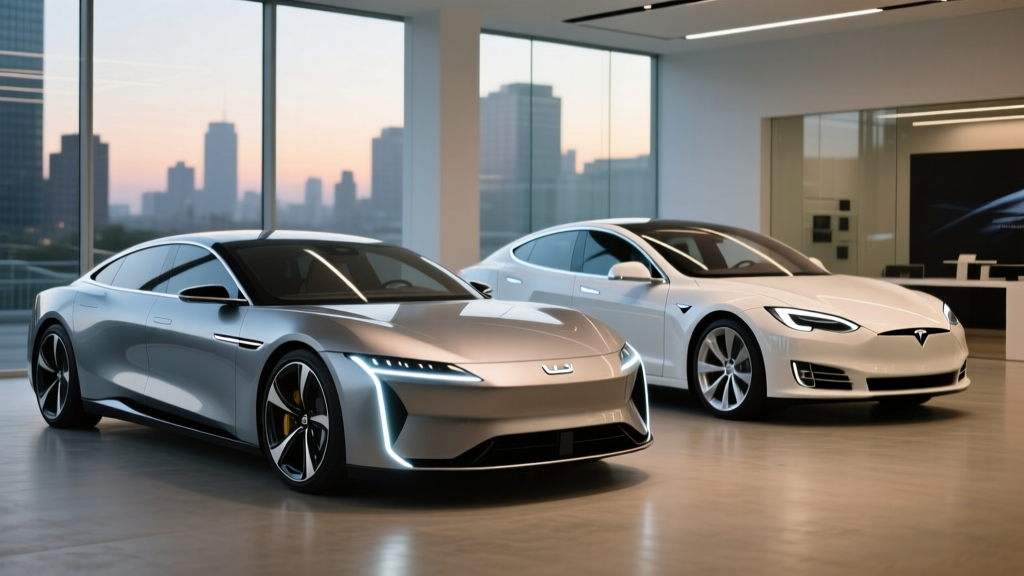
The Lucid Air and Tesla Model S represent two distinct philosophies in the luxury electric sedan segment. Tesla leans on its unmatched Supercharger network, proven software ecosystem, and aggressive performance tuning. Lucid counters with class-leading efficiency, a more traditional luxury interior, and an EPA range figure that still tops the segment. Neither is universally better — the right choice depends entirely on whether you prioritize road-trip infrastructure, interior refinement, outright range, or software sophistication.
Below, we break down every measurable category using 2026 model-year data from the EPA, manufacturer spec sheets, and IRS §30D tax credit guidelines.
Side-by-Side Spec Table: Lucid Air vs Tesla Model S
| Spec | Lucid Air Pure | Lucid Air Grand Touring | Tesla Model S Long Range | Tesla Model S Plaid |
|---|---|---|---|---|
| EPA Range | 419 mi | 516 mi | 402 mi | 359 mi |
| Battery (usable kWh) | 88 kWh (NMC) | 112 kWh (NMC) | ~100 kWh (NMC) | ~100 kWh (NMC) |
| Efficiency (MPGe combined) | 146 MPGe | 131 MPGe | 124 MPGe | 116 MPGe |
| Peak DC Fast Charge | 200 kW | 300 kW | 250 kW | 250 kW |
| 10–80% DC Charge Time | ~25 min | ~22 min | ~28 min | ~28 min |
| Level 2 Charge Rate | 19.2 kW | 19.2 kW | 11.5 kW | 11.5 kW |
| 0–60 mph | 5.0 sec | 3.0 sec | 3.1 sec | 1.99 sec |
| Horsepower | 430 hp | 819 hp | 670 hp | 1,020 hp |
| Cargo Volume | 32 cu ft (trunk + frunk) | 32 cu ft | 28 cu ft (trunk + frunk) | 28 cu ft |
| Base MSRP | $69,900 | $125,600 | $74,990 | $89,990 |
| Battery/Powertrain Warranty | 8 yr / 100,000 mi | 8 yr / 100,000 mi | 8 yr / 120,000 mi | 8 yr / 120,000 mi |
Sources: fueleconomy.gov, Lucid Motors and Tesla official specification pages. Real-world range will vary — see range section below.
Range and Efficiency: Lucid's Engineering Edge
Lucid's advantage in range is not simply a function of packing in a bigger battery. The Air Pure achieves 419 miles from an 88 kWh pack — that's 4.76 miles per kWh, one of the highest efficiency figures in any production EV sold today. The Grand Touring's 516-mile EPA rating from 112 kWh still delivers 4.61 mi/kWh. For context, the Model S Long Range returns roughly 4.02 mi/kWh.
Lucid Air Grand Touring: EPA 516 mi → expect ~420–450 mi highway at 70 mph; ~350–380 mi in freezing temperatures with cabin heat.
Lucid Air Pure: EPA 419 mi → expect ~340–370 mi highway; ~280–310 mi in cold weather.
Tesla Model S LR: EPA 402 mi → expect ~320–350 mi highway; ~270–300 mi in cold weather.
Tesla Model S Plaid: EPA 359 mi → expect ~280–310 mi highway; ~240–270 mi in cold weather.
Lucid's efficiency advantage means you spend less on electricity per mile and recover more range per minute of charging — even when peak kW figures are similar. On a long road trip, the Air Grand Touring's combination of 516-mile range and 4.6 mi/kWh efficiency means fewer stops and shorter stops.
Range winner: Lucid Air — by a wide margin, on both EPA paper and real-world projection.
Charging Speed and Network: Tesla's Infrastructure Moat
This is where the comparison splits into two separate realities: raw charging speed versus charging infrastructure access.
Charging Hardware
The Air Grand Touring peaks at 300 kW on a compatible DC fast charger, and its 900-volt architecture allows it to sustain high charge rates deeper into the session. The Air Pure peaks at 200 kW. Both use the NACS connector natively as of the 2025 model year.
The Model S peaks at 250 kW on V3 Superchargers and has also transitioned to NACS. Tesla's charge curve is well-managed but operates on a 400-volt architecture, which limits sustained peak rates compared to Lucid's 900V system.
Charging Network Reality
Tesla's Supercharger network remains the gold standard for reliability, plug-and-charge simplicity, and geographic coverage. As of early 2026, Tesla operates over 6,500 Supercharger stations in North America. While Lucid owners with NACS connectors can now access Superchargers (via Tesla's opened network), the experience isn't always as seamless as it is for native Tesla vehicles — some stalls require an adapter for older models, and routing integration isn't as tight.
Lucid relies on third-party networks (Electrify America, EVgo, ChargePoint) plus Supercharger access. Third-party reliability has improved but still lags Tesla's closed ecosystem in uptime and ease of use.
Charging speed winner: Lucid Air Grand Touring (300 kW peak, 900V architecture, faster 10–80%).
Charging network winner: Tesla Model S (Supercharger reliability, integrated routing, ubiquity).
Performance and Driving Dynamics
In straight-line acceleration, the Model S Plaid's 1.99-second 0–60 time is absurdly quick — a figure that was hypercar territory just a few years ago. The Air Grand Touring's 3.0-second run is also blistering, but it's not competing in the same bracket.
However, the Air's driving character is oriented more toward grand touring than track performance. Its ride quality, cabin isolation, and suspension tuning are noticeably more refined than the Model S, which retains a firmer, sportier character. The Air's smaller motors and compact drivetrain (Lucid's proprietary miniaturized motor technology) also contribute to a lower vehicle weight, improving handling balance and tire wear.
Drag-strip winner: Tesla Model S Plaid (1.99 sec 0–60, 1,020 hp).
Grand touring comfort winner: Lucid Air (ride quality, cabin quietness, efficiency at speed).
Interior, Tech, and Software
Interior Quality
The Lucid Air's cabin uses higher-grade materials — available Nappa leather, open-pore wood, and a curved glass cockpit display that spans 34 inches. Rear-seat legroom is exceptional thanks to Lucid's compact motor packaging, and the available Executive Rear Seating package offers reclining, massaging rear chairs that the Model S doesn't offer.
The Model S interior has improved with the refresh (yoke or round steering wheel, 17-inch center touchscreen, rear passenger screen), but material quality and panel gap consistency still trail Lucid and traditional luxury automakers. Tesla's minimalist approach is polarizing — some buyers love it, others find it sparse for a $75,000+ vehicle.
Software and ADAS
Tesla's software ecosystem remains best-in-class: over-the-air updates, trip planning with live Supercharger integration, Sentry Mode, Dog Mode, and the broadest feature set of any EV. Autopilot is standard; Full Self-Driving (Supervised) is a $8,000 add-on (or $99/month subscription as of 2026).
Both Tesla Autopilot/FSD (Supervised) and Lucid's DreamDrive Pro are SAE Level 2 driver-assistance systems. The driver must remain fully engaged and supervise at all times. Neither system is "self-driving." Only Level 4 services like Waymo operate without a human driver — and those are geofenced robotaxis, not consumer vehicles.
Lucid's DreamDrive Pro uses 32 sensors including LiDAR, offering strong highway assist and parking features, but its feature set and update cadence don't yet match Tesla's. Lucid has been steadily improving its ADAS via OTA updates.
Interior luxury winner: Lucid Air.
Software/tech ecosystem winner: Tesla Model S.
Pricing, Tax Credits, and Total Ownership Cost
Purchase Price and §30D Tax Credit
Federal EV tax credit eligibility under IRS §30D is a major differentiator here. The credit has an MSRP cap of $55,000 for sedans. This means:
- Lucid Air Pure ($69,900 MSRP): Does NOT qualify for the $7,500 federal credit — exceeds the sedan MSRP cap.
- Lucid Air Grand Touring ($125,600 MSRP): Does NOT qualify.
- Tesla Model S Long Range ($74,990 MSRP): Does NOT qualify — also exceeds the sedan MSRP cap.
- Tesla Model S Plaid ($89,990 MSRP): Does NOT qualify.
Neither vehicle qualifies for the federal §30D new EV credit in 2026 due to the $55,000 sedan MSRP cap. Buyers should check for state-level incentives (California's CVRP, Colorado's state credit, etc.) which vary by jurisdiction — consult your state's energy office or a tax professional for current eligibility.
- Vehicle MSRP must be ≤ $55,000 (sedans) or ≤ $80,000 (SUVs/trucks/vans)
- Buyer AGI must not exceed $150K (single) / $300K (joint)
- Battery components and critical minerals must meet North American sourcing thresholds
- Credit can be transferred to the dealer at point of sale for an instant price reduction
- Verify current rules at irs.gov — requirements change annually
Efficiency and Charging Cost
Lucid's efficiency advantage translates directly to lower fueling costs. At a national average DC fast-charging rate of ~$0.40/kWh and home electricity at ~$0.16/kWh:
| Model | kWh/100 mi | Annual kWh | Estimated Annual Cost |
|---|---|---|---|
| Lucid Air Pure | 21 kWh | 2,520 kWh | ~$585 |
| Lucid Air Grand Touring | 23 kWh | 2,760 kWh | ~$640 |
| Tesla Model S LR | 25 kWh | 3,000 kWh | ~$695 |
| Tesla Model S Plaid | 27 kWh | 3,240 kWh | ~$750 |
The efficiency gap saves Lucid owners roughly $55–$165 per year in charging costs versus equivalent Model S trims. Over five years, that's $275–$825 — not a deal-breaker, but it compounds with other ownership factors.
Insurance and Maintenance
Tesla insurance premiums tend to run higher than segment averages due to repair cost data and Tesla's own insurance program pricing. Lucid insurance is similarly elevated given low production volumes and limited repair network data. Expect $2,500–$4,000/year for either vehicle depending on your profile, location, and coverage — get quotes before committing.
Maintenance is minimal for both (no oil changes, minimal brake wear thanks to regen). Tesla's mobile service network is more mature. Lucid's service network is growing but remains limited outside major metros — a real consideration for buyers in smaller markets.
Value winner: Tie, with caveats. Neither gets the federal credit. Lucid wins on efficiency cost; Tesla wins on service infrastructure and resale liquidity.
Decision Framework: Which Should You Choose?
Choose the Lucid Air if:
- You prioritize maximum range and want the longest single-charge distance available in any production sedan (516 mi EPA on Grand Touring)
- Interior luxury, material quality, and rear-seat comfort are top criteria
- You value best-in-class efficiency (lowest kWh/100 mi) and the 900V charging architecture
- You mostly charge at home and take road trips infrequently enough that Supercharger access isn't a daily concern
- You want a more exclusive, lower-volume vehicle
Choose the Tesla Model S if:
- Road-trip charging infrastructure is non-negotiable — the Supercharger network is still the most reliable and integrated
- You want the best software ecosystem, OTA feature pipeline, and integrated trip planning
- Straight-line performance matters (Plaid's 1.99-sec 0–60 is in a class of its own)
- You value a mature service network with mobile service availability in most US markets
- Resale value and brand liquidity matter — Tesla has a much larger used market
Final Recommendation
If you're a road warrior who regularly drives 300+ miles between stops and values the most reliable public charging experience, the Tesla Model S Long Range remains the pragmatic pick. Its 402-mile range is more than adequate, and Supercharger integration eliminates most charging friction.
If you want the most range, the most efficiency, and the most refined luxury cabin in the segment — and you can accommodate slightly less seamless road-trip charging — the Lucid Air Grand Touring is the engineering showcase. The Air Pure at $69,900 also undercuts the Model S LR on price while delivering more range and better efficiency, making it a strong value argument if you can accept the smaller service footprint.
For pure performance theater, the Model S Plaid has no rival. For grand touring composure, the Lucid Air does.
Frequently Asked Questions
Does the Lucid Air or Tesla Model S qualify for the $7,500 federal EV tax credit?
No. Under the 2026 IRS §30D rules, sedans must have an MSRP at or below $55,000 to qualify. Both the Lucid Air (starting at $69,900) and Tesla Model S (starting at $74,990) exceed this cap. Check your state for additional incentives — some states offer credits that aren't MSRP-capped.
Can I charge a Lucid Air at a Tesla Supercharger?
Yes. Since the 2025 model year, Lucid Air models are equipped with the NACS charge port natively, allowing direct access to Tesla's Supercharger network. Older Lucid Air models (2022–2024 with CCS ports) can use a NACS adapter.
Which is cheaper to own over 5 years?
Depreciation is the largest ownership cost for both. Tesla benefits from higher resale liquidity but has seen steeper depreciation in recent years. Lucid's lower production volume could mean either stronger exclusivity retention or weaker resale due to limited demand — data is still maturing. On operational costs (charging + maintenance), Lucid's efficiency advantage saves a few hundred dollars over five years. Insurance costs are comparable and high for both.
Is the Lucid Air's 516-mile range real?
The 516-mile EPA figure is legitimate for the Grand Touring with the standard wheels. Expect 420–450 miles in real-world highway driving at 70 mph, and 350–380 miles in freezing weather with cabin heating. That still makes it the longest-range production EV sedan available.
How does Lucid's service network compare to Tesla's?
Tesla has a far more mature service infrastructure, including mobile service vans in most US metro areas and service centers nationwide. Lucid has been expanding its service footprint (including mobile service in select markets), but coverage outside major coastal metros remains limited. If you live in a smaller market, verify Lucid service availability before purchasing.