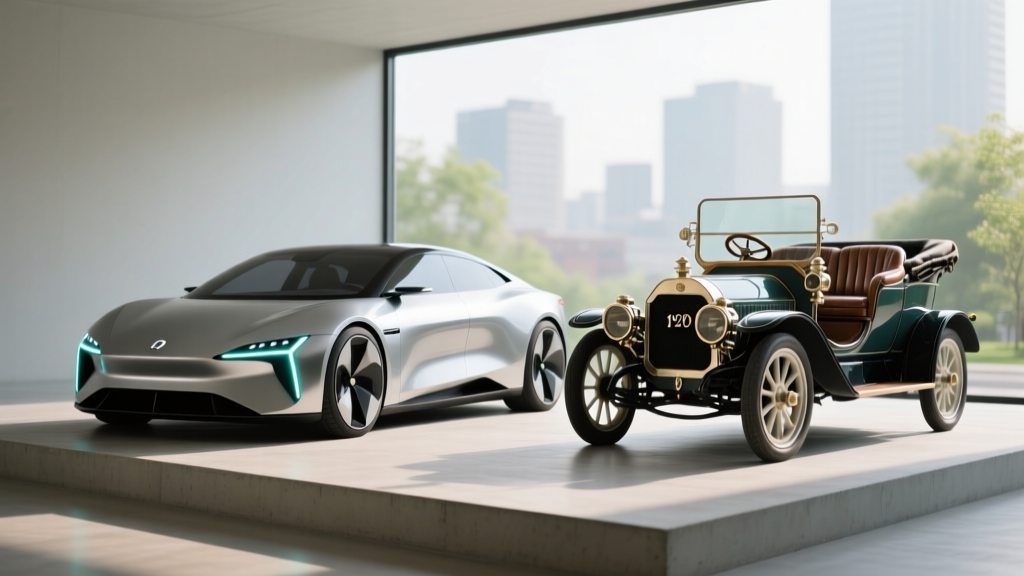
The 1920 Electric Car vs. Today's EVs: The Short Answer
Around 1920, electric cars like the Detroit Electric offered roughly 40–80 miles of range at a top speed of 20 mph, powered by heavy lead-acid batteries with no charging infrastructure beyond a household outlet. In 2026, mainstream EVs deliver 250–350+ EPA-rated miles, recharge from 10–80% in 18–25 minutes at DC fast chargers, and start near $30,000 before federal tax credits. The century-long gap between these eras is defined by lithium-ion energy density (from ~40 Wh/kg in 1920 lead-acid to ~250+ Wh/kg in modern NMC and LFP cells), charging power (from ~0.5 kW to 250+ kW), and the existence of a nationwide charging network. If you're researching EVs today, the practical question is no longer "do they work?" — it's whether your driving pattern, home electrical setup, and budget align with current ownership economics.
What a 1920 Electric Car Actually Offered
At the turn of the 20th century, electric vehicles outsold gasoline and steam cars in several U.S. markets. By 1920, models from Detroit Electric, Baker Electric, and Milburn Electric were marketed primarily to urban drivers — especially women — for their quiet operation, lack of hand-cranking, and zero exhaust smell.
Here's what a typical 1920 electric car delivered:
- Battery: Lead-acid, ~80–140 cells, weighing 800–1,200 lbs
- Range: 40–80 miles per charge (some Detroit Electric models claimed up to 100 miles under ideal conditions with upgraded Edison nickel-iron batteries)
- Top speed: 15–20 mph
- Charging: Plugged into household DC current or motor-generator sets; a full charge took 8–12 hours
- Price: $1,750–$3,000 (roughly $28,000–$48,000 in 2026 dollars)
The 1920 electric car declined because of three converging factors: Henry Ford's Model T undercut EV pricing by 50%+, the discovery of cheap Texas crude dropped gasoline costs, and the electric starter (invented 1912) eliminated the hand-crank disadvantage of gas cars. By 1930, the passenger EV was effectively extinct in the U.S.
How a 2026 EV Compares: The Data
The leap from 1920s electrics to modern EVs is measurable across every spec that matters to a buyer. Below is a side-by-side comparison using a representative 2026 model — the Hyundai Ioniq 5 SE Standard Range — as a mainstream benchmark.
| Specification | 1920 Detroit Electric (Typical) | 2026 Hyundai Ioniq 5 SE Std Range | 2026 Toyota Camry LE (Gas Baseline) |
|---|---|---|---|
| EPA Range / Tank Range | ~50 miles | 245 miles (EPA) | ~530 miles (13.2-gal tank @ 40 mpg hwy) |
| Battery / Fuel Capacity | Lead-acid, ~15 kWh equivalent | 63 kWh usable (NMC lithium-ion) | 13.2 gal gasoline |
| Energy Density | ~40 Wh/kg | ~250 Wh/kg (cell-level) | N/A |
| "Refuel" Time | 8–12 hours | 10–80% in ~22 min (DCFC, 150 kW peak); ~6 hrs (Level 2, 10.9 kW) | ~3 minutes |
| Top Speed / 0–60 mph | 20 mph / N/A | 107 mph / 7.4 sec | 130 mph / 7.6 sec |
| Horsepower | ~3–5 HP | 168 HP | 203 HP |
| Starting Price (2026) | $1,750 (~$28,000 adj.) | $42,600 MSRP | $29,995 MSRP |
| Fuel / Energy Cost per Mile | ~$0.04 (1920 electricity) | ~$0.04–$0.06 (home L2, $0.14/kWh avg) | ~$0.11 ($3.40/gal @ 32 mpg combined) |
| Annual Maintenance | Battery plate replacement, brushes | ~$300–$400 (tire rotation, cabin filter, fluid checks) | ~$600–$900 (oil, filters, brakes, spark plugs) |
Sources: fueleconomy.gov for 2026 EPA data; historical figures from automotive museum archives and Detroit Electric owner manuals.
Real-World Range: What the EPA Sticker Doesn't Tell You
The EPA range number on a 2026 EV sticker is a laboratory composite. Real-world range varies with speed, temperature, and terrain. Here's what testing and owner data consistently show:
EPA Sticker: 245 miles (Ioniq 5 SE Std Range)
Highway (70–75 mph, 75°F): Expect ~210–225 miles
Cold Weather (20°F, highway): Expect ~155–185 miles (25–35% loss due to cabin heating and increased battery resistance)
City / Suburban (regenerative braking active): Expect ~240–260 miles (regen recovers energy in stop-and-go)
The 1920 electric car had no EPA sticker, but its real-world range was equally variable. Hills, headwinds, and battery age could cut that 50-mile claim to 30 miles. The key difference: in 2026, you can precondition your battery (warm it while plugged in) to minimize cold-weather losses — a concept that didn't exist in the lead-acid era.
Charging at Home: The Real First-Time Buyer Decision
The single biggest ownership divide in 2026 isn't brand loyalty — it's whether you can charge at home. Here's the cost breakdown for a typical Level 2 home installation:
| Item | Low Estimate | High Estimate | Notes |
|---|---|---|---|
| Level 2 Charger (hardware, 32–48A) | $300 | $700 | ChargePoint Home Flex, Emporia Level 2, Wallbox Pulsar Plus |
| Electrician (240V circuit, 50–60A breaker) | $500 | $1,500 | Depends on panel proximity, conduit run length |
| Electrical Panel Upgrade (if needed, 100A→200A) | $1,500 | $3,500 | Older homes may require this; get 2–3 quotes |
| Permit & Inspection | $50 | $300 | Varies by municipality |
| Total (no panel upgrade) | $850 | $2,500 | |
| Total (with panel upgrade) | $2,350 | $6,000 |
Once installed, a Level 2 charger adds roughly 25–35 miles of range per hour of charging. Plug in overnight (8 hours) and you'll recover 200+ miles — enough for most daily driving. For comparison, a 1920 electric car owner charging from a household DC line added maybe 5–8 miles per hour.
If you cannot charge at home (apartment, street parking, condo without EV infrastructure), public DC fast charging at networks like Electrify America or EVgo costs $0.35–$0.55/kWh, pushing your per-mile cost to $0.10–$0.15 — closer to a gas car. Factor this into your purchase decision honestly.
Total Cost of Ownership: 5-Year Breakdown
The upfront price of a 2026 EV is still higher than a comparable gas car, but the IRS §30D federal tax credit (up to $7,500 for qualifying new EVs, subject to MSRP caps, buyer income limits, and battery-sourcing requirements — see IRS.gov for current eligibility) can narrow the gap substantially. Here's a 5-year comparison assuming 12,000 miles/year:
| Cost Category | 2026 Ioniq 5 SE (EV) | 2026 Camry LE (Gas) |
|---|---|---|
| MSRP / Purchase Price | $42,600 | $29,995 |
| Federal Tax Credit (§30D, if eligible) | −$7,500 (point-of-sale transfer available) | $0 |
| Effective Purchase Price | $35,100 | $29,995 |
| Fuel/Energy (5 yrs, 60K mi) | $2,400 (home L2 @ $0.14/kWh) | $6,375 ($3.40/gal, 32 mpg combined) |
| Maintenance (5 yrs) | $1,750 | $3,750 |
| Insurance (5 yrs, avg) | $7,500 | $5,500 |
| Home Charger Install (one-time) | $1,500 | $0 |
| 5-Year Total Cost | $48,250 | $45,620 |
| Cost per Mile (all-in) | $0.80 | $0.76 |
The EV still costs slightly more over 5 years in this scenario, primarily due to higher insurance premiums and the charger install. However, if you drive 15,000+ miles/year, the fuel savings swing the math in the EV's favor. Depreciation also varies — check current resale values for your specific model on Kelley Blue Book or Edmunds before committing.
Common Misconceptions: Myth vs. Fact
| Myth | Fact (with data) |
|---|---|
| "EVs don't have enough range for road trips." | The 2026 Ioniq 5 (245 mi EPA) and Tesla Model Y (320 mi EPA) cover most inter-city routes with one 20-minute DCFC stop. The 1920 electric car's 50-mile range is what actually made road trips impossible. |
| "Batteries need replacing every few years." | Modern NMC and LFP batteries degrade ~1.5–2.5% per year. At year 8, most retain 80–90% capacity. Federal law mandates warranty coverage of 8 years/100,000 miles (capacity retention ≥70%). Replacement cost, if needed out of warranty: $8,000–$18,000 depending on pack size. |
| "EVs are worse in cold weather." | Range drops 20–35% in sub-freezing temps — real, but manageable with preconditioning and a heat pump (standard on most 2026 models). Gas cars also lose ~10–15% fuel economy in cold. A 1920 electric car had no thermal management at all. |
| "Charging takes too long." | At a 150+ kW DC fast charger, 10–80% takes 18–25 minutes. At home on Level 2, you charge while sleeping — zero active waiting time. The 1920 electric car required 8–12 hours for a full charge. |
| "The power grid can't handle EVs." | Most EV charging happens overnight during off-peak hours. A single EV adds roughly the same load as a central air conditioner. Utilities are adding managed-charging programs to balance demand. |
Federal Tax Credit: What You Actually Need to Know
The §30D Clean Vehicle Credit can reduce your effective purchase price by up to $7,500, but eligibility depends on multiple factors that change annually. As of 2026, key requirements include:
- MSRP Caps: Vans, SUVs, and pickups ≤ $80,000; sedans and other vehicles ≤ $55,000
- Buyer Income Limits: AGI ≤ $300,000 (joint), $225,000 (head of household), $150,000 (single)
- Battery Sourcing: Critical minerals and battery components must meet escalating domestic/free-trade-partner percentages (requirements tighten each year through 2032)
- Point-of-Sale Transfer: You can transfer the credit to the dealer at purchase, reducing your out-of-pocket cost immediately — you do not need to wait until tax filing
- Final Assembly: Vehicle must be assembled in North America
Always verify eligibility for your specific VIN at fueleconomy.gov and consult a tax professional. Rules are subject to legislative change and model-specific sourcing updates throughout the year.
Decision Framework: Should You Buy an EV in 2026?
Choose a battery-electric vehicle (BEV) if:
- You can install a Level 2 charger at home (garage, driveway, or workplace charging available)
- Your daily driving is under 150 miles round-trip
- You want to minimize maintenance (no oil changes, fewer brake replacements due to regen)
- You qualify for the §30D credit, narrowing the price gap with gas cars
- You take road trips ≤2–3 times/year and can plan DCFC stops
Choose a plug-in hybrid (PHEV) if:
- You lack reliable home charging but want electric for short daily commutes (20–40 mi electric range)
- You frequently drive 300+ miles in areas with sparse charging infrastructure
- You want to hedge against range uncertainty while still reducing fuel consumption
Stick with a gas or conventional hybrid (HEV) if:
- You live in an apartment with zero charging access and no workplace charging
- Your budget is strictly under $25,000 and you're buying used in a market without used-EV credit options
- You regularly tow heavy loads long distances in extreme cold (current EV range penalties make this impractical for most models)
Frequently Asked Questions
Why did the 1920 electric car disappear, and why are EVs succeeding now?
The 1920 electric car failed because lead-acid batteries were too heavy and low-density, gasoline became cheap, and the Model T's mass production undercut EV pricing. Modern EVs succeed because lithium-ion cells offer 6x the energy density, electric motors deliver instant torque rivaling V6 engines, and charging infrastructure now exists along major highway corridors.
How long does an EV battery actually last?
Data from fleet operators and warranty claims show modern NMC and LFP batteries retain 80–90% of original capacity after 8 years and 100,000+ miles. Federal warranty requirements mandate at least 8 years/100,000 miles with ≥70% capacity retention. Many packs last 15–20 years before falling below 70% SoH (State of Health).
What's the difference between kW and kWh?
kW (kilowatts) measures power — how fast energy flows, like water pressure in a hose. A 150 kW DC fast charger delivers energy quickly. kWh (kilowatt-hours) measures energy — total capacity, like gallons in a tank. A 63 kWh battery holds 63 kilowatt-hours of energy. Confusing them is the most common EV mistake: a 150 kW charger doesn't put 150 kWh into your battery.
Can I charge an EV from a regular wall outlet?
Yes, but slowly. A standard 120V outlet (Level 1) delivers ~1.2–1.4 kW, adding roughly 3–5 miles of range per hour. A full charge for a 63 kWh battery would take 45+ hours. This works for overnight top-ups if your daily driving is under 30 miles, but a 240V Level 2 installation is strongly recommended for practical daily use.
Are EVs actually cheaper to own than gas cars?
It depends on your mileage, electricity rate, and tax-credit eligibility. For drivers covering 12,000–15,000 miles/year with home charging at $0.12–$0.16/kWh and a qualifying §30D credit, 5-year total cost of ownership can match or beat a comparable gas sedan. For low-mileage drivers or those relying exclusively on expensive public DCFC, gas or hybrid may still be cheaper. Run your own numbers using the DOE's EV cost calculator.
What is preconditioning and why does it matter?
Preconditioning warms the battery to its optimal charging temperature (typically 68–86°F) before you arrive at a DC fast charger. In cold weather, a cold battery may accept only 30–50 kW instead of its peak 150+ kW, doubling your charge time. Most 2026 EVs precondition automatically when you navigate to a charger in the vehicle's built-in navigation system.