The Short Answer on Kia's Electric SUVs
Kia currently sells two battery-electric SUVs in the U.S.: the EV6 (compact/midsize crossover, EPA range up to 310 miles, starting around $42,900) and the EV9 (three-row family hauler, EPA range up to 304 miles, starting around $54,900). Both ride on Hyundai Motor Group's E-GMP platform with 800V architecture, enabling DC fast charging from 10–80% in roughly 18 minutes at a 350 kW charger. If you need three rows and towing, pick the EV9. If you prioritize lower price, sportier driving, and slightly better efficiency, pick the EV6. Both may qualify for the federal §30D tax credit depending on your income, the vehicle's MSRP, and battery-sourcing compliance — check the latest IRS guidance before purchasing.
Kia's Electric SUV Lineup at a Glance
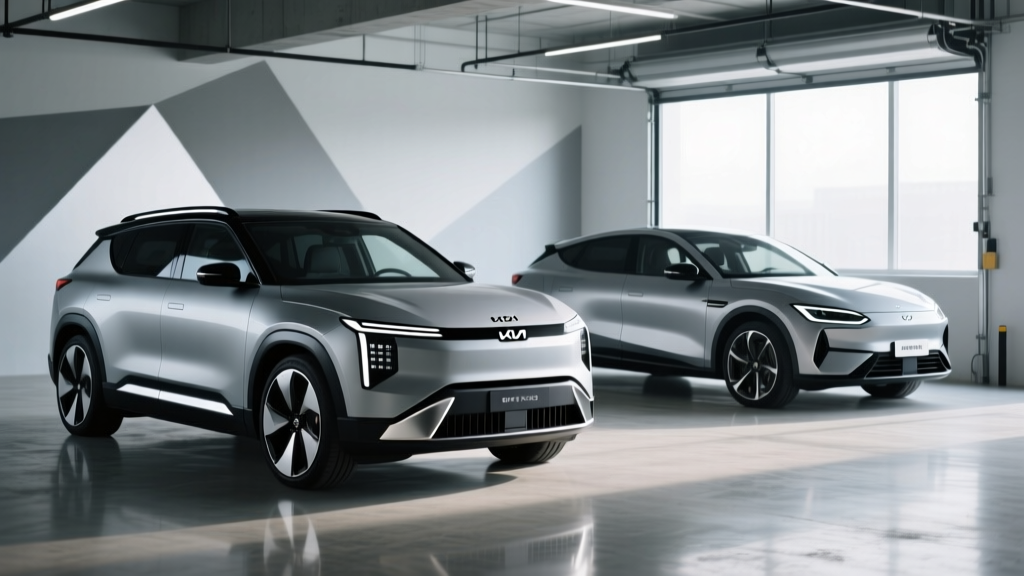
Kia's electric SUV strategy in 2026 centers on two production models built on the E-GMP skateboard platform. A third, the smaller EV5, has been announced for global markets but remains unreleased in the U.S. as of this writing. That means American buyers choosing an electric SUV from Kia are deciding between the EV6 and EV9.
| Spec | 2026 Kia EV6 (Light RWD) | 2026 Kia EV6 GT-Line AWD | 2026 Kia EV9 (Light RWD) | 2026 Kia EV9 GT-Line AWD |
|---|---|---|---|---|
| EPA Range | 310 mi | 282 mi | 304 mi | 270 mi |
| Battery (usable) | 77.4 kWh (NMC) | 77.4 kWh (NMC) | 100.0 kWh (NMC) | 100.0 kWh (NMC) |
| Horsepower | 225 hp | 320 hp | 215 hp | 379 hp |
| 0–60 mph | 7.2 sec | 4.5 sec | 7.8 sec | 4.9 sec |
| Peak DC Charge Rate | ~240 kW | ~240 kW | ~210 kW | ~210 kW |
| 10–80% DCFC Time | ~18 min | ~18 min | ~20 min | ~20 min |
| Level 2 (240V) Rate | 10.9 kW | 10.9 kW | 10.9 kW | 10.9 kW |
| MPGe (combined) | 134 MPGe | 106 MPGe | 89 MPGe | 83 MPGe |
| Towing Capacity | Not rated | Not rated | 2,000 lbs | 5,000 lbs |
| Starting MSRP | $42,900 | $53,500 | $54,900 | $63,900 |
| Battery/Powertrain Warranty | 10 yr / 100,000 mi | 10 yr / 100,000 mi | 10 yr / 100,000 mi | 10 yr / 100,000 mi |
EV6 vs. Gas and Hybrid SUVs: The Real Cost Comparison
Many shoppers cross-shop the Kia EV6 against the Kia Sportage Hybrid or even the gas-only Sportage. Here's what five years of ownership looks like when you run the numbers.
| Cost Factor (5 years / 75,000 mi) | Kia EV6 Light RWD | Kia Sportage Hybrid (HEV) | Kia Sportage (Gas, FWD) |
|---|---|---|---|
| Base MSRP | $42,900 | $32,590 | $30,490 |
| Est. Federal Tax Credit (§30D) | Up to $7,500* | $0 | $0 |
| Effective Purchase Price | ~$35,400 | $32,590 | $30,490 |
| Fuel / Electricity (75k mi) | ~$2,625† | ~$5,625‡ | ~$7,500§ |
| Maintenance (5 yr est.) | ~$1,200 | ~$2,800 | ~$3,200 |
| Insurance (5 yr avg.) | ~$9,500 | ~$7,800 | ~$7,400 |
| 5-Year Total Cost | ~$48,725 | ~$48,815 | ~$48,590 |
* §30D credit eligibility depends on buyer income caps, vehicle MSRP limits (SUVs: $80,000), and battery component/mineral sourcing rules. Verify at IRS.gov and consult a tax professional. Point-of-sale transfer is available at participating dealers.
† Assumes 80% home Level 2 charging at $0.16/kWh avg, 20% public DCFC at $0.48/kWh, EV6 efficiency of 3.5 mi/kWh.
‡ Sportage HEV at 43 MPG combined, $3.25/gal.
§ Gas Sportage at 28 MPG combined, $3.25/gal.
The takeaway: once you factor in the tax credit, fuel savings, and lower maintenance (no oil changes, fewer brake replacements thanks to regenerative braking), the EV6 reaches near cost parity with the gas Sportage over five years — despite a higher sticker price. Higher insurance premiums for EVs partially offset the fuel savings. Your personal electricity rate and driving volume shift these numbers significantly.
Home Charging: What You Actually Need
Home charging access is the single biggest factor in EV satisfaction. If you can install a Level 2 charger, daily EV ownership is effortless. If you can't, think carefully before buying.
| Level | Power | Miles of Range Added per Hour | Use Case |
|---|---|---|---|
| Level 1 (120V outlet) | ~1.4 kW | ~4–5 miles/hr | Overnight top-up if you drive <40 mi/day |
| Level 2 (240V, 48A) | ~10.9 kW | ~35–38 miles/hr | Full overnight charge; the standard for EV owners |
| DC Fast Charge (public) | Up to 240 kW (EV6) | ~10+ miles/min at peak | Road trips; 10–80% in ~18 min |
Installation cost reality: A Level 2 home charger (like a ChargePoint Home Flex or Emporia Level 2) costs $400–$700 for the unit. Professional installation by a licensed electrician runs $500–$2,000 if your panel has capacity for a 60A circuit. If you need a panel upgrade (common in older homes), add $1,500–$3,500. Total: $900–$6,200 depending on your home's electrical infrastructure.
Both the EV6 and EV9 use the CCS1 connector for DC fast charging and the J1772 connector for Level 2 AC. Kia also provides a NACS adapter for Tesla Supercharger access on newer model years, expanding your public charging network substantially. Always confirm adapter compatibility with your specific model year and trim.
Tax Credits and Incentives: What You Can Actually Claim
The federal §30D Clean Vehicle Credit offers up to $7,500 for qualifying new EVs, but multiple conditions apply:
- MSRP cap: SUVs (including the EV6 and EV9) must have an MSRP at or below $80,000. Both models qualify at most trims.
- Buyer income limits: Adjusted gross income must not exceed $300,000 (married filing jointly), $225,000 (head of household), or $150,000 (single).
- Battery sourcing requirements: The credit splits into two halves ($3,750 each) — one tied to critical minerals sourcing, the other to battery component manufacturing. These thresholds tighten annually. As of 2026, a growing number of Kia EVs assembled in Georgia at the Metaplant America facility meet an increasing share of these requirements, but exact eligibility varies by build date and battery lot.
- Point-of-sale transfer: You can transfer the credit to the dealer at purchase, reducing your out-of-pocket cost immediately rather than waiting for tax filing.
Because sourcing rules shift and are model-year-specific, always check the latest list at fueleconomy.gov and confirm with your dealer before signing paperwork. State incentives (like California's CVRP or Colorado's innovative motor vehicle credit) stack on top but vary widely — consult your state energy office.
Real-World Ownership: What First-Time EV Buyers Miss
Beyond range and price, here are the practical realities that new Kia EV owners consistently report:
Charging curve taper: Kia advertises "10–80% in 18 minutes" — and that's achievable at a 350 kW charger under ideal battery temperature conditions. But charging speed drops sharply above 80% SoC. Going from 80–100% can take as long as 10–80%. On road trips, plan to charge to 80% and drive on; topping off is rarely worth the time.
Preconditioning matters: Both models let you precondition the battery via the Kia Access app before arriving at a DC fast charger. This warms the battery to optimal charging temperature. Without preconditioning in cold weather, your peak charge rate may be cut in half, stretching a 18-minute stop to 35+ minutes.
Tire wear: EVs are heavier and deliver instant torque. Expect to replace tires 20–30% sooner than on an equivalent gas vehicle. Budget $800–$1,400 for a set of EV-optimized tires every 30,000–40,000 miles.
Insurance premiums: EVs typically cost 15–25% more to insure than comparable gas vehicles due to higher repair costs and specialized parts. Get quotes before buying — the difference can be $200–$400/year depending on your profile and state.
Public charging reliability: While Electrify America, EVgo, and Tesla Superchargers (via adapter) cover most U.S. highway corridors, charger uptime varies. Apps like PlugShare and A Better Routeplanner help you plan, but rural charging deserts remain a real limitation in parts of the Mountain West, Great Plains, and rural South.
Decision Framework: Which Kia Electric SUV Is Right for You?
Choose the Kia EV6 If:
- Your daily commute is under 60 miles round-trip and you rarely carry more than four passengers
- You want the lowest possible purchase price in Kia's EV lineup ($42,900 base)
- You value driving dynamics — the GT-Line AWD hits 0–60 in 4.5 seconds with 320 hp
- Efficiency matters: 134 MPGe combined (Light RWD) means lower electricity costs per mile
- You don't need towing capability
Choose the Kia EV9 If:
- You need three rows of seating for family hauling (up to 7 passengers)
- You tow a trailer: the GT-Line AWD is rated for up to 5,000 lbs
- Cargo space is a priority: 81.7 cu ft with both rear rows folded vs. 50.2 cu ft in the EV6
- You're willing to pay a $12,000+ premium and accept slightly lower efficiency (83–89 MPGe)
- You want the newest platform features, including available Highway Driving Assist 2 and Digital Center Mirror
Consider a Kia Hybrid (Sportage HEV/PHEV) Instead If:
- You lack reliable access to home or workplace charging
- You regularly drive 400+ miles in single stretches through charging-desert regions
- Your budget is under $35,000 and you want lower upfront cost without credit dependency
- You live in extreme cold (-20°F regularly) where EV range loss becomes a genuine hardship
Common Misconceptions About Kia's Electric SUVs
| Myth | Fact |
|---|---|
| "The battery will need replacing in 5 years and cost $20,000." | Kia's battery warranty covers 10 years/100,000 miles with a minimum 70% capacity retention threshold. Real-world E-GMP degradation data from 2022–2025 model-year EV6 owners shows roughly 5–8% loss over 100,000 miles. Full battery replacements are rare and mostly covered under warranty. |
| "EVs are worse in winter." | Range drops 20–30% in freezing temps — that's real. But EVs start instantly in cold weather, the heat pump provides efficient cabin heating, and preconditioning while plugged in means a warm car every morning without idling. Traction is comparable to any AWD vehicle with proper tires. |
| "Charging takes hours." | At home on Level 2, a full overnight charge takes ~7–9 hours while you sleep. On road trips, a DC fast charger adds ~180 miles in 18 minutes (10–80%). Most EV owners spend less time "refueling" than gas-car owners because home charging is passive. |
| "Kia's electric SUVs can't use Tesla Superchargers." | Kia provides a NACS adapter (or has integrated NACS ports on newer builds), enabling access to Tesla's Supercharger network — the largest and most reliable in the U.S. Confirm adapter availability for your specific model year with your dealer. |
| "The EV9 is just a bigger EV6." | While both use E-GMP, the EV9 has a larger 100 kWh battery (vs. 77.4 kWh), a longer wheelbase, available air suspension, V2L (vehicle-to-load) capability for powering devices, and a fundamentally different interior layout optimized for three-row family use. |
Frequently Asked Questions
What is the real-world range of the Kia EV6 and EV9?
The EV6 Light RWD achieves an EPA-estimated 310 miles, but real-world highway driving at 75 mph typically yields 265–280 miles. In winter, expect 220–250 miles. The EV9 Light RWD is EPA-rated at 304 miles, with real-world highway figures around 255–275 miles and winter highway range around 215–245 miles. AWD trims reduce these figures by roughly 8–12%.
Can I charge a Kia EV at a Tesla Supercharger?
Yes. Kia has equipped newer model-year EV6 and EV9 vehicles with NACS compatibility, either through an included adapter or a native NACS charge port (depending on production date). This grants access to 20,000+ Tesla Superchargers across the U.S. Always verify your specific vehicle's adapter status before relying on Supercharger access.
How much does it cost to charge the EV6 or EV9 at home?
At the U.S. average residential electricity rate of ~$0.16/kWh, fully charging the EV6's 77.4 kWh battery costs roughly $12.40, yielding about $0.045 per mile. A full EV9 charge (100 kWh) costs about $16.00, or roughly $0.055 per mile. Compare that to $0.12–$0.15 per mile in a gas Sportage at current fuel prices.
Do the EV6 and EV9 qualify for the $7,500 federal tax credit?
Eligibility depends on three factors: your income (below IRS thresholds), the vehicle's MSRP (under $80,000 for SUVs — both models qualify), and battery component/critical-mineral sourcing compliance. With Kia's U.S. production at Metaplant America in Georgia, an increasing share of 2026 builds meet sourcing requirements, but the exact credit amount ($3,750 or $7,500) can vary by build date. Check fueleconomy.gov for the latest qualifying list and consult a tax professional.
What happens if the battery degrades significantly?
Kia's battery warranty guarantees at least 70% capacity retention over 10 years or 100,000 miles. If degradation exceeds that threshold, Kia will repair or replace the battery at no cost. Independent data from E-GMP vehicles suggests most owners will see 90–95% capacity at 100,000 miles under normal use — well above the warranty floor. Avoid routinely charging to 100% or leaving the vehicle at 0% SoC for extended periods to maximize longevity.
Is the EV9 a good tow vehicle?
The EV9 GT-Line AWD is rated to tow up to 5,000 lbs — sufficient for a small camper, utility trailer, or a pair of personal watercraft. However, towing at or near maximum capacity will reduce range by 30–50% depending on speed, terrain, and trailer aerodynamics. Plan for 150–180 miles of range while towing and ensure your route has adequate DC fast-charging stops. The Light RWD trim is rated for 2,000 lbs only.