Quick Verdict: Two Very Different Flagships
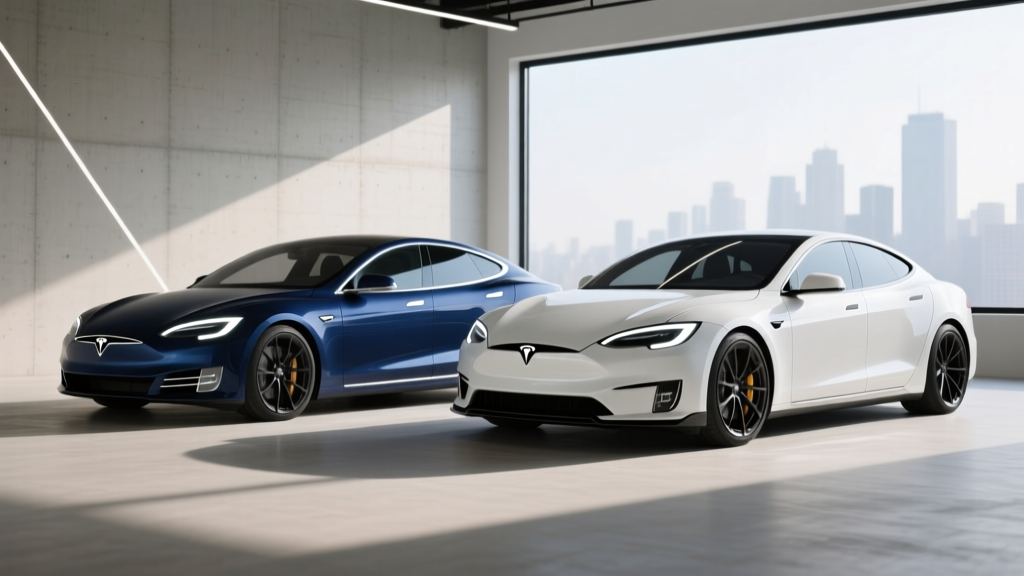
The 2026 Tesla Model S lineup forces buyers into a clear either/or decision. The Long Range trim prioritizes distance and daily usability with an EPA-estimated 402 miles of range, while the Plaid trades roughly 40 miles of range for 1,020 horsepower and a sub-2-second 0-60 time. Both share the same 100 kWh (usable) battery architecture, tri-motor layout, and Supercharger network access — but the tuning, price, and ownership experience diverge sharply. This guide breaks down every spec, real-world caveat, and cost factor so you can match the right Model S to your driving pattern.
Side-by-Side Specifications
| Specification | Model S Long Range | Model S Plaid |
|---|---|---|
| EPA Range | 402 mi | 396 mi (21" wheels) / 359 mi (19" wheels)* |
| Battery (usable) | ~100 kWh, NMC | ~100 kWh, NMC |
| Drivetrain | Tri-Motor AWD | Tri-Motor AWD |
| Horsepower | 670 hp | 1,020 hp |
| 0-60 mph | 3.1 sec | 1.99 sec |
| Top Speed | 155 mph | 200 mph |
| Peak DC Fast Charge | 250 kW | 250 kW |
| 10-80% DC Charge Time | ~28 min | ~28 min |
| Level 2 Charge Rate | 11.5 kW (48A) | 11.5 kW (48A) |
| Efficiency (MPGe combined) | 124 MPGe | 116 MPGe |
| Cargo Volume | 28 cu ft (rear + frunk) | 28 cu ft (rear + frunk) |
| Curb Weight | 4,561 lbs | 4,766 lbs |
| Base MSRP | $79,990 | $94,990 |
| Battery/Drive Unit Warranty | 8 yr / 150,000 mi | 8 yr / 150,000 mi |
*EPA range varies by wheel option. Verify current figures at fueleconomy.gov.
Range and Efficiency: Real-World Expectations
EPA vs. Reality — Model S Long Range: The 402-mile EPA sticker is class-leading, but expect roughly 340-360 miles on sustained 75-mph highway driving in moderate temperatures. In sub-30°F winter conditions, plan for 280-310 miles of usable range before needing a charge stop.
EPA vs. Reality — Model S Plaid: With 21-inch wheels, the 396-mile EPA figure drops to approximately 320-340 miles highway, and closer to 260-290 miles in cold weather. Aggressive throttle use — easy to indulge with 1,020 hp — can push consumption above 400 Wh/mi, cutting range further.
Both trims share the same ~100 kWh NMC battery pack. The Long Range's efficiency edge comes from less aggressive motor tuning and slightly lower curb weight (205 lbs lighter). The Plaid's third motor and track-capable cooling add mass and parasitic drag.
For context, the Long Range's 124 MPGe combined translates to roughly 27 kWh/100mi. The Plaid sits at 116 MPGe, or about 29 kWh/100mi. On a national average electricity rate of $0.16/kWh (EIA data), that's $4.32 vs $4.64 per 100 miles — a negligible daily difference, but it compounds on road trips.
Charging Speed and Network Access
Both trims peak at 250 kW on V3 Superchargers and achieve a 10-80% charge in approximately 28 minutes. The charge curve is nearly identical: power holds above 200 kW up to roughly 50% state of charge, then tapers through 150 kW by 70% and drops below 100 kW past 85%. This means the last 20% of the battery takes as long as the first 50%.
| Charging Level | Power | Miles Added per Hour |
|---|---|---|
| Level 1 (120V / 12A) | ~1.4 kW | ~4 mi/hr |
| Level 2 (240V / 48A) | 11.5 kW | ~34 mi/hr |
| DC Fast (V3 Supercharger) | Up to 250 kW | ~500 mi/hr (peak) |
Supercharger network advantage: Both trims use the native NACS connector and access Tesla's Supercharger network — over 6,000 U.S. stations as of early 2026. This remains the most reliable public DC fast-charging network by uptime and plug-and-pay simplicity. Non-Tesla EVs now access many Supercharger stalls via NACS adapters, but Tesla owners still benefit from integrated navigation preconditioning, which warms the battery en route to a charger for faster charging upon arrival.
Home charging reality: At 11.5 kW, a full Level 2 charge from 10-80% takes about 6 hours — adequate for overnight replenishment. Installation of a 60-amp circuit (to support 48A continuous draw) typically costs $800-$2,000 depending on panel proximity and local permitting. Homes with older 100-amp electrical panels may need a $2,000-$4,000 panel upgrade. Always consult a licensed electrician for final specifications.
Performance and Driving Dynamics
The Long Range's 670 hp and 3.1-second 0-60 time already place it among the quickest sedans ever sold. The Plaid's 1,020 hp and 1.99-second 0-60 (with rollout subtracted, on prepped surface) exist in hypercar territory. But the practical differences extend beyond straight-line speed:
- Thermal management: The Plaid features a more robust cooling system with track-mode capability, sustaining peak power through repeated hard launches. The Long Range will thermally derate after 2-3 consecutive full-power accelerations.
- Braking: The Plaid includes larger front rotors and higher-capability calipers. Both trims rely heavily on regenerative braking for daily driving, but the Plaid's friction brakes handle track-level heat better.
- Suspension: Both use adaptive air suspension. The Plaid's tuning is slightly firmer with revised damper calibration for cornering composure.
- Weight: The Plaid's 205-lb penalty is noticeable in transitions but masked by its power advantage.
Neither trim offers one-pedal driving as strongly as earlier Tesla models — the 2026 Model S creeps at low speed by default, though regenerative braking remains substantial at higher speeds.
Price, Tax Credits, and Ownership Costs
| Factor | Long Range | Plaid |
|---|---|---|
| Base MSRP | $79,990 | $94,990 |
| Federal §30D Tax Credit | $0 (exceeds MSRP cap) | $0 (exceeds MSRP cap) |
| Estimated Insurance (annual avg) | $2,800-$3,400 | $3,400-$4,200 |
| Annual Electricity Cost (12,000 mi) | ~$520 | ~$560 |
| Maintenance (annual avg) | ~$300-$500 | ~$400-$700 |
| 5-Year Est. Total Cost of Ownership | ~$108,000-$115,000 | ~$128,000-$138,000 |
Federal tax credit: Neither Model S trim qualifies for the §30D Clean Vehicle Credit. The IRS caps sedan eligibility at $55,000 MSRP (IRS §30D guidelines), and both trims exceed that threshold by a wide margin. State and local incentives may apply — check your jurisdiction's official energy or DMV site for current programs.
Insurance: The Plaid commands a 15-25% insurance premium over the Long Range due to its power output and higher repair costs. Get quotes from your insurer before committing — the gap can exceed $800/year.
Maintenance: Both trims share Tesla's minimal maintenance schedule — cabin air filter, brake fluid check, tire rotation. The Plaid's wider rear tires (275-section vs 255) cost roughly $50-$80 more per corner and wear faster under hard driving. Expect tire replacement every 20,000-30,000 miles on the Plaid vs 30,000-40,000 on the Long Range.
Technology, Interior, and Autopilot
Both trims share identical interior hardware: a 17-inch center touchscreen, 12.3-inch driver display, yoke or round steering wheel (buyer's choice at no extra cost), 22-speaker audio, and ventilated front seats. Rear passengers get a 9.4-inch touchscreen for climate and entertainment.
Autopilot and FSD: Both include basic Autopilot (traffic-aware cruise control and lane centering). Tesla's Full Self-Driving (Supervised) package is an $8,000 add-on or $99/month subscription. FSD operates at SAE Level 2 — the driver must remain fully engaged, monitor the road, and be ready to intervene at any moment. This is not autonomous driving. No consumer Tesla vehicle is self-driving.
SAE Automation Level Reminder: Tesla Autopilot and FSD (Supervised) are Level 2 systems — partial automation with continuous driver supervision required. Level 4 (driverless in defined conditions) applies only to robotaxi services like Waymo. Never treat Level 2 as hands-free or eyes-off.
Category Winners
🏆 Range & Efficiency: Long Range
402 EPA miles vs 396 (or 359 with 19" wheels). Lower consumption, lighter weight, and better cold-weather retention.
🏆 Performance: Plaid
1,020 hp, 1.99s 0-60, track-capable cooling. No sedan at any price matches this acceleration.
🏆 Charging: Tie
Identical 250 kW peak, ~28 min 10-80%, same Supercharger access and preconditioning.
🏆 Value: Long Range
$15,000 less at MSRP, lower insurance, lower tire costs, nearly identical interior and tech.
🏆 Tech & Interior: Tie
Same screens, audio, seats, software, and FSD availability.
🏆 Cargo & Practicality: Tie
28 cu ft combined, same frunk, same rear hatch, identical dimensions.
Decision Framework: Which Model S Should You Buy?
Choose the Model S Long Range if:
- You regularly drive 300+ miles between charge stops and want maximum range buffer
- Your budget tops out around $85,000-$90,000 (with options like FSD or premium paint)
- You want a luxury EV daily driver that happens to be very quick (3.1s is already supercar-quick)
- You live in a cold-weather region where every mile of range matters
- You prioritize lower insurance and tire replacement costs
Choose the Model S Plaid if:
- Track days or repeated hard acceleration are part of your ownership plan
- You want the fastest-accelerating production sedan available, period
- The $15,000 price premium and higher running costs are inconsequential to your budget
- You value the exclusivity and engineering showcase of 1,020 hp
- 359-396 miles of range is sufficient for your typical routes
Model S Long Range — Pros & Cons
Pros:
- Best-in-class 402-mile EPA range
- Still extremely fast at 3.1s 0-60
- $15,000 savings over Plaid
- Lower insurance and tire costs
- Full Supercharger network access
Cons:
- No federal tax credit (above MSRP cap)
- Interior materials don't match German luxury rivals at this price
- Yoke steering requires adaptation
- Service center availability varies by region
Model S Plaid — Pros & Cons
Pros:
- 1,020 hp / 1.99s 0-60 — unmatched sedan performance
- Track-capable thermal management
- Same 402-adjacent range as Long Range (with 21" wheels)
- Full Supercharger network access
- Identical luxury interior and tech
Cons:
- $94,990 starting price with no federal credit
- Higher insurance premiums ($600-$1,000+ more/year)
- Rear tire wear accelerates under hard use
- Performance advantage rarely usable on public roads
Final Recommendation
For the vast majority of buyers, the Model S Long Range is the rational choice. It delivers 95% of the Plaid's capability at 84% of the price, with better range, lower running costs, and the same interior, tech, and charging experience. The 3.1-second 0-60 time already exceeds what most drivers will ever use on public roads.
The Model S Plaid exists for a specific buyer: someone who wants the ultimate performance sedan, plans to use track mode, and views the $15,000 premium as the cost of owning an engineering benchmark. If that describes you, the Plaid delivers an experience no other four-door car can match. If it doesn't, the Long Range is the smarter allocation of your budget — and you'll never feel underpowered.
Frequently Asked Questions
Does either Model S qualify for the $7,500 federal tax credit?
No. The IRS §30D credit caps sedan eligibility at $55,000 MSRP. Both the Long Range ($79,990) and Plaid ($94,990) exceed this limit. Check your state's incentive programs for possible local credits.
Is the Plaid's range significantly worse than the Long Range?
On paper, the gap is small — 402 vs 396 miles with comparable wheels. In practice, the Plaid's higher weight and the temptation to use its power increase consumption. Expect a 10-15% real-world range gap in mixed driving if you drive the Plaid aggressively.
Can I add the Plaid powertrain to the Long Range later?
No. The tri-motor configuration and thermal hardware are factory-installed and cannot be retrofitted. The decision is final at purchase.
Which trim holds its value better?
Historically, high-performance Tesla trims depreciate faster in percentage terms due to their higher starting price. The Long Range typically retains value slightly better as a proportion of MSRP, though both face steeper depreciation than mainstream EVs due to the luxury segment's depreciation patterns and Tesla's frequent pricing adjustments.
Is FSD worth adding to either trim?
FSD (Supervised) remains a Level 2 driver-assist system requiring full driver attention. At $8,000 or $99/month, its value depends on your commute pattern and tolerance for beta-level software. It does not make either car self-driving. Try the monthly subscription before committing to a purchase.
What's the battery replacement cost out of warranty?
Tesla does not publish a fixed replacement price, but out-of-warranty Model S battery replacements have been reported in the $15,000-$22,000 range. Both trims carry an 8-year/150,000-mile battery and drive unit warranty covering degradation below 70% capacity retention. NMC chemistry in the Model S typically retains 85-90% capacity at 100,000 miles based on fleet data.