The Quick Answer
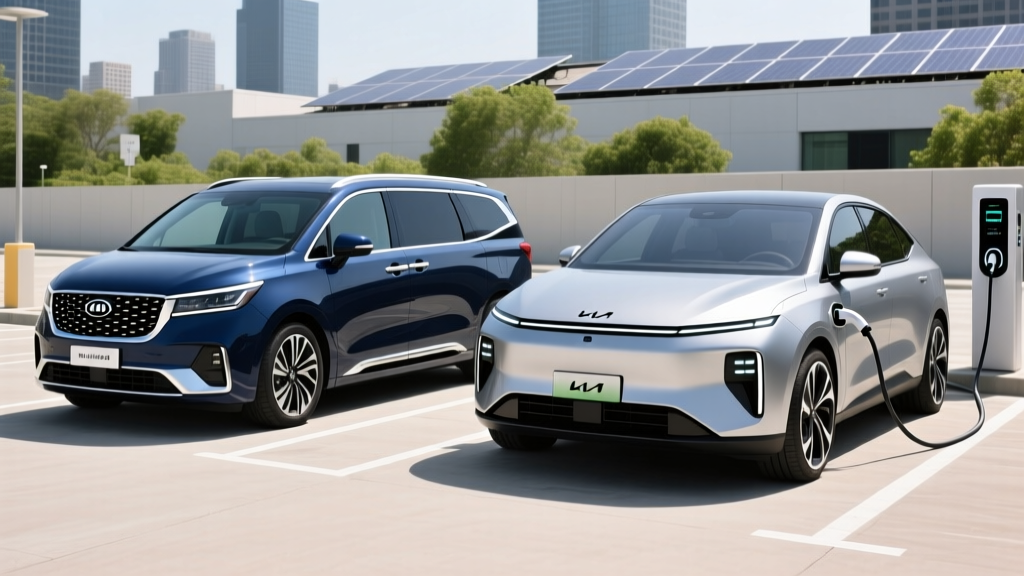
As of 2026, Kia does not sell a fully electric minivan in the United States. The Kia Carnival is available exclusively as a gasoline V6 model and, new for 2025-2026, as a 1.6-liter turbo hybrid (HEV). There is no plug-in hybrid (PHEV) or battery-electric (BEV) Carnival currently on sale. If you need a three-row Kia with electric propulsion today, the closest option is the Kia EV9, an all-electric three-row SUV with an EPA-estimated 279 miles of range and a starting MSRP around $54,900. A battery-electric Carnival successor has been hinted at in Kia's long-term roadmap but remains unannounced with no confirmed timeline.
What Kia Actually Offers in 2026: Carnival Powertrains
The Kia Carnival enters the 2026 model year with two powertrain choices, neither of which is a true electric minivan:
| Spec | Carnival V6 (Gas) | Carnival Hybrid (HEV) |
|---|---|---|
| Powertrain | 3.5L V6 | 1.6L Turbo + electric motor |
| Horsepower | 290 hp | 245 hp combined |
| Transmission | 8-speed auto | 6-speed auto |
| EPA MPG (City/Hwy/Combined) | 19 / 26 / 22 | 34 / 31 / 33 (est.) |
| Drivetrain | FWD | FWD |
| Seating | 7 or 8 passengers | 7 or 8 passengers |
| Starting MSRP | ~$34,600 | ~$40,600 |
| Federal EV Tax Credit | None | None (HEV, not plug-in) |
The hybrid is a conventional HEV—meaning it charges its small battery through regenerative braking and the gas engine. You cannot plug it in, and it has no electric-only driving range. This is a meaningful distinction: some shoppers searching for a "Kia electric minivan" may be thinking of a plug-in vehicle, but the Carnival Hybrid does not qualify.
The Closest Thing: Kia EV9 Three-Row Electric SUV
If your priority is a three-row Kia with a plug, the Kia EV9 is the only current option. It's an SUV, not a minivan, but it seats up to seven and competes directly with minivans on family-hauling duty.
| Spec | Kia EV9 Light (RWD) | Kia EV9 Wind/Land (AWD) | Kia EV9 GT-Line (AWD) |
|---|---|---|---|
| Battery (usable) | 76.1 kWh (NMC) | 99.8 kWh (NMC) | 99.8 kWh (NMC) |
| EPA Range | 230 mi | 279 mi | 270 mi |
| Horsepower | 215 hp | 379 hp | 379 hp |
| 0-60 mph | ~8.2 sec | ~5.0 sec | ~5.0 sec |
| Max DC Fast Charge | ~170 kW | ~210 kW | ~210 kW |
| 10-80% DCFC Time | ~24 min | ~20 min | ~20 min |
| Level 2 Charge Rate | 10.9 kW | 10.9 kW | 10.9 kW |
| MPGe (Combined) | 94 MPGe | 87 MPGe | 85 MPGe |
| Starting MSRP | ~$54,900 | ~$63,900 | ~$73,900 |
| Federal Tax Credit (§30D) | Up to $7,500* | Up to $7,500* | Up to $7,500* |
| Battery Warranty | 10 yr / 100,000 mi | 10 yr / 100,000 mi | 10 yr / 100,000 mi |
*§30D tax credit eligibility depends on buyer income limits (AGI ≤$150K single / $300K joint), MSRP caps ($80K for SUVs/vans), battery critical-mineral and component sourcing requirements, and point-of-sale transfer rules. Verify current eligibility at IRS.gov before purchasing. The EV9 is assembled in Georgia, which has helped its credit qualification, but sourcing rules are subject to change.
Real-World Range vs. EPA Sticker
The EV9 Wind AWD carries an EPA estimate of 279 miles. In real-world highway driving at 70-75 mph, expect 240-255 miles in mild weather. In cold conditions (below 30°F), range can drop to 195-220 miles due to cabin heating demands and reduced battery efficiency. If your typical trip exceeds 200 miles one-way, plan a DC fast-charging stop.
EV9 vs. Carnival Hybrid: 5-Year Cost Comparison
Here's where the math gets interesting. The EV9 costs significantly more upfront, but lower fueling and maintenance costs narrow the gap over time.
| Cost Factor (5 Years / 75,000 mi) | Carnival Hybrid (~$40,600) | EV9 Wind AWD (~$63,900) |
|---|---|---|
| Purchase Price (MSRP) | $40,600 | $63,900 |
| Federal Tax Credit | $0 | −$7,500 (if eligible) |
| Net Purchase | $40,600 | $56,400 |
| Fuel/Energy Cost | ~$7,900 (gas @ $3.40/gal, 33 MPG) | ~$3,600 (electricity @ $0.16/kWh, home charging) |
| Maintenance | ~$3,200 (oil, filters, brakes) | ~$1,200 (cabin filter, tire rotation, wipers) |
| Insurance (est. avg) | ~$8,500 | ~$10,500 (EVs typically 15-25% higher) |
| Estimated Depreciation | ~$18,000 | ~$24,000 |
| Total 5-Year Cost | ~$78,200 | ~$88,200 |
The EV9 still costs roughly $10,000 more over five years in this scenario, primarily due to higher purchase price and depreciation. However, if you drive more than 15,000 miles per year, have access to cheap home electricity, or qualify for additional state incentives, the gap shrinks. The Carnival Hybrid wins on pure economics for average-mileage families who want to minimize upfront spend.
Ownership Realities: What First-Time EV Buyers Must Know
If you're considering the EV9 as your "electric minivan" substitute, these practical factors determine whether it works for your household:
Home Charging Is Essential
Public DC fast charging at 210 kW sounds quick—and a 10-80% session in ~20 minutes is genuinely usable for road trips. But daily life demands Level 2 home charging. A 240V/48-amp home charger (like a ChargePoint Home Flex or Wallbox Pulsar Plus) delivers roughly 30-35 miles of range per hour of charging, easily replenishing a day's driving overnight. Installation costs range from $500-$2,500 depending on whether your electrical panel needs an upgrade from 100A to 200A service.
Cold Climate Considerations
If you live where winters drop below freezing, the EV9's heat pump (standard on most trims) helps preserve range, but you'll still see 15-25% range reduction in sustained cold. Preconditioning the battery while plugged in—using the Kia Access app to warm the cabin and battery before departure—mitigates this significantly and is a habit every EV owner should develop.
Minivan Practicality Gap
The EV9 offers 81.7 cu ft of total cargo space (behind the first row), which is competitive. But it lacks the Carnival's signature feature: a low, flat load floor and available slide-in second-row seats that fold into the floor. If you regularly haul bulky cargo or need wheelchair accessibility, the Carnival's minivan architecture still has a practicality edge that no current three-row SUV fully matches.
Common Misconceptions About a Kia Electric Minivan
| Myth | Fact |
|---|---|
| "The Carnival Hybrid is a plug-in electric minivan." | It's a conventional HEV with no plug and no electric-only range. It cannot qualify for the §30D federal EV tax credit. |
| "Kia is releasing an electric Carnival in 2026." | Kia has not announced a battery-electric Carnival. The EV9 is the brand's only three-row electric vehicle in the US market as of 2026. |
| "The EV9 qualifies for the full $7,500 tax credit for everyone." | Eligibility requires meeting AGI income caps, MSRP limits, and battery-sourcing requirements. Check the fueleconomy.gov credit lookup for the latest status. |
| "Electric minivans from any brand are widely available." | The only all-electric minivan sold in the US is the Chrysler Pacifica... and it's a PHEV, not a BEV. No fully electric minivan from any automaker is currently on the US market. |
| "I can fast-charge an EV9 in 10 minutes." | Peak rate is ~210 kW, but the charge curve tapers above 80%. A 10-80% session takes ~20 minutes. Charging from 80-100% can take an additional 15-20 minutes. |
Decision Framework: Which Kia Should You Buy?
Choose the Carnival Hybrid if:
- You want the lowest purchase price and simplest ownership (no charging needed)
- Your household drives under 15,000 miles per year
- You need true minivan features: low step-in height, stowable second-row seats, sliding doors in tight parking spots
- You live in an apartment or lack access to reliable home or workplace charging
- You take frequent long road trips through areas with sparse charging infrastructure
Choose the EV9 if:
- You have (or can install) Level 2 home charging
- You want zero tailpipe emissions and lower per-mile energy costs
- You're eligible for the §30D tax credit, bringing the effective price closer to $56,000
- You prioritize instant torque, quiet operation, and a tech-forward cabin
- Your daily driving is under 200 miles and road trips are occasional (or you're comfortable planning DC fast-charge stops)
Wait if:
- You specifically need a battery-electric minivan with sliding doors and a flat load floor—no such vehicle exists from Kia or any other brand in 2026
- Your budget is firm below $35,000 and you want electric propulsion (consider a used EV or wait for more affordable options)
Frequently Asked Questions
Will Kia ever make a fully electric Carnival minivan?
Kia has committed to launching 15 battery-electric models globally by 2027, but a dedicated electric minivan has not been confirmed for the US market. Industry speculation suggests a next-generation Carnival could adopt the EV9's E-GMP platform, but any such vehicle would likely arrive no earlier than 2028-2029.
Does the Carnival Hybrid qualify for any tax credits?
No. The §30D federal clean vehicle credit applies only to plug-in electric vehicles (BEVs and PHEVs) with sufficient battery capacity and qualifying battery sourcing. Conventional hybrids like the Carnival HEV do not qualify. Some states may offer small incentives for HEVs, but these vary by jurisdiction—check your state energy office for details.
How does the EV9's cargo space compare to the Carnival?
The Carnival offers 145.1 cu ft behind the first row (with second-row seats removed), compared to the EV9's 81.7 cu ft. The Carnival's minivan architecture gives it a significant cargo advantage, especially for tall or bulky items. If maximum cargo volume is your top priority, the Carnival wins decisively.
What does it cost to install a home charger for the EV9?
A quality Level 2 charger (hardware) costs $400-$700. Professional installation by a licensed electrician runs $300-$800 for a straightforward setup near your electrical panel. If your home needs a panel upgrade from 100A to 200A service, add $1,500-$3,000. Total typical range: $700-$4,500. Some utilities offer rebates that offset $200-$500 of this cost.
Is the EV9 safe for families?
The EV9 earned the IIHS Top Safety Pick+ designation for the 2025 model year with Good ratings across all crash tests. It comes standard with Highway Driving Assist 2 (an SAE Level 2 driver-assistance system), automatic emergency braking, blind-spot monitoring, and rear cross-traffic alert. It is not a self-driving vehicle—the driver must remain engaged at all times.
What's the real cost per mile: EV9 vs Carnival Hybrid?
At $0.16/kWh (national average residential electricity), the EV9 costs roughly $0.048 per mile (using ~3.0 kWh/mi or ~33 kWh/100mi). The Carnival Hybrid at 33 MPG combined and $3.40/gallon costs $0.103 per mile. That's a savings of about $0.055/mile with the EV9—roughly $825 per year at 15,000 miles. Over five years, that's ~$4,100 in fuel savings, though it doesn't fully offset the EV9's higher purchase price.
Sources: EPA fuel economy data via fueleconomy.gov, Kia America official specifications, IRS §30D clean vehicle credit rules, IIHS safety ratings. Prices and credit eligibility reflect 2026 model year information and are subject to change.