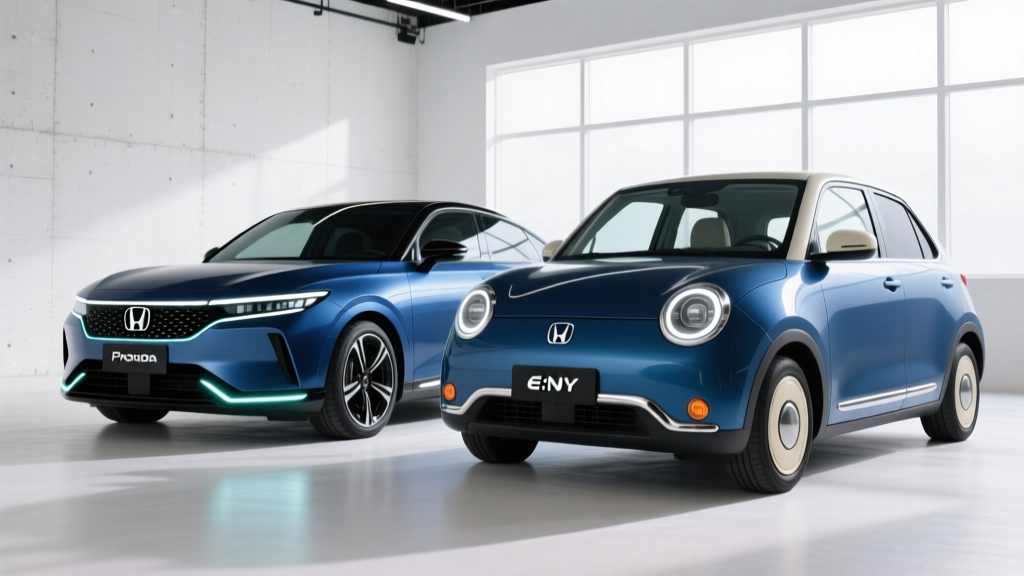
Searching for the "Honda electric blue" lineup usually means one of two things in 2026: you're either looking at the Honda Prologue (the Ultium-based midsize SUV sold in North America) or the Honda e:NY1 (the compact electric crossover sold in Europe and Asia). Both wear Honda's signature blue badging on their EV variants, but they share almost nothing mechanically. Here's the direct answer: the Prologue offers up to 308 miles of EPA range, 150 kW DC fast charging, and starts around $48,795 before incentives; the e:NY1 delivers roughly 256 miles (WLTP), 150 kW peak charging, and is not sold in the US. For American buyers, the Prologue is your Honda EV — and whether it beats a CR-V Hybrid depends heavily on your charging access and driving patterns.
Quick Verdict: Which Honda EV Is Right for You?
Choose the Honda Prologue if: You have Level 2 home charging, drive under 250 miles daily, want a midsize electric SUV, and qualify for partial or full federal tax credits.
Choose the CR-V Hybrid instead if: You lack reliable home charging, frequently drive 300+ miles in cold weather, or need a lower upfront cost with no charging logistics.
The e:NY1 is not available in the US market as of 2026.
Honda Prologue 2026: Range, Battery, and Real-World Efficiency
The 2026 Honda Prologue rides on GM's Ultium platform — the same architecture underpinning the Chevrolet Blazer EV and Cadillac Lyriq. It's available with front-wheel drive (single motor, 212 hp) or all-wheel drive (dual motor, 288 hp). The usable battery capacity is 85 kWh (NMC chemistry), which translates to the following EPA estimates depending on trim and drivetrain:
| Trim / Drivetrain | EPA Range | Battery (usable) | Peak DC Charge | 10–80% Time | 0–60 mph | Base MSRP |
|---|---|---|---|---|---|---|
| EX FWD | 308 mi | 85 kWh NMC | 150 kW | ~32 min | 7.4 sec | $48,795 |
| Touring FWD | 296 mi | 85 kWh NMC | 150 kW | ~32 min | 7.4 sec | $53,495 |
| Elite AWD | 273 mi | 85 kWh NMC | 150 kW | ~32 min | 5.9 sec | $57,295 |
Real-World Range vs. EPA Sticker
EPA 308 mi (EX FWD): Expect 250–270 miles on sustained highway driving at 70+ mph. In freezing temperatures (below 32°F), range drops to approximately 210–230 miles due to cabin heating demands and battery chemistry limitations. The Prologue does not include a heat pump as standard, which amplifies cold-weather losses compared to competitors like the Hyundai Ioniq 5.
Efficiency lands around 99 MPGe combined for the FWD EX, or roughly 34 kWh per 100 miles, per fueleconomy.gov. That's competitive with the Blazer EV but trails the more aerodynamic Ioniq 5 (110 MPGe combined). The AWD Elite's heavier curb weight and larger 20-inch wheels drop efficiency to about 91 MPGe.
Charging Speeds: Home and Public Infrastructure
The Prologue supports three charging tiers. Understanding the difference between kW (power, or charge rate) and kWh (energy, or battery capacity) is essential — a 150 kW charger delivers energy faster than a 7.7 kW home unit, but the battery holds 85 kWh total regardless.
| Level | Power (kW) | Connector | Speed (mi/hr added) | Full Charge Time |
|---|---|---|---|---|
| Level 1 (120V) | 1.4 kW | J1772 / NACS* | ~4 mi/hr | ~60 hours |
| Level 2 (240V home) | 7.7 kW | J1772 / NACS* | ~23 mi/hr | ~11 hours |
| DC Fast Charge | 150 kW peak | CCS1 / NACS* | ~220 mi/hr (peak) | 10–80% in ~32 min |
*Honda confirmed NACS adapter compatibility for 2025+ Prologue models, enabling Tesla Supercharger access. Verify adapter inclusion with your dealer — some 2024 build dates shipped with CCS only.
The 150 kW peak charge rate is the Prologue's most significant limitation. While competitors like the Ioniq 5 (peak 240 kW, 10–80% in ~18 min) and the Kia EV6 (peak 239 kW) charge substantially faster, the Prologue's charge curve holds closer to its peak for longer — you won't see a dramatic cliff after 80%, but you also won't see the blistering 18-minute fills that 800V architectures deliver. On a road trip, plan for 35–40 minute charging stops, not 20.
Prologue vs. CR-V Hybrid: The Ownership Cost Comparison
The CR-V Hybrid is Honda's volume seller and the most common cross-shop. Here's a 5-year total cost of ownership (TCO) comparison assuming 15,000 miles/year, $0.14/kWh home electricity, $3.50/gallon gas, and no tax credit for the baseline scenario:
| Cost Category | 2026 Prologue EX FWD | 2026 CR-V Sport Hybrid AWD |
|---|---|---|
| Base MSRP | $48,795 | $36,350 |
| Federal Tax Credit (§30D) | Up to $7,500* | $0 |
| Effective Purchase Price | $41,295 | $36,350 |
| Fuel/Energy (5 yr / 75,000 mi) | $3,570 | $7,350 |
| Maintenance (5 yr) | ~$1,200 | ~$2,800 |
| Insurance (5 yr avg) | ~$9,500 | ~$7,200 |
| Estimated Depreciation | ~$18,000 | ~$12,500 |
| 5-Year Total | ~$73,565 | ~$66,200 |
*§30D credit eligibility depends on MSRP caps (SUVs: $80,000), buyer income limits ($150K single / $300K joint AGI), and battery critical-mineral sourcing requirements. The Prologue's Ultium battery sourcing has been in flux — verify current-year eligibility at IRS.gov before purchase. Point-of-sale transfer is available through registered dealers.
The Prologue wins on fuel and maintenance costs — electricity at $0.14/kWh means roughly $0.047/mile versus $0.098/mile for the CR-V Hybrid at 36 MPG combined. But the higher purchase price, steeper depreciation (EV resale values remain volatile), and elevated insurance premiums (average 25–30% higher for EVs) mean the Prologue doesn't break even at 5 years unless you secure the full $7,500 credit and have cheap home charging. At 10 years and 150,000 miles, the math flips more favorably for the EV.
What First-Time Honda EV Buyers Must Know
If you're coming from a Civic or CR-V, the Prologue introduces ownership variables that gas Hondas never required. Here are the non-obvious realities:
Home charging is nearly mandatory. Relying on public DC fast charging exclusively costs $0.30–$0.48/kWh at networks like Electrify America, which erases the fuel-cost advantage entirely. A Level 2 home charger installation runs $800–$2,200 (equipment + electrician + permit) if your electrical panel has capacity. A 200-amp panel upgrade can add $1,500–$3,000. Budget for this before purchase.
The Prologue uses GM's software ecosystem. The infotainment system, OnStar connectivity, and Google Built-in are GM-derived — not Honda's native interface. If you're a Honda loyalist expecting the Civic's UI, expect a learning curve. Wireless Apple CarPlay and Android Auto are supported.
Battery warranty: Honda covers the Prologue's Ultium battery for 8 years / 100,000 miles against defects and capacity loss below 70% of original capacity. This is standard for the segment and matches GM's coverage.
Honda Sensing ADAS is Level 2. The Prologue includes adaptive cruise control, lane-centering, and automatic emergency braking under the Honda Sensing suite. This is SAE Level 2 driver assistance — you must keep your hands on the wheel and eyes on the road. It is not autonomous driving.
Common EV Misconceptions — Fact-Checked for Honda Buyers
| Myth | Fact (with data) |
|---|---|
| "The battery will need replacing in 5 years." | NMC batteries typically retain 85–90% capacity at 100,000 miles. Replacement cost is $12,000–$18,000 if out of warranty, but most batteries outlast 150,000+ miles before hitting 70% SoH. |
| "I'll save $10,000 on fuel immediately." | At 15K mi/yr and $0.14/kWh, annual fuel savings over the CR-V Hybrid are ~$760. Break-even on fuel alone takes 6–8 years without a tax credit. |
| "The $7,500 tax credit applies to everyone." | §30D has income caps ($150K single / $300K joint), MSRP caps ($80K for SUVs), and critical-mineral sourcing rules that change annually. Many buyers qualify for partial or zero credit. |
| "Fast charging takes 15 minutes." | The Prologue peaks at 150 kW — expect 32–40 minutes for 10–80%, not 15. Only 800V vehicles (Ioniq 5, EV6, Taycan) approach sub-20-minute fills. |
| "EVs don't work in cold climates." | They work, but range drops 20–35% below freezing. A 308-mile Prologue becomes a ~220-mile car in January in Minnesota. Preconditioning while plugged in mitigates some loss. |
Decision Framework: Should You Buy the Honda Prologue?
If-Then EV Purchase Guide
- IF you have a garage or driveway where a Level 2 charger can be installed AND your daily driving is under 80 miles round-trip → THEN the Prologue is an excellent fit. You'll charge overnight at home and rarely need public charging.
- IF you live in an apartment without charging access AND your workplace doesn't offer charging → THEN the Prologue will be frustrating and expensive. Choose the CR-V Hybrid.
- IF you regularly drive 300+ miles in sub-freezing weather (e.g., Minneapolis to Chicago in January) → THEN the Prologue's ~220-mile cold-weather range will require at least one charging stop. If you want zero stops, choose a longer-range EV (Tesla Model Y LR: 320 mi EPA) or the CR-V Hybrid (480+ mi range).
- IF you qualify for the full $7,500 §30D credit via point-of-sale transfer → THEN the Prologue EX effectively drops to ~$41,295, making it competitive with loaded CR-V Touring Hybrids.
- IF you tow → THEN note the Prologue's maximum towing capacity is 1,500 lbs (FWD) or 4,500 lbs (AWD with towing package). The CR-V Hybrid is rated for 1,000 lbs only.
Honda's Electric Future: What's Next After the Prologue
The Prologue is Honda's bridge vehicle — an Ultium-based stopgap while Honda develops its proprietary "e:Architecture" platform. Honda has announced (but not yet released for sale) the Honda 0 Series lineup, expected to debut as 2027 models with thinner battery packs, steer-by-wire, and Level 3 autonomous capability on highways. Until those vehicles ship and receive EPA certification, the Prologue remains Honda's only new EV available in the US market. If you can wait 12–18 months, Honda's next-generation EVs may offer faster charging and better efficiency — but announced specs are never guaranteed.
Frequently Asked Questions
Is the Honda Prologue eligible for the $7,500 federal tax credit in 2026?
Possibly, but eligibility depends on three factors: your adjusted gross income (must be under $150K single / $300K joint), the vehicle's MSRP (under $80,000 for SUVs — all Prologue trims qualify), and battery critical-mineral sourcing compliance, which the IRS updates annually. Check the fueleconomy.gov tax credit tracker for the current Prologue eligibility status before purchasing, and confirm with a tax professional.
Does the Honda Prologue use NACS or CCS for charging?
The 2024 Prologue launched with CCS1. For 2025 and 2026 model years, Honda provides a NACS adapter enabling access to Tesla Superchargers (V3 and V4 stalls with Magic Dock). Confirm adapter inclusion with your dealer at purchase — it should be included at no extra cost.
How does the Prologue compare to the Hyundai Ioniq 5?
The Ioniq 5 charges faster (240 kW peak, 10–80% in ~18 min vs. the Prologue's ~32 min), offers slightly more range (318 mi EPA on SEL RWD), and includes a heat pump for better cold-weather efficiency. The Prologue offers a more traditional SUV interior layout and GM's OnStar ecosystem. If fast road-trip charging is your priority, the Ioniq 5 wins. If you prefer a conventional cabin and Honda brand loyalty, the Prologue is the closer fit.
What's the real cost to install a Level 2 charger at home for the Prologue?
Expect $800–$2,200 total if your electrical panel has spare capacity (a 50-amp circuit for a 40-amp charger). If your home has a 100-amp panel and needs a 200-amp upgrade, add $1,500–$3,000. Always get a quote from a licensed electrician before committing to the vehicle — charging access is the single biggest ownership variable.
Will the Honda e:NY1 ever be sold in the United States?
As of 2026, Honda has not announced US availability for the e:NY1. It's positioned as a compact European/Asian market EV and would overlap heavily with the Prologue in Honda's US lineup. Don't wait for it — if you want a Honda EV in America today, the Prologue is the option.