If you've picked up a Hertz Tesla rental at the airport recently, you already know the appeal: instant torque, a minimalist cabin, and access to the Supercharger network. But after a week of living with a Model Y on the road, many renters start running the numbers. Does it make more sense to buy? In this review, we put the 2026 Tesla Model Y Long Range AWD under the microscope — EPA range, real-world efficiency, DC fast-charging curves, battery chemistry, and the full tax-credit picture — so you can decide whether to return the keys or head to a Tesla store.
2026 Tesla Model Y: Quick Verdict for Hertz Renters
The 2026 Model Y Long Range AWD remains Tesla's best-selling vehicle for good reason. It pairs a usable 75 kWh battery pack with a heat pump, dual-motor all-wheel drive, and access to North America's most reliable DC fast-charging network. For renters who've sampled the car through Hertz and found themselves wanting more seat time, the ownership math has shifted favorably in 2026 thanks to updated pricing and continued §30D federal tax credit eligibility. The catch? Real-world highway range falls short of the EPA sticker, and insurance costs run higher than comparable crossovers.
| Spec | Value |
|---|---|
| EPA Range | 320 miles |
| Battery (Usable) | 75 kWh, NMC (Nickel Manganese Cobalt) |
| Max DC Fast Charge | 250 kW peak |
| 10–80% DC Charge Time | ~25 minutes |
| Level 2 Charge Rate | 11.5 kW (~44 mi/hr) |
| 0–60 mph | 4.8 seconds |
| Horsepower | 384 hp (dual motor combined) |
| Drivetrain | Dual-motor AWD |
| MPGe (Combined) | 117 MPGe |
| Efficiency | 28 kWh/100 mi |
| Base MSRP | $44,990 |
| Battery Warranty | 8 years / 120,000 miles |
Real-World Range: What the EPA Sticker Doesn't Tell You
EPA Estimated: 320 miles
Real-World Highway (70–80 mph): ~260–280 miles
Real-World City/Mixed: ~290–310 miles
Cold Weather (below 32°F): ~220–250 miles (20–30% reduction)
The Model Y Long Range AWD carries an EPA-estimated 320 miles of range, which puts it near the top of the compact electric SUV segment. But as any seasoned EV owner will tell you, the sticker number assumes a mix of city and highway driving at moderate temperatures.
In sustained highway driving at 75 mph — the kind of road-trip scenario Hertz renters frequently encounter — expect between 260 and 280 miles before the battery hits 10%. The Model Y's aerodynamic profile helps, but physics dictates that drag increases with the square of speed. Push to 80+ mph and you'll see closer to 240 miles of usable range.
Cold weather compounds the loss. Tesla's heat pump is among the best in the industry, but lithium-ion chemistry inherently loses efficiency below freezing. Plan for a 20–30% range reduction in sustained sub-32°F conditions. If your Hertz rental experience was in a warm climate, recalibrate expectations before committing to ownership in Minnesota or Maine.
Charging Speed: DC Fast Charge and Home Level 2
One reason Hertz renters tend to come away impressed is the Tesla Supercharger network. The 2026 Model Y Long Range supports a peak DC fast-charge rate of 250 kW on V3 and V4 Superchargers, though — as with all EVs — that peak is not sustained across the entire charging session.
| Charging Level | Power (kW) | Speed (miles added per hour) | Typical Use Case |
|---|---|---|---|
| Level 1 (120V household) | ~1.4 kW | ~5 mi/hr | Emergency top-off only |
| Level 2 (240V, 48A) | 11.5 kW | ~44 mi/hr | Overnight home charging |
| DC Fast (Supercharger V3/V4) | Up to 250 kW peak | ~1,000 mi/hr (peak) | Road trips, 10–80% in ~25 min |
| DC Fast (CCS adapter, EA/others) | Up to 150–200 kW | Varies | Non-Tesla networks via adapter |
The charge curve matters more than the peak number. The Model Y pulls its maximum 250 kW only between roughly 10–30% State of Charge. From 30–60%, it tapers to approximately 150 kW, and above 80%, it drops below 50 kW to protect the NMC cells. This is why Tesla — and every responsible EV reviewer — quotes 10–80% charge times rather than 0–100%. Expect roughly 25 minutes from 10% to 80% at a V3 Supercharger under ideal battery temperatures.
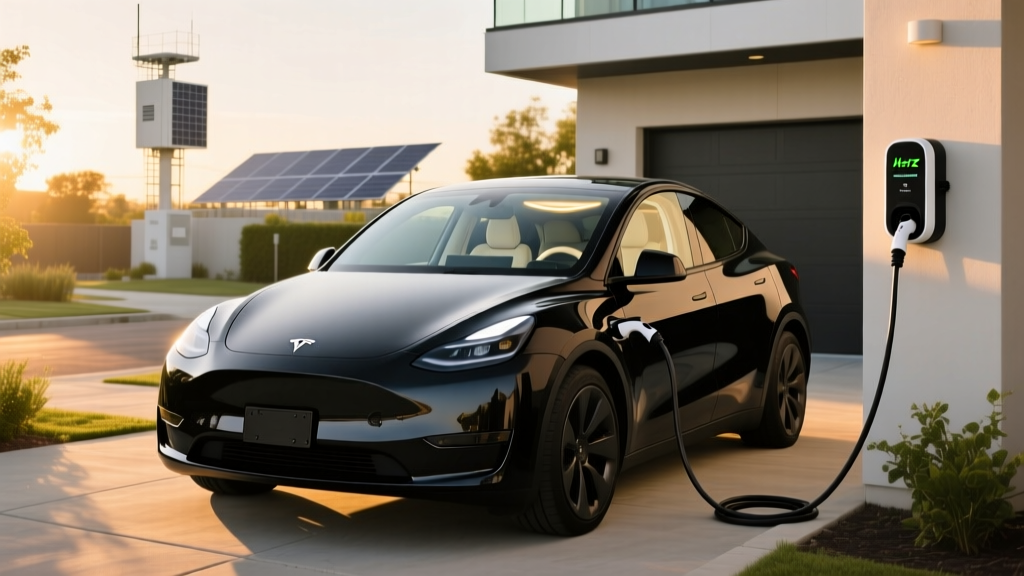
For home charging, the Model Y's onboard charger accepts up to 11.5 kW on a 240V/48A circuit (Hardwired Wall Connector). That translates to roughly 44 miles of range per hour of charging, meaning a full overnight session easily replenishes a day's driving. Installation typically costs $800–$2,000 depending on panel capacity and conduit run — factor this into your ownership budget.
Performance and Driving Impressions
The dual-motor AWD powertrain produces 384 combined horsepower and launches the Model Y from 0–60 mph in 4.8 seconds. That's sports-sedan acceleration in a family crossover — something that consistently surprises first-time EV renters at Hertz.
Regenerative braking is aggressive in the Model Y (Tesla removed the user-adjustable regen setting several years ago), enabling one-pedal driving in most city scenarios. The ride quality on the 2026 refresh is improved over earlier model years, with revised damper tuning that better absorbs sharp impacts, though it still leans firm compared to a Hyundai Ioniq 5 or Ford Mustang Mach-E.
The 2026 Model Y comes standard with Tesla's Basic Autopilot, which includes Traffic-Aware Cruise Control and Autosteer — a SAE Level 2 driver-assistance system. The driver must remain engaged with hands on the wheel at all times. Tesla's Full Self-Driving (Supervised) package, available as a $8,000 add-on or $99/month subscription, adds automated lane changes, intersection handling, and navigation-guided steering, but it remains a Level 2 system requiring continuous driver supervision — it is not autonomous driving.
Pricing, Trims, and Federal Tax Credit Eligibility
The 2026 Model Y lineup has simplified considerably. Here's how the pricing breaks down:
| Trim | MSRP | Est. After §30D Credit* | Drivetrain |
|---|---|---|---|
| Long Range AWD | $44,990 | ~$37,490 | Dual-motor AWD |
| Performance AWD | $51,490 | ~$43,990 | Dual-motor AWD |
*Federal tax credit eligibility depends on multiple IRS requirements. See checklist below.
- MSRP Cap: SUVs/crossovers must be ≤ $80,000 — both Model Y trims qualify ✅
- Buyer Income Cap: AGI ≤ $150,000 (single) / $225,000 (head of household) / $300,000 (joint) — verify with IRS guidelines
- Battery Sourcing: Critical minerals and battery components must meet phased-in domestic/free-trade-agreement thresholds — Tesla sources from multiple suppliers; confirm at point of sale
- Point-of-Sale Transfer: Eligible buyers can transfer the credit to the dealer for an immediate price reduction at purchase
- Credit Amount: Up to $7,500 if both critical-mineral AND battery-component requirements are met; $3,750 if only one is met
The point-of-sale transfer provision is a game-changer for cash-flow-conscious buyers: instead of waiting until tax filing to claim the credit, eligible buyers can take the reduction directly off the purchase price. Consult a tax professional to confirm your specific eligibility — income limits, sourcing requirements, and annual phase-in thresholds shift and vary by buyer.
Interior Space, Cargo, and Daily Practicality
The Model Y's crossover form factor is why Hertz stocks it heavily — it fits families and luggage. Here's how the space breaks down:
- Cargo (rear seats up): 30.2 cu ft
- Cargo (rear seats folded): 72.1 cu ft
- Front trunk (frunk): 4.1 cu ft
- Rear legroom: 41.6 inches
- Front headroom: 41.0 inches
- Seating: 5-passenger standard (7-seat option discontinued for 2026)
The 15.4-inch center touchscreen handles all infotainment, climate, and vehicle settings — there are no physical buttons for climate or audio, which some renters love and others find distracting. The 2026 model year includes an updated processor for faster UI response and improved voice recognition. Wireless phone charging, a 17-speaker audio system, and a panoramic glass roof are standard.
Notable drawback: the all-glass roof provides no shade panel, and in hot climates, cabin heat soak through the roof is a real comfort issue. Aftermarket shade inserts are a popular owner accessory.
- Supercharger network reliability
- 320-mile EPA range
- Strong acceleration (4.8s 0–60)
- Over-the-air updates improve the car over time
- Point-of-sale tax credit transfer available
- Class-leading cargo space for the segment
- No physical climate or volume controls
- Glass roof heat soak in summer
- Higher insurance premiums vs. rivals
- FSD subscription adds significant cost
- Firm ride on rough pavement
- Real-world highway range ~260–280 mi, not 320
Model Y vs. Key Competitors: Is It Worth Buying?
If you're cross-shopping after a Hertz Tesla rental, the Model Y's most direct rivals include the Hyundai Ioniq 5, Ford Mustang Mach-E, and Chevrolet Equinox EV. Here's how they stack up on the metrics that matter:
| Model | EPA Range | Peak DC kW | 10–80% Time | Starting MSRP |
|---|---|---|---|---|
| Tesla Model Y LR AWD | 320 mi | 250 kW | ~25 min | $44,990 |
| Hyundai Ioniq 5 (AWD LR) | 290 mi | 240 kW | ~18 min | $46,500 |
| Ford Mustang Mach-E (ER AWD) | 305 mi | 150 kW | ~36 min | |
| Chevy Equinox EV (RS AWD) | 307 mi | 150 kW | ~34 min | $43,900 |
The Model Y's edge remains the Supercharger network — still the most reliable and widely available DC fast-charging ecosystem in North America, even as NACS adoption expands access for rival brands. The Ioniq 5 charges faster on paper (18 minutes 10–80%), but Tesla's network uptime and plug-and-charge simplicity are hard to replicate at Electrify America or EVgo stations.
The Mach-E offers a more traditional cockpit layout with physical controls and a more compliant ride, while the Equinox EV undercuts on price. But if your Hertz rental showed you the value of seamless long-distance charging, the Model Y still owns that use case.
Who Should Buy the Model Y (and Who Shouldn't)
- You frequently take road trips and value Supercharger network access
- You want strong acceleration in a practical family crossover
- You have home Level 2 charging and can exploit cheap overnight electricity
- You qualify for the full §30D credit, bringing effective price below $38,000
- You live in an apartment without charging access (public charging costs add up fast)
- You prefer physical buttons and a traditional instrument cluster
- You need more than 30 cu ft of cargo space with seats up (consider the Kia EV9 or Rivian R1S)
- Insurance premiums in your state push total cost of ownership above a hybrid alternative
Frequently Asked Questions
What is the real-world range of the 2026 Tesla Model Y?
The EPA rates the Model Y Long Range AWD at 320 miles. In real-world highway driving at 70–80 mph, expect 260–280 miles. In cold weather below freezing, plan for 220–250 miles. City and mixed driving with regenerative braking recovers more energy, typically yielding 290–310 miles.
How fast does the Model Y charge at home and on the road?
At home on a 240V/48A Level 2 circuit, the Model Y charges at 11.5 kW, adding roughly 44 miles of range per hour — a full overnight session covers most daily needs. On a Tesla V3/V4 Supercharger, it peaks at 250 kW and charges from 10–80% in approximately 25 minutes. Note that charging slows significantly above 80% to protect battery health.
How much does the Model Y cost after the federal tax credit?
The Long Range AWD starts at $44,990. If you meet all §30D requirements — income caps, MSRP cap (under $80K for SUVs), and battery-sourcing thresholds — the credit can reduce your effective cost to approximately $37,490 via point-of-sale transfer. Verify eligibility at irs.gov and with your tax professional before purchasing.
Does the Tesla Model Y qualify for the $7,500 federal EV tax credit?
The Model Y qualifies for up to $7,500 under §30D, but the actual amount depends on whether the vehicle meets both the critical-mineral and battery-component sourcing requirements for the 2026 model year, and whether the buyer falls under the income caps ($150K single / $300K joint filing). The MSRP is well under the $80,000 SUV cap. Always confirm current sourcing compliance at the point of sale.
Is the Model Y worth buying over the Ioniq 5 or Mach-E?
If road-trip charging reliability is your priority, the Model Y's Supercharger access gives it a tangible edge. The Ioniq 5 charges faster on compatible chargers and offers a more comfortable ride. The Mach-E has a more intuitive interior. Test-drive all three, but weigh your local charging infrastructure and typical driving patterns heavily in the decision.
Can I use non-Tesla chargers with the Model Y?
Yes. The 2026 Model Y uses the NACS (North American Charging Standard) connector natively. Tesla also provides or sells a CCS adapter for use on Electrify America, EVgo, and other CCS-equipped networks. As more networks add NACS cables in 2025–2026, adapter-free charging on non-Tesla networks is expanding.
What's the battery warranty on the Model Y?
Tesla covers the Model Y's battery and drive unit for 8 years or 120,000 miles, whichever comes first, with a guaranteed minimum 70% capacity retention over that period. NMC chemistry in Tesla's thermal management system has shown strong longevity data, with most packs retaining 85–90% capacity at 100,000 miles based on fleet and owner-reported data.