The Short Answer on Flaunt Electric Bikes vs. Electric Cars
If your daily commute is under 15 miles round-trip and you have secure bike storage, a Flaunt electric bike (priced around $1,400–$1,800, 25–40 miles of range, ~$0.01/mile energy cost) can realistically replace a car for that single trip. However, if you need year-round all-weather capability, cargo/passenger capacity, highway travel, or trips longer than 20 miles, a compact EV like the 2026 Chevy Equinox EV (EPA 319 miles, starting near $33,600 before incentives) or a plug-in hybrid remains the practical choice. Most buyers use Flaunt e-bikes as a supplement to an EV or hybrid, not a full replacement.
Searches for "Flaunt electric bikes" tend to come from commuters weighing whether an e-bike can eliminate a second car — or even their only car. As someone who has owned both EVs and commuter e-bikes, I'll run the actual math here: purchase cost, energy cost per mile, insurance, maintenance, weather limitations, and what happens when your commute isn't a straight bike-lane shot. AutoEdgeView focuses on four-wheeled EVs, so this article frames Flaunt e-bikes strictly as a comparison baseline against electric and plug-in-hybrid cars for the commute use case.
Flaunt Electric Bikes at a Glance: What the Specs Actually Mean
Flaunt's lineup (the Spark, Flash, and Falcon models) sits in the affordable commuter e-bike category. Here's what the numbers look like in practice:
- Motor: 350W–500W rear hub (Class 2/Class 3 depending on model — max assisted speed 20–28 mph)
- Battery: ~360–500 Wh (watt-hours, the e-bike equivalent of kWh in a car)
- Claimed range: 25–40 miles on pedal-assist; expect 18–28 miles if you're heavier, riding into wind, or using throttle-only
- Charge time: ~3–5 hours on a standard 120V wall outlet (no special installation needed)
- Purchase price: ~$1,400–$1,800 direct
- Weight: ~45–55 lbs
For context, the 2026 Chevy Equinox EV carries a 85 kWh (usable) NMC battery with an EPA-rated 319 miles of range, 213 HP, and DC fast charging that peaks around 150 kW (10–80% in roughly 30 minutes). The energy scales are radically different — an e-bike battery holds about 0.4 kWh versus 85 kWh in the Equinox — which is exactly why the cost-per-mile math diverges so dramatically.
Cost Comparison: Flaunt E-Bike vs. EV vs. Gas Car vs. PHEV
Below is a five-year, 7,500-mile-per-year (37,500-mile total) ownership comparison for a 10-mile round-trip commute. Energy costs assume $0.16/kWh electricity and $3.40/gallon regular gas.
| Cost Category | Flaunt E-Bike | 2026 Chevy Equinox EV | 2026 Toyota Prius PHEV | 2024 Honda Civic (Gas) |
|---|---|---|---|---|
| Purchase / MSRP | $1,600 | $33,600 | $32,975 | $24,950 |
| Federal tax credit (§30D) | $0 | Up to $7,500* | Up to $3,750* | $0 |
| Energy / fuel (5 yrs, 37.5k mi) | ~$96 | ~$2,160 | ~$1,400 (mix) | ~$3,970 |
| Maintenance (5 yrs) | ~$400 | ~$1,200 | ~$1,800 | ~$2,400 |
| Insurance (5 yrs avg.) | ~$600 (rider) | ~$9,000 | ~$8,200 | ~$7,800 |
| Estimated 5-yr total | ~$2,696 | ~$28,460** | ~$30,625** | ~$39,120 |
*§30D credit eligibility depends on MSRP caps, buyer AGI limits, battery sourcing, and point-of-sale transfer rules. Confirm at IRS.gov before purchase. E-bikes currently do not qualify for federal credits; some states/localities offer small rebates.
**EV and PHEV totals exclude depreciation, which typically adds another 40–55% of purchase price over 5 years — but applies equally to resale offset.
The e-bike's per-mile energy cost is roughly $0.0026/mile (20 Wh/mi × $0.16/kWh). The Equinox EV comes in around $0.058/mile (360 Wh/mi ÷ 1,000 × $0.16). The gas Civic costs $0.106/mile at 32 MPG combined. So the EV is roughly 22× more expensive per mile than the e-bike, but still half the cost of gas — and the e-bike only works for short, fair-weather trips.
EV vs. Gas vs. E-Bike: Where Each Actually Wins
| Factor | Flaunt E-Bike | Battery EV | PHEV | Gas Car |
|---|---|---|---|---|
| Sub-15-mi commute cost | ✅ Lowest | Low | Low (EV mode) | Highest |
| All-weather / winter | ❌ Poor | ✅ Good (heat pump helps) | ✅ Good | ✅ Good |
| Highway / long trip | ❌ No | ✅ Yes | ✅ Yes | ✅ Yes |
| Cargo / passengers | ❌ Minimal | ✅ Full | ✅ Full | ✅ Full |
| Home "refuel" ease | ✅ Any 120V outlet | ⚠️ Needs 240V Level 2 install ($800–$2,000) | ⚠️ Same as EV + gas station | Gas station only |
| Cold-weather range loss | ~30–40% | ~20–30% | Engine covers heat | Minimal MPG loss |
| Tax credit eligible | ❌ | ✅ Up to $7,500 | ✅ Up to $3,750 | ❌ |
Real-World Ownership Considerations Most Reviews Skip
Spec sheets lie by omission. Here's what actually shapes daily life with either option:
Home charging access isn't guaranteed for either
An e-bike battery can charge from any standard 120V outlet — a huge advantage for apartment dwellers, if your landlord allows indoor battery storage (many don't, due to lithium fire risk). For an EV, Level 2 home charging requires a 240V circuit; installation typically runs $800–$2,000 if your panel has capacity, but a 200-amp panel upgrade can push costs to $3,500–$5,000. Street-parking EV owners in cities remain dependent on public chargers, where per-kWh costs often hit $0.40–$0.60, erasing much of the home-charging savings.
Cold weather hits e-bikes harder than EVs
Lithium-ion batteries lose usable capacity in the cold, and e-bike batteries lack the active thermal management systems that EVs use. Expect a Flaunt e-bike's 30-mile summer range to drop to 18–22 miles at 30°F, compounded by heavier clothing and slower riding. EVs also lose 20–30% of EPA range in freezing temps (per fueleconomy.gov), but preconditioning while plugged in recovers much of that loss.
Insurance and theft are real line items
E-bikes are theft magnets — a Flaunt left on a street rack is a target. Most homeowners/renters policies cap bike coverage at $1,500–$2,500; dedicated e-bike insurance (from providers like Velosurance or Sundays) runs $100–$300/year. EV insurance premiums currently run 15–25% higher than comparable gas cars, according to industry data, partly due to repair costs for aluminum structures and battery packs.
The "second vehicle" math
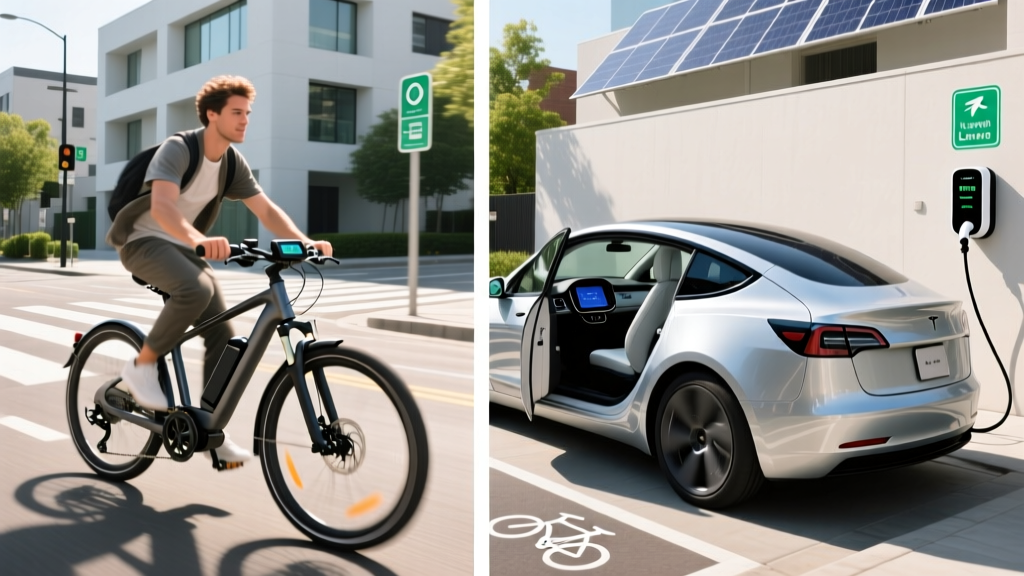
The strongest case for a Flaunt e-bike isn't replacing your only car — it's replacing a second car. A household with one EV and one e-bike can handle most two-commuter scenarios while avoiding the $6,000–$10,000/year cost of insuring, maintaining, and depreciating a second vehicle.
Common Misconceptions, With Facts
| Myth | Fact |
|---|---|
| "An e-bike replaces my car entirely." | Only for ~15% of U.S. commuters (per Census data) whose trips are <10 miles, solo, and fair-weather. |
| "EVs are more expensive to own than gas cars." | Over 5 years and 75k miles, most EVs beat gas on total cost — especially with §30D credit and home charging. But upfront MSRP and insurance remain higher. |
| "E-bikes don't need a helmet or insurance." | Class 3 e-bikes (28 mph) require helmets in most states; liability in a car-bike collision can exceed any policy limit without coverage. |
| "EV batteries die in 5 years." | Modern NMC/LFP packs retain 85–92% capacity at 100k miles; federal warranty mandates 8 years / 100,000 miles minimum on battery and powertrain. |
| "I can charge an EV from a regular outlet." | Level 1 (120V) adds ~3–5 miles per hour — workable for <30-mile daily commutes but inadequate for most drivers. Level 2 (240V) adds 25–40 miles/hour. |
Decision Framework: Which Should You Actually Buy?
Buy a Flaunt (or similar) e-bike IF:
- Your one-way commute is ≤8 miles with protected bike infrastructure
- You already own or plan to own a primary vehicle for long trips and bad weather
- You have secure indoor storage at both home and work
- You want to cut a second-car budget by $6k–$10k/year
- You live in a mild climate (rarely below 35°F or above 95°F on commute days)
Buy an EV (Equinox EV, Tesla Model 3, Hyundai Ioniq 5, etc.) IF:
- You need a primary vehicle for year-round, all-weather use
- You can install Level 2 charging at home OR work near reliable public DC chargers
- You regularly carry passengers, groceries, or gear
- Your annual mileage exceeds 8,000 miles (fuel savings compound)
- You qualify for the §30D credit based on AGI, MSRP cap, and battery sourcing
Buy a PHEV (Prius Prime, RAV4 Prime, etc.) IF:
- Your commute fits the EV-only range (25–45 miles) but you take monthly long trips
- You lack reliable public charging for road trips
- You live in a very cold climate where EV range loss hurts more
Consider neither (keep your current car) IF:
- Your current vehicle is a recent, efficient hybrid or small gas car paid off and running well
- You lack home charging access and public infrastructure in your area is sparse
Frequently Asked Questions
Do Flaunt electric bikes qualify for the federal EV tax credit?
No. The IRS §30D credit applies only to four-wheeled plug-in vehicles meeting battery sourcing, MSRP, and buyer income requirements. Two-wheeled e-bikes are excluded. Some states (California, Colorado, Massachusetts) and local utilities offer e-bike rebates of $200–$1,000 — check your state energy office.
How does the real-world range of a Flaunt e-bike compare to the sticker claim?
Expect about 70–80% of the advertised range in typical use. A 40-mile claimed range becomes ~28–32 miles with a 180-lb rider, moderate pedal-assist, and mixed terrain. Throttle-only mode can cut range in half. EVs show a similar pattern: the EPA 319-mile Equinox EV typically delivers 250–280 miles on highway trips at 70 mph, and less in freezing weather.
Is an e-bike actually safer than a car for commuting?
No. Per NHTSA data, cyclist fatalities per mile traveled are orders of magnitude higher than for car occupants, even accounting for infrastructure improvements. Protected bike lanes narrow the gap but don't eliminate it. If safety is your top priority, a modern EV with automatic emergency braking and strong IIHS crash ratings is the safer choice.
Can I use a Flaunt e-bike in winter?
Yes, but with tradeoffs: range drops 30–40%, traction on ice is poor even with studded tires, and road salt accelerates drivetrain wear. Most e-bike commuters in northern states switch to transit, an EV, or a PHEV from December through March.
What's the actual cost per mile to charge an EV at home vs. an e-bike?
At $0.16/kWh: an efficient e-bike uses ~20 Wh/mile = $0.003/mile; an efficient EV like the Ioniq 5 uses ~300 Wh/mile = $0.048/mile; a 32-MPG gas car at $3.40/gallon = $0.106/mile. The e-bike wins on pure cost, but only for trips it can physically handle.
Should I buy an e-bike AND an EV?
This is often the optimal setup for two-adult households. Use the e-bike for short solo commutes in fair weather, and the EV for everything else. The combined energy cost per household-mile drops significantly versus owning two gas cars, while preserving all-weather and long-trip capability.
Sources: IRS §30D Clean Vehicle Credit rules, EPA fueleconomy.gov for 2026 model-year range/MPGe data, manufacturer spec sheets for Chevy Equinox EV, Toyota Prius Prime, and Flaunt e-bikes.