The Quick Answer
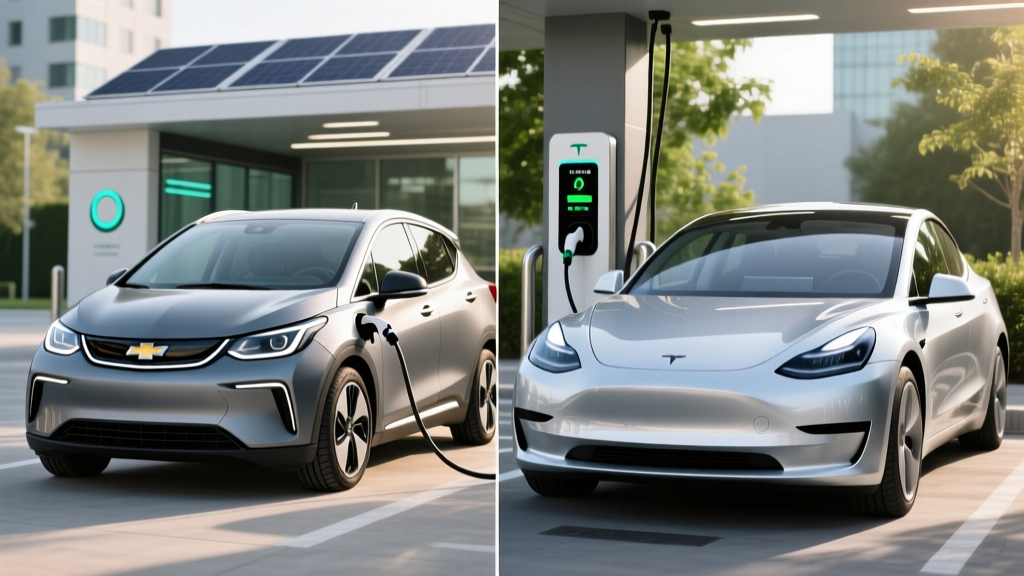
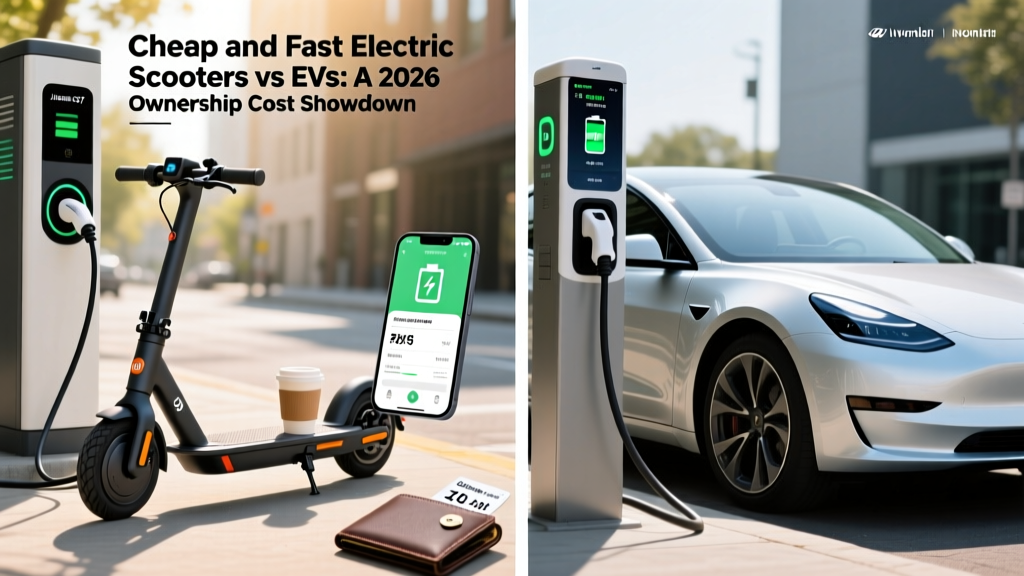
Cheap and fast electric scooters (typically $800–$2,500, 25–40 mph top speed, 20–50 mile range) excel for solo urban commutes under 15 miles round-trip. But they cannot replace a car for families, highway travel, cargo, cold-weather commuting, or rideshare work. A used EV like a 2023 Chevrolet Bolt EV ($18,000–$22,000 used) or a new 2026 Nissan Leaf ($29,990 base) delivers 150–250 miles of EPA range, climate control, safety structure, and cargo space — at a per-mile energy cost nearly identical to a scooter when charged at home. The right choice depends on your commute distance, household size, climate, and whether you need a vehicle that works year-round in all conditions.
What "Cheap and Fast" Actually Gets You in 2026
The electric scooter market has stratified sharply. Budget models from brands like Segway-Ninebot, Apollo, and NIU cluster around $800–$1,500 with 350–500W motors, 20–30 mile real-world range, and 20–25 mph top speeds. The "fast" tier ($1,500–$2,500) pushes 500–1,000W motors, 30–50 mile range, and 25–40 mph — but at these speeds, most U.S. jurisdictions classify them as motor vehicles requiring registration, insurance, and sometimes a license.
Battery capacity on these scooters typically runs 0.36–1.0 kWh (lithium-ion, usually NMC chemistry). That's roughly 1/60th to 1/80th the energy stored in a mainstream EV battery. Charging happens on a standard 120V outlet in 4–8 hours via the included brick charger — no Level 2 installation required. Peak charge rates hover around 100–200W, meaning a full charge costs roughly $0.05–$0.12 at the U.S. average electricity rate of $0.17/kWh (EIA, 2025).
Scooter vs EV vs Gas Car: The Numbers Side by Side
To make a fair comparison, let's stack a representative fast electric scooter against an affordable new EV and an efficient gas compact car across the metrics that matter for daily commuting.
| Metric | Fast E-Scooter ($1,800) | 2026 Nissan Leaf S ($29,990) | 2026 Honda Civic LX ($25,000) |
|---|---|---|---|
| Upfront Cost | $1,800 | $29,990 (MSRP) | $25,000 (MSRP) |
| EPA / Real Range | ~35 mi (real-world) | 212 mi EPA / ~170 mi hwy | 330 mi (31 mpg combined) |
| Energy / Fuel Cost per Mile | ~$0.006 | ~$0.045 (home charging) | ~$0.11 (at $3.40/gal) |
| Top Speed | 30–40 mph | 90+ mph (electronically limited) | 118 mph |
| Charge / Refuel Time | 5–7 hours (full) | 10–80% in ~45 min (DC fast) | ~5 minutes |
| Cargo Capacity | Backpack only (~0.5 cu ft) | 23.6 cu ft (trunk) | 14.8 cu ft (trunk) |
| Passengers | 1 | 5 | 5 |
| Climate Control | None | Heat pump HVAC | Standard HVAC |
| Annual Insurance (avg.) | $0–$200 (optional) | $1,400–$1,800 | $1,200–$1,500 |
| Federal Tax Credit (§30D) | Not eligible | Up to $7,500 (eligibility varies) | Not eligible |
| 5-Year Maintenance | ~$300 (tires, brakes) | ~$1,200 (tires, cabin filter, fluid) | ~$3,500 (oil, brakes, tires, filters) |
Sources: fueleconomy.gov (2026 Nissan Leaf), manufacturer specifications, EIA fuel cost data. Tax credit eligibility depends on income, MSRP caps, and battery sourcing — verify at irs.gov.
The Real 5-Year Cost of Ownership
Upfront price tells only part of the story. Let's project five years of commuting 15 miles round-trip, 250 days per year (3,750 miles annually), with home electricity at $0.17/kWh and gas at $3.40/gallon.
| Cost Category (5 Years) | E-Scooter | Nissan Leaf (EV) | Honda Civic (Gas) |
|---|---|---|---|
| Purchase Price | $1,800 | $29,990 | $25,000 |
| Federal Tax Credit | $0 | –$3,750 to –$7,500* | $0 |
| Energy / Fuel | $225 | $1,688 | $4,412 |
| Insurance | $500 | $8,000 | $6,750 |
| Maintenance | $300 | $1,200 | $3,500 |
| Depreciation (est.) | $1,200 | $12,000 | $10,000 |
| Total 5-Year Cost | $4,025 | $26,878–$30,628 | $39,662 |
| Cost per Mile | $0.11 | $0.72–$0.82 | $1.06 |
*§30D credit varies by buyer income (phase-out above $150K single / $300K joint), vehicle MSRP caps ($55K cars), and battery critical-mineral sourcing requirements. Always confirm eligibility with a tax professional and irs.gov.
The scooter wins on pure cost — but only if it can actually handle your daily needs. The gap narrows considerably when you factor in a scooter's battery replacement ($200–$500 at year 3–4 as capacity degrades to 70–80% of original), potential theft loss, and zero crash protection.
Where Scooters Fail: Real-World Ownership Limitations
Marketing materials for cheap and fast electric scooters rarely mention the conditions that make them impractical for many U.S. commuters:
| Common Claim | Real-World Reality |
|---|---|
| "40-mile range!" | Expect 55–70% of that at full speed, with a 180+ lb rider, on hills, or in wind. Real-world range on a 40-mi rated scooter is often 22–28 miles. |
| "Charges overnight!" | True, but at 100–200W charge rates, a depleted 1.0 kWh battery takes 5–8 hours. You cannot opportunity-charge quickly. |
| "Replaces a car!" | Only for solo, fair-weather, short-distance commuting. No rain protection, no cargo, no passengers, no highway access, no winter usability in most climates. |
| "Zero maintenance!" | Tires wear fast on heavy scooters (1–2 replacements/year at $30–$60 each). Brake pads, bearings, and controller electronics fail. Battery degradation is real. |
| "Street-legal everywhere!" | Scooters above 20 mph or 750W are classified as mopeds or motorcycles in many states, requiring registration, insurance, helmet laws, and sometimes a motorcycle endorsement. |
What a First-Time EV Buyer Should Know Instead
If your commute exceeds 15 miles round-trip, you carry passengers or cargo regularly, you live in a climate with real winter, or you need a single vehicle that does everything — an EV is the practical upgrade path. Here's what matters in 2026:
- Home charging is the make-or-break factor. Level 1 (120V) adds 3–5 miles of range per hour — fine for overnight charging on commutes under 40 miles. Level 2 (240V, 7–11.5 kW) adds 25–45 miles per hour and requires a dedicated 40–60A circuit. Professional installation runs $500–$2,500 depending on panel capacity and run length.
- Real-world range is 75–85% of EPA in cold weather. A 250-mile EPA EV may deliver 185–200 miles at 25°F with cabin heat. Heat pumps (standard on most 2026 models) reduce but don't eliminate this loss.
- DC fast charging curves taper above 80%. A "200 kW peak" charger may sustain that rate only from 10–50% SoC, then taper to 50–80 kW. Plan 10–80% stops, not 0–100%.
- The §30D tax credit is not guaranteed. Battery sourcing rules, MSRP caps ($55K for cars, $80K for SUVs/trucks), and buyer income limits all apply. Point-of-sale transfer is available, reducing your dealer price directly — but verify eligibility before signing.
- Used EVs offer massive value. A 2023 Bolt EV with 30K miles and 259-mile EPA range sells for $18,000–$22,000. The used-EV credit (§25E) offers up to $4,000 on vehicles priced under $25,000.
Decision Framework: Scooter, EV, or Something Else?
Choose a cheap and fast electric scooter if:
- Your round-trip commute is under 15 miles on surface streets
- You have secure storage (garage, indoor parking) to prevent theft
- You live in a mild climate (rarely below 40°F, minimal rain/snow)
- You already own or have access to a car for longer trips and bad weather
- You're a solo commuter with no passenger or cargo needs
- Your budget is strictly under $2,500
Choose an affordable EV (new or used) if:
- Your commute exceeds 15 miles or includes highway segments
- You need year-round, all-weather transportation
- You carry passengers, groceries, or gear regularly
- You can install Level 2 charging at home or have reliable workplace charging
- You want NHTSA crash-test safety, airbags, and structural protection
- You qualify for the §30D or §25E tax credit, reducing effective cost by $4,000–$7,500
Choose a PHEV (plug-in hybrid) if:
- You have a short commute (20–40 miles) that fits electric-only range
- You take regular road trips where charging infrastructure is sparse
- You lack reliable home charging but want some electric driving
- Models like the 2026 Toyota RAV4 Prime (42 mi electric, 38 mpg gas) or Hyundai Tucson PHEV (33 mi electric) bridge both worlds
Frequently Asked Questions
Do I need a license to ride a fast electric scooter?
It depends on your state and the scooter's power. In most states, scooters under 750W and 20 mph are classified as bicycles or "low-speed electric bicycles" and require no license. Above those thresholds — which most "fast" scooters exceed — they may be classified as mopeds or motorcycles, requiring registration, insurance, a driver's license, and sometimes a motorcycle endorsement. Check your state DMV before purchasing.
How long do electric scooter batteries last before replacement?
Most scooter batteries (NMC lithium-ion) are rated for 500–800 full charge cycles before degrading to 80% capacity. At one charge per day, that's roughly 1.5–2.5 years of daily use before you'll notice meaningful range loss. Replacement batteries cost $200–$500 depending on the model. By comparison, EV batteries are warranted for 8 years / 100,000 miles and typically retain 85–90% capacity at that point.
Is it cheaper to charge a scooter or an EV at home?
Per mile, the scooter is cheaper — roughly $0.006/mile vs. $0.04–$0.05/mile for an EV. But the scooter's range is 1/7th to 1/10th of an EV's, and its per-mile cost advantage disappears when you factor in insurance, depreciation, and the fact that a scooter can't replace a car for most households. The EV's higher per-mile energy cost still translates to $500–$800/year in electricity — far less than $1,200–$1,800/year in gas for a comparable compact car.
Can I ride an electric scooter in the rain or winter?
Most scooters carry an IP54 or IP65 water-resistance rating, meaning they handle light rain but not submersion or heavy downpours. Wet roads dramatically reduce tire grip on small scooter wheels, making braking hazardous. In winter, lithium-ion scooter batteries lose 20–40% capacity below freezing, and icy roads make two-wheeled travel dangerous. EVs, with their enclosed cabins, heated batteries, traction control, and all-wheel-drive options, remain practical year-round.
What's the cheapest EV that actually makes sense in 2026?
The 2026 Nissan Leaf S starts at $29,990 with 212 miles of EPA range and qualifies for up to $7,500 in §30D credit (if you meet income and sourcing requirements), potentially bringing effective cost below $23,000. On the used market, a 2023 Chevrolet Bolt EV (259 mi EPA) sells for $18,000–$22,000 and may qualify for the $4,000 used-EV credit (§25E). Both offer dramatically more capability, safety, and range than any scooter.