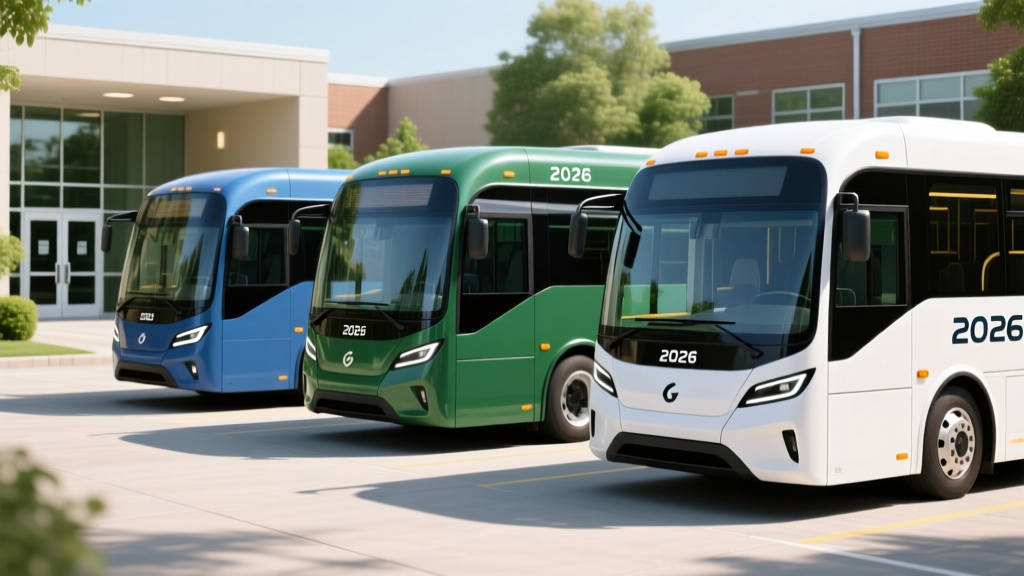
Quick Answer: The dominant electric school bus brands in the U.S. for the 2026 model year are Blue Bird (Vision Electric and All American RE Electric), Thomas Built Buses (Saf-T-Liner EFX and C2 Electric), and IC Bus (CE Series Electric). Newer entrants include Lion Electric (LionC) and GreenPower Motor Company (BEAST and Nano BEAST). Expect 100–155 miles of EPA-estimated range, 150–195 kWh battery packs (mostly NMC chemistry), DC fast charging at 60–150 kW, and base pricing between $230,000 and $390,000 before federal and state incentives. Total cost of ownership (TCO) over 12 years typically undercuts a comparable diesel bus by $80,000–$170,000 when factoring fuel, maintenance, and EPA Clean School Bus Program grants.
Who Makes Electric School Buses? The 2026 Brand Landscape
School districts evaluating fleet electrification face a narrower but increasingly mature market than consumer EV buyers. Five manufacturers account for the vast majority of electric school buses delivered or on order in North America as of 2026. Unlike consumer EVs, these vehicles are classified as medium- and heavy-duty (Class 5–8), meaning they do not qualify for the IRS §30D consumer tax credit. Instead, they rely on the EPA Clean School Bus Program, state-level voucher incentive programs (such as California's HVIP and New York's Truck Voucher Incentive Program), and the Qualified Commercial Clean Vehicle credit under IRC §45W, which can offset up to $40,000 per vehicle for qualifying commercial fleets.
Here is how the major electric school bus brands stack up across the metrics fleet managers actually use to make procurement decisions.
| Brand / Model | Type | Battery (kWh usable) | EPA Est. Range (mi) | DC Fast Charge (kW peak) | 10–80% Charge Time | GVWR / Class | Base MSRP (est.) |
|---|---|---|---|---|---|---|---|
| Blue Bird Vision Electric | Type C (Conventional) | 155 kWh (NMC) | ~130 | 150 kW | ~60 min | Class 6–7 | $289,000 |
| Blue Bird All American RE Electric | Type D (Transit-Style) | 195 kWh (NMC) | ~155 | 150 kW | ~75 min | Class 8 | $385,000 |
| Thomas Saf-T-Liner EFX Electric | Type D (Transit-Style) | 180 kWh (NMC) | ~140 | 120 kW | ~70 min | Class 7–8 | $370,000 |
| Thomas C2 Electric | Type C (Conventional) | 150 kWh (NMC) | ~120 | 120 kW | ~65 min | Class 6–7 | $275,000 |
| IC Bus CE Series Electric | Type C (Conventional) | 210 kWh (NMC) | ~135 | 60 kW | ~120 min | Class 6–7 | $295,000 |
| Lion Electric LionC | Type C (Conventional) | 155 kWh (NMC) | ~125 | 150 kW | ~60 min | Class 6–7 | $265,000 |
| GreenPower BEAST (Type D) | Type D (Transit-Style) | 195 kWh (NMC) | ~150 | 120 kW | ~75 min | Class 7–8 | $355,000 |
| GreenPower Nano BEAST | Type A (Small/SPED) | 85 kWh (NMC) | ~100 | 60 kW | ~55 min | Class 4–5 | $230,000 |
Source: Manufacturer spec sheets, EPA Clean School Bus Program awardee data. Range figures are EPA-estimated; real-world range varies significantly based on temperature, terrain, passenger load, HVAC use, and stop frequency. Expect 15–30% range reduction in cold climates (below 25°F) with cabin heating active.
Electric vs. Diesel School Bus: Total Cost of Ownership
The upfront price gap is real: a new diesel Type C school bus costs roughly $110,000–$130,000, while an electric equivalent runs $265,000–$295,000. But school buses are typically held for 12–15 years and accumulate 120,000–180,000 miles, which is where the economics flip. Diesel fuel, diesel exhaust fluid (DEF), oil changes, particulate filter replacements, and transmission servicing add up relentlessly. Electric buses eliminate most of those line items.
| Cost Category | Diesel Bus | Electric Bus | Difference |
|---|---|---|---|
| Vehicle Purchase (MSRP) | $120,000 | $289,000 | +$169,000 (electric) |
| EPA Clean School Bus Grant (applied) | $0 | –$285,000* | –$285,000 (electric) |
| Net Purchase After Incentive | $120,000 | $4,000 | –$116,000 (electric) |
| Fuel / Electricity (150k mi) | $78,000 (diesel @ ~$4.10/gal, 6.5 mpg) | $22,500 (~$0.15/kWh, 2.1 kWh/mi) | –$55,500 (electric) |
| Maintenance (12 years) | $52,000 | $18,000 | –$34,000 (electric) |
| DEF, Oil, Filters, Trans. Service | $14,000 | $0 | –$14,000 (electric) |
| Charging Infrastructure (bus share) | $0 | $35,000 | +$35,000 (electric) |
| Insurance (12 years) | $30,000 | $34,000 | +$4,000 (electric) |
| Total 12-Year TCO | $294,000 | $113,500 | –$180,500 (electric) |
*EPA Clean School Bus Program rebates vary by district priority (Title I, rural, tribal districts receive priority). Maximum rebate for a zero-emission bus was $285,000 in recent funding rounds. Not all applicants receive maximum awards. Check epa.gov/cleanschoolbus for current funding availability.
Even without maximum grant awards, the break-even point for an electric school bus vs. diesel typically arrives between years 5 and 8 depending on annual mileage, local electricity rates, and diesel prices. Districts running routes under 80 miles per day with depot charging see the fastest payback.
Real-World Range: What the EPA Sticker Doesn't Tell You
EPA Sticker vs. Real-World Range Reality
A Blue Bird Vision Electric rated at ~130 miles EPA will typically deliver:
- Spring/Fall (50–75°F, mild terrain): 115–130 miles — close to sticker
- Summer with A/C (90°F+): 100–115 miles — HVAC compressor draws 5–10 kW continuous
- Winter with cabin heat (below 25°F): 85–100 miles — resistive heating can pull 15–25 kW, cutting range 25–35%
- Hilly terrain (loaded): 90–110 miles — regen recovers some downhill energy, but loaded climbs are costly
Fleet managers should plan routes assuming worst-case (winter) range and keep a 20% buffer for detours, traffic idling, and battery degradation over the bus's service life.
Most school bus routes in the U.S. are 60–90 miles per day, which means even the worst-case winter range of the largest battery packs (150+ kWh) covers the route with margin. The concern is outlier routes — rural runs exceeding 100 miles, split-shift operations where the bus runs morning and afternoon routes with no mid-day charging opportunity, and field trips or athletic transport that exceed daily patterns.
Battery degradation is a factor but manageable. NMC (nickel manganese cobalt) packs in commercial applications typically retain 80–85% of original capacity after 10 years or 2,000–3,000 charge cycles, depending on thermal management quality and charge practices. Most manufacturers warranty their traction batteries for 8 years / 100,000 miles at 70% minimum capacity retention. Districts should factor in a potential battery replacement or refurbishment cost of $40,000–$65,000 around year 10–12 if the bus remains in service beyond warranty.
Charging Infrastructure: The Hidden Line Item
Unlike consumer EVs that can rely on public DC fast-charging networks, school buses charge almost exclusively at the depot. This means the district must build or upgrade its own charging infrastructure — a capital cost that frequently catches first-time electric fleet buyers off guard.
| Component | Level 2 (19.2 kW) Per Bus | DC Fast Charger (60–150 kW, shared 2:1) |
|---|---|---|
| Charger hardware | $5,000–$8,000 | $45,000–$95,000 |
| Electrical panel / transformer upgrade | $5,000–$25,000 (shared) | $15,000–$60,000 (shared) |
| Trenching, conduit, wiring | $3,000–$12,000 | $8,000–$30,000 |
| Permits, engineering, utility interconnect | $2,000–$8,000 | $5,000–$20,000 |
| Software / charge management | $500–$1,500/yr | $1,000–$3,000/yr |
| Total per bus (allocated) | $15,000–$40,000 | $35,000–$80,000 |
Most districts use a hybrid approach: Level 2 chargers at each bus parking space for overnight charging (a full charge from 10% to 100% takes 8–10 hours at 19.2 kW), supplemented by one or two shared DC fast chargers for mid-day top-ups or route recovery. Charge management software (such as EPA-recommended fleet solutions) staggers charging to avoid peak demand charges from the utility, which can add $5,000–$15,000/year if unmanaged.
Utility coordination is critical. A depot with 10 buses charging simultaneously at 19.2 kW draws ~192 kW — roughly the load of a small commercial building. Districts should engage their utility 12–18 months before bus delivery to assess whether a new transformer, upgraded service drop, or dedicated feeder line is required. Some utilities offer make-ready programs that cover the cost of infrastructure on the utility side of the meter.
Electric School Bus vs. Diesel vs. Propane: Data Comparison
| Metric | Diesel | Propane (LPG) | Electric (BEV) |
|---|---|---|---|
| Purchase Price (MSRP) | $110,000–$130,000 | $105,000–$120,000 | $265,000–$295,000 |
| Fuel Cost Per Mile | $0.52–$0.68 | $0.30–$0.42 | $0.12–$0.20 |
| Maintenance Cost Per Mile | $0.28–$0.38 | $0.22–$0.30 | $0.08–$0.14 |
| Tailpipe Emissions | NOx, PM, CO₂ | Lower NOx/PM, CO₂ | None at tailpipe |
| Range (realistic loaded) | 450–600 mi | 350–500 mi | 85–130 mi |
| Refuel / Recharge Time | 10–15 min | 10–15 min | 4–10 hours (L2) / 1–2 hours (DCFC) |
| Noise (idle + drive) | High | Moderate | Very low |
| Cold-Weather Range Impact | Minimal (block heater) | Minimal | 15–35% loss |
| Federal Incentive Available | None | Limited | EPA CSB + §45W credit |
The range gap is the most operationally significant difference. Diesel and propane buses can handle any route in any condition without planning. Electric buses require route analysis — but since the majority of U.S. school bus routes are under 90 miles round-trip, the range is sufficient for most districts. The trade-off is planning discipline: you must know your routes, your climate, and your charging capacity.
Common Misconceptions About Electric School Buses
| Myth | Fact |
|---|---|
| "Electric buses can't handle cold weather." | Cold reduces range 15–35% and requires preconditioning, but districts in Minnesota, New York, and Massachusetts operate electric buses year-round. Route planning and battery oversizing solve this. |
| "The batteries will need replacement every 5 years." | NMC packs in school bus applications are warrantied for 8 years / 100,000 miles at ≥70% capacity. Real-world data from early adopters (2017–2019 deployments) shows 82–88% retention at year 8. |
| "Electric buses are slower and can't keep up with traffic." | Electric drivetrains produce peak torque from 0 RPM. A loaded Blue Bird Vision Electric reaches 50 mph faster than its diesel counterpart. Top speed is electronically governed to 65 mph for safety, same as diesel. |
| "Charging takes too long for school schedules." | Overnight Level 2 charging (8–10 hours) aligns perfectly with school bus duty cycles — buses are parked from ~4 PM to ~6 AM. Mid-day DC fast charging can add 50–80 miles in 30–45 minutes for split shifts. |
| "The grid can't handle a fleet of electric buses." | A 20-bus depot charging overnight at 19.2 kW each draws ~384 kW — manageable with utility coordination and smart charging software that staggers start times and avoids peak demand windows. |
| "There's no funding available." | The EPA Clean School Bus Program allocated $5 billion through 2026. Additionally, IRC §45W provides up to $40,000 per vehicle for qualifying commercial fleets. State programs (CA HVIP, NY TVIP, CO ALT Fuels) stack on top. |
Decision Framework: Should Your District Go Electric?
Use this framework to evaluate whether an electric school bus fits your operation:
Choose ELECTRIC if:
- Your daily routes are under 100 miles round-trip (covers ~80% of U.S. school bus routes)
- You have depot parking with access to utility service that can support Level 2 or DCFC infrastructure
- Your district qualifies for EPA Clean School Bus Program priority (Title I, rural, or tribal designation)
- You plan to hold buses 10+ years (maximizing TCO advantage)
- Your state offers stacking incentives (CA, NY, CO, MA, WA, NJ, MD)
- Noise and tailpipe emissions near schools are a community concern
Choose DIESEL or PROPANE if:
- Your routes regularly exceed 120 miles per day or include long field-trip/athletic routes with no charging en route
- You operate split-shift routes with less than 3 hours between runs and no DCFC infrastructure budget
- Your depot lacks utility capacity for charging and a panel/service upgrade is cost-prohibitive
- You are in a region with extremely cold winters (consistent –20°F or below) AND routes near range limits
- You cannot secure grant funding and the $150,000+ upfront premium is not absorbable
Consider a MIXED FLEET (phased approach) if:
- You want to pilot 2–5 electric buses on shorter routes while retaining diesel for long/outlier routes
- Your utility requires 18+ months for infrastructure upgrades and you want to begin procurement now
- You want to build operational experience and charging data before committing to full fleet conversion
What First-Time Electric Fleet Buyers Need to Know
Transitioning from diesel to electric is not simply swapping the vehicle. It requires simultaneous planning across procurement, facilities, utility coordination, and driver training. Here are the non-obvious realities that experienced fleet managers wish they had known before their first electric bus order:
Order lead times are long. Electric school buses are built in lower volumes than diesel. Expect 12–18 months from purchase order to delivery. Start the process — including grant applications and utility engagement — at least 24 months before you need buses in service.
Regenerative braking changes driving behavior. Electric buses recover energy during deceleration, which extends range and reduces brake wear (brake pads on electric buses often last 200,000+ miles). But drivers need training to use regen effectively rather than defaulting to the friction brake. Most manufacturers offer driver training programs as part of the purchase package.
Preconditioning is essential in cold climates. Heating the battery pack while the bus is still plugged in (before departure) preserves range that would otherwise be spent warming the pack on-route. Buses with active thermal management systems (liquid heating/cooling) perform significantly better in extreme temperatures than those relying on passive air cooling. Ask manufacturers specifically about their thermal management architecture.
Vehicle-to-Everything (V2X) is emerging. Some electric school bus models (notably the Lion LionC and select Blue Bird configurations) support bidirectional charging — the bus battery can export power to the building (V2B) or the grid (V2G) during peak demand or outages. This is still early-stage in terms of utility interconnection agreements, but districts exploring V2G should specify bidirectional-capable chargers (such as the NREL-evaluated bidirectional systems) during infrastructure procurement.
Insurance costs slightly more. Electric school buses carry higher insured values and battery replacement risk, leading to premiums roughly 10–15% higher than equivalent diesel buses. However, lower accident frequency (quieter operation, better acceleration for merging) may partially offset this over time.
Frequently Asked Questions
What is the most popular electric school bus brand in 2026?
Blue Bird holds the largest market share among electric school bus brands, driven by the Vision Electric (Type C) and All American RE Electric (Type D). Blue Bird has been the dominant player in the EPA Clean School Bus Program funding rounds. Thomas Built Buses and IC Bus (a Navistar/International brand) are the other major legacy competitors, while Lion Electric and GreenPower serve growing niches.
How long does it take to charge an electric school bus?
At a Level 2 charger (19.2 kW), a full charge from 10% to 100% takes approximately 8–10 hours for a 150–195 kWh battery pack — ideal for overnight depot charging. At a DC fast charger (150 kW peak), the same bus reaches 80% in roughly 60–75 minutes, though charging speed tapers significantly above 80% SoC to protect battery health. Most fleets rely on overnight L2 charging and use DCFC only for mid-day top-ups.
Do electric school buses qualify for the $7,500 federal tax credit?
No. The IRS §30D Clean Vehicle Credit applies only to light-duty vehicles under 14,000 lbs GVWR. School buses are Class 5–8 (16,000–33,000+ lbs GVWR). Instead, they may qualify for the IRC §45W Qualified Commercial Clean Vehicle Credit (up to $40,000 for vehicles over 14,000 lbs, subject to MSRP and sourcing requirements) and the EPA Clean School Bus Program (rebates up to $285,000+ for zero-emission buses, with priority for high-need districts). Consult a tax professional for §45W eligibility specifics.
What happens to an electric school bus battery at end of life?
School bus batteries (150–210 kWh NMC packs) can be repurposed for stationary energy storage (second-life applications) before eventual recycling. Manufacturers including Blue Bird and Lion have partnerships with battery recyclers such as Redwood Materials and Li-Cycle. Replacement cost for a new pack is approximately $40,000–$65,000 depending on capacity and chemistry, but most packs outlast the bus's first service life of 12–15 years.
Can electric school buses operate in extreme cold?
Yes, but with range penalties. Districts in Minnesota, Maine, and Canada operate electric buses in sub-zero conditions. The key is oversizing the battery (choose 195 kWh over 155 kWh for cold-climate routes), preconditioning the pack while plugged in, and using heated seats/steering (which draw far less energy than cabin air heating). Expect 25–35% range loss at 0°F compared to mild-weather range.
How does the EPA Clean School Bus Program funding work?
The EPA Clean School Bus Program distributes $5 billion in rebate funding through 2026 via periodic lottery-based application rounds. Zero-emission (electric) bus rebates can cover up to $285,000 per bus plus up to $20,000 per bus for charging infrastructure. Priority is given to high-need (Title I), rural, and tribal school districts. Applications are submitted at epa.gov/cleanschoolbus. Funding is competitive — not all applicants receive awards in every round.