What Is an Electric Railcar Mover — and Who Actually Needs One?
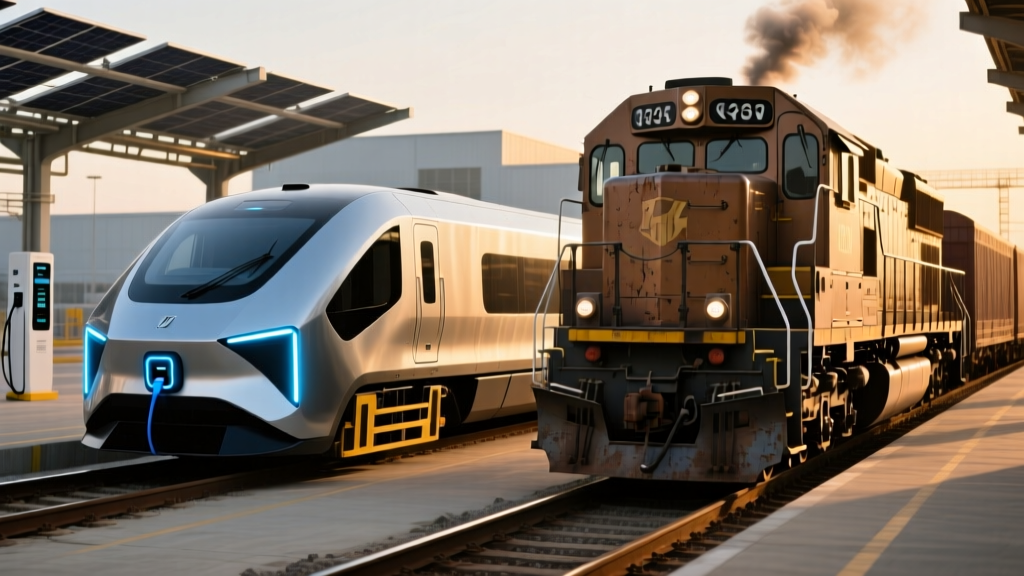
Short answer: An electric railcar mover is a battery-electric (BEV) or diesel-electric locomotive designed to switch, spot, and shuttle railcars inside yards, ports, and industrial sidings — not for mainline hauling. In 2026, heavy-duty battery-electric railcar movers (from OEMs such as Zephir, Shuttlewicket / Unimog-derived platforms, and North American suppliers like RailKing/Brandt and NRE) typically deliver 60–120 kWh of usable LFP battery capacity, 8–16 hours of yard duty per charge, and 200–350 kW of continuous tractive effort. Purchase price runs roughly $350,000–$650,000 depending on axle load and battery size, versus $275,000–$450,000 for an equivalent Tier 4 diesel switcher. Payback on fuel and maintenance alone typically lands between 4 and 7 years at 2026 diesel and industrial electricity rates.
If you've arrived here from a consumer EV search wondering whether this applies to your driveway — it doesn't. An electric railcar mover is a piece of industrial rolling stock, not a passenger vehicle. But for fleet managers, short-line operators, intermodal terminals, and heavy-industry logistics teams, the EV-versus-diesel question in 2026 is every bit as consequential as the one passenger-car shoppers face, with the same core variables: duty-cycle range, charging infrastructure, total cost of ownership, and real-world limitations that brochures gloss over.
Spec Snapshot: Battery, Tractive Effort, and Duty-Cycle Range
Unlike a highway EV measured in EPA miles, a railcar mover is measured in hours of continuous switching duty and tons of trailing load it can shove up a 1% grade. Here's what the current-generation (2025–2026 model-year) battery-electric platforms cluster around:
| Spec | Typical 2026 BEV Mover | Typical Tier 4 Diesel Mover |
|---|---|---|
| Battery / Engine | 60–120 kWh usable, LFP | 6.7–9.0 L inline-6 diesel |
| Tractive effort (continuous) | 200–350 kN | 220–380 kN |
| Duty cycle per charge/tank | 8–16 hours (light); 5–9 hours (heavy) | 16–24 hours on ~300 gal tank |
| Max speed | 15–25 mph (yard) | 15–25 mph (yard) |
| Charge / refuel time | 2–5 h (AC Level 2); ~1.5 h (DC) | 15–30 min (diesel fill) |
| Base price (2026) | $350k–$650k | $275k–$450k |
| Warranty | 5 yr / 10,000 h battery | 2–5 yr powertrain |
Real-world duty-cycle caveat: Published "16-hour shift" claims assume flat trackage, moderate car weights, and temperate ambient temperatures. In cold-weather yards (below 20°F / -7°C), expect 20–35% reduction in usable run-time due to battery internal resistance and cab/auxiliary heating loads — the same physics that cuts highway EV range, just expressed in hours instead of miles. Heavy shove cycles on graded track can halve the light-duty figure.
Electric Railcar Mover vs Diesel: The Head-to-Head Numbers
The decision framework is the same one we apply to passenger EVs — total cost of ownership over a realistic holding period — but the magnitudes are industrial. The table below models a 10-year hold, 2,500 operating hours per year, $3.80/gal off-road diesel, and $0.14/kWh industrial electricity (2026 U.S. averages):
| Cost Category (10 yr) | BEV Mover | Diesel Mover |
|---|---|---|
| Purchase price | $485,000 | $340,000 |
| Fuel / energy | $42,000 (≈ 300 MWh) | $237,500 (≈ 62,500 gal) |
| Maintenance (engine/aftertreatment vs battery) | $55,000 | $145,000 |
| Charging / refueling infrastructure | $65,000 (Level 2 + panel) | $12,000 (tank & pump) |
| Downtime cost (est.) | $18,000 | $34,000 |
| 10-year total | $665,000 | $768,500 |
| Cost per operating hour | $266 | $307 |
Two observations drive the decision. First, the BEV's upfront premium — roughly $145,000 in this model — is recovered primarily through fuel savings, not maintenance, because yard-switching duty cycles are brutally inefficient on diesel (lots of idle, low-load, high-SCR-contamination running). Second, EPA heavy-duty emissions rules and emerging port/yard zero-emission mandates (notably in California under CARB) can flip the math further by restricting diesel operation or adding aftertreatment compliance cost.
Charging a Railcar Mover: It's Not a Supercharger Problem
Forget NACS and CCS1 — industrial railcar movers almost universally charge via hard-wired three-phase AC (Level 2-equivalent, 19–50 kW) or, on newer platforms, a heavy-duty DC connection (CCS2-derived or proprietary) at 80–150 kW. You are charging a 100 kWh battery with the same infrastructure you'd use to spec a warehouse forklift fleet:
| Level | Power | 0→100% (100 kWh pack) | Typical install cost |
|---|---|---|---|
| AC 3-phase (19 kW) | 19 kW | ~5.5 hours | $25k–$45k |
| AC 3-phase (50 kW) | 50 kW | ~2.2 hours | $45k–$75k |
| DC fast (120 kW) | 120 kW | ~1.2 hours (to 90%) | $75k–$130k |
Three real-world constraints buyers miss in the brochure:
- Panel capacity. A 50 kW charger draws roughly 70 amps at 480V 3-phase. Most older industrial yards need a service upgrade or dedicated transformer — budget $15k–$40k and 8–14 weeks lead time.
- Demand charges. Industrial utilities bill on peak kW, not just kWh. A single 120 kW DC session during a billing peak can add thousands per month. Most operators spec a 19–50 kW AC charger and charge overnight on off-peak rates to avoid this.
- Cold-weather preconditioning. LFP chemistry, while durable and fire-safe, loses charge-acceptance rate below ~40°F. Budget for a heated storage track or cab-block heater, or your 2-hour charge becomes a 4-hour charge in January.
Tax Credits, Incentives, and What Actually Applies
The federal §30D clean-vehicle credit that passenger EV buyers know — up to $7,500 with MSRP, income, and critical-mineral sourcing rules — does not apply to railcar movers. These machines fall under different incentive programs:
- IRC §45W — the Commercial Clean Vehicle Credit — can apply to qualifying off-road and industrial electric equipment, subject to MSRP and domestic-content rules. Consult a tax professional; the statute's applicability to rail equipment is fact-specific.
- EPA DERA / state port-electrification grants — California's CARB, the Port of Los Angeles, NY/NJ PANYNJ, and similar authorities regularly issue RFPs subsidizing 40–75% of BEV switcher acquisition.
- Utility make-ready programs — many investor-owned utilities will fund the wiring and conduit to your charger pad at no cost, reducing the $65k infrastructure line item substantially.
Never assume a flat dollar incentive at purchase. Rules for commercial and off-road equipment shift annually; confirm eligibility with the issuing authority and a qualified tax advisor before signing the PO.
Common Misconceptions About Electric Railcar Movers
| Myth | Fact |
|---|---|
| "Battery-electric can't pull a 20-car cut." | Tractive effort is a function of adhesion weight and motor torque, not fuel source. A 60-ton BEV mover can pull comparable tonnage to a diesel of equal weight; what differs is duration, not peak force. |
| "Charging takes too long for a working yard." | Most yards operate on 2–3 shifts with natural breaks. Opportunity-charging during crew change or lunch on a 50 kW AC pad recovers 30–50% of pack in under an hour. |
| "LFP batteries won't last 10 years in industrial use." | LFP cycle life exceeds 3,000 full cycles at 80% depth-of-discharge. At 1 cycle/day, that's 8+ years before hitting the 80% State-of-Health warranty threshold — matching or beating diesel powertrain overhaul intervals. |
| "BEV is always the right call for emissions." | Grid carbon intensity matters. A yard in coal-heavy grid territory reduces criteria pollutants (NOx, PM) but may see modest CO2 reductions vs. a modern Tier 4 diesel. A yard on hydro, nuclear, or renewable-heavy grid sees dramatic CO2 cuts. |
Decision Framework: Should Your Yard Go Electric?
Choose a battery-electric railcar mover if:
- Your operation runs ≤ 12 hours per day on a single shift (overnight charging covers the duty cycle).
- You operate in a regulated port, California air district, or urban yard where diesel idle and NOx are under scrutiny.
- Your industrial electricity rate is below $0.18/kWh and you can charge off-peak.
- You hold equipment 7+ years (enough time to recover the upfront premium).
- You already have 480V 3-phase service at or near the yard.
Stick with (or spec) a Tier 4 diesel mover if:
- Your yard runs 24/7 with no natural charge windows and no budget for DC fast-charge infrastructure.
- You operate in extreme cold (sustained sub-0°F) where LFP derating is operationally unacceptable.
- You move the equipment between sites frequently — diesel refuels anywhere, BEV needs a cord.
- Your holding period is under 5 years, where the purchase premium won't amortize.
First-Time Buyer Checklist
If this is your yard's first electric railcar mover, treat it like a first EV purchase — the homework is surprisingly similar:
- Audit your duty cycle. Log actual engine hours, load profile, and idle time for 30 days on an existing diesel. This is your kWh target.
- Call the utility before the OEM. Confirm 480V availability, demand-charge structure, and make-ready programs. This determines whether you spec a 19 kW or 50 kW charger.
- Size the battery for the 80th-percentile day, not the worst day. Oversizing to cover your single busiest shift of the year adds $40k–$80k and accelerates degradation by running at low SoC.
- Specify cab heating separately. Resistive cab heat can draw 3–5 kW continuously; a heat-pump option (increasingly available on 2026 models) cuts that by 60%.
- Require State-of-Health telemetry. You want monthly SoH reports with warranty-backed thresholds, identical to what a passenger-EV owner monitors via the OEM app.
- Model the residual. BEV industrial equipment resale is still establishing; negotiate buyback or trade-in language into the purchase agreement.
Frequently Asked Questions
How far can an electric railcar mover travel on a charge?
It's measured in duty hours, not miles. Expect 8–16 hours of yard switching on a 60–120 kWh LFP pack, with the lower end in heavy shove cycles and cold weather. Top speed is typically 15–25 mph, so a full-shift mover rarely covers more than 20–40 miles of track distance.
What does it cost to charge an electric railcar mover per shift?
At $0.14/kWh industrial rate and 80 kWh consumed per shift, roughly $11 in electricity — versus $95 in diesel for an equivalent shift at 6.5 gal/hr and $3.80/gal. The spread is roughly 8:1 in the BEV's favor.
Do I need a special license or crew certification for a BEV mover?
Federal Railroad Administration (FRA) operating rules apply based on the type of service and track class, not the power source. Most yard-only industrial sidings fall under plant rules rather than FRA crew certification, but confirm with your legal and safety team.
What happens to the battery after its rail service life?
LFP packs from railcar movers are excellent candidates for stationary second-life storage because they retain usable capacity and have no automotive crash-history concerns. Several OEMs in 2026 offer buyback or recycling credits of $8,000–$18,000 against the next pack.
Is hydrogen or a hybrid a better alternative?
Hydrogen fuel-cell movers exist in pilot form but lack refueling infrastructure in almost every U.S. yard as of 2026. Diesel-electric hybrids (series-hybrid) remain popular where 24/7 duty is non-negotiable, offering 25–35% fuel savings without range compromise — a sensible middle path if your operation can't accommodate charge downtime.