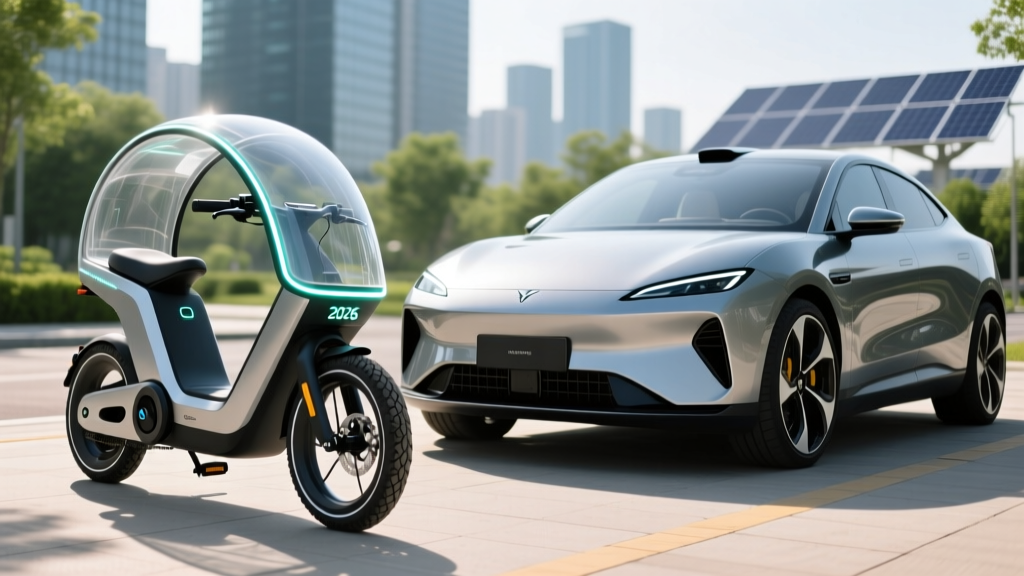
If you're weighing an electric enclosed bike (a three- or four-wheeled cabin-equipped electric trike or velomobile) against a compact battery-electric car for daily commuting, the right answer depends on your trip distance, weather tolerance, and local road-legal classification. Most electric enclosed bikes sold in the U.S. in 2026—like the PodRide, Organic Transit ELF, or newer Chinese-import cabin trikes—offer 30–60 miles of range from a 1–5 kWh battery, cost $4,000–$12,000, and charge fully on a standard 120V outlet in 3–6 hours. A compact EV like the 2026 Nissan LEAF or Chevrolet Equinox EV delivers 250+ miles of EPA range, a 60+ kWh battery, highway legality everywhere, and full crash protection—but starts around $30,000 before incentives. The enclosed bike wins on purchase price and energy cost per mile; the EV wins on range, safety, climate comfort, and year-round practicality for most American commutes.
What Is an Electric Enclosed Bike—and Is It Street-Legal?
An electric enclosed bike is a human-electric hybrid or fully electric vehicle with a weather-protective cabin, typically configured as a three-wheeled recumbent (two wheels front, one rear) or a four-wheeled quadricycle. The enclosure ranges from a partial fairing and windshield to a full hard-shell cabin with doors, wipers, and basic heating. Popular 2026 examples include the Organic Transit ELF (solar-assisted, pedal-electric, ~$7,500), various imported cabin e-trikes from Alibaba vendors ($3,500–$6,000), and boutique builds like the PodRide (Sweden, ~$10,000).
Street legality is the first hurdle. In most U.S. states, three-wheeled electric vehicles under a certain power and weight threshold are classified as autocycles or low-speed vehicles (LSVs), which require registration, insurance, a driver's license, and are restricted to roads with speed limits of 35 mph or less (LSVs per NHTSA FMVSS 500). Fully enclosed electric trikes that exceed 20 mph and 1,500 lbs may qualify as passenger vehicles, but most enclosed bikes fall into a regulatory gray area—legal on bike paths in some jurisdictions, banned from highways in nearly all. Check your state DMV before purchasing.
Quick Answer: An electric enclosed bike costs $4,000–$12,000, delivers 30–60 miles of range, and is best for fair-weather commutes under 20 miles on low-speed roads. A compact EV costs $28,000–$38,000 (before credits), offers 240–320 EPA miles, and works everywhere, year-round. Choose the enclosed bike only if your commute is short, slow, and you have secure storage and backup transport for bad days.
Range, Battery, and Charging: Enclosed Bike vs. Compact EV
The gap in energy capacity between an enclosed bike and a compact EV is enormous—and it dictates what each vehicle can realistically do for you.
| Spec | Typical Enclosed E-Bike (2026) | 2026 Nissan LEAF S | 2026 Chevy Equinox EV LT |
|---|---|---|---|
| Battery Capacity | 1.0–5.0 kWh (lithium-ion) | 60 kWh usable (NMC) | 85 kWh usable (NMC) |
| EPA / Claimed Range | 30–60 mi (varies by pedaling) | 212 mi (EPA) | 319 mi (EPA) |
| Real-World Highway Range | N/A (not highway-legal) | ~170–185 mi (70 mph) | ~260–280 mi (70 mph) |
| Cold-Weather Range Loss | 30–45% (no thermal mgmt) | ~20–30% | ~15–25% (heat pump) |
| Charge Time (120V Level 1) | 3–6 hours (full) | ~50 hours (0–100%) | ~70 hours (0–100%) |
| Level 2 (240V) Charging | Not supported (most models) | ~8 hrs (6.6 kW onboard) | ~9 hrs (11.5 kW onboard) |
| DC Fast Charging | None | Not available (LEAF discontinued CHAdeMO on some trims) | 150 kW peak, 10–80% in ~30 min |
A few things jump out. First, an enclosed bike's 1–5 kWh battery is roughly the same energy as one gallon of gasoline (33.7 kWh equivalent). That's enough for neighborhood errands, not cross-town commutes in winter. Second, enclosed bikes lack battery thermal management—so in sub-40°F weather, expect range to drop sharply, and charging speeds slow further. Third, while enclosed bikes charge conveniently from any wall outlet, EVs require a Level 2 home charger (240V, ~$500–$1,500 installed) for practical overnight top-ups.
Total Cost of Ownership: 5-Year Breakdown
The purchase price of an enclosed bike looks irresistible next to a new EV. But ownership costs depend on how you use it, whether you still need a car, and how your state taxes and insures it.
| Cost Category | Electric Enclosed Bike | 2026 Chevy Equinox EV LT | 2026 Toyota Corolla Hybrid (Gas Baseline) |
|---|---|---|---|
| Purchase Price (MSRP) | $6,500 (avg. cabin trike) | $33,600 | $24,500 |
| Federal Tax Credit (§30D) | $0 (not a qualified vehicle) | Up to $7,500 (subject to IRS §30D income, MSRP cap, sourcing rules) | $0 |
| Effective Purchase Price | $6,500 | ~$26,100 (if full credit, point-of-sale) | $24,500 |
| Energy/Fuel (5 yrs, 75K mi) | ~$450 (electricity, $0.15/kWh) | ~$2,850 (electricity, $0.15/kWh, 3.5 mi/kWh) | ~$6,750 (gas, $3.50/gal, 50 MPG combined) |
| Insurance (5 yrs) | ~$0–$600 (often not insurable as vehicle; homeowner's rider) | ~$7,500 ($1,500/yr avg.) | ~$6,000 ($1,200/yr avg.) |
| Maintenance (5 yrs) | ~$500 (tires, brake pads, chain, battery top-up) | ~$1,500 (cabin filter, tires, fluid, wipers) | ~$3,500 (oil, filters, brakes, tires) |
| Battery Replacement Risk | $500–$1,500 (if cells degrade past warranty) | Covered under 8-yr/100K-mi warranty | N/A (12V battery only) |
| Total 5-Year Cost | ~$8,000–$9,500 | ~$38,000–$42,000 | ~$40,750 |
The enclosed bike's total cost is dramatically lower—but this comparison is misleading if the bike replaces your only vehicle. Most enclosed-bike owners still maintain a car or use transit for longer trips, bad weather, and highway travel. If the enclosed bike is a secondary commuter and your primary car sits in the garage for your daily 12-mile round trip, the savings are real. If it's your only vehicle, the limitations compound fast: no road trips, no Uber rides home when it breaks down, no passenger capacity beyond one.
Safety, Crash Protection, and Real-World Practicality
This is where the enclosed bike faces its steepest tradeoff. Even the best cabin-equipped trike offers minimal crash protection compared to a modern EV with crumple zones, airbags, and electronic stability control. The 2026 Equinox EV earns top marks from IIHS in crashworthiness; no enclosed bike has been crash-tested by NHTSA or IIHS, and the physics of a 300-lb vehicle vs. a 4,500-lb SUV in a collision are unforgiving.
Beyond crash safety, consider daily livability:
- Cargo: Enclosed bikes typically carry one rider plus a small rear cargo area (10–20 gallons equivalent). An Equinox EV offers 26.4 cu ft behind the rear seats, 63.5 cu ft folded—enough for Costco runs, luggage, or a child seat.
- Climate control: Some enclosed bikes offer a small electric heater drawing from the same 1–5 kWh battery that powers propulsion. Running a 500W heater for one hour consumes 0.5 kWh—potentially 10–25% of your total battery. EVs use heat pumps or resistive heaters powered by a 60–85 kWh battery, with negligible range impact relative to total capacity.
- Parking & theft: Enclosed bikes are small enough to park in a garage or covered bike shelter, but they are also easier to steal than a car. You'll need a heavy-duty lock and ideally indoor storage.
- Rain, snow, and ice: The cabin protects from rain but not from road spray, crosswinds, or black ice. Three-wheeled vehicles are inherently less stable than four-wheeled ones in cornering and braking on wet surfaces.
Common Misconceptions: Myth vs. Fact
| Myth | Fact |
|---|---|
| "An enclosed bike qualifies for the $7,500 federal EV tax credit." | Federal §30D credits apply only to qualified plug-in electric drive motor vehicles with 4+ wheels and a GVWR under 14,000 lbs. Most 3-wheel enclosed bikes do not qualify. Some may qualify under the separate §25E used-EV credit or the §30D e-bike credit (up to $900 for e-bikes under IRC §30D as amended), but eligibility is narrow—consult a tax professional. |
| "I can ride it on the highway shoulder." | LSV-class vehicles are federally restricted to roads with speed limits ≤35 mph. Riding on highways or interstates is illegal in virtually all states and extremely dangerous. |
| "The solar panel on the roof recharges the battery while I ride." | Typical roof-mounted solar panels on enclosed bikes produce 50–150 watts—enough to add 2–5 miles of range per full day of peak sun. It offsets parasitic drain, not meaningful propulsion. |
| "It's basically free to operate." | Electricity costs are low (~$0.04/mi vs. ~$0.09/mi for a hybrid), but tires, brake pads, chain/belt replacement, and eventual battery degradation add $100–$300/year in maintenance. |
| "It'll work year-round in cold climates." | Lithium-ion batteries lose 30–45% of usable capacity below freezing without active thermal management. Cabin heating further drains the small battery. Enclosed bikes are best suited for mild-climate or three-season use. |
Decision Framework: Enclosed Bike, Compact EV, or Hybrid?
Choose an electric enclosed bike if:
- Your one-way commute is under 15 miles on roads with speed limits ≤35 mph.
- You live in a mild climate (rarely below 35°F) or accept seasonal-only use.
- You already own or have access to a car for longer trips, bad weather, and passengers.
- You have secure indoor storage (garage, shed) at home and at work.
- Your primary goal is minimizing purchase cost and per-mile energy spend.
Choose a compact EV (LEAF, Equinox EV, Hyundai Kona Electric) if:
- Your commute involves highways, speeds over 45 mph, or distances over 20 miles one way.
- You need year-round, all-weather reliability in cold or rainy climates.
- You carry passengers, child seats, or more than a backpack's worth of cargo.
- You want full crash protection, airbags, and ADAS (automatic emergency braking, lane-keep).
- You qualify for the §30D tax credit (income under $150K single / $300K joint; vehicle MSRP under $55K for cars).
Choose a hybrid (Toyota Corolla Hybrid, Prius) if:
- You lack reliable home charging access (apartment, street parking).
- You regularly drive 300+ miles without stopping and don't want to plan around chargers.
- Your budget is $22,000–$28,000 and you want maximum flexibility with minimum infrastructure.
Charging at Home: What Each Option Requires
Enclosed bikes win on charging simplicity. Most use a standard IEC C13/C14 or barrel connector and charge from any 120V/15A household outlet. A full charge on a 3 kWh battery at 120V/5A (600W) takes roughly 5 hours. No electrician, no permit, no panel upgrade.
Compact EVs are different. While they can trickle-charge on Level 1 (120V), adding only 3–5 miles of range per hour, practical daily use requires a Level 2 home charger (240V, 32–48A). Here's what that involves:
- Equipment: $350–$700 for a quality Level 2 EVSE (ChargePoint Home Flex, Emporia Vue, Tesla Wall Connector).
- Electrical work: $500–$2,000 for a licensed electrician to run a 240V/50A circuit from your panel to your garage or driveway. Older homes with 100A service may need a panel upgrade ($1,500–$3,500) to accommodate the additional load.
- Permit & inspection: $50–$250 depending on municipality.
- Total Level 2 install: $900–$6,000 depending on home age, panel capacity, and conduit run length.
If you're renting, live in a condo, or park on the street, home Level 2 charging may not be feasible. In that case, an enclosed bike's wall-outlet charging is a genuine advantage—assuming your landlord or HOA allows it. But you'll be reliant on public DC fast charging for the EV, which costs $0.30–$0.50/kWh (roughly double home rates) and requires route planning.
Frequently Asked Questions
Can I insure an electric enclosed bike?
Most major auto insurers (Geico, Progressive, State Farm) do not offer standard policies for 3-wheel enclosed e-bikes classified as LSVs or e-bikes. Some specialty insurers and homeowner's/renter's policies can cover theft and liability, but you may not get collision or medical payments coverage. Check with your agent before purchasing. A compact EV is insurable through any standard carrier.
Do enclosed bikes have regenerative braking?
Some higher-end models (ELF, certain imported quadricycles) include basic regenerative braking that recovers 5–15% of energy on deceleration. However, the small battery capacity means regen gains are measured in fractions of a mile, not the 20–30% range recovery you see in a full EV with one-pedal driving modes.
What happens if the battery dies mid-commute?
Many enclosed bikes include pedals, so you can limp home at 8–12 mph using human power alone—a significant advantage over a dead EV, which requires a flatbed tow ($150–$300). However, pedaling a 150–300 lb enclosed trike for 10 miles in work clothes is a workout most commuters don't want.
Are there any federal or state incentives for enclosed bikes?
The federal Alternative Fuel Vehicle Refueling Property Credit (§30C) does not apply to the vehicle itself, only to charging infrastructure. Some states and municipalities offer e-bike rebates ($300–$1,500) that may cover enclosed e-bikes if they meet the legal definition of a low-speed electric bicycle (motor under 750W, top speed under 20 mph on motor alone). Check your state energy office or local air-quality district for current programs.
How long does an enclosed bike battery last?
Most use commodity lithium-ion cells (similar to e-bike or power-tool packs) rated for 500–1,000 charge cycles before degrading to 80% of original capacity. At one full cycle per day, that's roughly 2–4 years of daily use before noticeable range loss. Replacement battery packs cost $500–$1,500 depending on capacity. Compare this to a modern EV's 8-year/100,000-mile battery warranty with a guaranteed 70% capacity retention threshold.