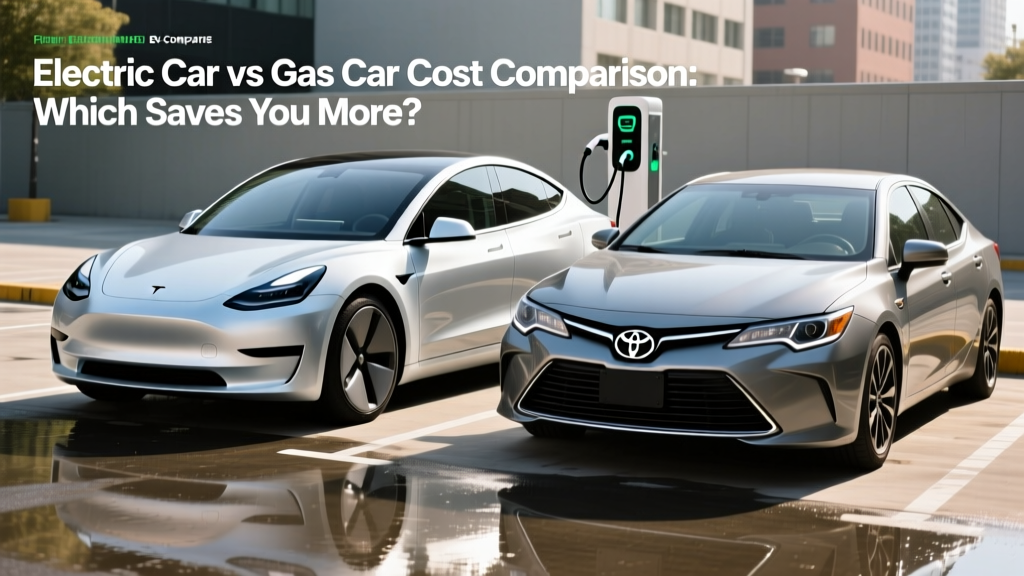
Electric Car vs Gas Car Cost Comparison: Which Saves You More?
The decision between an electric vehicle (EV) and a traditional gasoline-powered car extends far beyond the sticker price. From fuel expenses and maintenance to insurance premiums and long-term resale value, the total cost of ownership paints a far more complete picture than any showroom tag ever could. In this comprehensive comparison, we break down every major cost category to help you determine whether an electric car or a gas car is the smarter financial move for your lifestyle and budget.
If you are new to the EV world, our beginner's guide to electric vehicles covers everything you need to know before diving in. For those ready to explore specific models, check out our best electric vehicles rankings to see which EVs deliver the most value.
Overview: The Contenders
Before we crunch the numbers, let us establish what we are comparing. On one side, we have the modern battery-electric vehicle (BEV) — a car powered entirely by an electric motor and rechargeable battery pack, with zero tailpipe emissions. On the other side sits the conventional internal combustion engine (ICE) vehicle, fueled by gasoline and refined over more than a century of automotive engineering.
Both vehicle types have matured significantly. Today's EVs offer ranges exceeding 250 miles on a single charge, rapid acceleration, and increasingly competitive pricing thanks to battery cost reductions and expanded manufacturing. Gasoline cars, meanwhile, continue to benefit from an extensive refueling infrastructure, lower upfront costs in many segments, and incremental efficiency improvements.
To make this comparison concrete, we reference popular models from each camp — such as the Tesla Model 3, Hyundai Ioniq 6, and Chevrolet Bolt on the EV side, and the Toyota Camry, Honda Accord, and Mazda3 on the gas side — while also presenting industry-wide averages backed by EPA fuel economy data and independent research from organizations like the Insurance Information Institute and Consumer Reports.
Side-by-Side Cost Comparison Table
| Cost Category | Electric Vehicle (Average) | Gasoline Vehicle (Average) |
|---|---|---|
| Average Purchase Price | $47,000 – $55,000 | $35,000 – $42,000 |
| Federal Tax Credit | Up to $7,500 (eligible models) | $0 |
| Annual Fuel / Energy Cost | $500 – $800 | $1,500 – $2,200 |
| Annual Maintenance Cost | $300 – $500 | $800 – $1,200 |
| Average Annual Insurance | $1,800 – $2,400 | $1,400 – $1,900 |
| 5-Year Total Cost of Ownership | $52,000 – $62,000 | $50,000 – $60,000 |
| Estimated Resale Value (5 Years) | 40% – 55% retained | 40% – 50% retained |
Note: Figures represent U.S. national averages and may vary by region, driving habits, and specific model. Sources include EPA estimates, AAA's Your Driving Costs study, and independent automotive analysis.
Purchase Price & Incentives: The Upfront Equation
The most immediate cost difference between electric cars and gas cars is the purchase price. On average, EVs command a premium of roughly $8,000 to $13,000 over comparable gasoline models. This gap has narrowed considerably as battery costs have plummeted — falling from over $1,000 per kilowatt-hour a decade ago to well under $150 per kWh in recent industry reports — but it remains a factor for budget-conscious buyers.
However, the sticker price rarely tells the full story. Federal tax incentives can offset up to $7,500 of an EV's cost for eligible vehicles and buyers, instantly closing a significant portion of the price gap. Many states and local utilities sweeten the deal further with additional rebates ranging from $1,000 to $5,000, reduced registration fees, or HOV lane access.
When you factor in these incentives, several mainstream EVs — such as the Chevrolet Equinox EV, Tesla Model 3 ( qualifying trims), and Volkswagen ID.4 — land within striking distance of well-equipped gas sedans and crossovers. Our best affordable electric vehicles list highlights models that deliver exceptional value after incentives are applied.
On the gas side, buyers benefit from a wider selection of entry-level and mid-range models, aggressive dealer negotiations, and manufacturer incentives that can bring the transaction price well below MSRP. For buyers who prioritize the lowest possible monthly payment today, gasoline vehicles often retain an edge in upfront affordability.
Fuel & Energy Costs: Where EVs Shine
This is the category where electric vehicles deliver their most dramatic cost advantage. According to EPA fuel economy estimates, the average gasoline vehicle achieves roughly 25 to 30 miles per gallon combined. At a national average gas price of $3.50 per gallon, a driver covering 12,000 miles annually spends approximately $1,400 to $1,680 on fuel each year.
By contrast, the average EV consumes roughly 3 to 4 miles per kWh. With the U.S. residential electricity average hovering around $0.16 per kWh, that same 12,000-mile year costs between $480 and $640 in electricity — roughly one-third the cost of gasoline. Drivers in regions with lower electricity rates or access to free workplace and public charging can push their annual energy costs even lower.
Even when using public DC fast-charging networks — which typically charge $0.30 to $0.50 per kWh — the cost per mile remains competitive with or below gasoline for most vehicles. The savings compound over time: over a 10-year ownership period, an EV driver could save $8,000 to $12,000 in fuel costs alone compared to a gas car driver.
It is worth noting that electricity rates vary widely by state. Residents in Louisiana, Idaho, and Washington enjoy some of the lowest rates in the country, maximizing EV savings. Those in California, Hawaii, and the Northeast pay more per kWh, though even in these regions, EVs generally maintain a fuel-cost advantage. Use the EPA's EV cost calculator to estimate your specific savings based on local utility rates.
Maintenance & Repair Costs: The Simplicity Advantage
Electric vehicles have a fundamental mechanical advantage when it comes to maintenance: they have far fewer moving parts. A gasoline engine contains hundreds of components — pistons, valves, timing chains, fuel injectors, exhaust systems — any of which can wear out or fail. An electric motor, by comparison, has essentially one moving part: the rotor.
This simplicity translates into tangible savings. EV owners never pay for oil changes, spark plug replacements, timing belt services, fuel filter swaps, or emissions system repairs. Brake wear is also significantly reduced thanks to regenerative braking, which uses the electric motor to slow the vehicle and recapture energy, sparing the friction brakes. Many EV owners report original brake pads lasting 100,000 miles or more.
According to a comprehensive study by Consumer Reports, EV owners spend roughly 50% less on maintenance and repairs over the life of their vehicles compared to gas car owners. The average annual maintenance cost for an EV falls between $300 and $500, while gasoline vehicles typically require $800 to $1,200 per year — a gap that widens as vehicles age and major service intervals arrive.
The primary maintenance concern unique to EVs is the battery pack. While battery degradation is a reality, modern lithium-ion packs are engineered to last the life of the vehicle. Most manufacturers warranty their batteries for 8 years or 100,000 miles, and independent data from sources like Recurrent Auto shows that the vast majority of EV batteries retain 90% or more of their original capacity after 100,000 miles.
Insurance Costs: The One Area Where Gas Cars Win
Insurance is one cost category where gasoline vehicles generally hold an advantage. EVs tend to cost more to insure for several reasons: higher repair costs following collisions (specialized parts and trained technicians), higher purchase prices, and the cost of battery replacement in the event of severe damage.
On average, insuring an electric vehicle costs 15% to 25% more than insuring a comparable gasoline car. For a driver paying $1,500 annually for gas car insurance, the equivalent EV policy might run $1,725 to $1,875 — an additional $225 to $375 per year. Over five years, that adds up to roughly $1,100 to $1,900 in extra insurance costs.
However, the insurance gap is narrowing. As EVs become more common, repair networks are expanding, parts availability is improving, and insurers are gaining more data to price policies accurately. Some insurers now offer dedicated EV discounts or green vehicle programs. Shopping around and comparing quotes from multiple providers — including companies that specialize in EV coverage — can significantly reduce this cost differential.
For a deeper look at how insurance costs vary by model, our complete EV ownership cost breakdown covers insurance alongside every other expense category.
Resale Value & Depreciation: A Shifting Landscape
Depreciation is typically the single largest cost of vehicle ownership, and this is an area where the EV vs. gas comparison has evolved rapidly. Historically, electric vehicles depreciated faster than gasoline cars due to concerns about battery longevity, rapidly advancing EV technology making older models seem outdated, and a smaller used-EV buyer pool.
That narrative has shifted considerably. As consumer confidence in EV battery durability has grown and the used EV market has expanded, resale values for popular electric models have strengthened. Tesla Model 3 and Model Y vehicles, for instance, have demonstrated resale value retention competitive with top gas-powered sedans and SUVs. The broader trend shows EVs retaining approximately 40% to 55% of their original value after five years, compared to 40% to 50% for the average gasoline vehicle.
Several factors influence EV resale value: battery health (which can be verified through diagnostic reports), the availability of over-the-air software updates that keep older vehicles current, and regional demand (EVs command stronger prices in states with charging infrastructure and environmental awareness).
Gasoline vehicles face their own depreciation headwinds. As governments worldwide tighten emissions standards and more consumers consider the long-term viability of internal combustion vehicles, some analysts project that gas car resale values could soften over the coming decade. The risk of future regulations — such as low-emission zones in urban centers — adds uncertainty to long-term gas car values.
Charging Convenience vs. Refueling: The Time Factor
While not a direct dollar cost, the time spent refueling or recharging has real value. Gasoline vehicles enjoy a clear advantage here: a full tank takes roughly five minutes at any of the nation's 150,000+ gas stations. The convenience is unmatched, particularly for road trips and apartment dwellers without home charging access.
EV charging operates on a different paradigm. The majority of EV charging — roughly 80% to 90% according to industry surveys — happens at home overnight. For homeowners with a Level 2 charger (240-volt), a full charge takes 6 to 10 hours, which aligns perfectly with a night's sleep. In this scenario, EV owners actually spend less time "refueling" than gas car drivers, since they never make dedicated trips to a gas station.
The challenge arises on road trips and for drivers without home charging. DC fast chargers can replenish an EV battery from 10% to 80% in 20 to 40 minutes, depending on the vehicle and charger capability. While this is longer than a gas stop, it can be combined with meal breaks or rest stops. The PlugShare and A Better Route Planner apps make trip planning straightforward.
Public charging infrastructure continues to expand rapidly. The U.S. now has over 60,000 public charging stations, and federal funding initiatives are accelerating deployment along major highways. For a curated look at the EVs with the fastest charging speeds currently available, see our fastest-charging EVs roundup.
Total Cost of Ownership: The Bottom Line
When all costs are tallied — purchase price, incentives, fuel, maintenance, insurance, and depreciation — the gap between electric and gasoline vehicles narrows considerably over a typical ownership period. Here is a representative five-year cost breakdown for an average driver covering 12,000 miles per year:
| Cost Factor (5 Years) | Electric Vehicle | Gasoline Vehicle |
|---|---|---|
| Purchase Price (after incentives) | $42,000 | $38,000 |
| Fuel / Energy | $3,000 | $8,500 |
| Maintenance & Repairs | $2,000 | $5,000 |
| Insurance | $10,000 | $8,000 |
| Depreciation (amount lost) | $21,000 | $20,000 |
| Total 5-Year Cost | $78,000 | $79,500 |
In this representative scenario, the electric vehicle edges out the gasoline car by approximately $1,500 over five years — despite a higher purchase price and higher insurance costs. The savings in fuel and maintenance more than offset those premiums. Extend the ownership period to eight or ten years, and the EV's advantage grows substantially as fuel savings compound and the gas car incurs increasingly expensive maintenance.
Of course, individual results depend on your specific situation. High-mileage drivers save more with an EV, while those who drive very few miles annually may not recoup the upfront premium. Your local electricity and gas prices, available incentives, and insurance rates all play a role. The U.S. Department of Energy offers a personalized cost comparison tool that lets you input your exact zip code and driving habits.
Verdict: Which Should You Choose?
Choose an Electric Vehicle If:
- You can charge at home. Home charging unlocks the full convenience and cost-saving potential of EV ownership.
- You drive 10,000+ miles per year. Higher mileage means greater fuel savings, helping you recoup the purchase premium faster.
- You plan to keep your car for 5+ years. Long-term ownership maximizes maintenance savings and lets you ride out initial depreciation.
- You live in a region with high gas prices or low electricity rates. The fuel cost gap widens in your favor.
- You value performance and technology. EVs deliver instant torque, quiet operation, and cutting-edge software features.
Choose a Gasoline Vehicle If:
- You lack reliable home or workplace charging. Dependence on public charging erodes the convenience and cost advantages of EVs.
- You frequently tow heavy loads or take long road trips in rural areas. Gas vehicles still offer superior range flexibility in remote regions.
- You need the lowest possible monthly payment today. Gas cars generally have lower sticker prices and more aggressive financing deals.
- You drive fewer than 6,000 miles per year. Low mileage means fuel savings are minimal, making it harder to offset the EV premium.
- You prefer the widest possible selection of body styles and price points. The gas vehicle market remains broader, especially in budget segments.
Still deciding? Browse our top-rated electric vehicles and in-depth vehicle reviews to compare specific models side by side and find the right fit for your needs.
Frequently Asked Questions
Is an electric car really cheaper to own than a gas car?
Over a typical ownership period of five to ten years, many electric vehicles achieve a lower total cost of ownership than comparable gasoline cars. The savings come primarily from dramatically lower fuel costs (electricity costs roughly one-third as much per mile as gasoline) and reduced maintenance expenses (EVs have fewer moving parts and do not require oil changes, spark plugs, or exhaust repairs). However, the answer depends on your driving habits, local energy prices, available incentives, and how long you keep the vehicle. High-mileage drivers in states with favorable electricity rates see the largest savings, while low-mileage drivers may not recoup the higher initial purchase price.
How long do electric car batteries last, and what does replacement cost?
Modern EV batteries are designed to last the life of the vehicle. Most manufacturers warranty their battery packs for 8 years or 100,000 miles, whichever comes first. Independent data from battery analytics firms shows that the average EV battery retains approximately 90% of its original capacity after 100,000 miles of driving, with degradation slowing significantly after the initial break-in period. Full battery replacement is rare but can cost between $5,000 and $15,000 depending on the vehicle. As battery manufacturing scales and technology improves, replacement costs are expected to continue declining.
Do electric cars save money on maintenance?
Yes, significantly. Studies by Consumer Reports and the U.S. Department of Energy estimate that EV owners spend roughly 50% less on maintenance compared to gas car owners. This is because electric vehicles eliminate many routine service items — oil changes, transmission fluid replacements, spark plugs, timing belts, and emissions system repairs. Regenerative braking also extends brake pad life dramatically, often to 100,000 miles or beyond. The primary maintenance items for an EV are tire rotations, cabin air filter replacements, windshield washer fluid, and occasional coolant checks.
What happens to an EV's cost advantage if gas prices drop?
Even at lower gasoline prices, electric vehicles typically maintain a fuel cost advantage because electricity prices are generally more stable and less volatile than oil markets. At $2.50 per gallon, the average gas car still costs roughly $1,000 to $1,200 annually to fuel, while an EV using residential electricity costs $480 to $640. The gap narrows but does not disappear. Additionally, EVs retain their maintenance cost advantage regardless of fuel prices. The overall cost-of-ownership equation may shift slightly, but the structural savings of electric drivetrains remain intact across a wide range of fuel price scenarios.
For more comparisons, reviews, and buying guides, explore our electric vehicle hub or check our best electric SUVs and best electric trucks rankings.