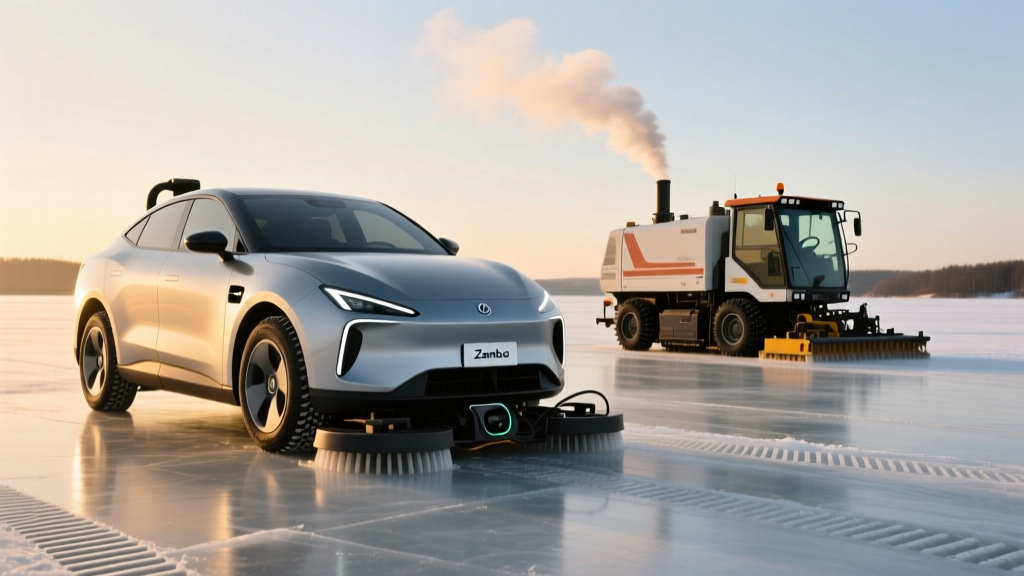
Ice rink operators face a distinct electrification decision that has nothing to do with consumer cars. The electric Zamboni—specifically the battery-electric ice resurfacers produced by Frank J. Zamboni & Co. and competitors like Engo and Resurfice Corp (Olympia)—replaces a propane, CNG, or gasoline machine with a lithium-ion-powered equivalent. The quick answer for fleet buyers: an electric Zamboni typically carries a higher upfront purchase price ($160,000–$220,000 vs. $120,000–$160,000 for an ICE unit), but delivers $15,000–$25,000 in annual fuel and maintenance savings, with payback in 3–5 years for high-use rinks. Range per charge is measured in resurfacing cycles (10–18 per charge), not miles, and charging happens on-site at Level 2 or Level 3 DC speeds between ice cuts.
Quick Verdict: Electric vs. Gas Ice Resurfacer
Choose electric if: Your rink runs 6+ resurfacing cycles per day, has access to 3-phase power for charging, and plans to keep the machine 8+ years.
Choose gas/propane if: You operate a seasonal outdoor rink, run fewer than 4 cycles daily, or lack the electrical infrastructure for on-site charging.
Electric Zamboni Specs: Battery, Range, and Charge Rates
Modern electric ice resurfacers use lithium-ion packs—typically NMC chemistry for energy density in cold environments. The Zamboni Model 560AC (battery-electric variant) and similar machines from Engo and Resurfice Corp (Olympia Ice Machine) represent the current market. Here are the figures that matter for fleet planning:
| Specification | Electric Resurfacer (Typical) | Gas/Propane Equivalent |
|---|---|---|
| Battery Capacity | 60–90 kWh (NMC lithium-ion) | N/A — 15–20 gal fuel tank |
| Resurfacing Cycles per Charge | 10–18 full sheets | Unlimited (refuel in 5 min) |
| Energy Used per Resurfacing | 3.5–5.5 kWh per cycle | 0.8–1.2 gal propane equivalent |
| Charge Time (Level 2, 19.2 kW) | 3.5–5 hours (0–100%) | 5 minutes (refuel) |
| Charge Time (DC Fast, 50 kW) | ~1.5 hours (10–80%) | N/A |
| Peak Motor Output | 60–85 kW (80–114 HP) | 74–97 kW (100–130 HP) |
| Top Speed on Ice | 9–11 mph | 10–12 mph |
| Weight (with water/snow) | 9,500–11,500 lbs | 8,500–10,500 lbs |
| Base MSRP (2025–2026) | $160,000–$220,000 | $120,000–$160,000 |
One critical distinction for facility managers: kW measures the charge rate (how fast energy flows into the battery), while kWh measures battery capacity (total energy stored). A 50 kW DC fast charger will replenish a 75 kWh battery from 10–80% in roughly 1.5 hours—adequate for overnight turnaround between evening hockey and morning figure skating sessions.
Total Cost of Ownership: Electric Zamboni vs. Gas Over 10 Years
The financial case for an electric Zamboni rests on operational savings, not the sticker price. Commercial fleet operators should model total cost of ownership (TCO) across the machine's typical 10–15 year service life. The following breakdown assumes a municipal rink running 10 resurfacing cycles per day, 300 operating days per year.
| Cost Category (10-Year) | Electric Resurfacer | Gas/Propane Resurfacer |
|---|---|---|
| Purchase Price | $185,000 | $140,000 |
| Fuel/Energy (10 years) | $18,000–$24,000 (electricity at $0.10/kWh commercial) | $72,000–$96,000 (propane at $2.50–$3.50/gal) |
| Maintenance (10 years) | $12,000–$18,000 (no engine, no exhaust, no oil changes) | $35,000–$50,000 (engine rebuilds, catalytic converters, filters) |
| Battery Replacement (Year 8–10) | $15,000–$25,000 | $0 |
| Charging Infrastructure Install | $8,000–$20,000 (Level 2 + possible panel upgrade) | $0 (fuel storage already in place) |
| Ventilation/HVAC Savings | $15,000–$30,000 saved (no exhaust → reduced air exchange) | $0 |
| 10-Year Total | $218,000–$272,000 | $247,000–$286,000 |
The numbers reveal a consistent pattern: the electric Zamboni breaks even around year 4–6 and accumulates $20,000–$60,000 in net savings over a 10-year lifecycle. The HVAC savings alone—eliminating combustion exhaust means reduced fresh-air intake requirements—can offset the charging infrastructure cost. According to ASHRAE ventilation standards, indoor ice rinks running propane resurfacers must exchange air at significantly higher rates, increasing heating costs in cold climates by 15–25%.
Real-World Ownership: What Rink Managers Actually Face
Charging Infrastructure at the Rink
Unlike consumer EVs, electric Zambonis never leave the facility. Charging is 100% on-site, which eliminates range anxiety but introduces infrastructure requirements:
- Level 2 charging (19.2 kW, 240V/80A): Standard for overnight charging. Requires a dedicated circuit and typically a 200A electrical panel. Installation runs $8,000–$15,000 including conduit, wiring, and the commercial-grade EVSE unit.
- DC fast charging (25–50 kW): Optional for multi-sheet facilities needing quick turnaround. Adds $25,000–$50,000 for equipment and may require a utility transformer upgrade ($10,000–$30,000 additional).
- Panel upgrade: Older rinks with 100A or 200A service may need a 400A upgrade ($5,000–$15,000) to support simultaneous resurfacer charging and building HVAC loads.
Most rink operators plug in after the last evening resurfacing cycle and have a full battery by 6 AM. The charge curve matters: lithium-ion packs accept peak kW only up to ~80% state of charge, then taper. For a 75 kWh battery on a 19.2 kW Level 2 charger, 0–80% takes about 3.1 hours, while 80–100% adds another 1.5 hours due to taper.
Cold-Weather Battery Performance
Ice rinks are inherently cold environments—typically 40–55°F air temperature, with ice at 18–24°F. Lithium-ion batteries lose capacity and charge acceptance in cold conditions. However, electric Zambonis operate in a thermally stable environment (the rink building), not outdoors in subzero weather. Battery thermal management systems (active liquid cooling/heating) maintain pack temperature between 59–86°F regardless of ambient rink conditions.
Real-world capacity loss in a well-managed rink environment is minimal: expect 3–5% range reduction compared to laboratory ratings, versus the 20–40% loss consumer EVs experience in winter highway driving. Battery degradation over the machine's life typically follows this curve:
- Year 1–3: 2–3% capacity loss per year
- Year 4–7: 1–2% capacity loss per year
- Year 8–10: 80–85% original capacity retained
Most manufacturers warranty the traction battery for 5 years / 5,000 operating hours with a capacity retention floor of 70–80%. Verify exact terms with your dealer, as warranty structures differ between Zamboni, Engo, and Olympia.
Indoor Air Quality: The Hidden Advantage
Propane and gasoline resurfacers emit carbon monoxide (CO), nitrogen dioxide (NO₂), and ultrafine particulates into the rink environment. The CDC has documented cases of CO and NO₂ poisoning at poorly ventilated indoor rinks. Electric resurfacers eliminate these emissions entirely, reducing health liability, lowering insurance premiums, and improving the experience for skaters and staff. Several states and municipalities now require continuous air monitoring for combustion-powered resurfacers—a compliance cost that electric machines avoid.
Federal and State Incentives for Electric Ice Resurfacers
The IRS §30D clean vehicle tax credit is designed for on-road passenger vehicles and does not apply to off-road industrial equipment like ice resurfacers. However, other incentive pathways exist:
| Common Misconception | Fact |
|---|---|
| "I'll get the $7,500 federal EV tax credit for an electric Zamboni." | No. §30D applies to on-road vehicles under 14,000 lbs GVWR used on public roads. Ice resurfacers are off-road industrial equipment. |
| "There are no incentives available." | Incorrect. EPA's Clean Ports and Industrial Equipment grants, state clean-air programs, and utility demand-side management rebates often cover 20–40% of purchase cost. |
| "Electric resurfacers are too new and unproven." | Battery-electric ice resurfacers have been in commercial operation since 2012. The 2022 Beijing Winter Olympics used electric resurfacers exclusively, and hundreds of North American rinks now operate them daily. |
| "Battery replacement will bankrupt us." | At $15,000–$25,000 for a replacement pack (year 8–10), this cost is offset by 8+ years of fuel and maintenance savings already accumulated. |
| "Charging takes too long between ice cuts." | With proper scheduling (charge overnight, top-up during off-peak hours), a single electric resurfacer handles 10–18 cycles—sufficient for most single-sheet rinks. Multi-sheet facilities may spec a DC fast charger or a second machine. |
Utility rebates are often the most lucrative source. Many commercial electric utilities offer $5,000–$20,000 rebates for electric industrial equipment that shifts load to off-peak hours. Check with your local utility's commercial energy-efficiency program. State-level clean-air grants (particularly in California, New York, Massachusetts, and Minnesota) can stack with utility rebates to reduce net purchase cost by 30–50%.
Decision Framework: Should Your Rink Go Electric?
If / Then Guide for Fleet Buyers
- If your rink runs 8+ resurfacing cycles per day → Electric is the clear winner. High utilization maximizes fuel and maintenance savings, accelerating payback to 3–4 years.
- If you operate a single-sheet community rink with 4–6 daily cycles → Electric is favorable if you plan to own the machine 8+ years. Model TCO carefully and pursue utility rebates.
- If you run a seasonal outdoor rink (November–March only) → Gas/propane likely wins. Low annual utilization doesn't justify the higher upfront cost, and cold outdoor charging adds complexity.
- If your building has 100A electrical service and no upgrade path → Address infrastructure first. Get an electrician's quote for a panel upgrade before committing to electric.
- If you manage a multi-sheet arena with back-to-back scheduling → Specify a DC fast charger (25–50 kW) or purchase two electric machines to ensure availability during peak hours.
- If indoor air quality complaints or CO monitoring costs are a recurring issue → Electric eliminates the problem at the source. Factor in avoided compliance costs and potential insurance premium reductions.
- If your municipality has a zero-emissions fleet mandate by 2030–2035 → Electric is your only path. Begin infrastructure planning now to avoid last-minute capital crunches.
Comparing Electric Resurfacer Brands in 2026
Three manufacturers dominate the North American electric ice resurfacer market:
Frank J. Zamboni & Co. — The original name in ice resurfacing offers battery-electric variants of its 500-series machines. The Zamboni e5 (battery-electric) uses a 75–90 kWh NMC pack and offers the widest dealer/service network. MSRP typically $180,000–$220,000 depending on options.
Resurfice Corp (Olympia) — The Canadian manufacturer's Olympia Ice Machine lineup includes full-electric models popular in NHL and collegiate arenas. Known for robust build quality and aggressive pricing. MSRP typically $160,000–$195,000.
Engo — The Italian manufacturer offers the Engo E-lectric line with competitive specs and strong European market presence. Growing North American dealer network. MSRP typically $165,000–$200,000.
All three manufacturers offer similar core capabilities. Your decision should hinge on dealer proximity, service contract terms, battery warranty specifics, and compatibility with your existing rink infrastructure. Request demonstrations from at least two manufacturers and ask for references from rinks with similar daily cycle counts.
Frequently Asked Questions
How many ice resurfacing cycles can an electric Zamboni complete on a single charge?
Most current electric resurfacers deliver 10–18 full-sheet resurfacing cycles per charge, depending on battery capacity (60–90 kWh), ice thickness, water temperature, and snow load. A typical NHL-size rink resurfacing uses 3.5–5.5 kWh. For a 75 kWh battery, expect 13–18 cycles—more than sufficient for a single-sheet rink's daily needs.
Can I charge the electric resurfacer between ice cuts during a busy day?
Yes, but with caveats. Level 2 charging (19.2 kW) adds roughly 3.5–5 kWh in a 15-minute break—enough for one additional cycle. For genuine between-cut charging, a DC fast charger (25–50 kW) can add 8–15 kWh in 15–20 minutes, providing 2–4 additional cycles. Most single-sheet rinks don't need this; multi-sheet arenas should budget for DC fast charging.
What is the battery replacement cost, and how often is it needed?
Battery replacement runs $15,000–$25,000 and is typically needed once during the machine's 10–15 year service life (around year 8–10). NMC lithium-ion packs degrade gradually; you'll notice reduced cycles-per-charge before the battery reaches end-of-life. Many operators find the battery replacement cost is fully covered by accumulated fuel savings.
Do electric ice resurfacers qualify for the $7,500 federal EV tax credit?
No. The IRS §30D clean vehicle credit applies to on-road passenger vehicles and light trucks. Ice resurfacers are classified as off-road industrial equipment. However, EPA industrial equipment grants, state clean-air programs, and utility rebates can provide $10,000–$60,000 in incentives depending on your jurisdiction. Consult a tax professional and your local utility for current program availability.
How does cold rink temperature affect battery performance?
Minimal impact in practice. While lithium-ion batteries lose capacity in extreme cold, rink environments are thermally stable (40–55°F air). Electric resurfacers include active thermal management that maintains battery temperature in the optimal 59–86°F range. Expect 3–5% capacity reduction versus lab ratings—negligible compared to the 20–40% winter loss in consumer EVs.
What electrical upgrades does my rink need to support an electric resurfacer?
At minimum: a dedicated 240V/80A circuit for Level 2 charging and a compatible commercial EVSE ($8,000–$15,000 installed). Older rinks with 100A or 200A main panels may need a service upgrade to 400A ($5,000–$15,000). DC fast charging adds a 480V 3-phase requirement and may need a utility transformer upgrade. Always get a licensed electrician's assessment before committing.
Is an electric Zamboni better for indoor air quality?
Significantly. Propane and gasoline resurfacers emit CO, NO₂, and particulates that require continuous air monitoring and high ventilation rates. Electric resurfacers produce zero tailpipe emissions, eliminating these pollutants. The CDC has documented health incidents from combustion-powered resurfacers in poorly ventilated rinks. Going electric reduces health liability, lowers HVAC costs, and improves the environment for skaters and staff.