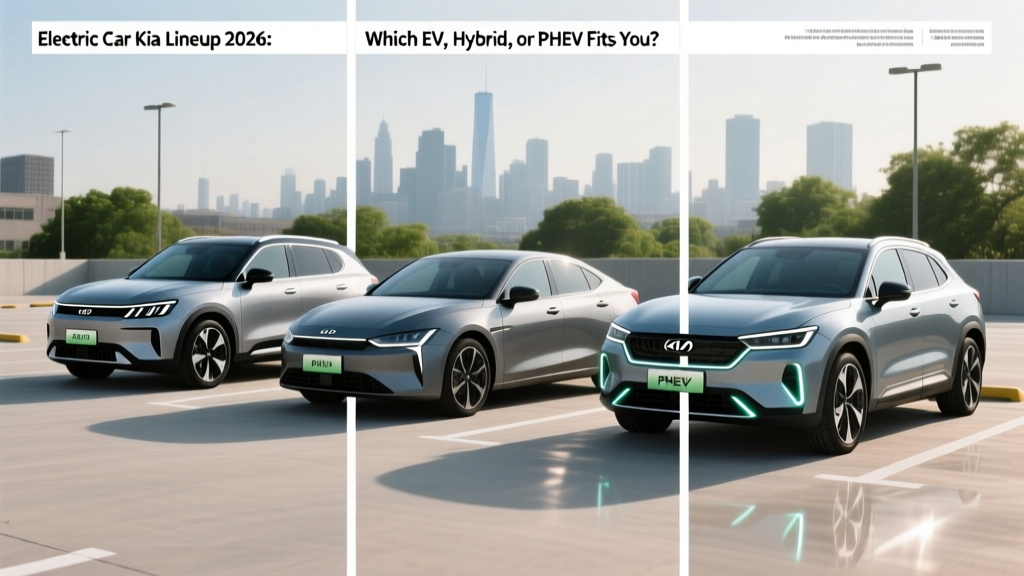
Quick Answer: Which Kia Electric Car Should You Buy?
If you want a true battery-electric vehicle (BEV), Kia currently offers the EV6, EV9, and Niro EV. The EV6 is the best all-around pick for most buyers: 310 miles of EPA range, 800V architecture enabling 10–80% DC fast charging in ~18 minutes, and a starting MSRP around $42,900 before incentives. The EV9 adds three-row SUV space with up to 304 miles of range at ~$54,900. The Niro EV is the budget-friendly commuter at ~$39,600 with 239 miles of range. If you're not ready for full electric, the Niro PHEV (33 miles electric-only, ~$34,390) and Sorento PHEV bridge the gap. Federal tax credit eligibility under IRS §30D varies by model, battery sourcing, your income, and MSRP caps — details below.
The 2026 Kia Electrified Lineup at a Glance
Kia's electrified portfolio spans three BEVs and two PHEVs. Here's how they stack up on the numbers that matter most to buyers.
| Model | Type | EPA Range / EV Range | Battery (kWh) | Max DC Charge (kW) | 10–80% Time | 0–60 mph | Base MSRP |
|---|---|---|---|---|---|---|---|
| EV6 (RWD LR) | BEV | 310 mi | 77.4 (NMC) | 235 kW | ~18 min | 7.2 sec | $42,900 |
| EV6 GT-Line AWD | BEV | 282 mi | 77.4 (NMC) | 235 kW | ~18 min | 5.1 sec | $49,900 |
| EV9 (RWD LR) | BEV | 304 mi | 100.0 (NMC) | 210 kW | ~20 min | 8.2 sec | $54,900 |
| EV9 GT-Line AWD | BEV | 270 mi | 100.0 (NMC) | 210 kW | ~20 min | 5.3 sec | $63,900 |
| Niro EV | BEV | 239 mi | 64.8 (NMC) | 85 kW | ~44 min | 7.8 sec | $39,600 |
| Niro PHEV | PHEV | 33 mi EV / 440 mi total | 11.1 (NMC) | N/A (L2 only) | ~2.5 hr (L2) | 7.4 sec | $34,390 |
| Sorento PHEV | PHEV | 32 mi EV / 420 mi total | 13.8 (NMC) | N/A (L2 only) | ~3 hr (L2) | 7.0 sec | $50,290 |
Sources: fueleconomy.gov, Kia USA specifications. Range figures are EPA estimates; real-world results vary with temperature, speed, and terrain.
Real-World Range vs. EPA Sticker: What to Actually Expect
EPA range is a useful baseline, but it's not what you'll see on every drive. Here's a realistic reconciliation based on highway testing and cold-weather data for Kia's BEVs:
Kia EV6 RWD Long Range
EPA: 310 miles | Real-world highway (70 mph, 75°F): ~265–280 miles | Cold weather (30°F, highway): ~220–245 miles
The EV6's 800V architecture and heat pump (standard on most trims) help it retain more range in cold conditions than many competitors, but expect 20–30% reduction when temperatures drop below freezing. Highway driving at 75+ mph also reduces range 10–15% compared to the EPA combined cycle.
Kia EV9 RWD Long Range
EPA: 304 miles | Real-world highway: ~255–270 miles | Cold weather highway: ~210–235 miles
As a large, boxy three-row SUV, the EV9 is more sensitive to highway speeds and headwinds. The 100 kWh battery provides a large buffer, but aerodynamic drag is the enemy of efficiency at speed.
Kia Niro EV
EPA: 239 miles | Real-world highway: ~205–220 miles | Cold weather highway: ~170–195 miles
The Niro EV is best suited to commuting and suburban driving. On road trips, plan for more frequent stops — and note that its 85 kW peak DC charge rate means longer sessions at fast chargers.
Charging Speed and Infrastructure: The 800V Advantage
The single biggest technical differentiator in Kia's BEV lineup is the 800V electrical architecture shared by the EV6 and EV9. Here's why it matters:
kW vs. kWh explained: kWh (kilowatt-hours) measures your battery's energy capacity — think of it as the size of the fuel tank. kW (kilowatts) measures charging power — think of it as the speed of the fuel pump. A 77.4 kWh battery charged at 235 kW fills much faster than a 64.8 kWh battery charged at 85 kW.
| Charging Level | Power | EV6 Miles/Hour | EV9 Miles/Hour | Niro EV Miles/Hour |
|---|---|---|---|---|
| Level 1 (120V household) | ~1.4 kW | ~4 mi/hr | ~3 mi/hr | ~4 mi/hr |
| Level 2 (240V home) | 7.2–11.5 kW | ~24–38 mi/hr | ~21–35 mi/hr | ~24–26 mi/hr |
| DC Fast Charge (peak) | 235 kW (EV6/EV9) / 85 kW (Niro) | ~650 mi/hr* | ~550 mi/hr* | ~250 mi/hr* |
*Peak rate sustained only during the 10–40% SoC window. All BEVs taper charging speed significantly above 80% SoC to protect battery health. A "10–80% in 18 minutes" spec means the final 20% could take an additional 20+ minutes.
Charging curve reality: The EV6 peaks at 235 kW only briefly between roughly 10–40% state of charge. From 40–80%, it tapers progressively. The 18-minute 10–80% figure assumes a 350 kW-capable charger and battery preconditioning (navigating to a DC fast charger in the EV6's nav system triggers automatic preconditioning). Arriving at a charger with a cold battery — especially in winter — can double your charge time.
Connector note: All 2026 Kia BEVs sold in North America use the NACS (Tesla-style) charge port, granting native access to Tesla Supercharger stations (17,000+ stalls) without an adapter. This was a major shift from the CCS1 port on 2022–2024 models.
Cost of Ownership: Kia EV vs. Gas vs. Hybrid
Let's compare five-year costs for the EV6 RWD, a comparably equipped gas crossover (Kia Sportage AWD), and the Niro PHEV. Assumptions: 15,000 miles/year, $0.14/kWh home electricity, $3.40/gallon gas, 80% home / 20% public charging for BEVs.
| Cost Category (5 Years) | EV6 RWD ($42,900) | Sportage AWD Gas ($32,500) | Niro PHEV ($34,390) |
|---|---|---|---|
| Purchase Price (before incentives) | $42,900 | $32,500 | $34,390 |
| Est. Federal Tax Credit (§30D) | $0–$7,500* | $0 | $0–$7,500* |
| Fuel / Electricity (75,000 mi) | $4,200–$5,800 | $8,925 | $3,100–$4,200 |
| Maintenance (5 yr) | $1,500 | $3,500 | $2,800 |
| Insurance (est. avg) | $8,500 | $6,500 | $7,000 |
| Est. 5-Year Total (after credit) | $49,100–$58,700 | $51,425 | $40,290–$48,390 |
*§30D credit eligibility depends on battery critical-mineral sourcing, your modified adjusted gross income (single: ≤$150K, joint: ≤$300K), and MSRP caps ($55K for cars, $80K for SUVs). The EV6 qualifies at some trims; check the IRS clean vehicle credits page for current eligibility. Point-of-sale transfer is available from participating dealers.
Key takeaways:
- The EV6 breaks even or beats the gas Sportage over five years if you qualify for the tax credit and charge primarily at home.
- Insurance for BEVs runs 15–30% higher than equivalent gas vehicles — get quotes before committing.
- The Niro PHEV is the lowest total-cost option if your daily commute is under 33 miles and you can charge at home, since most driving happens on cheap electricity.
- Public DC fast charging at $0.35–$0.50/kWh raises BEV fuel costs substantially. Home charging access is the single biggest cost variable.
Federal Tax Credit Eligibility: What Actually Qualifies
The §30D clean vehicle credit offers up to $7,500, but qualification is a moving target. Here's the current checklist:
- MSRP caps: Vans/SUVs/pickups ≤$80,000; sedans/other ≤$55,000. The EV6 (classed as a car) must be under $55K — meaning higher trims may not qualify.
- Buyer income limits: MAGI ≤$150,000 (single), ≤$225,000 (head of household), ≤$300,000 (joint filing).
- Battery sourcing: A percentage of critical minerals must be sourced from the US or FTA partners, increasing annually. This requirement has disqualified several models in prior years.
- Final assembly: Must occur in North America. All Kia EVs for the US market are assembled in West Point, Georgia (EV6, EV9) or South Korea (Niro EV — which may disqualify it from §30D).
- Point-of-sale transfer: You can transfer the credit to the dealer at purchase, reducing your out-of-pocket cost immediately rather than waiting for tax filing.
Consult a tax professional and verify current status at irs.gov. Rules change and model eligibility shifts with battery supply chains.
Myths vs. Facts About Kia EVs
| Myth | Fact |
|---|---|
| "EV batteries need replacing every few years and cost $20K." | Kia's BEV battery warranty covers 10 years/100,000 miles with a 70% capacity retention threshold. NMC degradation data shows most modern packs lose 10–15% capacity over 100K miles. Full replacement is rare and typically covered under warranty. |
| "You can't road-trip an EV." | The EV6 adds ~200 miles of range in 18 minutes on a 350 kW charger. With Tesla Supercharger access via NACS, the charging network is the largest in North America. Planning is required, but 300+ mile road trips are routine. |
| "EVs are worse for the environment because of battery mining." | Lifecycle analyses from the ICCT and Argonne National Lab consistently show BEVs produce 50–70% fewer lifetime emissions than gas equivalents in the US grid mix, even accounting for battery manufacturing. The grid is getting cleaner every year, making EVs cleaner over time. |
| "Home charging installation is prohibitively expensive." | A basic Level 2 (240V/48A) home charger install with an existing 200A panel typically costs $800–$2,000 including equipment and electrician labor. A panel upgrade to 200A adds $1,500–$3,500. Many utilities offer rebates of $200–$500. |
| "Kias aren't reliable as EVs." | Kia's E-GMP platform (EV6/EV9) has proven robust. Consumer Reports and J.D. Power data show fewer moving parts mean fewer failure points. The 10-year/100,000-mile powertrain warranty is among the longest in the industry. |
Decision Framework: Which Kia Electric Car Is Right for You?
Choose the EV6 if:
- You want the best balance of range (310 mi), charging speed (18 min 10–80%), and price in Kia's lineup
- You take road trips 3+ times per year and need fast DC charging
- You have or can install Level 2 home charging
- You want a sporty crossover with available AWD and up to 576 hp (GT trim)
Choose the EV9 if:
- You need three rows and 7+ passenger seating in a BEV
- You're replacing a large SUV (Telluride, Explorer) and want to electrify
- Your budget allows $55,000–$70,000+ (note: MSRP cap for §30D SUV credit is $80K)
- You value V2L (vehicle-to-load) capability to power devices or appliances from the battery
Choose the Niro EV if:
- Your budget is under $40,000 and you want a dedicated BEV
- Your daily driving is under 150 miles round-trip
- You primarily drive in urban/suburban settings and rarely road-trip
- You can accept slower 85 kW DC fast charging for the lower price
Choose the Niro PHEV or Sorento PHEV if:
- You don't have reliable home charging access (apartment, street parking)
- You want electric commuting (32–33 mi EV range) without range anxiety on longer trips
- You live in an area with limited public charging infrastructure
- You want a lower purchase price and the flexibility of a gas engine for road trips
First-Time EV Buyer Checklist
Before you sign, verify these five items:
- Home charging feasibility: Do you have a garage or dedicated parking with access to a 240V outlet or the ability to install one? Get an electrician quote before purchasing. A 200A panel is usually sufficient; older homes with 100A service may need an upgrade.
- Insurance quotes: Call your insurer for an EV-specific quote. BEV premiums are often 15–30% higher due to repair costs. This can erase fuel savings if not factored in.
- Tax credit eligibility: Verify the specific trim you're buying qualifies for §30D based on MSRP, your income, and current battery-sourcing rules. Don't assume — ask the dealer for written confirmation.
- Utility rate plan: Many utilities offer time-of-use (TOU) plans with off-peak rates as low as $0.06–$0.09/kWh overnight. Charging at home on a TOU plan dramatically reduces fuel costs vs. the national average of ~$0.14/kWh.
- Public charging in your area: Use apps like PlugShare to map DC fast chargers along your common routes. If you live in a charging desert, a PHEV may be the smarter choice until infrastructure improves.
Frequently Asked Questions
Is the Kia EV6 or EV9 eligible for the $7,500 federal tax credit?
Eligibility varies by trim, model year, and current IRS battery-sourcing rules. Both are assembled in Georgia (North American final assembly requirement met). The EV6, classified as a car, must have an MSRP at or below $55,000 — so higher trims (GT-Line AWD, GT) may exceed the cap. The EV9, classified as an SUV, has an $80,000 cap. Check the fueleconomy.gov tax credit lookup and consult a tax professional.
How long does a Kia EV battery last?
Kia warrants its BEV batteries for 10 years or 100,000 miles against capacity loss below 70%. Based on degradation data from similar NMC packs in the Hyundai Motor Group E-GMP platform, expect approximately 85–90% state of health (SoH) at 100,000 miles under normal use. Avoid frequent DC fast charging to 100% and prolonged storage at very low or very high SoC to maximize longevity.
Can I charge a Kia EV at Tesla Superchargers?
Yes. Starting with the 2025 model year, Kia BEVs sold in North America use the NACS charge port natively, meaning they can plug directly into Tesla Supercharger stalls (V3 and V4) without an adapter. This dramatically expands fast-charging access, especially on highway corridors.
What's the difference between the Kia EV6 and EV9?
The EV6 is a compact/midsize two-row crossover (310 mi range, ~$42,900+). The EV9 is a full-size three-row SUV (304 mi range, ~$54,900+) built on a stretched version of the same E-GMP platform. Both share 800V fast-charging architecture. Choose the EV6 for efficiency and value; choose the EV9 for passenger and cargo space.
Is a PHEV better than a full EV for my situation?
If you can charge at home and your daily driving is under 33 miles, the Niro PHEV lets you drive mostly on electricity while keeping a gas engine for longer trips — no range anxiety. If you have reliable charging access and want to eliminate gas entirely, a BEV like the EV6 offers lower operating costs and less maintenance over time. PHEVs are the pragmatic bridge if charging access or range anxiety is a concern.
Does cold weather significantly reduce Kia EV range?
Yes. Expect 20–30% range reduction below freezing, primarily due to battery chemistry limitations and cabin heating demand. The EV6 and EV9 include a heat pump (standard on most trims) that reduces HVAC energy consumption compared to resistive heating. Preconditioning the battery and cabin while plugged in at home recovers significant range.