The Real Math Behind Electric Car Fuel Cost
Strip away the marketing, and the decision to go electric comes down to dollars and cents. The sticker price of an EV often runs higher than a comparable gas car, but the operating costs — particularly the electric car fuel cost — can swing the equation dramatically in your favor over time. The question is: by how much, and does it actually offset the premium?
We ran the numbers for a realistic 2026 ownership scenario, comparing a mainstream EV against a similarly sized gas vehicle. The assumptions are grounded in national averages from the U.S. Department of Energy's fueleconomy.gov, current electricity rates from the EIA, and real-world insurance data. Your mileage — literally — will vary by state, utility, and driving habits.
Cost Per Mile: EV Charging vs. Gasoline (2026 Averages)
| Metric | EV (Home Charging) | EV (Public DC Fast) | Gas Car (28 MPG) |
|---|---|---|---|
| Energy/Fuel Price | $0.16/kWh (national avg) | $0.48/kWh (avg DCFC) | $3.45/gallon |
| Efficiency | 3.5 miles/kWh (114 MPGe) | 3.5 miles/kWh | 28 MPG combined |
| Cost Per Mile | $0.046 | $0.137 | $0.123 |
| Annual Cost (12,000 mi) | $552 | $1,644 | $1,479 |
Sources: EIA average residential electricity rate (late 2025), national average DCFC pricing from ChargePoint/Electrify America networks, AAA gas price average. EV efficiency based on a 2026 Hyundai Ioniq 5 (84 kWh usable, NMC battery, EPA 310 mi range).
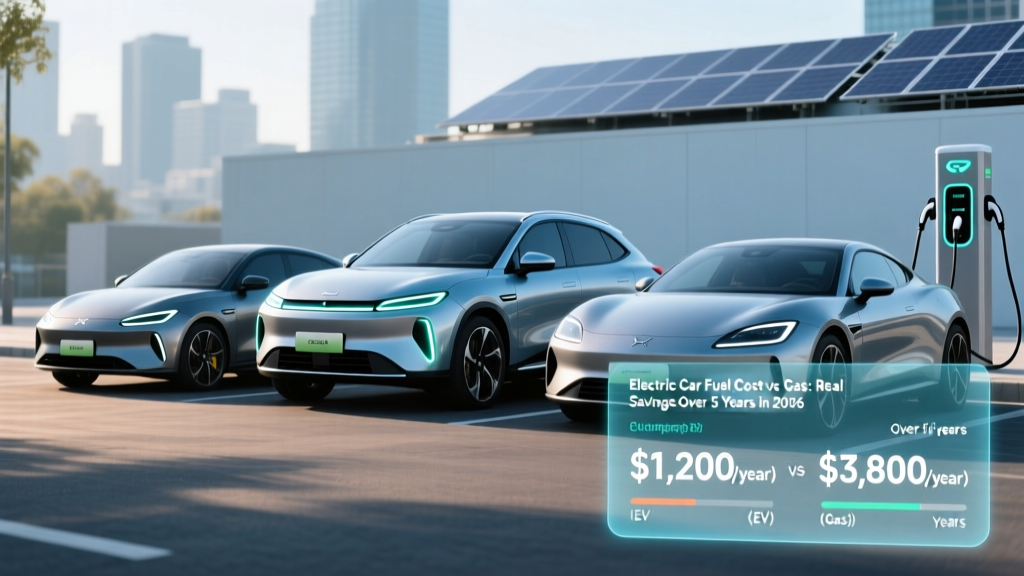
The takeaway is stark: if you charge primarily at home on a standard residential rate, your electric car fuel cost is roughly one-third of what you'd spend on gasoline. Even at public DC fast-charging prices, the per-mile cost is comparable to gas — and that's before factoring in off-peak utility rates or solar, which can push EV fueling costs even lower.
5-Year Total Cost of Ownership Breakdown
Fuel cost is only one piece of the puzzle. Here's a full 5-year/60,000-mile ownership comparison between a typical 2026 compact electric SUV (MSRP ~$42,000) and a comparably equipped gas compact SUV (MSRP ~$33,000).
| Cost Category | 2026 EV (Compact SUV) | 2026 Gas SUV | Difference |
|---|---|---|---|
| Purchase Price (MSRP) | $42,000 | $33,000 | +$9,000 (EV) |
| Federal Tax Credit (§30D) | −$7,500 | $0 | −$7,500 (EV) |
| Effective Purchase Price | $34,500 | $33,000 | +$1,500 (EV) |
| Fuel/Energy (5 yr, 60k mi) | $2,760 (home) | $7,393 | −$4,633 (EV saves) |
| Maintenance (5 yr) | $1,800 | $3,900 | −$2,100 (EV saves) |
| Insurance (5 yr) | $9,600 | $7,500 | +$2,100 (EV costs more) |
| Depreciation (5 yr) | $18,900 (45%) | $14,850 (45%) | +$4,050 (EV loses more $) |
| Total 5-Year Cost | $67,560 | $66,643 | +$917 (EV) |
Assumptions: 12,000 miles/year, home Level 2 charging at $0.16/kWh, 28 MPG gas average at $3.45/gal. Depreciation percentages are illustrative averages — actual resale values vary significantly by model. Insurance based on national average quotes. Tax credit assumes full §30D eligibility. State/local incentives not included.
The numbers reveal a near-parity scenario over five years — and that's without factoring in state rebates, utility incentives, or time-of-use electricity rates that could widen the EV's advantage. But it also exposes the cost categories where EVs still carry a premium: insurance and depreciation.
Federal Tax Credit: Do You Actually Qualify?
The IRS §30D Clean Vehicle Credit can knock up to $7,500 off your tax liability — or, as of 2024 onward, be transferred to the dealer as a point-of-sale discount. But qualifying is not automatic. The rules layer multiple requirements that eliminate many vehicles and many buyers.
§30D Federal Tax Credit Eligibility Checklist (2026 Rules)
- Vehicle MSRP Cap: Vans, SUVs, and pickups must have an MSRP ≤ $80,000. Sedans and other body styles must be ≤ $55,000. (IRS §30D guidelines)
- Buyer Income Cap (Modified AGI): Joint filers ≤ $300,000; Head of household ≤ $225,000; Single/other ≤ $150,000. Applies to the tax year of purchase or the prior year, whichever is lower.
- Battery Component Sourcing: A percentage of battery components must be manufactured or assembled in North America (threshold increases annually through 2029).
- Critical Minerals Requirement: A percentage of critical minerals must be sourced from the U.S. or a free-trade-agreement partner (threshold also escalates yearly).
- Foreign Entity of Concern (FEOC) Exclusion: Vehicles with battery components or critical minerals from a FEOC (primarily targeting certain Chinese supply chains) are disqualified.
- Final Assembly: Vehicle must undergo final assembly in North America.
- Point-of-Sale Transfer: Buyers can elect to transfer the credit to the dealer at purchase, receiving the discount upfront rather than waiting to claim it on their tax return.
- One Credit Per Vehicle, Lifetime Limit Per Buyer: The credit applies once per VIN. Buyers are limited to one transferred credit per year.
The practical result: many popular EVs qualify for the full $7,500, but the list shifts as supply chains evolve and thresholds tighten. Before purchasing, verify the specific model's eligibility on fueleconomy.gov's tax credit tracker and confirm your income situation with a tax professional.
State, Local, and Utility Incentives
Beyond the federal credit, incentives vary enormously by location:
- State rebates: California's CVRP offers up to $7,000 for income-qualified buyers. Colorado provides a $5,000 state tax credit. Many states offer $1,000–$4,000.
- Utility rebates: Many utilities offer $250–$1,500 for home Level 2 charger installation, plus time-of-use rates that slash overnight charging costs.
- HOV lane access: States like California, Virginia, and Maryland offer solo HOV lane access for EVs — a non-monetary perk worth thousands in commute time.
- Registration fees: Some states offset lost gas tax revenue with higher EV registration fees ($50–$225/year). Factor this into your state-specific math.
Check your state energy office and local utility for current programs — these change frequently and often have funding caps.
Maintenance Savings: Where EVs Quietly Win
The electric car fuel cost gets the headlines, but maintenance is where EVs deliver consistent, predictable savings. The physics are simple: an electric motor has roughly 20 moving parts versus 200+ in an internal combustion engine. No oil, no spark plugs, no timing belts, no exhaust system, no transmission fluid changes.
| Maintenance Item | Gas Car (5 yr / 60k mi) | EV (5 yr / 60k mi) |
|---|---|---|
| Oil Changes | $600–$900 (6–9 changes) | $0 |
| Transmission Fluid | $150–$300 | $0 (most EVs have sealed single-speed reducers) |
| Brake Pads/Rotors | $600–$1,200 | $0–$300 (regenerative braking extends pad life 2–3×) |
| Spark Plugs | $200–$400 | $0 |
| Engine Air Filter | $100–$200 | $0 |
| Coolant Flush | $150–$250 | $100–$150 (EV thermal management systems still require coolant service) |
| Tire Rotation/Replacement | $800–$1,500 | $900–$1,800 (EVs are heavier and deliver instant torque, wearing tires ~15–20% faster) |
| Cabin Air Filter | $100–$200 | $100–$200 |
| Total Estimated | $2,700–$4,950 | $1,100–$2,450 |
The tire caveat matters: EVs are heavier (a 2026 Ioniq 5 weighs ~4,600 lbs vs. ~3,500 lbs for a gas Tucson) and deliver instant torque, which accelerates tread wear. Budget for tire replacement every 30,000–40,000 miles rather than the 50,000+ you might get on a lighter gas vehicle.
Insurance: The Uncomfortable Reality
EV insurance premiums run 15–30% higher than equivalent gas vehicles, and this is the single biggest offset to fuel and maintenance savings. The reasons are structural, not arbitrary:
- Higher repair costs: EV battery packs are expensive to replace if damaged. Even minor collision damage near the battery enclosure can trigger a full pack replacement ($10,000–$20,000+).
- Specialized labor: High-voltage system repairs require certified technicians, and fewer shops have this capability, driving up labor rates.
- Higher vehicle values: The starting MSRP is typically higher, so comprehensive and collision coverage costs more.
- Total-loss thresholds: Insurers are more likely to declare an EV a total loss after battery-area damage, increasing claim payouts.
For our comparison scenario, expect to pay roughly $1,920/year for full-coverage EV insurance versus $1,500/year for the gas equivalent — a $2,100 gap over five years. Shop quotes aggressively: Tesla's in-house insurance, Progressive, and GEICO vary widely by model and state. Some insurers now offer EV-specific policies with battery coverage riders.
Depreciation and Resale Value: The Shifting Landscape
EV depreciation has been volatile. In 2023–2024, Tesla's aggressive price cuts cascaded through the used EV market, hammering resale values across all brands. By 2025–2026, the market has stabilized somewhat, but EVs still depreciate faster on average than comparable gas vehicles.
Key factors shaping EV resale value:
- Battery health perception: Buyers worry about degradation. Most 2026 EVs carry 8-year/100,000-mile battery warranties (mandated minimum for §30D eligibility), but the used market still discounts older EVs for perceived battery risk.
- Price compression from new models: As new EV prices drop, used EV values follow. A 2023 EV that cost $50,000 new now competes with a 2026 model at $38,000.
- Charging standard transition: The industry shift from CCS to NACS (Tesla's connector, now the dominant North American standard) has created a mild resale penalty for CCS-only vehicles without NACS adapters.
- Brand divergence: Models from Hyundai/Kia, BMW, and Porsche have held value better than some competitors. Teslas, paradoxically, saw steeper depreciation due to the brand's own price cuts.
Expect a typical 2026 EV to retain 50–60% of its MSRP after five years, versus 55–65% for a mainstream gas vehicle. The gap is narrowing as the EV market matures, but it remains a real cost factor. Leasing can be a smart hedge against depreciation risk — and many leases pass through the $7,500 federal credit as a cap-cost reduction even on models that wouldn't qualify for a retail buyer.
The Decision Framework: When the Numbers Work
Choose an EV if:
- You can install a Level 2 home charger (the $0.04–$0.06/mile home charging rate is where the economics sing)
- You qualify for the full $7,500 federal credit plus state incentives, narrowing the purchase-price gap
- You drive 12,000+ miles/year (higher mileage amplifies the per-mile fuel savings)
- Your daily commute is within the vehicle's real-world range (avoid chronic DCFC reliance)
- You plan to own the vehicle 5+ years (amortizing the upfront premium)
Consider a Hybrid/PHEV Instead if:
- You lack home charging access and would rely primarily on public DCFC (the per-mile cost advantage shrinks dramatically)
- You regularly drive 300+ miles in cold weather where range drops 20–30%
- The EV models in your budget don't qualify for the federal tax credit due to MSRP or sourcing rules
- You want to hedge against depreciation uncertainty while still reducing fuel costs
Frequently Asked Questions
How much does it really cost to own an EV over 5 years?
For a typical 2026 compact electric SUV with a $42,000 MSRP, the total 5-year/60,000-mile cost lands around $65,000–$70,000 when you include purchase price (net of tax credits), home charging, insurance, maintenance, and depreciation. That's within $1,000–$2,000 of a comparable gas SUV — and can swing in the EV's favor with state incentives, cheaper overnight electricity, or higher annual mileage.
Do I qualify for the $7,500 federal EV tax credit?
It depends on three things: your income (joint filers must be under $300,000 MAGI), the vehicle's MSRP (≤$80,000 for SUVs/trucks, ≤$55,000 for sedans), and the vehicle's battery sourcing compliance. The FEOC restrictions on Chinese-sourced minerals have disqualified several models. Always check the current eligible vehicle list on fueleconomy.gov and consult a tax professional for your specific situation. You can now transfer the credit to the dealer for an upfront price reduction.
How much do I actually save on fuel and maintenance?
With home charging at national average electricity rates ($0.16/kWh) and a vehicle averaging 3.5 miles/kWh, you'll spend roughly $550/year on electricity versus $1,480/year on gasoline for a 28 MPG vehicle — saving about $930/year on fuel alone. Add $400–$500/year in maintenance savings (no oil changes, reduced brake wear), and the combined annual operating savings run $1,300–$1,400. Over five years, that's $6,500–$7,000 in total operating savings.
Are EVs more expensive to insure?
Yes, typically 15–30% more than equivalent gas vehicles. For a $42,000 electric SUV, expect annual full-coverage premiums of $1,800–$2,200 versus $1,400–$1,700 for a gas equivalent. The gap is driven by higher repair costs (battery replacement risk), specialized labor requirements, and higher vehicle values. Shop multiple insurers — the spread between companies is wider for EVs than for gas cars.
How well do EVs hold their value?
EV depreciation has been steeper than gas vehicles, averaging 40–50% over five years versus 35–45% for mainstream gas cars. The gap stems from rapid price drops in new EVs, battery health concerns in the used market, and the CCS-to-NACS connector transition. However, depreciation varies heavily by brand and model — and leasing can mitigate the risk entirely while still capturing the tax credit benefit.
Does public DC fast charging erase the fuel cost advantage?
Partially. At $0.40–$0.55/kWh (typical 2026 DCFC rates), your per-mile cost rises to $0.11–$0.16, which is comparable to or slightly above gasoline at $3.45/gallon. The economics work best when 80%+ of your charging happens at home on Level 2. If you'll rely exclusively on public charging, a PHEV or hybrid may deliver better overall economics.