The Short Answer
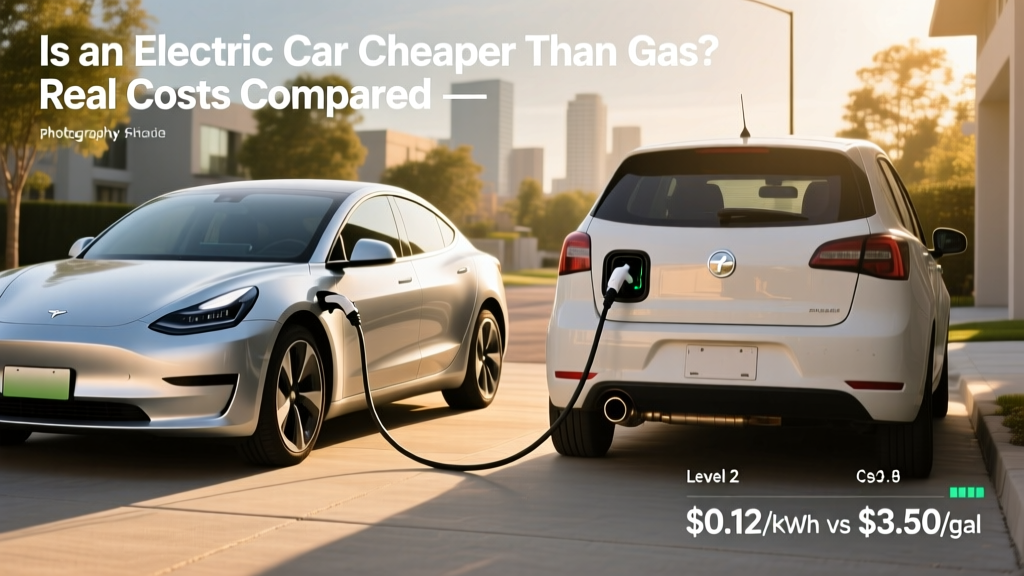
Yes — an electric car is usually cheaper to operate than a gas car, saving $800–$1,500 per year on fuel and maintenance combined. But whether it's cheaper overall depends on three factors: (1) whether you qualify for the federal §30D tax credit (up to $7,500), (2) whether you can charge at home on a Level 2 charger, and (3) how many miles you drive annually. For a driver covering 15,000 miles/year with home charging and full tax-credit eligibility, an EV typically breaks even against a comparable gas car within 2–4 years and saves $5,000–$10,000 over a 7-year ownership period. Without home charging or the tax credit, the math flips — a hybrid or efficient gas car may cost less.
Purchase Price: The Upfront Gap and the Tax-Credit Bridge
The average transaction price for a new EV in early 2026 sits around $46,000, compared to roughly $38,000 for a comparable gas-powered compact SUV. That $8,000 gap is the biggest hurdle EV buyers face. But the gap narrows — sometimes disappears — once you factor in incentives.
The federal §30D Clean Vehicle Credit offers up to $7,500 for qualifying new EVs and up to $4,000 for qualifying used EVs. However, eligibility is not automatic. Per IRS rules, the vehicle must meet MSRP caps ($80,000 for SUVs/pickups/vans; $55,000 for sedans), buyer income limits ($300,000 joint / $150,000 single modified AGI), and strict battery-sourcing requirements for critical minerals and components. As of 2026, these sourcing rules have tightened significantly, meaning fewer models qualify for the full $7,500 than in prior years. Always check the current fueleconomy.gov tax-credit list before purchasing.
Many EVs now also qualify for point-of-sale transfer, meaning the dealer applies the credit as an immediate price reduction rather than waiting for you to claim it on your tax return. This effectively lowers the sticker price on the spot.
Real Purchase-Price Example: EV vs Gas Compact SUV
| Factor | 2026 Hyundai Tucson (Gas SEL) | 2026 Hyundai Ioniq 5 SE (AWD) |
|---|---|---|
| Base MSRP | $32,250 | $46,700 |
| Federal Tax Credit (§30D) | $0 | Up to $7,500 (if eligible) |
| Effective Purchase Price | $32,250 | $39,200 |
| Price Gap After Credit | $6,950 | |
Even with the full credit, the EV costs roughly $7,000 more upfront. The rest of this article shows where that gap closes — and where it doesn't.
Fuel vs Electricity: The Biggest Ongoing Savings
This is where EVs consistently win. The cost advantage depends on your local electricity rate and gas price, but the physics are straightforward: electric motors convert 85–90% of battery energy into motion, while gasoline engines convert only 20–35%. You simply need less energy to go the same distance.
| Metric | Gas Car (30 MPG combined) | EV (3.5 mi/kWh / 120 MPGe) |
|---|---|---|
| Energy cost per gallon / kWh | $3.40/gal (2026 avg) | $0.16/kWh (home avg) |
| Cost per mile | $0.113/mi | $0.046/mi |
| Annual fuel cost (15,000 mi) | $1,695 | $690 |
| Annual savings driving EV | $1,005/year | |
At $0.16/kWh (the US residential average in 2026), home charging costs roughly $0.04–$0.05 per mile. Even at higher-tier rates of $0.25/kWh, you're still at $0.07/mile — well below gas. The savings widen if you have access to time-of-use (TOU) utility rates and charge overnight at $0.08–$0.10/kWh, dropping your per-mile cost to $0.025–$0.03.
Public DC fast charging is a different story. Networks like Electrify America, EVgo, and Tesla Superchargers typically charge $0.35–$0.55/kWh in 2026. At $0.48/kWh, your per-mile cost rises to $0.14 — actually more than gas. If you rely exclusively on public fast charging, the fuel-cost advantage disappears entirely. This is why home charging access is the single most important variable in the EV cost equation.
Maintenance: Fewer Moving Parts, Real Dollar Savings
EVs eliminate oil changes, spark plugs, timing belts, fuel filters, exhaust systems, and multi-speed transmissions. Regenerative braking dramatically reduces brake-pad wear — many EV owners report original brake pads at 80,000+ miles.
According to industry maintenance data, the average EV owner spends approximately $0.061/mile on maintenance over the vehicle's life, compared to $0.101/mile for a gas car. Over 15,000 miles per year, that's:
- Gas car maintenance: ~$1,515/year
- EV maintenance: ~$915/year
- Annual maintenance savings: ~$600/year
Over 7 years, that's roughly $4,200 in maintenance savings. Combined with fuel savings ($1,005/year × 7 = $7,035), total operating savings over 7 years reach approximately $11,235 — enough to more than cover the upfront price gap in our example above.
What EV maintenance does cost: cabin air filters ($30–$60 every 20,000 mi), tire rotation and replacement (EVs are heavier and produce instant torque, wearing tires 20–30% faster — budget $200–$400 more per tire set), windshield washer fluid, and coolant checks. Battery replacement is the elephant in the room, but modern NMC and LFP packs are warrantied for 8 years/100,000 miles, and real-world degradation data shows most packs retain 85–90% capacity at 150,000 miles. Full replacement costs range from $8,000–$18,000 depending on the model, but is statistically rare within normal ownership periods.
Insurance, Depreciation, and the Hidden Costs
EV insurance premiums run 15–25% higher than comparable gas cars, primarily because EV repair costs after collisions are higher (specialized high-voltage safety procedures, expensive battery modules, limited body-shop expertise). For a $45,000 EV, expect annual premiums of $1,800–$2,400 depending on your state and driving record, compared to $1,400–$1,900 for a gas equivalent. That's an added $400–$600/year.
Depreciation has historically hurt EVs more than gas cars, but this gap has narrowed as the used-EV market matured. A 2026 model-year EV from a mainstream brand (Hyundai, Kia, Tesla, Ford) typically retains 45–55% of its value after 5 years, compared to 50–60% for a comparable gas car. On a $45,000 EV, that 5–10 percentage-point difference translates to $2,250–$4,500 in additional depreciation over 5 years.
However, if you bought with the $7,500 point-of-sale credit, your effective cost basis is lower, and the depreciation hit as a percentage of what you actually paid is closer to parity.
7-Year Total Cost of Ownership: EV vs Gas
| Cost Category | Gas SUV ($32,250 MSRP) | EV ($46,700 MSRP, $7,500 credit) |
|---|---|---|
| Effective Purchase Price | $32,250 | $39,200 |
| Fuel/Energy (7 yrs, 15k mi/yr) | $11,865 | $4,830 |
| Maintenance (7 yrs) | $10,605 | $6,405 |
| Insurance (7 yrs) | $11,550 | $14,700 |
| Home Charger Install (Level 2) | $0 | $1,200 |
| Estimated Resale Value (Year 7) | -$14,500 | -$17,500 |
| Net 7-Year Cost | $51,770 | $48,835 |
| EV Savings Over 7 Years | $2,935 | |
In this scenario, the EV wins by nearly $3,000 over 7 years — and the gap widens if you drive more than 15,000 miles annually or have access to cheap overnight electricity. If you don't qualify for the tax credit, add $7,500 back to the EV column, and the gas car wins by ~$4,500.
Real-World Ownership Factors That Change the Math
Home Charging Access
If you can install a Level 2 home charger (240V, 32–48 amps, adding 25–40 miles of range per hour), the economics strongly favor EVs. A basic Level 2 installation costs $800–$2,000 depending on whether your electrical panel needs an upgrade. Without home charging, you'll rely on public infrastructure — and at $0.35–$0.55/kWh, your fuel costs may match or exceed gas.
Climate and Range
Cold weather reduces EV range by 15–30% due to battery chemistry and cabin heating demands. A 300-mile EPA-rated EV may deliver only 210–255 real-world miles in freezing temperatures. If you live in Minnesota or Montana and commute long distances, range loss is a genuine cost factor — you'll charge more often and may need a larger (more expensive) battery pack to maintain your lifestyle. Heat-pump-equipped EVs (standard on most 2026 Hyundai, Kia, Tesla, and Volkswagen models) mitigate this by 5–10 percentage points.
Driving Patterns
High-mileage drivers (20,000+ miles/year) benefit most from EVs because per-mile savings compound. Low-mileage drivers (under 8,000 miles/year) save less in absolute dollars, making the higher purchase price harder to justify. City-heavy driving favors EVs (regenerative braking maximizes efficiency); sustained highway driving at 75+ mph reduces EV efficiency more than it affects gas cars.
Common Misconceptions: Myth vs Fact
| Myth | Fact |
|---|---|
| "EV batteries need replacing every 5 years" | Modern packs are warrantied 8 yrs/100,000 mi. Real-world data shows 85–90% capacity retention at 150,000 mi for NMC, and even better for LFP chemistry. |
| "Charging an EV costs the same as gas" | Only if you exclusively use expensive DC fast chargers ($0.48/kWh). Home charging at $0.16/kWh costs roughly 40% of gasoline per mile. |
| "EVs are worse for the environment because of electricity generation" | Even on coal-heavy grids, EVs produce 30–50% fewer lifetime emissions than gas cars per EPA lifecycle analysis. On cleaner grids, the advantage exceeds 60%. |
| "The tax credit is $7,500 for any EV" | Per IRS §30D rules, the credit has MSRP caps, income limits, and battery-sourcing requirements. Many 2026 models qualify for partial or no credit. |
| "EVs are cheaper for everyone" | Without home charging, the tax credit, or high annual mileage, a hybrid like the Toyota RAV4 Hybrid (39 MPG combined, ~$33,000 MSRP) often costs less over 7 years. |
Decision Framework: Should You Buy an EV, Hybrid, or Gas Car?
Choose an EV if:
- You can install a Level 2 home charger (or already have one)
- You qualify for the federal §30D tax credit (check income limits and vehicle eligibility)
- You drive 12,000+ miles per year (savings compound with mileage)
- Your daily commute is under 80% of the EV's real-world range
- You want the lowest per-mile operating cost and minimal maintenance
Choose a plug-in hybrid (PHEV) if:
- You want electric-only commuting (25–45 miles) but need gas flexibility for road trips
- You can charge at home but have range-anxiety concerns for longer drives
- You don't qualify for the full EV tax credit but still want some electrification savings
Choose a conventional hybrid (HEV) if:
- You cannot charge at home (apartment, street parking, no garage)
- You drive fewer than 8,000 miles per year
- You want the lowest upfront cost with strong fuel economy (35–50 MPG)
- You live in an area with limited public charging infrastructure
Choose a gas car if:
- Your budget is strictly under $28,000 and you need a new vehicle
- You drive very low miles and prioritize minimal purchase cost over operating cost
- You frequently tow heavy loads in cold climates where EV range loss compounds
Frequently Asked Questions
How much does it cost to charge an EV at home per month?
For a driver covering 1,250 miles/month in an EV averaging 3.5 mi/kWh, you'll use about 357 kWh. At the 2026 US residential average of $0.16/kWh, that's roughly $57/month. Compare that to $141/month in gasoline for a 30 MPG car at $3.40/gallon.
Do EVs really save money on maintenance?
Yes. You eliminate oil changes ($40–$80 each, 2–3x/year), spark plugs, timing belts, and most brake-pad replacements. Expect to spend about $600/year less on maintenance compared to a gas car. The main added cost is faster tire wear due to vehicle weight and instant torque.
What happens if I can't charge at home?
Public DC fast charging at $0.35–$0.55/kWh eliminates most of the fuel-cost advantage. If you rely entirely on public charging, a hybrid (HEV or PHEV) is usually the more economical choice. Some workplaces, apartments, and municipalities offer subsidized Level 2 charging — check your local options before ruling out an EV.
Will I save money buying a used EV instead?
Used EVs can be excellent value. The §30D used-vehicle credit offers up to $4,000 (30% of the sale price) on EVs priced at $25,000 or less from a dealer, subject to income limits. A 2–3 year-old EV with 30,000–50,000 miles often provides 90%+ battery health at a 30–40% discount from new pricing.
How long until an EV pays for itself vs a gas car?
With the $7,500 tax credit, home charging, and 15,000 miles/year, the break-even point is typically 2–4 years. Without the credit, it extends to 5–8 years depending on the price gap and your mileage. Higher annual mileage accelerates the payback.
Are EVs more expensive to insure?
Yes, typically 15–25% more than a comparable gas car. On a $45,000 vehicle, expect $400–$600/year in additional insurance cost. Shop quotes from multiple insurers — some now offer EV-specific policies with competitive rates.