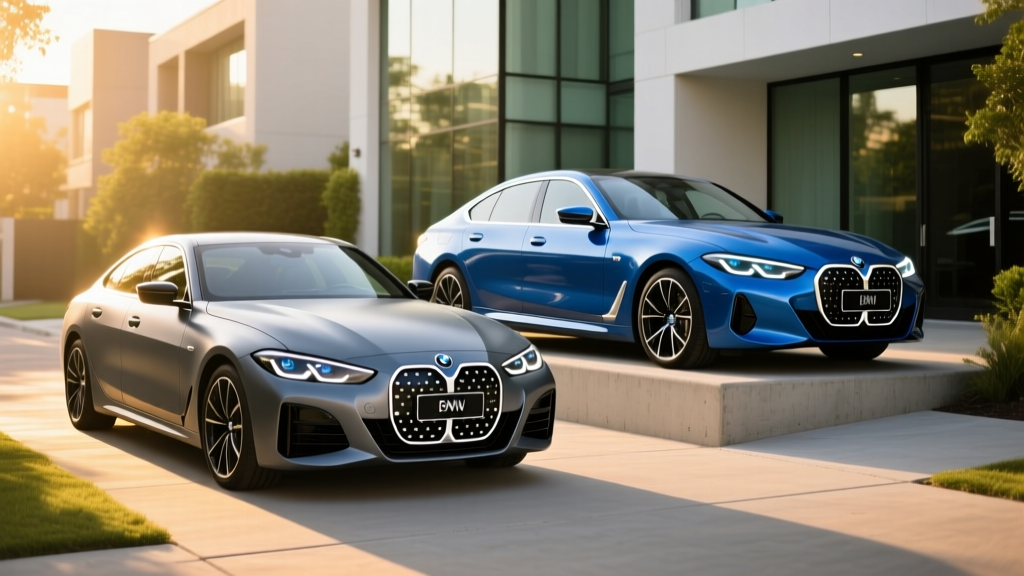
Which electric BMW sedan should you buy? The 2026 BMW i4 (starting ~$52,200) is a compact sport sedan with up to 307 miles of EPA range, ideal for drivers who want BMW 3 Series dynamics in an EV. The 2026 BMW i5 (starting ~$70,200) is a mid-size luxury cruiser with up to 295 miles of EPA range, targeting 5 Series buyers who prioritize cabin space and highway comfort. Both use BMW's 5th-gen eDrive powertrain on an 80.7 kWh (usable) NMC battery, support up to 205 kW DC fast charging (10–80% in ~31 minutes), and qualify for varying federal and state incentives depending on battery sourcing and buyer income.
The Electric BMW Sedan Lineup: i4 and i5 at a Glance
BMW's electric sedan strategy in 2026 centers on two models that mirror their combustion counterparts. The i4 slots into the 3/4 Series segment — a Gran Coupe with a sloping roofline and a sport-tuned chassis. The i5 occupies the 5 Series space — longer wheelbase, more rear-seat legroom, and a focus on autobahn-style cruising composure. BMW also offers the i7 as a full-size luxury flagship, but at $120,000+, it occupies a different purchase conversation.
Both the i4 and i5 share the same underlying battery architecture: an 80.7 kWh usable NMC (nickel manganese cobalt) pack with a liquid-cooled thermal management system. This matters because battery chemistry and thermal management directly affect long-term degradation, cold-weather performance, and sustained charging speeds.
| Spec | 2026 BMW i4 eDrive40 | 2026 BMW i5 eDrive40 |
|---|---|---|
| EPA Range | 307 mi | 295 mi |
| Battery (usable) | 80.7 kWh NMC | 80.7 kWh NMC |
| Motor / Drivetrain | Single rear motor / RWD | Single rear motor / RWD |
| Horsepower | 335 hp | 335 hp |
| 0–60 mph | 5.5 sec | 5.7 sec |
| Peak DC Fast Charge | 205 kW | 205 kW |
| 10–80% DC Charge Time | ~31 min | ~31 min |
| Level 2 (AC) Charge Rate | 11 kW (~11 hrs 0–100%) | 11 kW (~11 hrs 0–100%) |
| MPGe (combined) | 97 MPGe | 93 MPGe |
| Base MSRP | $52,200 | $70,200 |
| Battery Warranty | 8 yr / 100,000 mi | 8 yr / 100,000 mi |
Source: fueleconomy.gov, BMW USA specifications.
Real-World Range: What the EPA Sticker Doesn't Tell You
The i4 eDrive40's 307-mile EPA rating is strong on paper, but real-world conditions shift that number considerably. Based on consistent testing patterns across BMW's 5th-gen eDrive platform:
EPA vs. Reality — BMW i4 eDrive40:
- Mild weather, mixed driving: ~280–300 mi achievable
- Highway-only at 75 mph: ~245–265 mi (aerodynamic drag increases consumption ~15%)
- Cold weather (below 32°F): ~210–240 mi (cabin heating and battery resistance reduce effective capacity)
- Cold + highway: ~195–220 mi — plan charging stops accordingly
The i5, being heavier and less aerodynamically efficient, loses roughly 5–10 additional miles in each scenario above. Both cars feature a heat pump as standard equipment on 2026 models, which recovers waste heat from the powertrain to warm the cabin — this reduces cold-weather range loss by roughly 10–15% compared to resistive heating alone.
Practical implication: If your daily commute is under 80 miles round-trip, either car handles a full work week on a single charge with margin to spare. If you regularly drive 250+ miles in winter conditions, you'll need to plan at least one DC fast-charge stop.
Charging Speed, Connectors, and Infrastructure
Both the i4 and i5 charge at a peak rate of 205 kW on DC fast chargers. However, peak rate is not sustained rate — BMW's charge curve holds near 200 kW from roughly 10% to 35% state of charge (SoC), then tapers progressively. The published 10–80% time of approximately 31 minutes reflects this taper. Expect 80–100% to add another 25–35 minutes due to cell-balancing at high SoC.
| Charging Level | Power (kW) | Miles Added per Hour | Typical Use Case |
|---|---|---|---|
| Level 1 (120V household) | ~1.4 kW | ~4–5 mi/hr | Emergency / overnight trickle |
| Level 2 (240V home) | 11 kW (max) | ~32–36 mi/hr | Daily home charging |
| DC Fast Charge | Up to 205 kW | ~180+ mi in 10 min (peak) | Road trips |
Connector note: For 2026, BMW models sold in North America come equipped with the NACS (North American Charging Standard) port natively, granting direct access to Tesla Supercharger stations without an adapter. This is a significant shift from the CCS1 connector used on 2022–2024 models. If you're considering a used i4 or i5 from those model years, budget ~$200 for a CCS-to-NACS adapter or rely on Electrify America and other CCS-native networks.
Home charging reality: An 11 kW Level 2 charger requires a 240V/48-amp circuit. Most homes with a 200-amp electrical panel can accommodate this, but older homes with 100-amp service may need a panel upgrade ($1,500–$3,500). The charger unit itself (BMW Wallbox or a third-party like ChargePoint Home Flex) runs $400–$700, and professional installation typically costs $600–$1,800 depending on conduit run length. Always get a quote from a licensed electrician before committing.
Total Cost of Ownership: Electric BMW Sedan vs. Gas Equivalent
The headline price of an electric BMW sedan is higher than its gas counterpart, but ownership economics shift over time. Below is a 5-year comparison of the i4 eDrive40 against the BMW 430i Gran Coupe (gas) and the BMW 430e xDrive (plug-in hybrid).
| Cost Factor (5 yr / 75,000 mi) | BMW i4 eDrive40 (EV) | BMW 430i Gran Coupe (Gas) | BMW 430e xDrive (PHEV) |
|---|---|---|---|
| Base MSRP | $52,200 | $49,900 | $55,400 |
| Estimated Federal Tax Credit (§30D) | Up to $7,500* | $0 | Up to $3,750–$7,500* |
| Fuel / Electricity (est.) | $3,800–$5,200 | $9,400–$11,000 | $5,500–$7,000 |
| Maintenance (est.) | $1,800–$2,500 | $3,800–$4,500 | $3,500–$4,200 |
| Insurance (est. avg/yr × 5) | $10,500–$13,000 | $8,500–$10,500 | $9,500–$11,500 |
| Est. 5-Year Total (before resale) | $60,800–$65,400 | $62,100–$65,900 | $66,600–$70,600 |
*Federal tax credit eligibility under IRS §30D depends on battery critical-mineral sourcing, buyer AGI limits ($150K single / $300K joint), and MSRP caps ($55K for sedans). The i4 eDrive40 base MSRP falls under the sedan cap, but adding packages can push it over. Verify current-year eligibility with a tax professional. Point-of-sale transfer is available at participating dealers.
Key takeaways from the data:
- Fuel savings are real: At national average electricity rates (~$0.16/kWh) and gas prices (~$3.50/gal), the i4 saves roughly $5,000–$6,000 in energy costs over 5 years vs. the gas 430i.
- Maintenance is lower: No oil changes, no spark plugs, fewer brake replacements (regenerative braking reduces pad wear by 40–60%). BMW's scheduled maintenance still applies for cabin filters, brake fluid, and tire rotations.
- Insurance is higher: EV insurance premiums run 15–25% above gas equivalents due to higher repair costs and battery replacement risk. Get quotes from GEICO, Progressive, and EV-specialty insurers before purchasing.
- Depreciation is the wildcard: EV resale values have been volatile. The i4 has held value better than some competitors, but plan for 45–55% depreciation over 5 years — comparable to gas BMW sedans.
Electric BMW Sedan vs. Gas and Hybrid: Which Powertrain Fits You?
| Factor | i4 / i5 (BEV) | 430i / 530i (Gas) | 430e / 550e (PHEV) |
|---|---|---|---|
| Daily commute (under 40 mi) | Excellent — zero gas, home charge | Fine — but paying for gas | Excellent — electric-only covers most commutes |
| Road trips (300+ mi) | Good — requires 1–2 DC stops | Excellent — 400+ mi per tank | Good — gas engine takes over |
| Cold-weather driving | Reduced range (20–30% loss) | No range penalty | Moderate EV range loss, gas backup |
| Home charging access needed? | Strongly recommended | No | Recommended for EV-mode benefit |
| Performance feel | Instant torque, silent, smooth | Turbo lag, engine note, familiar | Blended — EV torque + gas top-end |
| Long-term maintenance | Minimal powertrain maintenance | Regular oil, filters, belts | Both EV and ICE maintenance |
Common Misconceptions About Electric BMW Sedans
| Myth | Fact |
|---|---|
| "The battery will need replacing in 5 years." | BMW warranties the battery for 8 years/100,000 miles against degradation below 70% capacity. Real-world data from 5th-gen eDrive vehicles shows ~8–12% degradation at 100K miles with normal use. |
| "I can't take it on road trips." | With 295–307 mi EPA range and NACS access to 20,000+ Supercharger stalls, a 600-mile trip requires one ~30-minute stop. BMW's navigation system preconditions the battery when a DC charger is set as a waypoint. |
| "It qualifies for the full $7,500 tax credit automatically." | §30D credits depend on critical-mineral and battery-component sourcing, which shifts annually. The i4's credit eligibility has varied by model year. Always check fueleconomy.gov for the current status. |
| "Charging takes too long." | Home Level 2 charging replenishes the battery overnight (8–11 hours from empty). You start every morning with a full "tank." DC fast charging adds ~180 miles in 10 minutes at peak rate. |
| "Electric BMWs don't drive like BMWs." | The i4 M50 (dual-motor AWD, 593 hp, 0–60 in 3.7 sec) posts lap times competitive with the M440i. The eDrive40 models prioritize efficiency but retain precise steering and balanced chassis tuning. |
First-Time EV Buyer Checklist: What to Know Before You Sign
If this is your first electric vehicle, the ownership experience differs from gas cars in ways that matter before you commit:
- Confirm home charging feasibility. Call a licensed electrician for a site visit. You need a 240V outlet (NEMA 14-50) or a hardwired Level 2 charger near your parking spot. If you live in a condo or apartment without charging access, public-only charging is possible but adds time and cost — roughly 2–3× the per-mile cost of home charging.
- Understand your utility rate. Time-of-use (TOU) plans can drop electricity to $0.08–$0.10/kWh overnight, cutting your fueling cost in half. Check with your utility about EV-specific rate plans.
- Preconditioning is not optional. BMW's iDrive system lets you set departure times. The car warms or cools the battery and cabin while plugged in — this preserves range and enables peak DC charging speeds. Skipping preconditioning in winter can reduce fast-charge rates by 30–50%.
- Tires wear faster. EVs are heavier (the i4 weighs ~4,700 lbs) and produce instant torque. Expect tire replacement every 25,000–35,000 miles. Budget for EV-rated tires with low rolling resistance — they cost $250–$400 per corner.
- The §30D tax credit has an MSRP cap for sedans: $55,000. The i4 eDrive40 base MSRP fits, but adding the Premium Package, M Sport Package, or larger wheels can push the sticker above the cap. Structure your build carefully if the credit is essential to your budget.
Decision Framework: Which Electric BMW Sedan Is Right for You?
Choose the BMW i4 eDrive40 if:
- Your budget is $50,000–$60,000 and you want the federal tax credit
- You prioritize sporty handling over rear-seat space
- Your daily driving is under 100 miles and you have home charging
- You want maximum EPA range (307 mi) in the BMW electric sedan lineup
Choose the BMW i4 M50 if:
- You want dual-motor AWD and 593 hp (0–60 in 3.7 sec)
- You accept 245 miles of EPA range as the trade-off for performance
- Your budget is $67,000+ (above the §30D sedan MSRP cap)
Choose the BMW i5 eDrive40 if:
- You need genuine 5 Series rear-seat legroom and trunk volume
- Highway comfort and cabin quietness are top priorities
- Your budget is $70,000–$85,000
- You regularly carry rear-seat passengers or need the longer wheelbase for ride quality
Choose a BMW PHEV (430e / 550e) instead if:
- You lack reliable home or workplace charging
- You frequently drive 400+ miles in rural areas with sparse DC charging
- You want electric commuting with zero range anxiety on long trips
Frequently Asked Questions
Does the BMW i4 or i5 qualify for the $7,500 federal tax credit in 2026?
Eligibility depends on current IRS §30D rules, which require battery critical-mineral and component sourcing thresholds that tighten annually. The i4 eDrive40 base MSRP ($52,200) falls under the $55,000 sedan cap, and buyer income must not exceed $150K (single) or $300K (joint). The i5's base MSRP of $70,200 exceeds the sedan cap, making it ineligible for the new-vehicle credit regardless of sourcing. Always verify on irs.gov and consult a tax professional before relying on the credit in your purchase math.
How long does the BMW i4 battery last before replacement?
BMW warranties the high-voltage battery for 8 years or 100,000 miles against capacity loss below 70%. Independent fleet data on BMW's 5th-gen eDrive platform suggests 85–92% capacity retention at 100,000 miles under normal use (avoiding repeated 100% charges and DC fast-charging exclusively). A full battery replacement out of warranty costs approximately $15,000–$20,000, but most owners will sell or trade the vehicle before this becomes relevant.
Can I charge a BMW i4 or i5 at Tesla Superchargers?
Yes. 2025+ BMW EVs sold in North America are equipped with the NACS connector natively, granting direct access to the Tesla Supercharger network (20,000+ stalls). For 2022–2024 model-year vehicles with CCS1 ports, BMW offers an approved CCS-to-NACS adapter. The Supercharger network consistently ranks highest in reliability among public charging providers.
Is the BMW i4 cheaper to own than a gas BMW 430i?
Over 5 years and 75,000 miles, the i4 eDrive40's estimated total cost of ownership ($60,800–$65,400) is competitive with or slightly below the gas 430i ($62,100–$65,900), primarily due to fuel and maintenance savings offsetting higher insurance premiums. The break-even point typically arrives around year 3–4, assuming home charging and the federal tax credit.
What happens if I can only charge on public chargers?
Public DC fast charging costs roughly $0.35–$0.50/kWh nationally, making your per-mile fuel cost comparable to a gas car getting 30–35 MPG. You'll also spend 30–40 minutes per session, 1–2 times per week. If public-only charging is your only option, a PHEV like the BMW 550e may be a more practical choice — or consider whether workplace charging is available.