The Short Answer on the DRT E3.1 Electric Mountain Bike
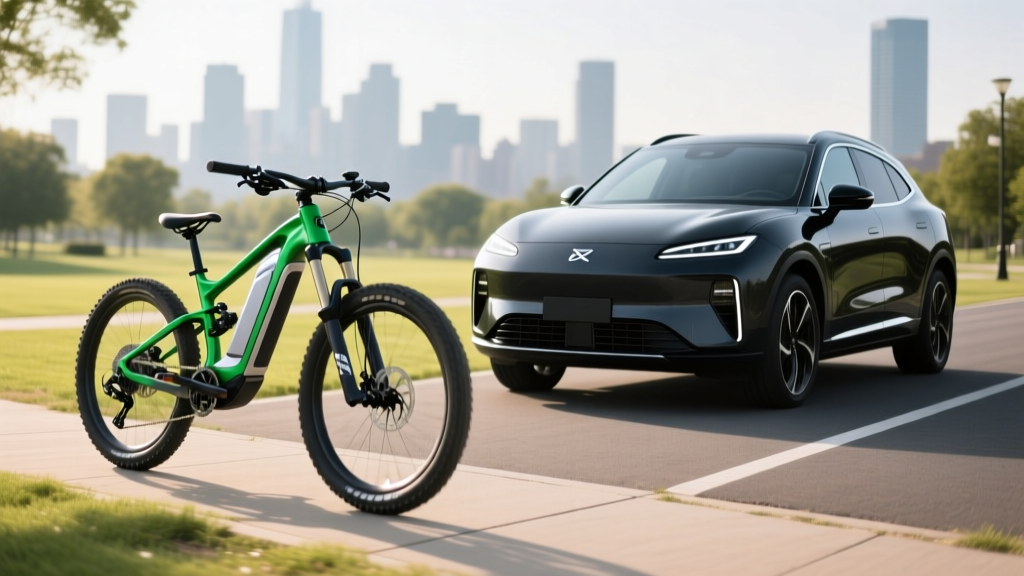
The DRT E3.1 electric mountain bike is a pedal-assist e-MTB designed for trail recreation and short off-road commutes — not a replacement for a full-size electric vehicle. If you need to carry passengers, cargo, or drive in all weather on highways, a compact EV like the Chevrolet Equinox EV or Hyundai Kona Electric will serve you far better. If your goal is trail riding, last-mile commuting, or reducing car trips on nice-weather days under 30 miles, the DRT E3.1 can be a practical complement to an EV household — but it does not qualify for the federal §30D EV tax credit, which applies only to four-wheeled vehicles.
What the DRT E3.1 Electric Mountain Bike Actually Is
The DRT E3.1 is a Class 1 pedal-assist electric mountain bike with a mid-drive or hub motor (typically 250–500W nominal), a removable lithium-ion battery pack (commonly 400–500 Wh), and front or full suspension designed for dirt trails and rough terrain. Unlike a throttle-equipped Class 2 e-bike, Class 1 models like the E3.1 only provide motor assist while you pedal, cutting off at 20 mph.
This matters because it places the DRT E3.1 in an entirely different vehicle category than a battery electric vehicle (BEV). E-bikes are regulated by the Consumer Product Safety Commission, not the NHTSA. They require no driver's license, registration, or auto insurance in most states, but they also offer zero crash protection compared to a modern EV with a full suite of ADAS features.
DRT E3.1 vs. a Compact Electric SUV: The Numbers Side by Side
Below is a real-world comparison between a typical DRT E3.1-class e-MTB and the 2026 Hyundai Kona Electric (one of the more affordable compact EV SUVs on the market). These serve very different use cases, but buyers cross-shopping e-bikes and EVs often want to understand the total financial picture.
| Spec / Cost Factor | DRT E3.1 Electric Mountain Bike (Typical) | 2026 Hyundai Kona Electric SEL |
|---|---|---|
| Purchase Price | $1,500–$3,000 | ~$34,000 MSRP (before incentives) |
| Battery Capacity | ~0.4–0.5 kWh (400–500 Wh) | 65.4 kWh usable (NMC) |
| Range Per Charge | 25–50 miles (pedal-assist, terrain dependent) | 261 miles EPA (real-world ~220–240 mi highway) |
| Top Speed | 20 mph (motor cutoff, Class 1) | 107 mph |
| Motor Power | 250–500W (0.3–0.7 HP) | 150 kW (201 HP) |
| Charge Time (0–100%) | 3–5 hours (standard 120V wall outlet) | ~6.5 hours Level 2 (240V); DC fast 10–80% in ~43 min at peak 100 kW |
| Passengers | 1 rider | 5 passengers |
| Cargo | Backpack or small pannier (~30 lbs max) | 25.5 cu ft behind rear seats (58.1 cu ft folded) |
| Federal Tax Credit (§30D) | Not eligible | Up to $7,500 (subject to income, MSRP, sourcing rules) |
| Weather Suitability | Fair weather only (rain/cold = reduced range and rider discomfort) | All-season, climate-controlled cabin |
| Insurance (Annual) | $0–$150 (optional e-bike rider on homeowner's policy) | ~$1,400–$2,200 (varies by state and driver profile) |
| Annual Maintenance | $100–$300 (tires, brake pads, chain, drivetrain) | $300–$600 (tire rotation, cabin filter, fluid top-off) |
Real Costs and Savings: E-Bike Ownership vs. EV Ownership
The financial comparison between the DRT E3.1 and a full EV is stark — but so is the difference in capability. Here is a five-year cost breakdown assuming you use either as a daily commuter (round-trip commute of 15 miles, 240 workdays/year).
| 5-Year Cost Category | DRT E3.1 E-MTB | 2026 Kona Electric (After $7,500 Credit) | 2026 Gas Compact SUV (30 MPG Combined) |
|---|---|---|---|
| Purchase / Net Cost | $2,200 | $26,500 | $28,000 |
| Energy / Fuel (5 years) | $75 (electricity at $0.14/kWh) | $2,400 (electricity at $0.14/kWh, ~2.8 kWh/mi efficiency) | $6,000 (gas at $3.30/gal) |
| Insurance (5 years) | $500 | $9,000 | $7,500 |
| Maintenance (5 years) | $1,000 | $2,000 | $3,500 |
| Total 5-Year Cost | $3,775 | $39,900 | $45,000 |
| Cost Per Mile | $0.21 | $0.33 | $0.38 |
The e-bike wins on pure cost — but only for the narrow slice of trips it can handle. If you need to drive in January snow, carry two kids to school, or make a 200-mile weekend road trip, the e-bike cannot substitute. The EV replaces your gas car entirely; the e-bike supplements it.
Real-World Ownership Considerations Most Buyers Overlook
Home Charging Access
One advantage of the DRT E3.1 is that its battery charges on a standard 120V household outlet — no Level 2 installation, no electrician visit, no panel upgrade. You simply plug the charger into any wall socket. A full EV, by contrast, benefits enormously from a 240V Level 2 home charger (adding roughly 25–30 miles of range per hour), which typically costs $800–$2,500 installed depending on your electrical panel's capacity. If your home has a 100-amp panel, you may need a $1,500–$3,000 panel upgrade before adding a 40-amp EV circuit.
Cold-Weather Range Loss
Both e-bikes and EVs suffer in cold weather, but the impact is more severe on the e-bike. Lithium-ion batteries lose roughly 20–30% of usable capacity at freezing temperatures (32°F). On a DRT E3.1 with a 400 Wh battery, that means your 40-mile summer range could drop to 28–32 miles in winter. EVs lose a similar percentage — a 261-mile Kona Electric might deliver 185–210 miles in sustained 20°F weather — but you still have 180+ miles of range and a heated cabin. On an e-bike, cold also means rider discomfort: wind chill at 15 mph in 30°F air is genuinely unpleasant without serious cold-weather cycling gear.
Charging Infrastructure
For the DRT E3.1, "charging infrastructure" is any wall outlet — at home, at a coffee shop, or at the office. This is a genuine advantage in apartment buildings or workplaces where EV charging is unavailable. However, you cannot use public DC fast chargers (Electrify America, EVgo, Tesla Superchargers) with an e-bike. Those networks are exclusively for four-wheeled EVs with CCS, NACS, or CHAdeMO connectors.
Common Misconceptions About E-Bikes and EVs
| Myth | Fact |
|---|---|
| "The DRT E3.1 qualifies for the $7,500 federal EV tax credit." | False. The §30D credit under the Inflation Reduction Act applies only to four-wheeled motor vehicles with a gross vehicle weight under 14,000 lbs. E-bikes are not eligible. Some states and cities offer separate e-bike rebates (typically $300–$1,500), but these vary by jurisdiction. Check your local transportation authority for current programs. |
| "An e-bike can fully replace my car." | For a small minority of riders in mild climates with short commutes and no passengers/cargo needs, possibly. For most households, an e-bike replaces 30–50% of car trips, not 100%. It is a supplement, not a substitute. |
| "E-bikes are zero-emission." | E-bikes produce zero tailpipe emissions, but the electricity charging them comes from a grid that may include fossil fuels. That said, the energy draw is negligible — charging a 500 Wh battery uses about $0.07 of electricity and generates a tiny fraction of the upstream emissions of charging a 65 kWh EV battery. |
| "EV batteries and e-bike batteries are the same." | Both use lithium-ion chemistry, but EV batteries are far larger (65–100 kWh vs. 0.4–0.7 kWh), use sophisticated thermal management (liquid cooling), and come with 8-year/100,000-mile federal warranty mandates. E-bike batteries are typically air-cooled, carry 1–2 year warranties, and cost $400–$800 to replace. Expect 3–5 years of usable life from an e-bike battery before noticeable degradation. |
| "I don't need insurance for an e-bike." | In most states, e-bike insurance is not legally required. However, if you crash and injure someone, your homeowner's or renter's policy may not cover e-bike liability. A dedicated e-bike insurance policy (from providers like Velosurance or Sundays Insurance) typically costs $100–$250/year and covers theft, damage, and liability. |
Decision Framework: Should You Buy the DRT E3.1, an EV, or Both?
Choose the DRT E3.1 Electric Mountain Bike If:
- Your primary use case is trail riding, recreation, or fair-weather commuting under 30 miles round-trip.
- You already have a car (gas, hybrid, or EV) for longer trips, bad weather, and passenger/cargo hauling.
- You live in an apartment or home without EV charging access and want an electrified option now.
- Your budget is under $3,000 and you want to reduce car dependency for short trips.
- You want zero installation cost — just plug into any 120V outlet.
Choose a Compact EV (Kona Electric, Equinox EV, Nissan Leaf) If:
- You need a primary vehicle for all-weather, all-season driving with passengers and cargo.
- You have a daily commute over 30 miles or regularly drive on highways (where e-bikes are impractical or illegal).
- You can install a Level 2 home charger or have reliable workplace/public charging access.
- You want to eliminate gasoline costs entirely and may qualify for the §30D federal tax credit (up to $7,500, subject to IRS eligibility rules including income caps, MSRP limits, and battery sourcing requirements).
Choose Both (E-Bike + EV Household) If:
- You want to maximize household efficiency: EV for highway/long trips, e-bike for short neighborhood errands and trails.
- You want to reduce wear, insurance miles, and energy use on your EV by substituting e-bike trips for short drives.
- You have secure bike storage (garage, shed, or indoor space) to protect a $2,000+ e-bike from theft.
What a First-Time Buyer Should Know Before Purchasing the DRT E3.1
Battery Chemistry and Longevity
Most e-MTBs in the DRT E3.1 class use standard lithium-ion cells (typically NMC chemistry, similar to many EVs but without the advanced thermal management). Expect the battery to retain roughly 70–80% of its original capacity after 500 full charge cycles — roughly 3–5 years of regular use. A replacement battery costs $400–$800, which is a significant fraction of the bike's original price. Store the battery between 20–80% state of charge when not in use for extended periods, and avoid charging or discharging in extreme heat or cold to maximize lifespan.
Safety and Legal Classification
As a Class 1 pedal-assist e-bike, the DRT E3.1 is legal on most multi-use paths and mountain bike trails where e-bikes are permitted — but not all. Check local trail regulations before riding. The Consumer Product Safety Commission regulates e-bikes at the federal level, but state and local rules vary widely on where Class 1 e-MTBs can operate. Always wear a certified helmet (CPSC or ASTM F1952 for mountain biking), and consider adding a handlebar-mounted light and rear reflector even if not legally required.
Where the DRT E3.1 Fits in the Broader EV Landscape
The e-bike market and the EV market are converging in interesting ways. Many EV owners report that adding an e-bike to their household reduces their EV mileage by 20–40%, which in turn reduces charging costs, tire wear, and insurance mileage premiums. According to data from fueleconomy.gov, the average American drives 37 miles per day — a distance well within the range of a quality e-MTB like the DRT E3.1 on fair-weather days. The question is not whether an e-bike can replace an EV, but whether it can replace enough short car trips to justify its purchase. For most riders with a secure storage location and a sub-30-mile commute, the answer is yes.
Frequently Asked Questions
Does the DRT E3.1 electric mountain bike qualify for any federal tax credits?
No. The §30D Clean Vehicle Credit applies only to four-wheeled plug-in electric vehicles. E-bikes are not eligible for the federal EV tax credit. However, some states, cities, and utility companies offer separate e-bike purchase rebates ranging from $200 to $1,500. Check with your local transportation authority or utility provider for current programs in your area.
How far can the DRT E3.1 go on a single charge?
Real-world range for a typical Class 1 e-MTB with a 400–500 Wh battery is 25–50 miles depending on assist level, rider weight, terrain, and temperature. On maximum assist with hilly terrain and a heavier rider, expect closer to 25 miles. On low assist with flat terrain and a lighter rider, you may reach 50 miles. Cold weather (below 40°F) reduces range by 20–30%.
Can I ride the DRT E3.1 in the rain?
Most e-MTBs have IP54 or IP65 water resistance ratings, meaning they can handle rain and puddles. However, sustained heavy rain, submersion, or pressure washing can damage the motor, battery contacts, or display. Dry the bike after wet rides and avoid storing it with a wet battery connection.
How does e-bike charging cost compare to EV charging?
Charging a 500 Wh e-bike battery from empty to full costs approximately $0.07 at the US average residential electricity rate of $0.14/kWh. Charging a 65 kWh EV battery costs roughly $9.10 at the same rate. Per mile, the e-bike costs about $0.002/mile in electricity versus $0.03–$0.04/mile for a compact EV. Both are dramatically cheaper than gasoline at $0.11–$0.15/mile.
Is the DRT E3.1 a good first purchase before buying an EV?
It can be a smart stepping stone if you want to experience electric propulsion and reduce car dependency at a low entry cost. However, an e-bike does not build familiarity with EV-specific ownership tasks like managing public charging networks, understanding charge curves, or installing a Level 2 home charger. Treat the DRT E3.1 as a complement to eventual EV ownership, not a trial run that prepares you for it.