Quick Verdict: Two EVs, Two Completely Different Missions
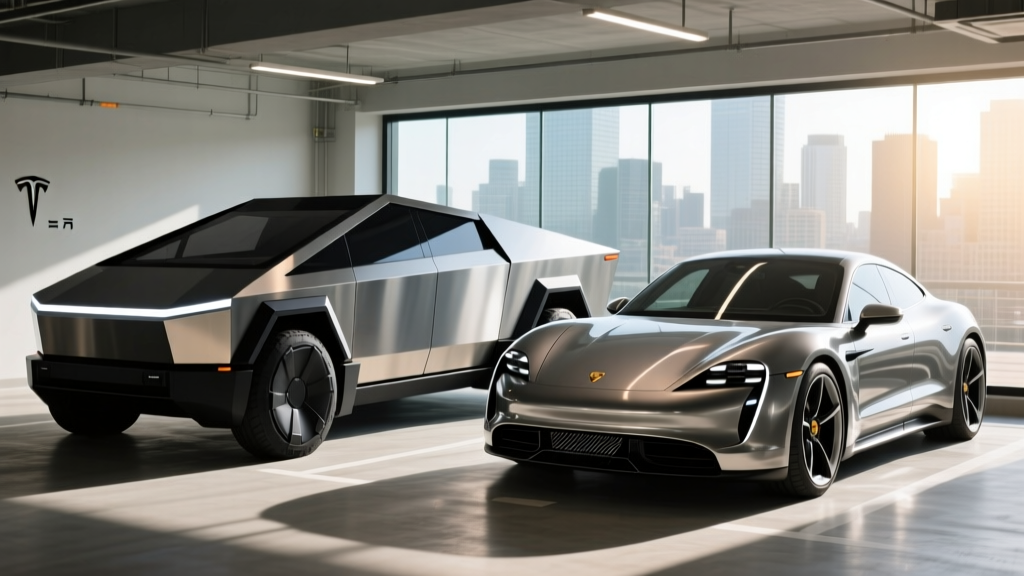
Comparing the Tesla Cybertruck to the Porsche Taycan isn't like comparing two sedans or two SUVs — these vehicles exist in entirely different categories with different buyer profiles. The Cybertruck is a stainless-steel electric pickup built for utility, towing, and off-road capability. The Taycan is a luxury electric sports sedan (and wagon) engineered for driving dynamics, refinement, and prestige. Yet both sit in the $80,000–$120,000 EV price band, and cross-shoppers do exist — buyers who want a high-profile electric vehicle and are weighing function against form.
This head-to-head breaks down every spec that matters: real-world range, charging speed and network access, performance, interior tech, ownership economics, and the tax-credit landscape as of 2026. The goal isn't to crown a universal winner — it's to make your specific priorities point clearly toward one or the other.
Side-by-Side Spec Table: Cybertruck vs Taycan
| Spec | Tesla Cybertruck AWD | Porsche Taycan 4S (Sedan) |
|---|---|---|
| EPA Range | 340 mi | 283 mi (with Performance Battery Plus) |
| Battery (usable, chemistry) | ~123 kWh, NMC | ~97 kWh (Performance Battery Plus), NMC |
| Peak DC Fast Charge | ~250 kW (NACS) | ~320 kW (CCS via NACS adapter) |
| 10–80% DC Charge Time | ~28 min | ~18 min (on 350 kW-class charger) |
| Level 2 Charge Rate | 11.5 kW (44 mi/hr) | 9.6 kW (optional 19.2 kW) |
| 0–60 mph | 3.9 sec (AWD) | 3.7 sec (4S with Launch Control) |
| Horsepower | 600 hp | 590 hp (overboost) |
| MPGe (combined) | ~67 MPGe | ~83 MPGe |
| Cargo Volume | ~67 cu ft (vault + frunk) | ~14.3 cu ft (rear trunk) + 3.0 cu ft (frunk) |
| Towing Capacity | 11,000 lb | Not rated |
| Base MSRP (representative trim) | $79,990 (AWD) | $103,800 (4S Sedan) |
| Battery / Powertrain Warranty | 8 yr / 120,000 mi | 8 yr / 100,000 mi |
| ADAS | Autopilot (Level 2); FSD Supervised option | Porsche InnoDrive (Level 2) |
Range, Efficiency, and Charging: Where Physics Favors Each
Range and charging tell two different stories here, and they map almost perfectly to each vehicle's design priorities.
Cybertruck: Big Battery, Big Appetite
The Cybertruck AWD's ~123 kWh usable battery is among the largest in any production EV. That delivers the 340-mile EPA figure, but the truck's aerodynamic drag (stainless-steel flat panels, tall ride height, 6,600+ lb curb weight) means it burns energy fast. Efficiency sits around 2.1–2.3 kWh/mi in mixed driving — roughly 50% thirstier per mile than the Taycan.
DC fast charging peaks near 250 kW on Tesla's Supercharger network, but the massive battery means sustained charge times are longer: 10–80% takes approximately 28 minutes under ideal conditions (preconditioned battery, V3/V4 Supercharger). The charge curve tapers notably above 70% SoC — plan for 35–40 minutes on a road trip if you need 85%+.
Taycan: 800V Architecture Wins on Speed
The Taycan's 800-volt electrical architecture is the decisive advantage at public chargers. On a 350 kW-class CCS station (Electrify America, Ionity), the Taycan 4S with Performance Battery Plus can sustain over 270 kW for a meaningful portion of the charge curve, hitting 10–80% in roughly 18 minutes. That's a 10-minute advantage over the Cybertruck despite the smaller battery — and those minutes compound on long road trips.
As of 2026, Porsche owners can access Tesla Superchargers using a Porsche-supplied NACS-to-CCS adapter, expanding the Taycan's network options significantly. However, on a NACS Supercharger (max 250 kW / 400V), the Taycan cannot leverage its 800V advantage — it charges at the station's limit, not its own.
🏆 Range Winner: Cybertruck
340 vs 283 EPA miles. If raw distance between charges is your priority — especially for towing or remote-area driving — the Cybertruck's 57-mile advantage is substantial.
🏆 Charging Speed Winner: Taycan
18 vs 28 minutes (10–80%). The Taycan's 800V system recovers range faster per minute at compatible DC stations, a real advantage on multi-stop road trips.
Performance and Driving Dynamics
On paper, 0–60 times are nearly identical (3.7s Taycan 4S vs 3.9s Cybertruck AWD). In practice, the driving experiences couldn't be more different.
The Taycan is a sports car that happens to be electric. Its low center of gravity, rear-biased torque distribution, available rear-axle steering, and adaptive air suspension deliver cornering composure that defies its ~5,100 lb curb weight. Porsche's two-speed transmission on the rear motor provides strong initial launch and efficient highway cruising. Track use, canyon carving, and high-speed Autobahn stability are where the Taycan's engineering budget shows.
The Cybertruck is quick in a straight line — genuinely startling for a vehicle its size — but its 6,600+ lb weight, high ride height, and steer-by-wire system prioritize capability over cornering. The stainless-steel exoskeleton and armored glass project toughness, and the 11,000-lb tow rating and adaptive air suspension (with 16 inches of ground clearance in Extract Mode) make it a legitimate work and off-road platform. If you need to haul a trailer to a job site or navigate a trailhead, the Taycan simply isn't in the conversation.
🏆 Driving Dynamics Winner: Taycan
Chassis tuning, steering feel, and cornering capability are in a different league. This is Porsche's core competency.
🏆 Utility / Capability Winner: Cybertruck
11,000-lb tow, 67 cu ft cargo vault, off-road clearance. No contest for work or adventure hauling.
Pricing, Tax Credits, and Total Purchase Cost
The pricing gap between these two is significant — and federal tax credit eligibility widens it further.
| Cost Factor | Tesla Cybertruck AWD | Porsche Taycan 4S |
|---|---|---|
| Base MSRP | $79,990 | $103,800 |
| Typical Options / Destination | + $2,500–$8,000 (FSD, wraps, accessories) | + $8,000–$20,000 (paint, wheels, packages) |
| Realistic As-Configured Price | $84,000–$90,000 | $112,000–$125,000 |
| §30D MSRP Cap (Trucks/Vans) | $80,000 (Cybertruck qualifies as truck) | N/A (sedans capped at $55,000 — Taycan exceeds) |
| §30D Federal Credit Eligibility | Up to $7,500 (if battery sourcing + income requirements met) | $0 (exceeds MSRP cap) |
| Effective Price After Max Credit | ~$76,500–$82,500 | $112,000–$125,000 |
Ownership Costs: Efficiency, Insurance, and Maintenance
Beyond the purchase price, these vehicles diverge sharply on running costs.
Energy Efficiency (Cost per Mile)
The Taycan's ~83 MPGe combined vs the Cybertruck's ~67 MPGe translates to real money. At a national average residential electricity rate of $0.17/kWh (2026 EIA data):
- Taycan 4S: ~$0.048/mi (34 kWh/100 mi)
- Cybertruck AWD: ~$0.073/mi (43 kWh/100 mi, light load)
- Cybertruck towing: ~$0.12–$0.15/mi (70+ kWh/100 mi under load)
Over 15,000 annual miles, the Taycan costs roughly $720/year to charge at home; the Cybertruck costs ~$1,095/year (no towing). If you tow regularly, the Cybertruck's energy cost can double or triple.
Insurance
The Cybertruck's stainless-steel body panels, specialized glass, and high repair costs have pushed insurance premiums well above average for the truck segment. Industry data from 2025–2026 places average Cybertruck annual premiums at $3,200–$4,500 depending on state and driver profile. The Taycan 4S, while not cheap to insure, typically runs $2,400–$3,500/year — a luxury-sedan premium but less than the Cybertruck's outlier pricing. Get quotes from your insurer before committing to either.
Maintenance
Both vehicles benefit from EV powertrain simplicity — no oil changes, no transmission fluid, no spark plugs. Tire wear is the primary recurring cost, and both are heavy vehicles with high-torque AWD that accelerates tire consumption. Expect $1,200–$2,000 for a set of four tires every 25,000–35,000 miles on either vehicle. Porsche dealership labor rates are significantly higher than Tesla mobile service rates, which can add $300–$600/year for cabin filter replacements, brake fluid checks, and wiper service.
🏆 Efficiency Winner: Taycan
~$375/year cheaper to charge at typical mileage, and the gap widens if you don't tow.
🏆 Value Winner: Cybertruck
$30,000+ lower purchase price, plus potential $7,500 tax credit. More vehicle per dollar by any cargo/utility metric.
Interior, Tech, and Daily Usability
The Cybertruck and Taycan take opposite approaches to interior design and technology.
The Cybertruck is minimalist to a fault: a single 18.5-inch center touchscreen controls nearly everything, with a yoke-style steering wheel and no traditional instrument cluster. The rear seat gets its own 9.4-inch screen. Build quality has improved since the 2024 launch, but panel gaps and material choices still draw mixed reviews. The 6-foot vault (bed) with powered tonneau, 120V/240V outlets, and available Powershare (V2L/V2H) capability make it a genuine mobile power platform — useful for job sites, camping, or backup home power.
The Taycan offers a more traditional luxury environment: curved 16.8-inch digital instrument cluster, 12.3-inch center touchscreen, optional passenger display, and physical buttons for climate and drive modes. Materials are premium (leather, Alcantara, carbon fiber trim). The trade-off is cargo space: 14.3 cu ft rear trunk plus a small 3.0 cu ft frunk is tight for a vehicle this size. The Taycan Cross Turismo (wagon variant, 283 mi range) adds rear headroom and up to ~23 cu ft of cargo, but still can't touch the Cybertruck's utility.
🏆 Tech / Software Winner: Tesla (Cybertruck)
OTA updates, Supercharger integration, FSD Supervised (Level 2), and Powershare V2L give Tesla the edge in software ecosystem.
🏆 Interior Quality Winner: Taycan
Fit, finish, materials, and cabin quietness are a class above. Porsche's luxury execution is proven.
Charging Network and Road-Trip Practicality
For 2026, the Tesla Supercharger network remains the gold standard for reliability and geographic coverage in North America — over 6,500 stations and 65,000+ stalls. The Cybertruck accesses this natively via NACS, and trip planning through the Tesla app is seamless with automatic battery preconditioning.
The Taycan, using CCS natively, relies on Electrify America, EVgo, and other third-party networks. Reliability on these networks has improved but still lags Tesla's uptime. Porsche's included NACS adapter grants Supercharger access, but at 250 kW / 400V — meaning the Taycan's 800V fast-charge advantage is neutralized on Tesla stalls. For the best Taycan charging experience, you need 350 kW CCS stations, which are less densely deployed than Superchargers, particularly in rural corridors.
If your road trips regularly take you through charging-desert regions (rural Mountain West, parts of the Southeast), the Cybertruck's native Supercharger access and larger battery provide a meaningful buffer. If your routes follow major interstates with Electrify America coverage, the Taycan's 800V speed advantage makes it the faster road-tripper stop for stop.
Decision Framework: Which Should You Choose?
Choose the Tesla Cybertruck if:
- You need a truck bed, towing capacity (11,000 lb), or V2L/V2H power capability
- You want maximum EPA range (340 mi) and native Supercharger access
- Your budget is $80,000–$90,000 and you want to capture the §30D tax credit
- You value over-the-air updates, Tesla's software ecosystem, and Powershare functionality
- You drive in areas where Supercharger coverage significantly outpaces CCS networks
Choose the Porsche Taycan if:
- Driving dynamics, chassis refinement, and sports-car handling are top priorities
- You want the fastest DC charging on compatible 350 kW CCS stations (18 min, 10–80%)
- Interior luxury, build quality, and brand prestige matter to you
- Your budget extends to $110,000–$125,000 and you don't need the §30D credit
- You don't need a truck bed or tow rating — your cargo needs fit a sedan or wagon
- You want Porsche InnoDrive (Level 2 ADAS) and a traditional luxury ownership experience
Bottom line: If you came here expecting a clear winner, the honest answer is that these vehicles solve different problems. The Cybertruck is the more capable, more affordable, more practical daily tool — especially for anyone with work, towing, or off-pavement needs. The Taycan is the better driver's car, the faster charger (on the right infrastructure), and the more refined luxury experience. Your priorities — utility vs dynamics, budget vs prestige, Supercharger dependence vs 800V speed — should make the call for you.
Frequently Asked Questions
Is the Cybertruck eligible for the $7,500 federal EV tax credit in 2026?
The base Cybertruck AWD at $79,990 falls under the §30D truck MSRP cap of $80,000, making it potentially eligible. However, the full $7,500 credit depends on meeting 2026 critical-mineral and battery-component sourcing thresholds, plus buyer income limits ($300K joint / $150K single). The credit can be transferred at point of sale as a purchase-price reduction. Always confirm current-year eligibility on IRS.gov and with a tax professional before purchasing.
Can the Porsche Taycan use Tesla Superchargers?
Yes. As of 2026, Porsche provides a NACS-to-CCS adapter for Taycan owners, enabling access to Tesla Supercharger stalls. However, Superchargers operate at 250 kW / 400V, which means the Taycan's 800V architecture cannot achieve its peak ~320 kW charge rate on Tesla stalls. For maximum charging speed, use 350 kW-class CCS stations (Electrify America, etc.).
Which is cheaper to own over 5 years?
The Cybertruck has a lower purchase price (~$30,000+ less) and potential tax credit, but higher insurance premiums ($800–$1,200/year more) and higher per-mile energy costs. The Taycan costs more upfront with no federal credit, but is cheaper to insure and more energy-efficient. Over 5 years / 75,000 miles, the Cybertruck's purchase-price advantage generally outweighs its higher running costs — making it the less expensive vehicle to own overall, assuming no major towing use.
Does the Cybertruck's range drop significantly when towing?
Yes. Towing a 5,000–7,000 lb trailer typically reduces range by 35–50%, bringing effective range to ~170–220 miles depending on trailer aerodynamics, terrain, and speed. This is a physics constraint common to all electric trucks, not specific to the Cybertruck. Plan charging stops accordingly and use Tesla's trip planner with trailer profiles.
Is Tesla's FSD or Porsche's InnoDrive actually self-driving?
No. Both are SAE Level 2 driver-assistance systems. Tesla's Full Self-Driving (Supervised) and Porsche InnoDrive require continuous driver attention, hands-on or eyes-on engagement, and the driver is legally responsible at all times. Neither system is autonomous (Level 4/5). Do not treat either as a substitute for active driving.
Which holds its value better?
Historically, Porsche vehicles — especially limited-production or high-demand trims — retain value well in the luxury segment. Tesla's depreciation has been more volatile, influenced by frequent price changes, new model introductions, and market saturation. Early 2024–2025 data suggests the Cybertruck has held value unusually well due to production constraints and high demand, but long-term depreciation curves for both vehicles are still forming. Check current resale data on Kelley Blue Book or Edmunds before purchasing.