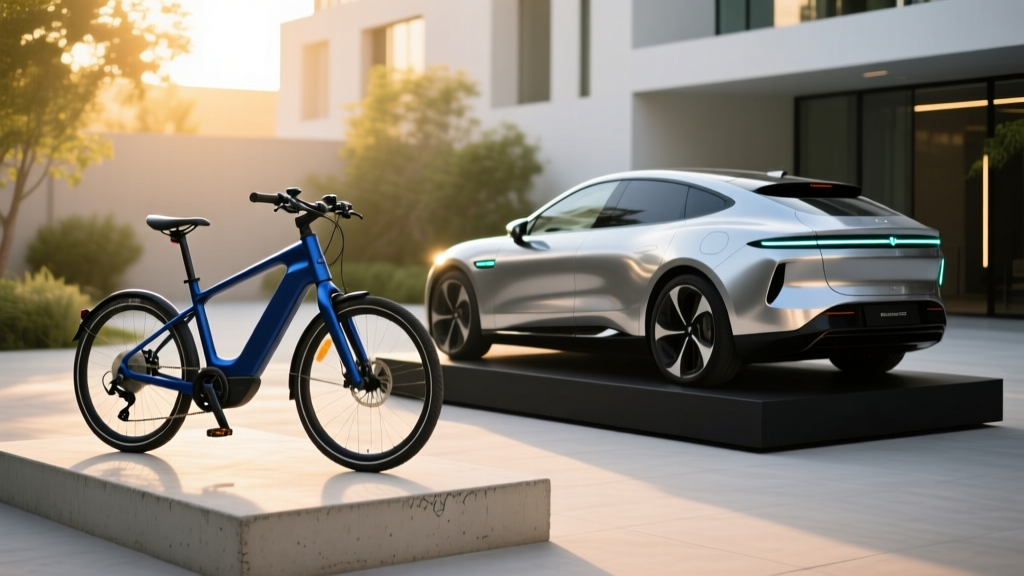
Every November, search terms like black friday deals electric bikes spike as shoppers look for discounted e-bikes and scooters. But for buyers weighing a bigger electrification decision — should I buy an e-bike for commuting, or invest in a full electric vehicle? — the holiday discount season raises a more complex question. An e-bike on sale for $1,200 looks cheap next to a $40,000 EV, but the total cost of ownership (TCO) math tells a more nuanced story when you factor in federal tax credits, fuel savings, insurance, and depreciation over five years.
This guide breaks down the real 5-year ownership costs of a mainstream 2026 EV versus a typical commuter e-bike purchased during Black Friday sales, so you can decide which electrified option actually saves you money — and which just shifts where you spend it.
The 5-Year Total Cost of Ownership: EV vs Electric Bike
To compare fairly, we'll use a representative 2026 EV — the Hyundai Ioniq 5 SE Standard Range (MSRP $42,400, 77.4 kWh NMC battery, 220-mile EPA range, 302 HP) — against a typical Black Friday discounted commuter e-bike (sale price ~$1,400, 500W hub motor, ~40-mile range per charge, 20 mph top speed). The e-bike replaces no car trips for most owners; it supplements them. The EV replaces a gasoline car entirely.
| Cost Category | Ioniq 5 SE (EV) | Commuter E-Bike |
|---|---|---|
| Purchase Price | $42,400 | $1,400 |
| Federal Tax Credit (§30D) | −$7,500 (if eligible) | $0 (not eligible) |
| State/Utility Incentives | −$500 to −$2,500 (varies) | −$0 to −$300 (rare) |
| Effective Purchase | ~$32,400–$34,400 | ~$1,100–$1,400 |
| Fuel/Energy (5 years, 12k mi/yr EV; 2k mi/yr e-bike) | $3,750 (at $0.14/kWh) | $72 (at $0.14/kWh) |
| Insurance (5 years) | $9,500–$11,000 | $0–$600 (optional) |
| Maintenance (5 years) | $1,800 | $400–$800 |
| Depreciation (5 years) | ~$14,000–$17,000 | ~$800–$1,100 |
| Estimated 5-Year TCO | ~$51,500–$56,700 | ~$2,400–$3,900 |
The e-bike wins on raw dollar outlay, but this comparison omits the critical context: the EV replaces a gasoline car's costs, while the e-bike typically does not. A fair comparison is EV vs the gas car it displaces.
Federal Tax Credit: IRS §30D Rules for 2026
The federal EV tax credit under IRS §30D can reduce the effective price of a qualifying new EV by up to $7,500, but eligibility is far from automatic. As of 2026, the rules have tightened significantly compared to the early days of the credit.
§30D Eligibility Checklist (2026 Tax Year)
- MSRP Caps: Vans, SUVs, and pickups must be under $80,000 MSRP; sedans and other body styles under $55,000. The Ioniq 5 ($42,400 base) qualifies.
- Buyer Income Limits: Modified adjusted gross income (MAGI) must not exceed $300,000 (joint filers), $225,000 (head of household), or $150,000 (single filers).
- Battery Sourcing — Critical Minerals: A specified percentage of critical minerals must be extracted or processed in the U.S. or a free-trade-agreement country, or recycled in North America. This threshold increases annually.
- Battery Sourcing — Components: A specified percentage of battery components must be manufactured or assembled in North America. This threshold also increases annually.
- Foreign Entity of Concern (FEOC) Restriction: Vehicles with battery components or critical minerals from a FEOC (primarily targeting Chinese supply chains) are disqualified entirely, regardless of other criteria.
- Point-of-Sale Transfer: As of 2024, buyers can transfer the credit to the dealer at purchase, reducing the sale price directly rather than waiting to claim it on their tax return. The dealer must be IRS-registered.
- One Credit Per VIN: The vehicle must not have been previously claimed for the §30D credit.
Why this matters for Black Friday shoppers: Dealers may advertise "Black Friday EV deals" that stack dealer discounts with the federal credit, but the credit is not a discount — it's a tax benefit subject to strict eligibility. A vehicle that qualifies in January may not qualify in December if battery sourcing changes or if the buyer's income exceeds the cap. Always verify eligibility on fueleconomy.gov before assuming the credit applies.
State, Local, and Utility Incentives
Beyond the federal credit, incentives vary dramatically by jurisdiction:
- California (CVRP): Up to $7,000 for income-qualified buyers on new EVs (funding-dependent).
- Colorado: $5,000 state tax credit for new EVs under $80,000 MSRP.
- Utility Rebates: Many utilities offer $250–$1,500 rebates for home Level 2 charger installation (e.g., PG&E, ConEdison, Xcel Energy).
- E-Bike Rebates: A growing number of cities (Denver, Boulder, Portland) offer $300–$1,700 e-bike rebates, some income-tiered. Check your local transportation or air-quality agency.
These programs change frequently. Consult your state energy office or utility provider for current availability.
Charging vs Gasoline: The Per-Mile Cost Reality
The most common EV ownership claim — "it's cheaper to charge than to fill up" — is broadly true but requires specific math to be useful.
| Vehicle | Energy Source | Efficiency | Cost Per Unit | Cost Per Mile |
|---|---|---|---|---|
| Ioniq 5 SE (home charging) | Electricity | 30 kWh/100 mi (3.33 mi/kWh) | $0.14/kWh (U.S. avg) | $0.042 |
| Ioniq 5 SE (DC fast charging) | Electricity | 30 kWh/100 mi | $0.35–$0.48/kWh | $0.105–$0.144 |
| 2026 Toyota RAV4 AWD (gas) | Gasoline | 30 MPG combined | $3.30/gal | $0.110 |
| Commuter E-Bike | Electricity | ~0.015 kWh/mi | $0.14/kWh | $0.002 |
Annual fuel savings (12,000 miles/year): Charging the Ioniq 5 at home costs roughly $504/year versus $1,320/year for the RAV4 — a savings of about $816 annually. Over five years, that's approximately $4,080 in fuel savings.
However, if you rely primarily on public DC fast charging (at $0.40/kWh average), your annual fuel cost rises to roughly $1,440 — actually more than the gas car. Home charging access is the single biggest variable in EV fuel economics. The e-bike, meanwhile, costs essentially nothing to "fuel" — about $3.60 per year at 2,000 miles.
Maintenance Savings: Fewer Moving Parts, Real Dollars
EVs eliminate the most routine maintenance items of internal combustion engines. Here's what changes:
| Service Item | Gas Car (5-Year Cost) | EV (5-Year Cost) |
|---|---|---|
| Oil Changes (2×/year) | $500–$750 | $0 |
| Brake Pads/Rotors | $600–$1,200 | $0–$300 (regen braking extends pad life 2–3×) |
| Transmission Fluid/Service | $200–$400 | $0 (single-speed reduction gear) |
| Engine Air Filter | $100–$150 | $0 (cabin filter only, ~$80) |
| Spark Plugs | $200–$400 | $0 |
| Coolant Flush | $150–$250 | $150–$250 (battery thermal loop) |
| Tire Rotation/Replacement | $1,200–$2,000 | $1,400–$2,400 (EVs wear tires ~20% faster due to weight/torque) |
| Total Estimated (5 yr) | $2,950–$5,150 | $1,630–$3,030 |
Net maintenance savings for the EV over five years: roughly $1,300–$2,100. The e-bike requires chain lubrication, occasional brake pad replacement, and battery replacement around year 4–5 ($300–$500 for a quality pack), totaling $400–$800 over five years.
Insurance: The Hidden EV Cost Premium
This is where the EV cost narrative gets honest. EVs typically cost 15–30% more to insure than comparable gasoline vehicles. According to industry data, the average annual EV insurance premium in 2026 is approximately $1,900–$2,200 versus $1,400–$1,700 for a gas equivalent.
Why EVs cost more to insure:
- Higher repair costs: Battery packs are expensive to replace after collision damage. Even minor structural damage near the battery enclosure can trigger a total-loss declaration.
- Specialized labor: High-voltage system repairs require certified technicians, which are still scarce in many markets.
- Parts availability: EV-specific body panels, battery modules, and power electronics often have longer lead times than ICE parts.
- Higher vehicle MSRP: Insurance premiums scale with replacement cost.
For the Ioniq 5 over five years, expect insurance costs of approximately $9,500–$11,000 versus $7,000–$8,500 for a comparably priced gas SUV. That's a $2,500 insurance premium for going electric — a real cost that offsets some fuel and maintenance savings.
E-bike insurance: Most homeowners or renters policies cover e-bikes for theft (often with sub-limits of $1,000–$2,500). Dedicated e-bike insurance from providers like Velosurance or Sundance runs $100–$300/year for liability and theft coverage. Many e-bike owners carry no dedicated insurance at all.
Depreciation and Resale Value: The Moving Target
EV depreciation has been volatile. In 2023–2024, aggressive Tesla price cuts cascaded through the used EV market, causing some models to lose 40–50% of value in two years. By 2026, the market has stabilized somewhat, but EVs still depreciate differently than gas cars.
Current 5-year depreciation estimates:
- Mainstream EVs (Ioniq 5, Model Y, Mach-E): 40–50% depreciation over 5 years / 60,000 miles. The Ioniq 5 SE purchased at $34,900 (after credit) might resell for $17,500–$21,000.
- Gas compact SUVs (RAV4, CR-V): 35–42% depreciation over the same period.
- E-bikes: 60–80% depreciation. A $1,400 Black Friday e-bike will likely resell for $300–$500 after five years of use, primarily due to battery degradation and rapid model-year improvements.
EV depreciation is heavily influenced by battery state-of-health (SoH) at resale. A vehicle with documented 90%+ battery capacity retention commands a premium. Most manufacturers warrant the battery for 8 years / 100,000 miles at a minimum 70% capacity retention threshold, which provides some floor for resale value within the warranty period.
The Decision Framework: E-Bike, EV, or Both?
Choose the Black Friday e-bike deal if:
- You already own a car and want to eliminate short commutes (under 15 miles round-trip).
- Your total budget is under $2,000 and you cannot finance a vehicle.
- You live in a city with protected bike lanes and mild weather for 7+ months of the year.
- Your goal is reducing car usage, not replacing a car.
Choose the EV (with §30D credit) if:
- You need a primary vehicle for commuting, family, or all-weather use.
- You have access to home Level 2 charging (or can install it for $800–$2,500).
- You qualify for the full $7,500 federal credit based on income and vehicle sourcing.
- Your annual mileage exceeds 10,000 miles, where fuel savings compound significantly.
Choose both if:
- You can afford the EV as your primary car and an e-bike as a last-mile/errand supplement.
- You want to minimize total household fuel and parking costs across all trip types.
Frequently Asked Questions
How much does it really cost to own an EV over 5 years?
For a mainstream 2026 EV like the Hyundai Ioniq 5 SE, expect a 5-year total cost of ownership between $51,500 and $56,700, including purchase (net of tax credits), home charging, insurance, maintenance, and depreciation. This compares to approximately $48,000–$54,000 for a similarly equipped gas compact SUV over the same period. The EV's advantage grows with higher annual mileage and lower electricity rates, but the insurance premium and depreciation narrow the gap for low-mileage drivers.
Do I qualify for the $7,500 federal EV tax credit?
Eligibility depends on four factors: (1) your income must be below the MAGI caps ($300K joint / $150K single), (2) the vehicle MSRP must be under $55,000 for cars or $80,000 for SUVs/trucks/vans, (3) the vehicle's battery must meet critical-mineral and component sourcing thresholds that increase annually, and (4) no battery components or critical minerals may come from a Foreign Entity of Concern. Check the current qualified vehicle list at fueleconomy.gov and consult a tax professional for your specific situation.
How much do I save on fuel and maintenance with an EV?
At the U.S. average electricity rate of $0.14/kWh and home charging, an EV saves approximately $800–$900 per year in fuel costs compared to a 30 MPG gas car at $3.30/gallon. Maintenance savings add another $260–$420 per year (no oil changes, reduced brake wear, no spark plugs). Combined, that's roughly $1,060–$1,320 in annual operating savings, or $5,300–$6,600 over five years. These savings are offset partially by higher insurance costs ($500–$600/year more).
Are EVs more expensive to insure?
Yes. Expect EV insurance premiums to run 15–30% higher than equivalent gas vehicles. The primary drivers are higher collision repair costs (battery replacement can exceed $15,000), specialized technician requirements, and higher initial MSRP. For a $42,000 EV, budget $1,900–$2,200 annually for full-coverage insurance versus $1,400–$1,700 for a comparable gas vehicle.
How well do EVs hold their value?
EV depreciation has been higher and more volatile than gas vehicles, averaging 40–50% over five years for mainstream models. Battery health at resale is the key variable — documented high SoH improves resale value. The 8-year/100,000-mile battery warranty provides a value floor for vehicles sold within that window. E-bikes depreciate even more steeply (60–80% over five years) due to rapid technology advancement and battery wear.
Are Black Friday e-bike deals actually worth it?
Black Friday discounts on e-bikes typically range from 15–35% off MSRP, making it one of the best times to buy. However, prioritize reputable brands with UL-certified batteries (UL 2849 standard) over deep-discount imports. A $600 e-bike with an uncertified battery poses fire and safety risks that no discount justifies. Expect to spend $1,200–$2,000 for a quality commuter e-bike even after holiday discounts.