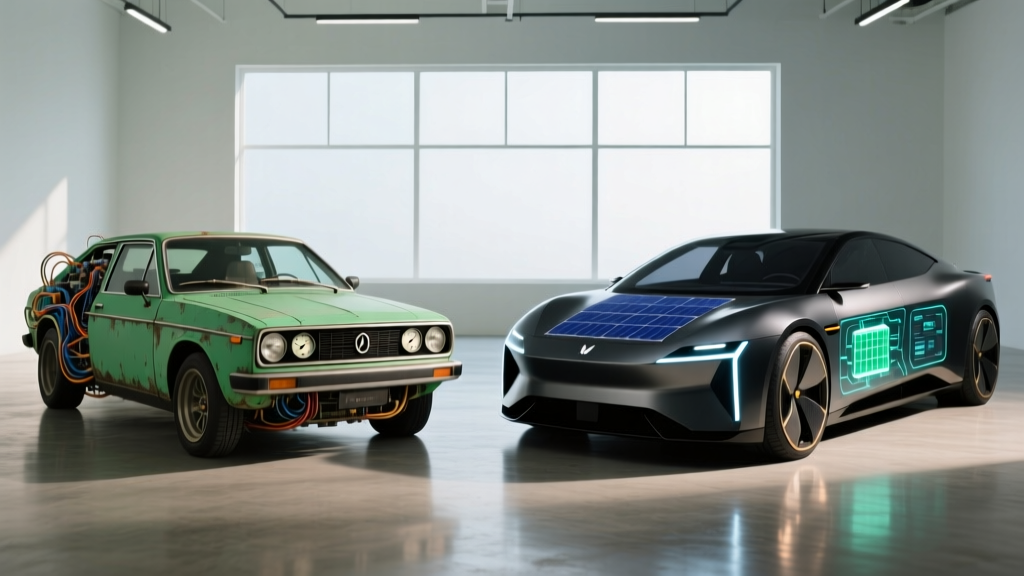
The short answer: A 1970 electric car — like the AMC Amitron concept or converted lead-acid electrics of that era — delivered roughly 20–40 miles of range on 500+ lbs of batteries, topped out near 50 mph, and took 6–8 hours to recharge. A 2026 EV like the Chevrolet Equinox EV offers 315 miles of EPA range, charges from 10–80% in about 23 minutes at 150 kW, and costs as little as $33,600 before potential federal tax incentives. The gap isn't incremental — it's a completely different category of vehicle.
Why Anyone Is Still Searching for a 1970 Electric Car
Searches for "1970 electric car" spike from three distinct groups: EV historians curious about pre-modern electrification, classic car restomod enthusiasts considering an electric conversion, and skeptics who argue that EVs have been "50 years away" for decades. Each group deserves an honest, data-grounded answer.
The reality is that electric vehicles are not new. Battery-electric prototypes existed as early as the 1830s, and electric taxis operated in New York City in the 1890s. But the 1970s represented a specific moment: the oil crisis pushed automakers and governments to explore alternatives, and several serious EV prototypes emerged. Understanding what those vehicles could — and couldn't — do is essential context for evaluating today's EVs.
The 1970 Electric Car Landscape: What Actually Existed
There was no single mass-produced "1970 electric car" you could walk into a dealership and buy. What existed were prototypes, conversions, and limited-run vehicles built around lead-acid battery technology. Here are the key examples from that era:
AMC Amitron (1967–1970s prototype): American Motors Corporation's concept used a lithium-based battery system (advanced for the time) and claimed up to 150 miles of range under ideal conditions. It never reached production. Real-world estimates from independent testing of similar lead-acid conversions of the period suggest 30–50 miles was the practical ceiling for most electric vehicles.
CitiCar (1974–1977): Produced by Sebring-Vanguard, this was the closest thing to a commercially available electric car of the 1970s. It used eight 6-volt lead-acid batteries, delivered roughly 35–40 miles of range, had a top speed of about 38 mph, and retailed for approximately $2,700 (roughly $15,000 in 2026 dollars adjusted for inflation).
EV conversions: Hobbyists and small shops converted VW Beetles, Renault Dauphines, and other lightweight cars to electric using lead-acid batteries. These typically achieved 20–40 miles of range, required 500–800 lbs of batteries, and cost $3,000–$6,000 to convert.
The fundamental physics limitation was energy density. Lead-acid batteries store approximately 30–50 watt-hours per kilogram (Wh/kg). That means a 20 kWh battery pack — enough for roughly 60–70 miles in a lightweight vehicle — would weigh over 900 lbs.
1970s EV vs. 2026 EV: The Numbers Don't Lie
Let's put the data side by side. We're comparing a representative 1970s-era electric conversion (lead-acid, lightweight sedan) against a 2026 Chevrolet Equinox EV 3LT (a mainstream, mid-priced American EV):
| Specification | 1970s Lead-Acid EV Conversion | 2026 Chevrolet Equinox EV 3LT |
|---|---|---|
| Battery Chemistry | Lead-acid | Ultium NMC lithium-ion |
| Usable Battery Capacity | ~8–12 kWh | 85 kWh |
| Battery Pack Weight | ~600–900 lbs | ~960 lbs |
| Energy Density | 30–50 Wh/kg | ~200+ Wh/kg (cell level) |
| EPA Range | N/A (pre-EPA labeling) | 315 miles |
| Real-World Practical Range | 20–40 miles | 250–280 miles (highway/cold) |
| Top Speed | 38–55 mph | 130 mph (electronically limited) |
| 0–60 mph | Not achievable | ~7.9 seconds |
| Recharge Time (Full) | 6–8 hours (120V) | ~9.5 hours (Level 2, 11.5 kW) |
| DC Fast Charging | Not available | 150 kW peak, 10–80% in ~23 min |
| Purchase Price (new) | $2,700–$6,000 (~$15K–$33K adj.) | $33,600 MSRP (before incentives) |
| Battery Cycle Life | 300–500 cycles | 1,500–2,000+ cycles (NMC) |
| Warranty | None | 8 years / 100,000 miles (battery) |
The energy density improvement is the headline: modern NMC lithium-ion cells store roughly 4 to 6 times more energy per kilogram than lead-acid batteries. That single improvement cascades into every other metric — range, weight, performance, and packaging.
What 55 Years of Battery Progress Actually Cost
The cost story is more nuanced than "EVs were always expensive." Here's a breakdown of the real economics, then and now.
1970s EV Operating Costs
Electricity in 1970 averaged roughly $0.02 per kWh (about $0.16 in 2026 dollars adjusted for inflation). A full 10 kWh charge cost $0.20 nominal ($1.60 adjusted). However, lead-acid batteries needed replacement every 2–3 years (300–500 cycles) at a cost of $400–$800 ($2,200–$4,400 adjusted). That battery replacement cost alone amounted to roughly $0.10–$0.20 per mile driven — making the total operating cost surprisingly high for such limited capability.
2026 EV Operating Costs
The national average residential electricity rate in 2026 is approximately $0.17 per kWh (U.S. EIA). Charging an 85 kWh Equinox EV from empty to full costs about $14.45 at home. At 3.7 miles per kWh, that's $0.046 per mile for energy. Battery replacement is rarely needed — modern NMC packs are warrantied for 8 years/100,000 miles with a minimum 70% capacity retention threshold, and real-world data from Tesla and GM shows most packs retain 85–90% capacity at 150,000 miles.
| Cost Factor | 1970s Lead-Acid EV | 2026 Equinox EV | 2026 Gas Car (30 MPG avg) |
|---|---|---|---|
| Energy/Fuel Cost per Mile | ~$0.02 (adj.) | $0.046 (home charging) | $0.11 (at $3.30/gal) |
| Battery Replacement Interval | 2–3 years | 10–15+ years (rarely needed) | N/A |
| Battery Replacement Cost | $2,200–$4,400 (adj.) | $8,000–$14,000 (if needed out of warranty) | N/A |
| Annual Maintenance | Minimal | ~$300–$500/yr | ~$900–$1,200/yr |
| 5-Year Fuel/Energy Cost (75K mi) | ~$1,500 (adj.) | ~$3,450 (home) | ~$8,250 |
The 2026 EV costs roughly 2.4x more per mile for energy than the 1970s EV in inflation-adjusted terms, but it delivers 8–10x the range, 3–4x the speed, genuine highway capability, climate control, safety systems, and DC fast charging. The value proposition per mile of usable range is incomparably better today.
Real-World Ownership in 2026: What First-Time Buyers Need to Know
If the history lesson has you convinced that a modern EV is worth considering, here's what actually matters in 2026 ownership — the stuff spec sheets don't always tell you.
Home Charging Is the Real Make-or-Break
Approximately 80–85% of EV charging happens at home. A Level 2 home charger (240V, 32–48 amps, 7.7–11.5 kW) adds 25–40 miles of range per hour and fully recharges most EVs overnight. Installation costs range from $500–$1,500 if your electrical panel has capacity, or $2,000–$4,000 if a panel upgrade (to 200A service) is needed. Without home charging, public DC fast charging costs $0.30–$0.50 per kWh — roughly $0.08–$0.14 per mile, which erases much of the fuel savings advantage.
Cold Weather Range Loss Is Real
Lithium-ion batteries lose 20–40% of their EPA-rated range in sustained sub-freezing temperatures, primarily because energy is diverted to heating the cabin and battery. A 315-mile Equinox EV might deliver 190–250 miles in 20°F weather. Vehicles equipped with a heat pump (standard on many 2026 models including Hyundai, Kia, and Tesla) mitigate this loss to roughly 15–25%.
Charging Curves Matter More Than Peak kW
When a manufacturer advertises "150 kW DC fast charging," that's a peak rate — not a sustained one. A typical charge curve starts at peak kW around 10–20% State of Charge (SoC), holds near-peak through ~50%, then tapers significantly above 80%. That 10–80% charge time of ~23 minutes assumes battery preconditioning and a functioning high-power stall. Always budget 30–40 minutes for a realistic road-trip charging stop.
Federal Tax Credit Reality for 2026
The IRS §30D Clean Vehicle Credit remains available in 2026 but with strict eligibility requirements that disqualify many vehicles and buyers. Here's what you must verify before counting on the credit:
- MSRP Caps: Vans, SUVs, and pickups must have an MSRP under $80,000; sedans and other body styles under $55,000.
- Buyer Income Limits: Modified adjusted gross income must not exceed $300,000 (joint filers), $225,000 (head of household), or $150,000 (single).
- Battery Component Sourcing: Increasing percentages of battery components must be manufactured or assembled in North America, and critical minerals must be sourced from the U.S. or free-trade-agreement partners. These thresholds tighten annually.
- Point-of-Sale Transfer: Eligible buyers can transfer the credit to the dealer at purchase, reducing the out-of-pocket price immediately — but you must not exceed income caps, or you'll owe the credit back at tax time.
- FEOC Restriction: Vehicles containing battery components from a "foreign entity of concern" (primarily targeting Chinese supply chains) are disqualified.
Always verify current eligibility on IRS.gov and consult a tax professional before relying on the credit in your purchase math. The Equinox EV, built on the Ultium platform with North American battery production, has qualified for partial or full credit in recent model years, but 2026 sourcing thresholds are stricter.
Common Misconceptions About Early and Modern EVs
| Myth | Fact |
|---|---|
| "EVs are nothing new — they've been around since the 1970s and never worked." | 1970s EVs used lead-acid batteries with 30–50 Wh/kg energy density. Modern NMC/LFP cells achieve 160–250+ Wh/kg. The battery chemistry revolution — not the concept — is what changed. |
| "Modern EVs just trade a gas bill for an electric bill." | At $0.17/kWh national average, home-charging an EV costs $0.046/mile vs. $0.11/mile for a 30 MPG gas car at $3.30/gallon. Over 75,000 miles, that's ~$4,800 in fuel savings. |
| "EV batteries need replacing every few years, just like old lead-acid." | Modern NMC and LFP packs are warrantied for 8 years/100,000 miles minimum. Real-world degradation data shows most retain 85–90% capacity at 150,000 miles. Lead-acid packs needed replacement every 2–3 years. |
| "If EVs were practical, they would've taken over in the 1970s." | They were impractical — 30 miles of range, 40 mph top speed, and $4,000+ battery swaps every 2 years. The technology simply didn't exist. Lithium-ion commercialization (1991, Sony) was the prerequisite. |
| "EV range hasn't really improved." | The 1974 CitiCar delivered 35 miles. The 2026 Equinox EV delivers 315 miles EPA — a 9x improvement — at a similar inflation-adjusted price point. |
Decision Framework: Is a 2026 EV Right for You?
Choose a 2026 battery EV (BEV) if:
- You have access to Level 2 home charging (garage, driveway, or workplace)
- Your daily driving is under 100 miles round-trip (covers 95%+ of American commutes)
- You want to minimize per-mile energy costs and routine maintenance
- You take fewer than four road trips over 300 miles per year (manageable with DC fast charging)
- You qualify for federal or state incentives that reduce the upfront price gap
Choose a plug-in hybrid (PHEV) if:
- You lack reliable home charging but want some electric-only driving (20–45 miles typical)
- You frequently drive in rural areas or regions with sparse DC charging infrastructure
- You want EV-like daily commuting without range anxiety on long trips
Stick with a conventional hybrid (HEV) or gas vehicle if:
- You have no access to any charging (no home, no workplace, limited public infrastructure)
- You regularly tow heavy loads over long distances (EV efficiency drops 30–50% when towing)
- Your budget is strictly under $25,000 and you need a newer vehicle (used EV market is growing but limited in this range)
Frequently Asked Questions
Was there a mass-produced electric car available in 1970?
No. In 1970, no major automaker sold a mass-produced electric car to consumers. The AMC Amitron was a concept vehicle, and most electric vehicles of the era were low-speed prototypes or hobbyist conversions using lead-acid batteries. The first meaningful production EV didn't arrive until the GM EV1 in 1996 (lease-only, 1,117 units) and the Tesla Roadster in 2008 (2,450 units).
What battery technology did 1970s electric cars use?
Nearly all 1970s electric vehicles used lead-acid batteries — the same chemistry found in a conventional car's 12V starter battery, but in much larger arrays. Lead-acid offers 30–50 Wh/kg energy density, compared to 160–250+ Wh/kg for modern lithium-ion cells. Some prototypes experimented with nickel-cadmium (NiCd) or early lithium systems, but none reached commercial scale.
How much would a 1970s electric car cost in today's dollars?
The CitiCar (1974–1977) retailed for approximately $2,700, which adjusts to roughly $15,000 in 2026 dollars. However, it delivered only 35–40 miles of range and a 38 mph top speed. A 2026 Chevy Equinox EV starts at $33,600 MSRP — about 2.2x the inflation-adjusted price — but delivers 315 miles of range, highway speeds, modern safety systems, and DC fast charging.
How does the range of a 1970s EV compare to a 2026 EV?
A typical 1970s lead-acid EV delivered 20–40 miles of real-world range. A 2026 mainstream EV like the Equinox EV offers 315 miles EPA (expect 250–280 miles in real-world highway or cold-weather driving). That's roughly an 8–10x improvement in usable range, enabled primarily by the shift from lead-acid (30–50 Wh/kg) to NMC lithium-ion (200+ Wh/kg) battery chemistry.
Are electric car restomod conversions of 1970s vehicles practical in 2026?
Yes, but at a premium. Companies like EV West, Zelectric, and Icon offer electric conversions of classic 1960s–1970s vehicles (VW Beetles, Porsche 911s, Ford Broncos) using modern lithium-ion batteries and drivetrains. These typically deliver 120–200 miles of range and cost $35,000–$100,000+ for the conversion alone, on top of the donor vehicle cost. They're viable as enthusiast vehicles but not as economical daily transportation.