The Reality of EV Towing: Why Range Drops Happen
Towing with an electric vehicle is the ultimate stress test for battery technology, thermal management, and aerodynamic efficiency. While internal combustion engine (ICE) trucks typically see a 30% to 50% reduction in fuel economy when pulling a heavy trailer, EVs experience a much more dramatic range drop—often between 50% and 70%. Why does this happen? The answer lies in the physics of aerodynamic drag and the sheer energy required to move heavy mass at highway speeds.
According to the Alternative Fuels Data Center, electric motors are incredibly efficient at converting stored energy into motion, but they cannot cheat the laws of physics. Pushing a flat-nosed trailer through the air at 70 mph requires exponential energy compared to driving an unladen vehicle. Furthermore, EVs are inherently heavy due to their battery packs, meaning the combined gross vehicle weight rating (GCWR) forces the powertrain to work significantly harder to maintain momentum on inclines.
However, not all electric trucks and SUVs handle this penalty equally. Battery pack size, thermal management systems, and vehicle aerodynamics play massive roles in determining real-world towing range. Below, we rank the best EVs for towing based specifically on their real-world range impact when pulling a standard 5,000-pound aerodynamic trailer.
Best EVs for Towing Ranked by Real-World Range Impact
The following rankings are based on aggregated real-world testing data, owner reports, and independent automotive journalism regarding a 5,000-pound trailer load at highway speeds (65-70 mph).
| EV Model | Max Tow Capacity | EPA Est. Range | Est. Towing Range (5k lbs) | Range Drop % |
|---|---|---|---|---|
| Chevrolet Silverado EV (4WT / RST) | 10,000 lbs | 450 miles | ~175 miles | 61% |
| Rivian R1T (Dual-Motor Max Pack) | 11,000 lbs | 410 miles | ~155 miles | 62% |
| Tesla Cybertruck (AWD / Beast) | 11,000 lbs | 340 miles | ~125 miles | 63% |
| Ford F-150 Lightning (Extended Range) | 10,000 lbs | 320 miles | ~115 miles | 64% |
| GMC Hummer EV Pickup (Edition 1) | 12,000 lbs | 329 miles | ~110 miles | 66% |
1. Chevrolet Silverado EV (4WT / RST)
The Chevrolet Silverado EV takes the top spot primarily due to its massive 200+ kWh Ultium battery pack and surprisingly slippery aerodynamics for a full-size truck. With an EPA-estimated range of up to 450 miles on the RST trim, the Silverado EV has the largest energy reservoir in the segment. Even with a 61% range drop when towing 5,000 pounds, the sheer size of the battery allows it to achieve an estimated 175 miles of real-world towing range. This makes it one of the few EVs capable of completing a 150-mile towing trip without requiring a mid-journey DC fast-charging stop.
2. Rivian R1T (Dual-Motor Max Pack)
Rivian has continuously refined its thermal management and software, making the R1T an exceptional tow rig. The Max Pack battery (149 kWh) provides a substantial buffer. Rivian's quad-motor and dual-motor setups feature excellent torque vectoring and trailer sway mitigation. While its boxy design creates more aerodynamic drag than the Silverado, the R1T's advanced heat pump and battery conditioning allow it to maintain consistent charging speeds on the road, keeping the overall towing experience highly manageable.
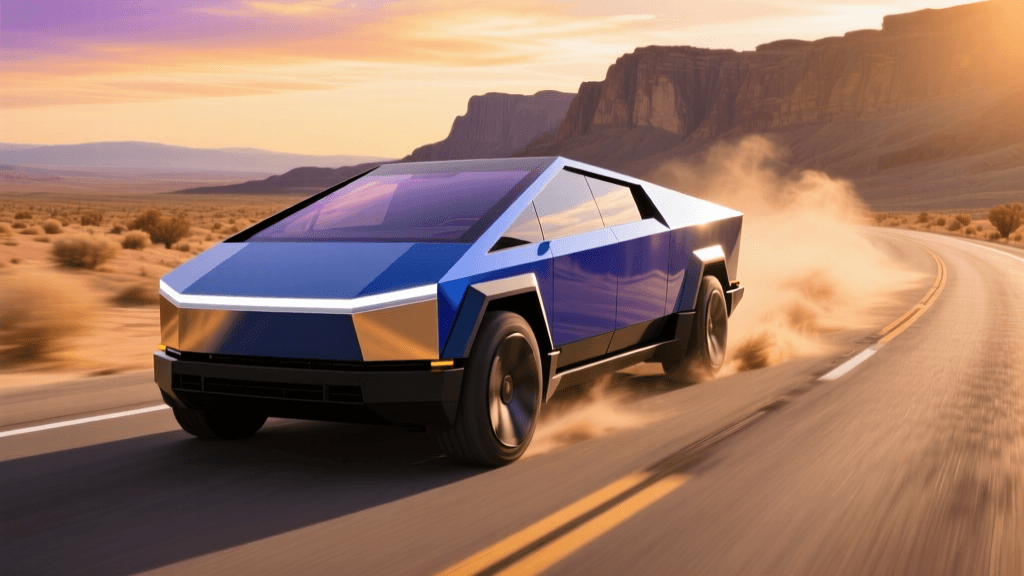
3. Tesla Cybertruck (AWD / Beast)
The Cybertruck's polarizing angular design is actually engineered for aerodynamic efficiency, boasting a lower drag coefficient than traditional pickups. When towing, this aero advantage helps mitigate some of the range loss. Furthermore, Tesla's Supercharger network with pull-through stalls gives the Cybertruck a distinct logistical advantage. However, its smaller battery pack compared to the Silverado EV limits its absolute maximum towing distance to roughly 125 miles under heavy loads.
4. Ford F-150 Lightning (Extended Range)
The F-150 Lightning is a phenomenal workhorse and a pioneer in the electric truck space. The Extended Range 131 kWh battery delivers 320 miles unladen. However, its upright, traditional truck profile acts like a parachute when a trailer is attached. Real-world tests consistently show the Lightning's range dropping by over 60% at 70 mph. It remains a top choice for local towing and boat launches, but long-distance highway towing requires meticulous route planning.
5. GMC Hummer EV Pickup
The Hummer EV is an engineering marvel with a staggering 212 kWh battery and 12,000-pound max towing capacity. So why does it rank last in range impact? Weight and aerodynamics. The Hummer is incredibly heavy, and its massive frontal area creates immense drag. When towing, the energy required to move the truck's own mass, plus the trailer, results in a brutal 66% range drop. It is built for raw capability and off-road dominance, not for maximizing highway towing efficiency.
Expert Tips & Best Practices for Maximizing Towing Range
As the U.S. Department of Energy notes, an EV's efficiency is highly sensitive to driving habits and environmental factors. When towing, these factors are magnified. Implement the following expert best practices to minimize your range drop and extend your towing distance.
1. Manage Your Highway Speeds (The 60 MPH Rule)
Aerodynamic drag increases with the square of your speed. When towing a trailer, the difference in energy consumption between 60 mph and 70 mph is staggering. Dropping your cruising speed by just 10 mph can improve your towing range by 15% to 20%. If you are facing a long stretch without a reliable DC fast charger, lock your adaptive cruise control to 60 or 62 mph. You will arrive at your destination with significantly more battery buffer.
2. Prioritize Trailer Aerodynamics Over Weight
EVs produce instantaneous torque, meaning they can easily pull heavy loads from a standstill. The real enemy of EV towing range is not weight; it is wind resistance. A 4,000-pound teardrop camper with a sloped front will consume vastly less energy at highway speeds than a 3,500-pound flat-nosed box trailer. When shopping for a trailer to pull behind your EV, prioritize aerodynamic profiles, low ride heights, and integrated trailer skirts to help the air flow smoothly over and around the rig.
3. Optimize Tire Pressures and Rolling Resistance
Rolling resistance accounts for a significant portion of energy loss. Before every towing trip, ensure your EV's tires are inflated to the maximum cold PSI listed on the door jamb to reduce sidewall flex and rolling resistance. Equally important, check the trailer's tire pressure. Under-inflated trailer tires create immense drag and heat, forcing the EV's motors to draw more current to maintain speed.
4. Master Tow/Haul Mode and Regenerative Braking
Always engage your vehicle's dedicated Tow/Haul mode. This does more than just adjust the throttle mapping; it recalibrates the regenerative braking system. Properly tuned regen prevents the trailer from pushing the truck during deceleration, which reduces trailer sway and safely recaptures kinetic energy back into the battery. On long mountain descents, strong regenerative braking can add 5% to 10% back into your battery, acting as a virtual engine brake and saving your physical brake pads from overheating.
5. Precondition the Battery on Shore Power
Batteries operate most efficiently at specific thermal windows. If you are starting a towing trip in cold weather, or if you plan to immediately hit the highway, use your EV's app to precondition the battery while the truck is still plugged into your home Level 2 charger. This warms the battery cells using grid power rather than battery power, ensuring that maximum regenerative braking is available from mile one and that the battery is primed for optimal DC fast-charging speeds later in the trip.
Strategic Route Planning for EV Towing
Towing with an EV requires a paradigm shift in how you plan road trips. You can no longer rely on driving until the tank is empty and pulling into any gas station. Instead, you must plan your route around high-speed DC fast chargers (150 kW to 350 kW) that offer pull-through parking. Pull-through stalls are critical; attempting to unhitch a trailer in a standard EV charging spot is inconvenient, blocks other users, and is often physically impossible due to space constraints.
Furthermore, the Environmental Protection Agency (EPA) highlights that real-world EV range is heavily influenced by terrain and weather. When mapping your route, use EV-specific routing software that accounts for elevation changes. Towing a trailer up a 6% grade will drain your battery at an alarming rate, but the regenerative braking on the descent will help recover some of that energy. Always plan your charging stops at the bottom of mountain passes, not the top, to take advantage of regenerative coasting and ensure you have enough buffer to reach the charger.
Final Thoughts on EV Towing
Electric vehicles are incredibly capable tow rigs, offering unmatched torque, stability, and quiet operation. However, the real-world range impact is a physical reality that cannot be ignored. By choosing an EV with a large battery and aerodynamic advantages—like the Silverado EV or Rivian R1T—and by adopting expert driving practices like speed management and aerodynamic trailer selection, you can transform your EV from a local hauler into a highly effective, long-distance towing machine.