The 'Minutes Per Mile' Metric: Why Peak kW is a Lie
When automakers market their latest electric vehicles, they love to boast about 'peak charging speeds'—often throwing around massive numbers like 250 kW, 300 kW, or even 350 kW. But for EV owners troubleshooting real-world road trip delays, peak kW is largely a marketing illusion. A vehicle might hit 250 kW for exactly 45 seconds before thermal management systems throttle the speed down to protect the battery. This is why the most critical metric for EV road-trippers isn't peak kilowatts; it is 'minutes per mile' or, conversely, 'miles added per 10 minutes.'
Understanding this metric is the first step in troubleshooting your EV's charging performance. If your vehicle is rated for 250 kW but you are only seeing 50 kW at the plug, you aren't necessarily dealing with a broken car or a broken charger. You are likely experiencing a bottleneck in battery preconditioning, thermal throttling, or infrastructure load-balancing. In this guide, we rank the best EVs based on their real-world sustained charging speeds, and we provide actionable troubleshooting steps to ensure your vehicle actually delivers the fast-charging performance you paid for.
Ranked: Best EVs for Fastest Real-World Charging Speed
To determine the best fast-charging EVs, we look at the 10% to 80% state of charge (SoC) curve. This is the sweet spot for road trips, as charging past 80% drastically slows down to protect battery health. Below is our ranking based on real-world efficiency and sustained charging rates.
| EV Model | Architecture | Peak kW | Miles per 10 Mins | Mins per 100 Miles |
|---|---|---|---|---|
| Hyundai Ioniq 5 / Kia EV6 | 800V E-GMP | 238 kW | ~115 miles | ~8.7 mins |
| Porsche Taycan / Audi e-tron GT | 800V J1 | 270 kW | ~105 miles | ~9.5 mins |
| Tesla Model 3 Highland | 400V | 250 kW | ~100 miles | ~10.0 mins |
| Lucid Air Pure | 900V | 250 kW | ~120 miles | ~8.3 mins |
| Rivian R1T / R1S | 400V | 200 kW | ~75 miles | ~13.3 mins |
1. Hyundai Ioniq 5 & Kia EV6 (The 800V Kings)
The Hyundai Motor Group's E-GMP platform remains the benchmark for accessible fast charging. By utilizing an 800-volt architecture, the Ioniq 5 and EV6 can sustain charging rates above 200 kW for a significant portion of the 10-80% curve. The secret to their success is exceptional thermal management. However, to achieve these numbers, the battery must be properly warmed up. If you pull into a 350 kW Electrify America station with a cold battery, you will be troubleshooting a sluggish 75 kW charge instead of enjoying the 238 kW peak.
2. Porsche Taycan & Audi e-tron GT (Thermal Management Masters)
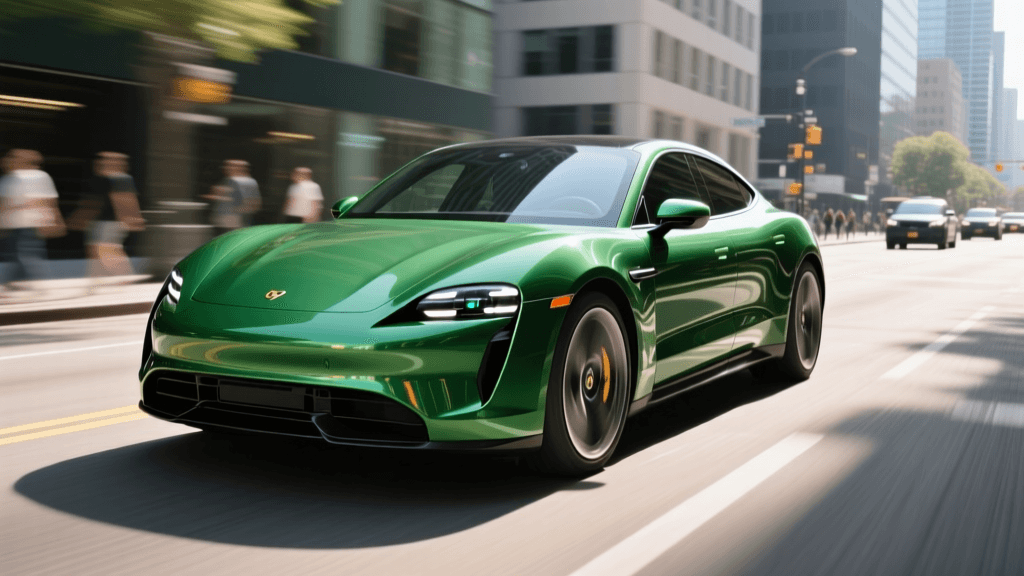
Porsche pioneered the 800V architecture in the EV space. While the Taycan's peak kW is slightly higher than the Hyundai's, its real-world advantage lies in its ability to handle repeat fast charges without severe thermal throttling. The Taycan's sophisticated liquid cooling system allows it to precondition the battery aggressively. If you are troubleshooting a Taycan that is charging slowly, the issue is almost never the car's thermal limits; it is usually a CCS adapter bottleneck or a faulty station.
3. Tesla Model 3 Highland (The V4 Supercharger Synergy)
Tesla's 400V architecture is older than the 800V systems from Hyundai and Porsche, but the Model 3 Highland compensates with unmatched efficiency and the proprietary Supercharger network. The Model 3's navigation system automatically preconditions the battery when a Supercharger is entered as a destination. This seamless integration eliminates the most common troubleshooting headache: forgetting to prep the battery.
4. Lucid Air (The Efficiency Marvel)
The Lucid Air boasts a 900V+ architecture and incredible efficiency, meaning it requires fewer electrons to add a mile of range. While its peak charging speed is capped around 250 kW on current CCS networks, its miles-per-minute ratio is phenomenal because it consumes so little energy per mile. According to data from the EPA Fuel Economy portal, Lucid's efficiency ratings consistently lead the market, translating directly to fewer minutes spent at the charger.
Troubleshooting: Why Isn't My EV Charging at Peak Speed?
You have one of the fastest-charging EVs on the market, you are plugged into a 350 kW DC fast charger, but the screen says you are only pulling 48 kW. What went wrong? Here is how to troubleshoot the most common charging bottlenecks.
1. Battery Preconditioning Failures
Lithium-ion batteries cannot safely accept high-current DC fast charges when they are cold. If the battery temperature is below optimal operating thresholds (usually around 70°F to 90°F at the cellular level), the Battery Management System (BMS) will artificially limit the charging speed to prevent lithium plating, which causes permanent degradation. The U.S. Department of Energy's Alternative Fuels Data Center notes that extreme temperatures heavily impact EV battery performance and charging acceptance rates.
The Fix: Always use the vehicle's native navigation system to route to the charger. In a Tesla, this triggers automatic preconditioning. In a Hyundai or Kia, you must manually enable 'Preconditioning for Charging' in the EV settings menu, or use the 'Navigation to Charger' trick by inputting the charger as your next stop. If you are using a third-party app like PlugShare to navigate, the car will not know you are going to a charger, and the battery will remain cold.
2. Thermal Throttling and the 80% Cliff
Fast charging generates immense heat. If you are on a multi-stop road trip and doing back-to-back fast charges, the battery cooling system may struggle to keep up. Furthermore, as the State of Charge (SoC) increases, the internal resistance of the battery changes, forcing the BMS to taper the charging speed to prevent overvoltage.
The Fix: Never charge past 80% on a road trip unless absolutely necessary. The charging curve drops off a cliff after 80%. It will often take the same amount of time to charge from 80% to 100% as it did to charge from 10% to 80%. If your charging speed suddenly drops at 50% SoC, check your vehicle's thermal management settings. Some EVs have a 'Battery Care' or 'Fast Charging Limit' mode that intentionally throttles speeds to preserve long-term battery health. Turn this off for road trips.
3. Infrastructure Bottlenecks and Load Balancing
Sometimes the problem isn't your car; it's the concrete pad you are parked on. Many older DC fast charging stations use 'load balancing' or 'power splitting.' If a station is rated for 150 kW total, and another vehicle plugs into the adjacent stall (Stall 1B while you are in 1A), the station will split the power, dropping your speed to 75 kW.
The Fix: Look for physical cabinet labels. If you see stalls labeled 1A and 1B, they likely share a single power cabinet. Move to a stall labeled 2A or 3A to ensure you have a dedicated power feed. Additionally, research the National Renewable Energy Laboratory (NREL) guidelines on charging infrastructure, which highlight how station uptime and power sharing architectures heavily dictate real-world charging speeds.
4. The CCS to NACS Adapter Bottleneck
As the industry transitions to the North American Charging Standard (NACS), many non-Tesla owners are using adapters to access Superchargers. However, early generation adapters or specific vehicle software bugs can cause communication handshake failures between the car's BMS and the Supercharger, resulting in severely throttled speeds or failed sessions.
The Fix: Ensure your vehicle's software is fully up to date, as automakers frequently release over-the-air (OTA) updates to improve adapter handshake protocols. If speeds are capped at exactly 50 kW or 125 kW while using an adapter, you may be hitting the thermal limit of the adapter itself, which lacks the active liquid cooling found in native NACS cables.
Actionable Road Trip Charging Strategy
To maximize your EV's ranking potential and minimize time spent at the plug, adopt the 'Highway Speed and Low SoC' strategy. Drive your EV at 65 mph instead of 75 mph; the reduction in aerodynamic drag will drastically improve your efficiency, meaning you need to add fewer total miles at the charger. Combine this with short, frequent charging bursts between 10% and 70% SoC. By keeping the battery in the low-resistance zone and utilizing the 800V architectures of vehicles like the Ioniq 5 or Taycan, you can reliably achieve sub-10-minute stops for every 100 miles of range. Troubleshooting isn't just about fixing what's broken; it's about optimizing the physics of your battery to make every second at the charger count.