The True Cost of Family EV SUVs: Space Meets Value
When shopping for a family vehicle, cargo space and passenger comfort are usually the top priorities. However, the transition to electric vehicles (EVs) introduces a new metric that savvy buyers must consider: cost-efficiency per cubic foot of space. Electric SUVs offer the undeniable benefits of zero tailpipe emissions, instant torque, and significantly lower running costs compared to their internal combustion engine (ICE) counterparts. Yet, the premium upfront cost of an EV can be a hurdle for growing families balancing budgets, mortgages, and college funds.
At AutoEdgeView, we believe that a family EV shouldn't just be about range and 0-60 mph times; it should be about practical utility and financial sense. In this comprehensive cost and value breakdown, we rank the best electric SUVs for families by analyzing their cargo capacity, effective pricing (factoring in federal incentives), and long-term ownership value.
Our Methodology: Calculating the "Cargo Value Score"
To objectively rank these vehicles, we developed a proprietary Cargo Value Score. This metric determines how much you are actually paying for usable space. We take the vehicle's base MSRP, subtract the maximum available federal clean vehicle tax credit (up to $7,500 for eligible buyers and vehicles), and divide that effective price by the maximum cargo volume (in cubic feet) with all rear seats folded down.
A lower score indicates a better financial value per cubic foot of cargo space. We also factor in the "frunk" (front trunk) where applicable, as this is a crucial bonus space for storing charging cables, groceries, or muddy shoes.
1. Tesla Model Y: The Undisputed Cargo-Per-Dollar Champion
The Tesla Model Y remains the benchmark for compact electric crossovers, and when it comes to pure cargo value, it is nearly untouchable. Despite its sloping roofline, the Model Y offers a cavernous 76.2 cubic feet of cargo space with the second row folded. Add the 4.1 cubic foot frunk and the deep rear under-floor storage, and you have a masterclass in packaging.
Cost & Value Breakdown
With the Long Range All-Wheel Drive model starting around $48,990 (before incentives), and eligible for the full $7,500 federal tax credit at the point of sale, the effective price drops to roughly $41,490. This equates to an astonishingly low $544 per cubic foot of maximum cargo space.
- Pros: Unmatched Supercharger network access, class-leading efficiency, excellent safety ratings from the IIHS.
- Cons: Firm ride quality, minimalist interior lacks physical buttons for glovebox or mirror adjustments, panoramic glass roof can make the cabin hot in summer.
2. Kia EV9: The Best 3-Row Value for Large Families
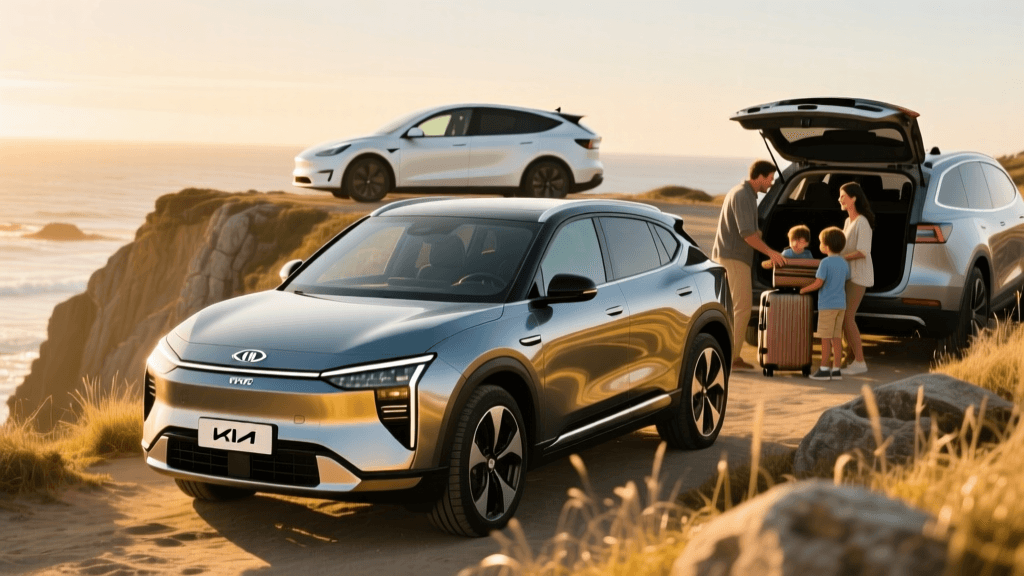
For families that absolutely need a third row, the Kia EV9 is a revelation. It is one of the few mainstream, reasonably priced three-row electric SUVs on the market. With all seats folded, the EV9 provides up to 81.7 cubic feet of cargo space. More importantly, its boxy design means that space is highly usable, with a wide load floor and vertical walls that easily accommodate large strollers or bulky furniture.
Cost & Value Breakdown
The EV9 Light Long Range RWD starts at an MSRP of $59,900. While the RWD models currently face hurdles with the $7,500 federal tax credit due to battery component sourcing, the AWD models (starting around $63,900) are often eligible or can be leased to bypass the restriction. Assuming the $7,500 incentive, the effective price is $52,400, resulting in a Cargo Value Score of $641 per cubic foot. For a three-row family hauler, this is exceptional value.
- Pros: True 3-row seating, 800V ultra-fast charging architecture, physical buttons for climate control, generous standard warranty.
- Cons: Range drops significantly on the highway, higher trim levels push the price into luxury territory.
3. Hyundai Ioniq 5: The Compact Family Sweet Spot
If you don't need a third row and find the Model Y's interior too spartan, the Hyundai Ioniq 5 is the perfect middle ground. It offers 59.3 cubic feet of cargo space behind the front seats. While this is less than the Model Y, the Ioniq 5's interior feels significantly more premium, comfortable, and family-friendly, with abundant storage cubbies and a sliding center console.
Cost & Value Breakdown
The Ioniq 5 SE Standard Range starts around $41,800, but the SEL AWD (the sweet spot for families) is priced around $49,350. With the $7,500 tax credit applied, the effective price is $41,850. This yields a Cargo Value Score of $705 per cubic foot. You are paying slightly more per cubic foot than the Tesla, but you are gaining a vastly superior ride quality, a quieter cabin, and a more traditional, intuitive interior layout.
- Pros: 800V fast charging, incredibly comfortable ride, V2L (Vehicle-to-Load) capability to power camping gear or home appliances.
- Cons: Smaller frunk compared to competitors, rear wiper was missing on early models (now added on newer trims).
4. Rivian R1S: Premium Space at a Premium Price
The Rivian R1S is a luxury adventure SUV designed for families who want to go off the beaten path. It offers three rows of seating and a massive 104.7 cubic feet of cargo space with the second and third rows folded. It also features a massive 11.1 cubic foot frunk that easily swallows multiple carry-on bags or camping gear.
Cost & Value Breakdown
The R1S is undeniably expensive. The Dual-Motor Standard Pack starts around $79,900. Even with the $7,500 federal tax credit, the effective price remains a steep $72,400. This results in a Cargo Value Score of $691 per cubic foot. While the per-cubic-foot cost is surprisingly close to the Kia EV9, the R1S is a luxury product. You are paying for quad-motor performance, air suspension, premium materials, and unmatched off-road capability, rather than pure budget efficiency.
- Pros: Incredible off-road capability, luxurious interior, massive front trunk, over-the-air updates constantly improve the vehicle.
- Cons: High initial purchase price, expensive insurance premiums, service center network is still expanding.
Comparison Table: Cost, Cargo, and Value Metrics
| Vehicle | Starting MSRP | Max Cargo (cu ft) | Effective Price (w/ $7.5k Credit) | Cost per Cu Ft (Lower is Better) |
|---|---|---|---|---|
| Tesla Model Y LR AWD | $48,990 | 76.2 | $41,490 | $544 |
| Kia EV9 Light LR RWD | $59,900 | 81.7 | $52,400* | $641 |
| Hyundai Ioniq 5 SEL AWD | $49,350 | 59.3 | $41,850 | $705 |
| Rivian R1S Dual Motor | $79,900 | 104.7 | $72,400 | $691 |
*Note: Tax credit eligibility for the Kia EV9 varies by battery sourcing and lease structures. Always consult the official IRS guidelines before purchasing.
Hidden Costs: Charging, Depreciation, and Maintenance
When evaluating the cost and value of a family EV SUV, the sticker price and tax credits are only part of the equation. According to the U.S. Department of Energy's Alternative Fuels Data Center, EV owners must also consider the infrastructure and long-term ownership costs.
Home Charging Infrastructure
To truly benefit from the low "fuel" costs of an EV, you need to charge at home. Installing a Level 2 (240V) home charger requires a dedicated circuit. If your electrical panel needs an upgrade, costs can range from $500 to $2,500. However, charging at home at an average electricity rate of $0.16 per kWh means "filling up" a Model Y's 75 kWh battery costs only about $12, compared to $50+ for a comparable gas SUV.
Tire Wear and Maintenance
Electric SUVs are significantly heavier than their gas counterparts due to the battery packs. The Kia EV9, for example, weighs over 5,800 pounds. This extra weight, combined with the instant torque of electric motors, means EVs tend to wear through tires 20% to 30% faster than ICE vehicles. Budgeting an extra $200 to $400 per year for premium, EV-specific touring tires is a smart financial move for families.
Depreciation and Insurance
The EV market is currently experiencing rapid price fluctuations, which has impacted resale values. While Tesla and Hyundai/Kia have historically held their value well, newer entrants may see steeper initial depreciation. Furthermore, insurance premiums for EVs can be 15% to 25% higher due to the specialized labor and parts required for battery and sensor repairs. Always get an insurance quote before signing the purchase agreement.
Final Verdict: Which Family EV SUV Wins?
If your primary goal is maximizing cargo space per dollar, the Tesla Model Y remains the undisputed champion. Its combination of low effective pricing, massive usable space, and industry-leading efficiency makes it the most financially sound choice for small to medium-sized families.
However, if you have a larger family requiring a third row, the Kia EV9 offers the best value proposition. It provides genuine three-row utility without forcing you into the six-figure luxury tax bracket of competitors like the Mercedes EQS SUV or BMW iX.
For those prioritizing comfort, interior quality, and V2L utility over sheer maximum volume, the Hyundai Ioniq 5 is the sweet spot. Finally, the Rivian R1S is reserved for families who view their vehicle as an adventure platform and are willing to pay a premium for unmatched off-road capability and luxury.
Ultimately, the "best" EV is the one that aligns with your specific family's spatial needs and financial boundaries. By looking beyond the MSRP and focusing on the effective cost per cubic foot, you can make a purchase that serves your family's adventures for years to come.