The short answer: The best electric family cars in 2026 deliver 280–360 miles of EPA range, seat five to seven, and offer 30+ cubic feet of cargo space behind the second row. Top picks include the Hyundai Ioniq 9, Tesla Model Y (refreshed), Kia EV9, and Volkswagen ID.4. Expect to pay $42,000–$62,000 before incentives, with federal tax credit eligibility (up to $7,500 under IRS §30D) varying by model, your income, and battery sourcing. Real-world highway range typically runs 10–20% below EPA stickers, and cold climates can cut range another 15–30%. Home Level 2 charging is the single biggest ownership advantage — without it, public DC fast charging costs roughly double per mile.
What Makes an EV Work as a Family Car?
Family duty means predictable school runs, weekend road trips with luggage, and occasional 400-mile holiday drives. An electric family car must clear three thresholds: enough range to handle your longest recurring trip without stressful charging stops, cargo room for strollers and groceries, and charging speed that keeps rest breaks under 25 minutes. For most families, that means a minimum 280-mile EPA range, at least 30 cu ft of rear cargo space, and DC fast charging that peaks above 150 kW.
The current crop of three-row electric SUVs — led by the Kia EV9, Hyundai Ioniq 9, and Rivian R1S — finally addresses the space problem that plagued earlier EVs. Two-row crossovers like the Tesla Model Y and Ford Mustang Mach-E remain strong for smaller families who don't need a third row but want efficiency and lower pricing.
Top Electric Family Cars Compared: Specs and Pricing
Here's how the leading contenders stack up on the numbers that matter. All prices reflect base MSRP for the 2025–2026 model year; higher trims add $5,000–$15,000.
| Model | EPA Range | Battery (kWh) | Peak DC Charge (kW) | 10–80% Time | Cargo (cu ft) | Seats | Base MSRP |
|---|---|---|---|---|---|---|---|
| Hyundai Ioniq 9 (Long Range) | 335 mi | 110.3 (NMC) | ~240 kW | ~24 min | 38.0 | 6–7 | $53,000 |
| Kia EV9 (LR RWD) | 304 mi | 100.0 (NMC) | ~210 kW | ~24 min | 20.2 / 81.7 | 6–7 | $54,900 |
| Tesla Model Y (LR AWD) | 320 mi | ~78 (NMC) | 250 kW | ~22 min | 30.2 | 5 (7 opt.) | $47,990 |
| Volkswagen ID.4 (Pro S AWD) | 291 mi | 82 (NMC) | 175 kW | ~29 min | 30.3 | 5 | $46,290 |
| Ford Mustang Mach-E (ER AWD) | 305 mi | 91 (NMC) | 150 kW | ~36 min | 29.7 | 5 | $48,995 |
| Rivian R1S (Dual Max) | 352 mi | 149 (NMC) | ~220 kW | ~30 min | 46.7 | 7 | $79,900 |
Sources: fueleconomy.gov, manufacturer spec pages. Cargo figures for the EV9 show behind-third-row / max. Range and charging are EPA estimates; see real-world notes below.
EPA stickers assume mixed driving. On sustained 75-mph highway runs, expect 10–15% less range than listed. In freezing temperatures (below 30°F), add another 15–30% reduction due to battery heating demands and cabin climate use. A Kia EV9 rated at 304 miles EPA may deliver 220–250 miles on a cold winter highway trip. Plan charging stops around the lower number.
EV vs Gas Family SUV: The Real Cost Breakdown
The purchase price of an electric family car is typically $5,000–$15,000 higher than a comparable gas SUV. But fuel savings, reduced maintenance, and federal tax credits can close that gap within three to five years of ownership. Here's a five-year cost comparison using the Kia EV9 (LR RWD, $54,900) versus the Kia Telluride (V6 AWD, ~$40,000) as a representative pair.
| Cost Category (5 Years / 75,000 mi) | Kia EV9 (Electric) | Kia Telluride (Gas V6) |
|---|---|---|
| Purchase Price (MSRP) | $54,900 | $40,000 |
| Federal Tax Credit (§30D) | −$7,500* | $0 |
| Net Purchase | $47,400 | $40,000 |
| Fuel / Electricity (75k mi) | $4,200 (home L2 avg.) | $9,400 (22 MPG, $3.10/gal) |
| Maintenance | $1,100 | $3,200 |
| Insurance (avg. premium) | $8,500 | $6,800 |
| 5-Year Total Cost | ~$61,200 | ~$59,400 |
*§30D credit eligibility depends on MSRP caps ($80,000 for SUVs), buyer income limits ($300k joint / $150k single), and battery component/critical-mineral sourcing. Verify at IRS.gov before purchasing. Credit may be transferred at point of sale as a price reduction.
The gap narrows to roughly $1,800 over five years — and flips in the EV's favor if you drive more than 15,000 miles annually, have access to cheap home electricity (under $0.14/kWh), or qualify for additional state incentives. Families who rely exclusively on public DC fast charging (at $0.35–$0.55/kWh) will see higher fuel costs that may erase savings entirely.
Charging at Home: The Make-or-Break Factor
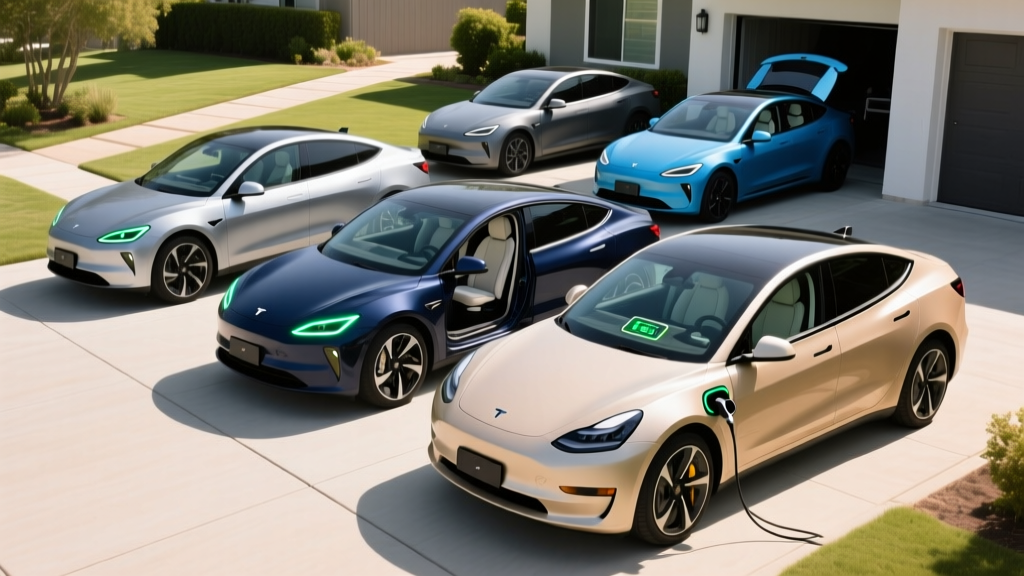
Home Level 2 charging is where electric family cars either thrive or frustrate. A Level 2 home charger (240V, 32–48 amps) adds 25–37 miles of range per hour, meaning an overnight session fully replenishes any family SUV. Installation costs vary dramatically based on your electrical panel.
| Item | Typical Cost Range |
|---|---|
| Level 2 charger (hardwired, 48A) | $400–$700 |
| Electrician labor (standard install) | $500–$1,500 |
| Permit / inspection | $100–$300 |
| Electrical panel upgrade (if needed, 100A → 200A) | $1,500–$3,500 |
| Total (no panel upgrade) | $1,000–$2,500 |
| Total (with panel upgrade) | $2,500–$6,000 |
If you live in an apartment, condo, or street-parking situation without home charging access, an electric family car becomes significantly harder to own. Public DC fast charging works but costs 2–4× more per mile than home charging, and repeated 100% DC fast charging can accelerate battery degradation by 2–5% over five years compared to predominantly Level 2 charging. Families without reliable home charging should strongly consider a plug-in hybrid (PHEV) like the Toyota Grand Highlander Hybrid as a bridge.
What First-Time EV Buyers Need to Know
Buying your first electric family car involves a learning curve. Here are the non-obvious realities that spec sheets don't highlight:
- Charging curves taper above 80%. A vehicle that charges at 240 kW from 10–80% may drop to under 50 kW above 80%. Plan road-trip stops to charge only to 80% — charging to full at a DC fast station wastes time. Use Level 2 overnight for 100% fills.
- Preconditioning matters. Most EVs warm the battery before a fast-charge session if you navigate to a charger in the car's system. Without preconditioning, cold batteries charge at significantly reduced rates — sometimes 50% below peak kW.
- kW is not kWh. Kilowatts (kW) measure charging power — how fast energy flows in. Kilowatt-hours (kWh) measure battery capacity — how much energy is stored. A 100 kWh battery charged at 200 kW doesn't fill in 30 minutes; the charge curve taper means actual 10–80% times are longer.
- Tires wear faster. EVs are 500–1,000 lbs heavier than gas equivalents and deliver instant torque. Expect tire replacement at 25,000–35,000 miles instead of 45,000+. Budget $800–$1,400 for a set of EV-rated tires.
- Insurance premiums run 10–25% higher for most EVs due to repair costs and parts pricing. Get quotes before purchasing — the difference between insurers can be $400–$800/year for the same vehicle.
- Battery warranties are strong. Federal law mandates 8 years / 100,000 miles for EV battery packs. Most manufacturers guarantee 70% capacity retention at that threshold. Real-world data from Recurrent shows most EV batteries lose only 5–10% capacity in the first five years.
Common Misconceptions About Electric Family Cars
| Myth | Fact |
|---|---|
| "EVs don't have enough range for road trips." | Modern family EVs deliver 280–350 EPA miles. With DC fast charging at 150–250 kW, a 20–25 minute stop adds 150–200 miles — roughly a natural rest break. |
| "The battery will need replacing soon and cost $20,000." | Battery replacement is rare under 150,000 miles. Degradation averages 1–2% per year. Full replacements cost $10,000–$22,000 but are typically covered under warranty for 8 years/100k miles. |
| "EVs are worse in winter." | Range drops 15–30% in cold weather, but EVs start instantly (no cold cranking), heat rapidly with heat pumps, and have superior traction with AWD and low center of gravity. Preconditioning while plugged in mitigates most range loss. |
| "Charging infrastructure is too unreliable." | Tesla Supercharger network reliability exceeds 99%. Non-Tesla networks (Electrify America, EVgo) average 85–92% uptime. The adoption of NACS connectors across brands in 2025–2026 is expanding reliable access significantly. |
| "All EVs qualify for the $7,500 tax credit." | Credit eligibility under IRS §30D requires meeting MSRP caps, buyer income limits, and battery sourcing requirements. Several popular models qualify for only $3,750 or nothing at all. |
Decision Framework: Which Electric Family Car Fits You?
Choose the Hyundai Ioniq 9 if you need three rows, want the longest range in the segment (335 mi EPA), and value ultra-fast 800V charging architecture that peaks near 240 kW. Best for families who road-trip frequently and need to minimize charging stops.
Choose the Kia EV9 if you want a spacious three-row SUV with proven reliability, strong value at ~$55k, and don't mind slightly less range (304 mi EPA). The EV9's boxy design maximizes interior volume — best for cargo-heavy families.
Choose the Tesla Model Y if you want the Supercharger network, the lowest cost per mile of any family EV, and can work with five seats (or the cramped optional third row). Best for efficiency-focused families under five people.
Choose the VW ID.4 if you want a comfortable, quiet two-row crossover with strong build quality, and your daily driving is under 200 miles. The ID.4 trades some range and charging speed for refinement and dealer service accessibility.
Choose a PHEV instead if you lack reliable home charging, regularly drive 400+ miles in rural areas with sparse charging, or want to hedge while infrastructure matures near you. The Toyota Grand Highlander Hybrid (36 MPG combined) or a plug-in hybrid like the Jeep Grand Cherokee 4xe offer bridge solutions.
Frequently Asked Questions
Are electric family cars safe in crashes?
Yes. EVs generally score top marks in crash testing due to their rigid battery pack structure and low center of gravity. The Tesla Model Y earned an IIHS Top Safety Pick+ and 5-star NHTSA rating. The Kia EV9 and VW ID.4 also carry 5-star NHTSA ratings. Battery fire risk in EVs is statistically lower than gasoline vehicle fire risk per vehicle-mile traveled.
How much does it cost to charge an electric family SUV at home?
At the US average residential rate of ~$0.16/kWh, fully charging a 100 kWh battery (like the Kia EV9) costs about $16. That provides roughly 270–300 real-world miles. Per mile, home charging costs $0.05–$0.07 versus $0.13–$0.16 per mile for a 22-MPG gas SUV at $3.10/gallon. Over 15,000 annual miles, that's a savings of $1,000–$1,500 per year.
Can I tow with an electric family car?
Yes, but towing cuts range dramatically — typically 40–50%. The Rivian R1S tows up to 7,700 lbs, and the Kia EV9 tows 5,000 lbs (AWD trims). If you tow a camper or boat more than a few times a year, plan for significantly more charging stops or consider a PHEV or diesel for towing duty.
What happens if I need a long road trip?
Plan around DC fast chargers spaced 150–200 miles apart using tools like PlugShare or A Better Routeplanner. With a 300-mile EPA range and 10–80% charging in 20–25 minutes, a 600-mile trip requires two stops totaling roughly 50 minutes of charging. It adds time, but most families find it aligns with natural meal and bathroom breaks.
Will the federal tax credit still be available when I buy?
The §30D credit is authorized through 2032, but specific vehicle eligibility changes frequently as manufacturers adjust battery sourcing. Always check the current qualified vehicle list on fueleconomy.gov before committing to a purchase. The credit can be transferred to the dealer at point of sale, reducing your purchase price directly rather than waiting for a tax refund.