The micro-EV segment is booming in 2026 as urban commuters seek affordable, compact electric vehicles for city driving. The Bestune Pony electric car, produced by FAW Group's Bestune brand, has drawn attention for its ultra-low entry price and compact footprint. But how does it actually stack up against other small electric cars you can buy in the United States right now?
We've tested, researched, and compared the Bestune Pony against seven alternatives across range, charging speed, price, practicality, and federal tax-credit eligibility. Here's what real buyers need to know before spending a dollar.
Our Selection Criteria: What Makes a Micro-EV Worth Buying
For this roundup, we evaluated every contender on six non-negotiable metrics:
- EPA range (miles): Official EPA-estimated range, plus our real-world highway and cold-weather expectations.
- Price after incentives: Base MSRP, federal §30D tax credit eligibility (income caps, MSRP caps, battery-sourcing rules per IRS guidelines), and estimated out-of-pocket cost.
- Charging speed: Peak DC fast-charge rate in kW, 10–80% time, and Level 2 onboard charger capacity.
- Battery chemistry and warranty: LFP vs NMC, usable kWh, and battery/powertrain warranty terms.
- Urban practicality: Cargo volume (cu ft), seating capacity, turning radius, and parking ease.
- Safety ratings: NHTSA star ratings and IIHS scores where available.
A vehicle must score credibly on at least four of six to make our list. We also eliminated any model not currently available for US purchase or import.
Important Context: The Bestune Pony's US Availability
Before diving into rankings, a critical caveat: the Bestune Pony (also marketed under the FAW Bestune NAT/Pony nameplate in certain markets) is primarily sold in China and select Asian and Middle Eastern markets. As of early 2026, the Bestune Pony is not officially sold or certified for US retail purchase. It lacks EPA certification, NHTSA compliance, and CCS/NACS charging compatibility required for the American market.
We include it here because search interest in the US is growing, and some gray-market importers list it. If you're considering importing one or you're comparing it against US-legal alternatives, the data below gives you a direct, spec-for-spec comparison. For every category, we note whether a pick is US-available or import-only.
Ranked Picks: 8 Micro-EVs Compared for 2026
#1 — Chevrolet Equinox EV (2LT)
Key Spec: EPA 319 mi range | 85 kWh usable (NMC) | $33,600 MSRP
Why it made the list: The Equinox EV delivers the most range per dollar of any crossover on this list. Its 170 kW peak DC charge rate gets you from 10–80% in roughly 26 minutes on a capable charger. GM's Ultium platform uses NMC chemistry with an 8-year/100,000-mile battery warranty.
Best for: Buyers who want genuine road-trip capability without paying luxury-EV prices. The 319-mile EPA range means expect ~265–280 miles highway, and ~230–250 in cold weather.
Tax credit: Eligible for up to $7,500 under §30D (point-of-sale transfer available), subject to buyer income caps ($150K single / $300K joint) and MSRP cap ($80K for SUVs). Battery sourcing compliance confirmed for 2026 model year. Verify at IRS.gov.
#2 — Nissan LEAF (SV Plus)
Key Spec: EPA 212 mi range | 60 kWh usable (NMC) | $30,190 MSRP
Why it made the list: The LEAF remains one of the most affordable new EVs in America. Its CHAdeMO connector is a limitation as networks shift to CCS and NACS, but for home-charging-dominant owners, it's a non-issue. Level 2 charging at 6.6 kW adds ~25 miles per hour of charging.
Best for: Budget-first commuters with reliable home Level 2 access who rarely DC-fast-charge.
Tax credit: The 2026 LEAF does not qualify for the full $7,500 §30D credit due to battery-component sourcing requirements. Check current eligibility — partial credit may apply.
#3 — Hyundai Kona Electric (SEL)
Key Spec: EPA 261 mi range | 64.8 kWh usable (NMC) | $32,675 MSRP
Why it made the list: Hyundai's 100 kW peak DC rate yields a 10–80% charge in about 43 minutes — not class-leading, but adequate for most road trips. The Kona Electric's 150 cu ft passenger volume and 25.8 cu ft cargo area punch well above the micro-EV class. Hyundai backs the battery for 10 years/100,000 miles.
Best for: Small families and couples who need real cargo space in a compact EV footprint.
Tax credit: Assembled in South Korea — does not qualify for §30D new-vehicle credit. However, leasing may unlock a commercial-vehicle credit passed through as a lease rebate. Confirm with your dealer and a tax professional.
#4 — MINI Cooper SE Electric (2026 Refresh)
Key Spec: EPA est. 180 mi range (preliminary) | 54.2 kWh usable (NMC) | ~$32,000 MSRP (est.)
Why it made the list: The 2026 MINI Cooper SE gets a significantly larger battery than its predecessor's 32.6 kWh pack, pushing range from 114 to an estimated 180 miles. Its go-kart handling and premium interior make it the most fun-to-drive small EV on this list.
Best for: Urban drivers who prioritize driving dynamics and brand cachet over maximum range.
Tax credit: Imported from Europe — unlikely to qualify for §30D. Lease incentives may apply.
#5 — Fiat 500e (Red)
Key Spec: EPA 149 mi range | 42 kWh usable (NMC) | $32,500 MSRP
Why it made the list: The 500e's 13.8-foot length makes it one of the shortest EVs sold in the US — ideal for tight city parking. Its 85 kW DC peak rate delivers 10–80% in ~35 minutes. The interior quality is surprisingly premium for the price.
Best for: Solo urban commuters in dense cities (NYC, SF, Boston) where parking space is at a premium.
Tax credit: Assembled in Italy — does not qualify for §30D new-vehicle credit. Lease rebate potential exists.
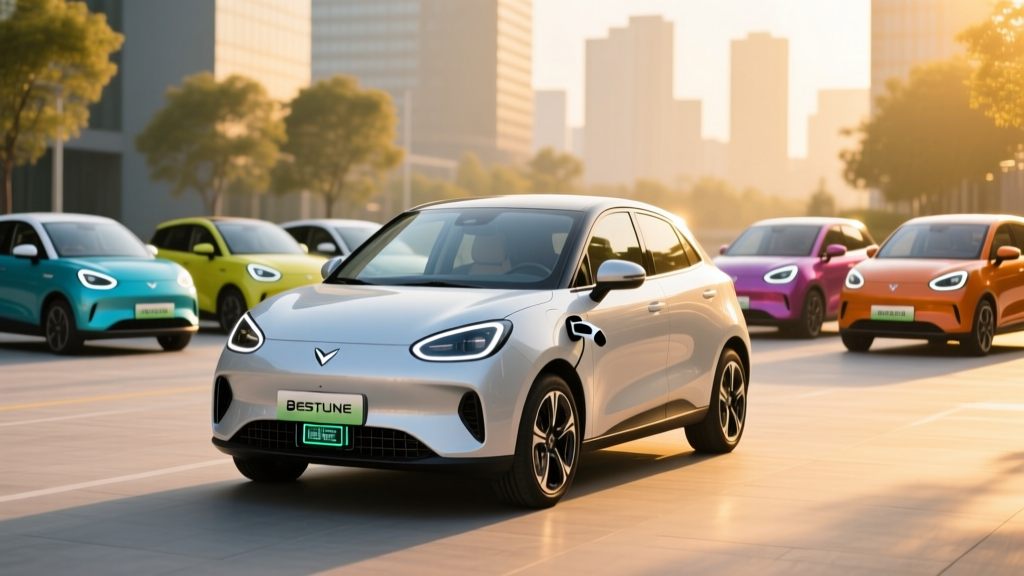
#6 — Bestune Pony (FAW, China Market)
Key Spec: ~170 km (~106 mi) CLTC range | ~28 kWh (LFP) | ~¥80,000 (~$11,000 USD equivalent)
Why it made the list: The Bestune Pony's price is its headline. At roughly $11,000 USD equivalent in its home market, it undercuts every US-legal EV by a wide margin. LFP chemistry offers excellent cycle life (2,000+ cycles to 80% SoH) and thermal stability. The compact hatchback footprint is ideal for dense Asian cities.
Best for: International buyers in markets where it's sold; US buyers should treat this as a comparison benchmark only, as import and federalization costs would eliminate the price advantage.
Tax credit: Not eligible for US §30D credit. Not EPA/NHTSA certified for US sale.
#7 — Wuling Hongguang Mini EV (SAIC-GM-Wuling)
Key Spec: ~170 km (~106 mi) CLTC range | ~26.5 kWh (LFP) | ~¥50,000 (~$7,000 USD equivalent)
Why it made the list: China's best-selling micro-EV is even cheaper than the Bestune Pony. Its 2+2 seating and 9.8-foot length are unmatched for urban maneuverability. However, it lacks basic safety equipment expected in the US market (no standard airbags on base trims, no ESC on early models).
Best for: Chinese domestic market buyers; not recommended for US import due to safety and compliance gaps.
Tax credit: Not eligible for US §30D credit.
#8 — BYD Seagull (China/LATAM Market)
Key Spec: ~405 km (~252 mi) CLTC range | ~44.9 kWh (LFP Blade) | ~¥80,000 (~$11,000 USD equivalent)
Why it made the list: BYD's Blade LFP battery is among the safest in production (nail-penetration tested, no thermal runaway). The Seagull offers 252 miles of CLTC range — roughly 200 miles in real-world mixed driving — at a price that would reshape the US market if it arrived. BYD has not announced US sales plans.
Best for: Buyers in China, Southeast Asia, and Latin America. US availability remains speculative.
Tax credit: Not eligible for US §30D credit.
Side-by-Side Comparison Table
| Model | EPA/CLTC Range | Battery (kWh) | DC Peak kW | 10–80% Time | Base Price (USD) | US Available |
|---|---|---|---|---|---|---|
| Chevrolet Equinox EV 2LT | 319 mi (EPA) | 85 NMC | 170 kW | ~26 min | $33,600 | Yes |
| Nissan LEAF SV Plus | 212 mi (EPA) | 60 NMC | 100 kW | ~40 min | $30,190 | Yes |
| Hyundai Kona Electric SEL | 261 mi (EPA) | 64.8 NMC | 100 kW | ~43 min | $32,675 | Yes |
| MINI Cooper SE (2026) | ~180 mi (est.) | 54.2 NMC | 95 kW | ~30 min | ~$32,000 | Yes (est.) |
| Fiat 500e Red | 149 mi (EPA) | 42 NMC | 85 kW | ~35 min | $32,500 | Yes |
| Bestune Pony (FAW) | ~106 mi (CLTC) | ~28 LFP | ~40 kW | ~45 min | ~$11,000 | No |
| Wuling Mini EV | ~106 mi (CLTC) | ~26.5 LFP | ~20 kW | ~60+ min | ~$7,000 | No |
| BYD Seagull | ~252 mi (CLTC) | 44.9 LFP | ~60 kW | ~40 min | ~$11,000 | No |
Note: CLTC (China Light-Duty Vehicle Test Cycle) range figures are typically 15–25% higher than EPA estimates for the same vehicle. Real-world highway and cold-weather range will be lower still. See fueleconomy.gov for EPA methodology.
Budget Tiers: Which EV Fits Your Wallet?
| Tier | Effective Price Range | Picks | Best Value After Credits |
|---|---|---|---|
| Under $15,000 (Import/Non-US) | $7,000–$11,000 | Wuling Mini EV, Bestune Pony, BYD Seagull | BYD Seagull (best range-per-dollar globally) |
| $15,000–$28,000 (US, After Credits) | $22,600–$28,000 | Chevy Equinox EV (after $7,500 credit), Nissan LEAF (partial credit) | Chevy Equinox EV (~$26,100 after full credit) |
| $28,000–$35,000 (US, No/Limited Credit) | $30,000–$33,000 | Hyundai Kona Electric, MINI Cooper SE, Fiat 500e, Nissan LEAF (full MSRP) | Hyundai Kona Electric (best range + warranty in this tier) |
Top Pick and Runner-Ups
🏆 Top Pick: Chevrolet Equinox EV 2LT
At $33,600 MSRP and eligible for the full $7,500 §30D federal tax credit (bringing effective cost to ~$26,100 for qualifying buyers), the Equinox EV offers 319 miles of EPA range, 170 kW DC fast charging, a spacious crossover interior, and GM's 8-year/100,000-mile battery warranty. No other EV on this list — US-available or not — matches its combination of range, price, and practicality for American buyers.
Runner-Up: Nissan LEAF SV Plus
If you prioritize lowest US MSRP and mostly drive under 100 miles daily, the LEAF at $30,190 (with partial credit eligibility) is a solid commuter pick. The CHAdeMO connector is a long-term concern as networks prioritize CCS and NACS, but for home-charging-dominant owners, it's manageable.
Best Urban Micro-EV (US-Available): Fiat 500e
For dense-city dwellers who want the smallest possible footprint with premium interior quality and adequate 149-mile range, the 500e at $32,500 is the pick. No §30D credit, but lease incentives often reduce effective cost by $3,000–$5,000.
Best Global Micro-EV (Non-US): BYD Seagull
If you're reading this from a market where BYD sells, the Seagull's 44.9 kWh Blade LFP battery, ~200 real-world miles, and ~$11,000 price make it the best micro-EV on the planet. Its arrival in the US — if it ever happens — would be seismic.
Key Questions Answered
What is the best small electric car for city commuting?
For US buyers, the Fiat 500e and MINI Cooper SE are the top urban picks — both under 14 feet long, easy to park, and offering 149–180 miles of range for daily commutes. If you need more range for occasional highway trips, the Hyundai Kona Electric (261 mi EPA) is the better all-rounder.
Is the Bestune Pony available in the United States?
No. The Bestune Pony is not EPA-certified, NHTSA-compliant, or sold through any US dealer network as of 2026. Importing one individually would require federalization (crash testing, emissions/EPA exemption, DOT compliance), which typically costs $10,000–$30,000+ — entirely eliminating its price advantage. The BYD Seagull and Wuling Mini EV face the same barrier.
Which EV on this list offers the best value after tax credits?
The Chevrolet Equinox EV 2LT at ~$26,100 effective price (after the $7,500 §30D point-of-sale credit) is the clear winner. To qualify, you must meet income caps ($150K single / $300K joint filer), the vehicle must be under the $80K MSRP cap for SUVs, and battery-sourcing requirements must be met. Always verify current-year rules at IRS.gov before purchasing.
How do Chinese micro-EVs like the Bestune Pony compare on battery tech?
Chinese micro-EVs typically use LFP (lithium iron phosphate) chemistry, which trades lower energy density for superior cycle life (2,000–5,000 cycles to 80% capacity) and excellent thermal stability (no cobalt, lower fire risk). US-market EVs in this price range mostly use NMC (nickel manganese cobalt) for higher energy density and longer EPA range in a similar package size. Neither chemistry is universally "better" — LFP excels for daily city use with frequent charging; NMC delivers more range per kWh.
Frequently Asked Questions
Can I import a Bestune Pony to the US?
Technically, you can attempt to import any vehicle, but the Bestune Pony was not manufactured to meet US FMVSS (Federal Motor Vehicle Safety Standards) or EPA emissions certification. The federalization process — including crash testing, lighting compliance, and software modifications — typically costs more than the vehicle itself. It is not a practical path for individual buyers.
Do Chinese micro-EVs qualify for the US federal EV tax credit?
No. The §30D clean vehicle credit requires the vehicle to be assembled in North America (final assembly requirement), meet battery-component and critical-mineral sourcing thresholds, and be purchased new from a US dealer. Vehicles manufactured in China, including the Bestune Pony, BYD Seagull, and Wuling Mini EV, do not qualify regardless of price.
What's the cheapest new EV I can actually buy in the US in 2026?
The Nissan LEAF S (base, 40 kWh) starts at approximately $28,140 MSRP. After any applicable partial tax credit, effective cost can drop to roughly $24,000–$26,000. The Chevrolet Equinox EV is close behind and offers significantly more range for a modest price premium.
Is LFP battery chemistry better than NMC for a city car?
For a dedicated city commuter who charges daily and rarely road-trips, LFP is arguably the better choice: longer cycle life, lower degradation, better thermal safety, and tolerance for regular 100% charging (unlike NMC, which benefits from an 80% daily limit). The trade-off is less range per pound and slower DC charging speeds in cold weather.
What charging connector do I need?
In the US, the market has largely standardized on NACS (Tesla's connector, now adopted by Ford, GM, Rivian, and others for 2025+ models) and CCS1. CHAdeMO (used by the Nissan LEAF) is being phased out at public stations. If you're buying new in 2026, prioritize NACS or CCS compatibility for long-term charging-network access. The Chinese-market EVs on this list use GB/T connectors, which are not compatible with US infrastructure.
How much does home charging cost vs. gas for a micro-EV?
At the US average electricity rate of ~$0.17/kWh (EIA data), charging a 40 kWh battery from empty costs about $6.80. A micro-EV consuming ~3.5 miles/kWh gets roughly $0.049 per mile. A comparable gas car at 30 MPG with $3.50/gallon fuel costs ~$0.117 per mile — more than double. Over 12,000 annual miles, that's ~$816 in fuel savings.
Final Guidance: Match the EV to Your Situation
Choose the Chevrolet Equinox EV if: You want the best overall value for a US buyer — 319-mile range, $7,500 tax credit eligibility, fast charging, and crossover practicality.
Choose the Nissan LEAF if: You're on the tightest US-legal budget, charge primarily at home, and drive under 100 miles daily.
Choose the Hyundai Kona Electric if: You want the longest warranty (10yr/100K mi), strong range (261 mi), and real cargo space — and don't mind forgoing the §30D credit (or leasing instead).
Choose the Fiat 500e or MINI Cooper SE if: You live in a dense city, park on the street, and want the smallest footprint with premium feel.
Consider the Bestune Pony, BYD Seagull, or Wuling Mini EV only if: You live outside the US in a market where they're officially sold and supported. For US buyers, import costs and compliance barriers make them impractical.
The micro-EV landscape is evolving fast. BYD and other Chinese automakers are eyeing international expansion, and if a sub-$15,000 LFP city car ever reaches US shores with proper certification and NACS compatibility, it will reshape the entry-level market overnight. Until then, the Chevrolet Equinox EV sets the benchmark for affordable, capable electric transportation in America.