Is an All Electric Pickup Right for You?
Quick Answer: An all electric pickup makes sense if you have home Level 2 charging, drive mostly under 250 miles daily, and can leverage the §30D tax credit (up to $7,500 for eligible buyers). The 2026 Ford F-150 Lightning delivers up to 320 miles EPA range and starts near $54,995; the Rivian R1T reaches 420 miles with the Max Pack at $87,900; and the Chevrolet Silverado EV offers 440 miles at $79,900. Expect real-world highway range to drop 15–25% below EPA estimates, and towing can cut range by 40–50%. If you tow frequently over 200 miles or lack reliable home charging, a hybrid truck like the Ford Maverick Hybrid (42 MPG combined) may serve you better.
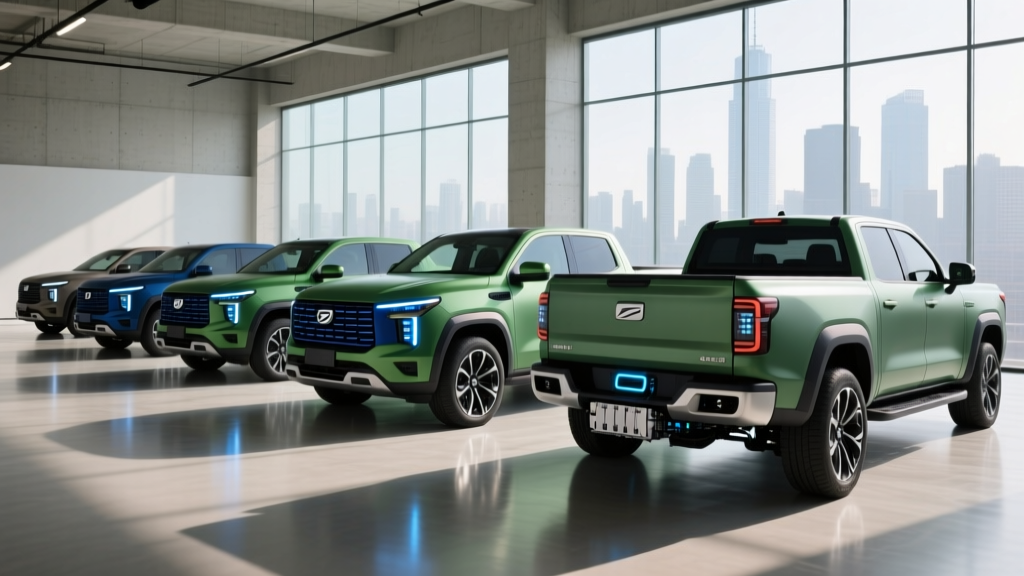
The all electric pickup segment has matured past early-adopter territory into a legitimate work-truck category. Three platforms dominate 2026: Ford's body-on-frame F-150 Lightning, Rivian's skateboard-based R1T, and GM's Ultium-platform Silverado EV. Each targets a different buyer — the Lightning prioritizes fleet and traditional truck buyers, the R1T leans into adventure and tech, and the Silverado EV chases maximum range and heavy-duty capability. The question isn't whether electric trucks exist — it's whether the math works for your specific driving pattern, charging situation, and budget.
2026 All Electric Pickup Spec Comparison
| Specification | Ford F-150 Lightning | Rivian R1T | Chevrolet Silverado EV |
|---|---|---|---|
| Base MSRP | $54,995 (Pro) | $69,900 (Standard) | $54,900 (Work Truck) |
| EPA Range | 240–320 mi | 270–420 mi | 390–440 mi |
| Battery (usable kWh) | 98 / 131 kWh (NMC) | 106 / 141 / 180 kWh (NMC/LFP) | 200 kWh (NMC) |
| Peak DC Fast Charge | 150 kW | 200+ kW | 350 kW |
| 10–80% DC Charge | ~41 min | ~30 min | ~20 min |
| Level 2 Charge Rate | 19.2 kW (80A) | 19.2 kW | 19.2 kW |
| Horsepower | 580 hp | 665 hp (Dual) | 664 hp (4WT) |
| 0–60 mph | ~4.0 sec | ~3.0 sec (Tri) | ~4.5 sec |
| Max Towing | 10,000 lbs | 11,000 lbs | 10,000 lbs |
| Max Payload | 2,235 lbs | 1,764 lbs | 1,800 lbs |
| Battery Warranty | 8 yr / 100,000 mi | 8 yr / 120,000 mi | 8 yr / 100,000 mi |
| §30D Tax Credit Eligible | Partial (check sourcing) | Up to $7,500 | Up to $7,500 |
Sources: fueleconomy.gov, Ford F-150 Lightning specs, Rivian R1T.
Real-World Range vs. EPA: What Actually Happens
EPA vs. Reality: The F-150 Lightning Extended Range carries a 320-mile EPA sticker. In real-world highway driving at 70–75 mph, expect 250–270 miles. In sub-freezing temperatures (below 32°F), that drops to 210–240 miles. Towing a 5,000-lb trailer? Plan for 150–180 miles between charges. The Silverado EV 4WT's 440-mile EPA rating is more forgiving — roughly 360–380 highway, and 220–260 while towing — but that comes with a $79,900+ price tag and a massive 200 kWh battery that takes longer to charge from a full depletion.
Battery chemistry matters here. Most electric pickups use NMC (nickel-manganese-cobalt) cells for their higher energy density, which is critical when packaging 130–200 kWh into a truck frame. NMC batteries lose more range in extreme cold than LFP (lithium iron phosphate) chemistry, but LFP's lower energy density makes it impractical for long-range truck applications at current cell-level technology. Rivian has introduced LFP options on shorter-range configurations where weight is less of a concern.
Preconditioning — warming the battery before DC fast charging — is essential for electric pickups. The Lightning, R1T, and Silverado EV all precondition automatically when you navigate to a fast charger. Skip this step in cold weather, and your 150 kW peak charge rate may start closer to 40–60 kW until the battery reaches optimal temperature, adding 15–20 minutes to your stop.
EV Truck vs. Gas Truck: The Ownership Cost Breakdown
| Cost Factor (5-Year / 75,000 mi) | F-150 Lightning (Pro) | F-150 Gas (XLT 4WD) |
|---|---|---|
| Purchase Price (MSRP) | $54,995 | $48,500 |
| §30D Tax Credit | –$3,750 to –$7,500 | $0 |
| Effective Purchase | $47,495–$51,245 | $48,500 |
| Fuel / Electricity (home L2) | $3,900 (avg $0.14/kWh) | $9,750 (avg $3.50/gal, 20 MPG) |
| Fuel / Electricity (DC public) | $5,800 (avg $0.40/kWh) | $9,750 |
| Maintenance | $1,800 | $4,200 |
| Insurance (avg) | $9,500 | $7,200 |
| Estimated Depreciation | $18,000 | $15,000 |
| Total 5-Year Cost (home charging) | $80,695–$84,445 | $84,650 |
The numbers reveal a tight race. Home charging is the critical variable — if you charge primarily at home on a Level 2 circuit at residential electricity rates ($0.10–$0.18/kWh nationally), the Lightning breaks even or beats a comparably equipped gas F-150 within 3–4 years. If you rely on DC public charging at $0.35–$0.55/kWh (common on Electrify America and EVgo networks), the fuel savings shrink dramatically, and the gas truck may cost less over five years.
Maintenance is where electric pickups consistently win. No oil changes, no transmission fluid, no spark plugs, no exhaust system. Brake pads last 100,000+ miles thanks to regenerative braking handling most deceleration. The main wear items are tires (EVs are heavier and produce more torque, wearing tires 20–30% faster), cabin air filters, and wiper fluid. Budget roughly $350–$400/year for EV truck maintenance versus $800–$1,000/year for a gas equivalent.
Insurance is the offsetting cost. Electric pickups carry premiums 15–30% higher than gas equivalents due to higher repair costs, specialized parts, and elevated total-loss thresholds after battery damage. Get quotes before purchasing — a $2,300/year gas truck policy may become $2,900–$3,100 for the Lightning.
Home Charging Setup: What It Actually Costs
| Component | Low End | High End | Notes |
|---|---|---|---|
| Level 2 Charger (hardware) | $400 | $750 | ChargePoint Home Flex, Wallbox Pulsar Plus, Ford Charge Station Pro |
| Electrical Panel Upgrade | $0 | $3,000 | Required if panel is below 200A or lacks spare breaker slots |
| Electrician Labor (240V run) | $600 | $2,500 | Depends on distance from panel to garage/driveway |
| Permit & Inspection | $50 | $300 | Varies by municipality |
| Total Install | $1,050 | $6,550 | Most homes with 200A panels: $1,500–$2,500 |
For an all electric pickup, Level 2 home charging isn't optional — it's essential. A 131 kWh Lightning battery on Level 1 (120V, 1.4 kW) would take over 90 hours for a full charge. On a 48-amp Level 2 circuit (11.5 kW), it takes roughly 11 hours. On an 80-amp circuit (19.2 kW) — which the Lightning, R1T, and Silverado EV all support — that drops to about 7 hours, meaning an overnight top-up easily covers daily use.
Most electric truck owners need a dedicated 60-amp or 100-amp circuit. If your home has a 200-amp panel with spare capacity, expect to pay $1,500–$2,500 total for a professional install. If your panel is older (100-amp service) or fully loaded, a panel upgrade to 200A or 400A can add $2,000–$4,000. Always hire a licensed electrician — improper EV charger installation is a fire risk and may void your home insurance coverage.
Renters and apartment dwellers face a harder reality. Without access to Level 2 charging, owning an electric pickup means relying on public DC fast chargers, which costs 2–4× more per kWh, takes 20–40 minutes per session, and adds inconvenience. If you can't charge at home or work, an electric truck probably isn't practical yet.
Towing and Payload: The Range Reality Check
| Scenario | F-150 Lightning (Ext. Range) | F-150 Gas (3.5L EcoBoost) |
|---|---|---|
| Unloaded highway range | ~260 mi (real-world) | ~480 mi (20 MPG, 26-gal tank) |
| Towing 5,000 lbs | ~160 mi | ~340 mi (12 MPG) |
| Towing 8,000 lbs | ~120 mi | ~260 mi (10 MPG) |
| Refuel/Recharge Time | 30–45 min (DC fast) | 5 min (gas station) |
| Trailer Charger Availability | Limited (growing) | Ubiquitous |
This is where electric pickups face their biggest limitation. Towing an enclosed cargo trailer, boat, or camper dramatically increases energy consumption — a loaded trailer can push efficiency from 2.0 kWh/mile down to 4.0–5.0 kWh/mile, effectively halving your range. A 320-mile EPA Lightning may deliver just 120–160 miles while towing 5,000–8,000 lbs.
For weekend warriors towing a boat 50 miles to the lake and back, this is manageable. For contractors towing equipment 200+ miles regularly, or RV owners planning cross-country trips, the charging infrastructure for trailers remains sparse. Some Electrify America and Tesla Supercharger stations now offer pull-through stalls, but they're not yet common. If you tow long distances more than a few times a year, a gas or hybrid truck is still the pragmatic choice.
Payload capacity is less of an issue. The Lightning's 2,235-lb payload handles most job-site loads, and the low center of gravity from the under-floor battery actually improves stability when loaded. The frunk (front trunk) adds 14.1 cu ft of secure, weatherproof storage — a genuine advantage over gas trucks.
§30D Federal Tax Credit: What You Actually Qualify For
2026 §30D EV Tax Credit Requirements (IRS):
- MSRP Cap: Pickup trucks/vans — $80,000 maximum MSRP
- Buyer Income Cap: $150,000 single / $225,000 head of household / $300,000 married filing jointly (modified AGI)
- Battery Sourcing: Critical minerals and battery components must meet escalating domestic/free-trade-partner thresholds (check IRS.gov for current-year rules)
- Assembly: Vehicle must undergo final assembly in North America
- Point-of-Sale: Eligible buyers can transfer the credit to the dealer for an immediate price reduction at purchase
- Credit Amount: $3,750 (meets one sourcing requirement) or $7,500 (meets both) — varies by model and production date
The F-150 Lightning, Rivian R1T, and Silverado EV all qualify for at least partial credits, but the exact amount depends on when the vehicle was manufactured and its battery component sourcing. Rivian and GM have largely secured qualifying supply chains for the full $7,500. Ford's credit eligibility has varied by production batch — verify the specific VIN's eligibility on the IRS clean vehicle portal before purchasing. Higher-trim Lightnings (Platinum at $96,874) exceed the $80,000 MSRP cap and are ineligible regardless of buyer income.
State incentives stack on top. Colorado offers up to $5,000, California's CVRP provides up to $7,000 for income-qualified buyers, and several states offer $1,000–$3,000 rebates. Check your state energy office for current programs — these change annually.
Common Misconceptions About Electric Trucks
| Myth | Fact |
|---|---|
| "The battery will need replacing in 5 years" | Modern NMC packs retain 85–92% capacity at 100,000 miles. Warranties guarantee 70%+ retention at 8 years / 100,000 miles. Full replacements cost $15,000–$25,000 but are rarely needed within the first decade. |
| "Electric trucks can't tow" | They tow powerfully — instant torque makes them excellent at pulling. The limitation is range while towing, not capability. A Lightning tows 10,000 lbs; you just can't go as far between stops. |
| "Charging takes too long for road trips" | The Silverado EV charges at 350 kW, adding ~100 miles in 10 minutes at compatible stations. Most road-trip stops take 20–30 minutes (10–80%). Plan routes with A Better Routeplanner or PlugShare. |
| "The grid can't handle electric trucks" | Most charging happens overnight when grid demand is low. A Level 2 home charger draws roughly the same power as an electric dryer. Utility time-of-use rates incentivize off-peak charging at $0.06–$0.10/kWh. |
| "All electric pickups are over $80,000" | The Lightning Pro starts at $54,995 and the Silverado EV Work Truck at $54,900. After a $7,500 credit, effective prices drop below $48,000 — competitive with mid-trim gas trucks. |
Decision Framework: Which Truck Should You Buy?
Buy the Ford F-150 Lightning if: You want a traditional truck experience with proven fleet support, need a frunk for job-site storage, prefer Ford dealer service networks, and tow under 150 miles per trip. Best value at the Pro and XLT trims with the standard 98 kWh battery.
Buy the Rivian R1T if: You prioritize performance and technology, want the most range options (270–420 mi), value the quad-motor tri-motor configurations for off-road capability, and don't mind a newer brand with fewer service centers. The adventure-oriented buyer's truck.
Buy the Chevrolet Silverado EV if: Maximum range and fastest DC charging are your top priorities, you need 440 miles EPA for long commutes or frequent road trips, and you're willing to pay a premium for the Ultium platform's 350 kW charging capability.
Stick with a gas or hybrid truck if: You tow heavy trailers over 200 miles regularly, lack home charging access, live in a rural charging desert, operate in extreme cold (below 0°F) frequently, or your budget is strictly under $40,000. The Ford Maverick Hybrid at 42 MPG combined and $29,000 starting is a compelling alternative for light-duty urban truck use.
Frequently Asked Questions
How long does it take to charge an all electric pickup at home?
On a Level 2 (240V) charger at 48 amps (11.5 kW), expect 10–14 hours for a full charge depending on battery size. On an 80-amp circuit (19.2 kW), that drops to 7–9 hours. Since most owners charge overnight and rarely deplete the battery fully, a typical daily top-up from 30% to 80% takes 3–5 hours on Level 2.
Do electric pickups lose range in winter?
Yes. Expect 20–35% range loss in temperatures below 32°F, and up to 40% below 0°F. The battery uses energy to heat itself and the cabin. Models with heat pumps (like the R1T and Silverado EV) recover some efficiency compared to resistive heating. Preconditioning while plugged in mitigates the loss.
What happens if the battery fails out of warranty?
Full battery replacements currently cost $15,000–$25,000 depending on pack size. However, data from high-mileage Tesla and early-adopter fleets show modern NMC packs degrading gradually rather than failing catastrophically. At 150,000–200,000 miles, expect 80–88% capacity retention — still plenty of range for daily use, just reduced from new.
Can I use a Tesla Supercharger with a non-Tesla electric truck?
The Ford F-150 Lightning and Silverado EV can access Tesla Superchargers using a provided NACS adapter (Ford) or native NACS port (newer Silverado EV builds). Rivian also supports NACS via adapter. Tesla's Supercharger network — now open to other brands — is widely considered the most reliable DC fast-charging network in the US, with over 30,000 stalls nationally.
Is an electric pickup good for a job site?
For daily commutes to a local job site with home charging, absolutely — the Lightning's Pro Power Onboard (up to 9.6 kW) can run power tools, lights, and even a small welder directly from the truck's battery, eliminating the need for a separate generator. For remote job sites without charging access within your daily range, a gas truck remains more practical.