The Fragmented Reality of Public EV Charging Payments
For early electric vehicle adopters, the public charging experience has often felt like a fragmented digital scavenger hunt. Pulling up to a public charging station frequently requires a multi-step digital dance: downloading a proprietary network app, creating an account, verifying an email address, linking a credit card, and finally, scanning a QR code or swiping an RFID card just to initiate a session. While this ecosystem has matured significantly over the last few years, the friction associated with charging station payment methods remains a primary pain point for mainstream EV buyers.
Today, the industry is undergoing a massive paradigm shift. Driven by federal infrastructure mandates, the widespread adoption of the North American Charging Standard (NACS), and the maturation of ISO 15118 protocols, the future of EV charging payments is moving rapidly toward invisibility. Understanding the current landscape of network apps versus emerging 'Plug & Charge' technologies is critical for both EV drivers planning cross-country road trips and industry watchers tracking infrastructure reliability.
The Technological Leap: Plug & Charge and ISO 15118
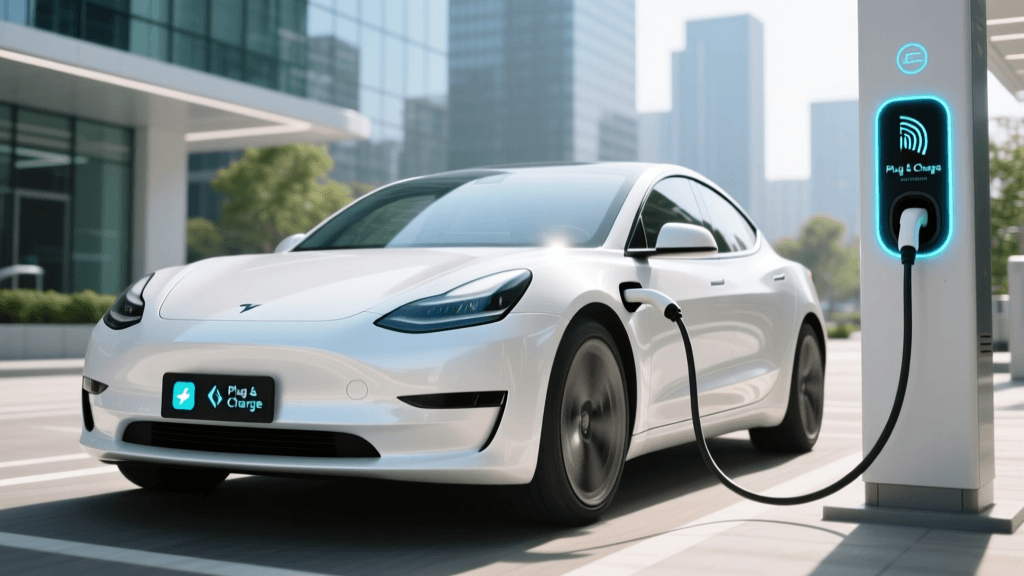
The holy grail of public EV charging is a truly frictionless experience, commonly referred to as 'Plug & Charge.' This technology is built upon the ISO 15118 standard, a vehicle-to-grid (V2G) communication protocol that allows the electric vehicle and the charging station to authenticate each other digitally the moment the cable is connected.
When an ISO 15118-compliant vehicle plugs into a compatible DC fast charger, the car transmits a secure, encrypted digital certificate to the charger via Power Line Communication (PLC) or Wi-Fi. The charger verifies this certificate with a central backend server, automatically identifying the driver's account, initiating the charging session, and processing the payment upon completion. No apps, no RFID cards, and no screens are required.
Networks like Electrify America have been aggressive in deploying Plug & Charge capabilities across their highway corridor stations. Vehicles such as the Porsche Taycan, Ford F-150 Lightning, and the Hyundai Ioniq 5 natively support this protocol. However, adoption has been bottlenecked by software bugs, certificate provisioning delays from automakers, and the sheer cost of upgrading legacy charger hardware to support secure PLC communication.
Regulatory Shifts: The NEVI Mandate and Open Payments
While Plug & Charge represents the premium, tech-forward solution, the U.S. government is simultaneously mandating a more universal baseline for payment accessibility. Under the National Electric Vehicle Infrastructure (NEVI) Formula Program, any charging station built with federal funds must adhere to strict interoperability and payment standards.
According to the final rule published in the Federal Register by the Federal Highway Administration, federally funded chargers must provide open access to payment methods. This means drivers cannot be forced to download a proprietary app or become a network member to initiate a session. By 2024 and into 2025, new NEVI-funded stations are required to feature contactless credit card readers (tap-to-pay) that comply with Payment Card Industry (PCI) security standards. This regulatory push ensures that the 'gas station model' of payment—simply tapping a Visa or Mastercard—will become a ubiquitous fallback, drastically reducing range anxiety for casual EV drivers.
Network App Ecosystems: A Comparative Analysis
Despite the push for open payments and Plug & Charge, proprietary network apps remain the most reliable way to access discounted rates, manage charging wallets, and troubleshoot hardware errors. Below is a comparison of the major U.S. charging networks and their current payment ecosystems.
| Network | App Wallet & Payment | Plug & Charge (ISO 15118) | RFID Card Option | Tap-to-Pay (Credit) |
|---|---|---|---|---|
| Electrify America | Pre-load wallet; auto-recharge available | Yes (Widespread on DCFC) | Yes | Yes (Newer/NEVI sites) |
| Tesla Supercharger | Linked directly to Tesla/Vehicle account | Proprietary Autocharge (NACS) | No | No (App/Account only) |
| EVgo | Autocharge+ feature; Apple Pay integration | Yes (Autocharge+ protocol) | Yes | Yes (Select locations) |
| ChargePoint | Pay-per-session or wallet; Apple Pay | Limited (Mostly fleet/Level 2) | Yes | Yes (Newer DCFC sites) |
| Blink | Member wallet; guest fees apply | No | Yes (Blink Member Card) | Yes (Select locations) |
The Rise of In-App Wallets and Roaming Agreements
A major trend in the app ecosystem is the shift from 'pay-per-session' to 'pre-loaded wallets.' Networks incentivize users to load $50 or $100 into their app wallets by offering lower per-kWh rates compared to guest or tap-to-pay pricing. Furthermore, roaming agreements are blurring the lines between these apps. For example, EVgo and Electrify America have established roaming partnerships, allowing EVgo app users to initiate sessions and pay seamlessly on Electrify America hardware, and vice versa. This eRoaming protocol, often facilitated by backend hubs like Hubject, is a critical stepping stone toward a unified national charging network.
The NACS Factor and Proprietary Autocharge
No discussion on the future of EV charging payments is complete without addressing the Tesla Supercharger network and the North American Charging Standard (NACS). Tesla does not use ISO 15118 for Plug & Charge; instead, it relies on a proprietary 'Autocharge' system linked directly to the vehicle's VIN and the owner's Tesla account. When a Tesla, or a newly approved NACS-adapted vehicle from Ford, GM, or Rivian, plugs into a Supercharger, the billing is handled entirely in the background via the Tesla app.
As the industry standardizes around NACS by 2025, third-party networks like EVgo and ChargePoint are integrating Tesla's payment APIs or developing their own NACS-compatible Autocharge protocols. This means the 'walled garden' of Tesla's payment system is slowly opening, but it remains the gold standard for reliability and frictionless user experience in the current market.
Future Outlook: Seamless Roaming and Invisible Payments
Looking ahead to 2026 and beyond, the industry anticipates a convergence of payment methods. The ultimate goal is 'invisible payments,' where the vehicle itself acts as a digital wallet. Automakers are exploring integrating payment gateways directly into the vehicle's infotainment system, allowing drivers to authorize payments via biometric sensors (like fingerprint or facial recognition) on the dashboard screen, regardless of the charger brand.
'The friction of downloading five different apps to cross the country will be a relic of the early 2020s. The combination of NEVI-mandated tap-to-pay terminals and widespread ISO 15118 Plug & Charge will reduce payment-related charging failures to near zero.'
Additionally, the integration of smart contracts and blockchain-based micropayments is being tested in European markets, allowing vehicles to autonomously pay for electricity, tolls, and even parking without human intervention. While this may be a decade away for the U.S. mainstream, the foundational software architecture is being laid today.
Actionable Strategies for Today's EV Driver
While the industry transitions toward a frictionless future, EV drivers must navigate the current hybrid landscape. Here is how to optimize your charging payment strategy today:
- Maintain a Digital Backup: Always keep at least two network apps (e.g., Electrify America and EVgo) installed on your phone with a credit card saved and a small wallet balance pre-loaded. Cellular dead zones at remote charging stations can prevent app-based guest checkouts, but pre-loaded wallets often cache authentication tokens locally.
- Order Physical RFID Cards: If your network offers a free RFID card (like ChargePoint or EVgo), order it and keep it in your glovebox. RFID readers on chargers operate on localized radio frequencies and do not require the charger's cellular modem to be online to initiate a handshake with the network server via your phone's Bluetooth or the charger's local cache.
- Leverage Apple Pay / Contactless: When visiting new NEVI-compliant stations, look for the contactless payment terminal. Tapping your phone or credit card bypasses the need to interact with the charger's often-glitchy touchscreen interface, initiating the session via the payment processor's direct API link to the charger's backend.
- Provision Plug & Charge Early: If you own an ISO 15118-capable vehicle like the Ford Mustang Mach-E or Porsche Taycan, ensure you have enabled Plug & Charge in the vehicle's settings and linked it to your Electrify America account *before* you arrive at the charger. Certificate provisioning can sometimes take up to 24 hours to sync across network servers.
By understanding the mechanics behind the screen, EV drivers can bypass the most common payment failures and enjoy the rapidly improving reality of modern electric road trips.