The Hidden Tech Behind EV Charging Reliability
As electric vehicle adoption accelerates globally, the focus of the automotive industry has shifted from vehicle range to infrastructure reliability. For EV drivers, few things are more frustrating than arriving at a public charging station with a low battery, only to find the chargers offline, screens blank, or dispensing power at a fraction of their rated capacity. According to the U.S. Department of Energy's Alternative Fuels Data Center, the rapid expansion of public charging infrastructure must be matched by rigorous maintenance protocols to ensure grid stability and consumer confidence. This is where EV charging station downtime trackers and advanced uptime telemetry come into play.
From a consumer perspective, a downtime tracker might simply be an app showing a red 'Out of Order' icon. However, from a technological standpoint, these trackers are complex, data-heavy systems operating within Network Operations Centers (NOCs). They rely on continuous bidirectional communication between the charging hardware, the payment gateway, and the cloud-based management software. In this deep dive, we will explore the underlying technology of EV charging downtime trackers, the protocols that make real-time monitoring possible, and how predictive maintenance is revolutionizing network reliability.
The Architecture of EV Charging Downtime Trackers
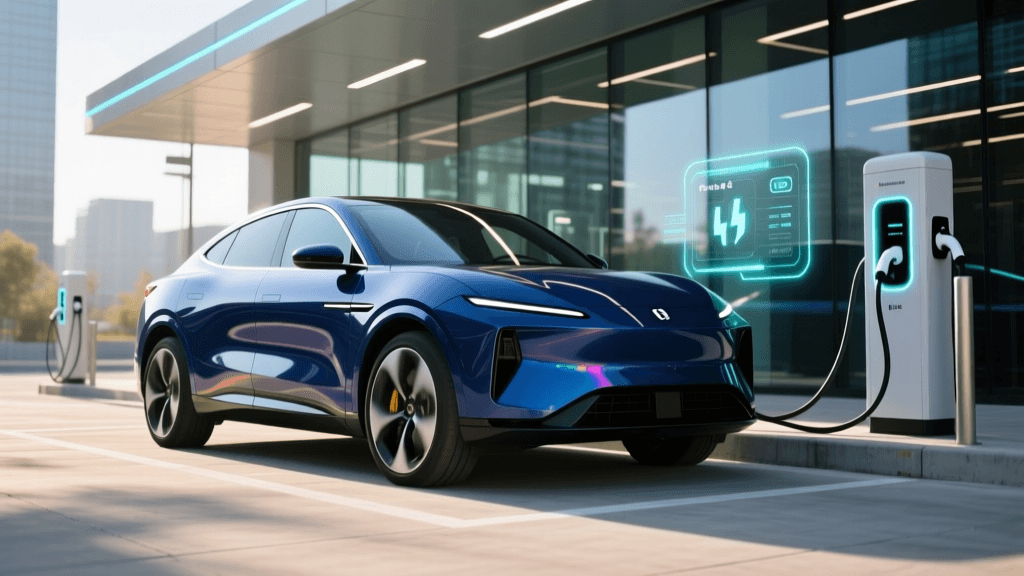
A modern EV charging downtime tracker is not a passive log; it is an active, IoT-driven telemetry system. When a Direct Current Fast Charger (DCFC) or a Level 2 station is installed, it is provisioned into a Charge Point Management System (CPMS). The CPMS acts as the central brain, continuously polling the charger for its health status.
The hardware itself is equipped with numerous internal sensors monitoring voltage, current, internal temperature, liquid cooling flow rates, and cable tension. If a liquid-cooled CCS cable experiences a micro-tear or a drop in coolant pressure, the internal sensors immediately flag an anomaly. The downtime tracker registers this as a 'ConnectorFaulted' state, automatically taking the specific plug offline to prevent electrical hazards, while keeping the rest of the station operational. This granular tracking allows networks to dispatch technicians with the exact error codes before they even arrive on site.
OCPP and the Language of Charger Telemetry
The backbone of most non-proprietary charging networks is the Open Charge Point Protocol (OCPP). By leveraging the Open Charge Point Protocol (OCPP) 2.0.1, networks standardize communication between diverse hardware manufacturers (like Tritium, ABB, or BTC Power) and centralized software platforms. OCPP 2.0.1 introduced advanced security features, smart charging profiles, and highly detailed diagnostic status notifications.
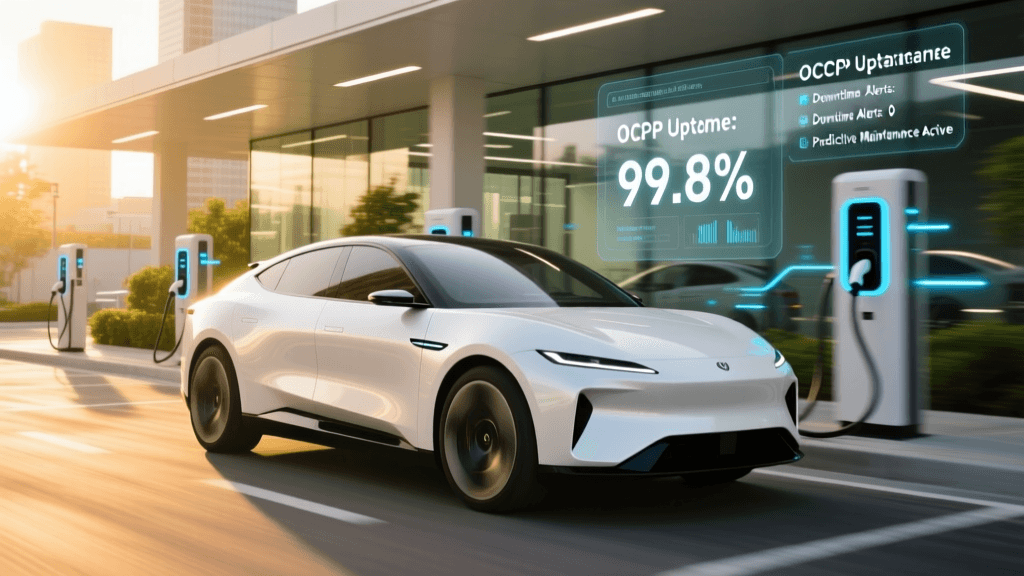
Through OCPP, a downtime tracker receives 'Heartbeat' signals from the charger at regular intervals (often every 30 to 60 seconds). If the CPMS misses a predefined number of heartbeats, the station is flagged for 'Communication Fault' downtime. Furthermore, OCPP allows the tracker to monitor transaction logs. If a charger is physically powered on but fails to initiate a session due to a payment terminal latency issue, the tracker logs this as a 'soft failure,' a critical metric that older tracking systems often missed.
Hard Downtime vs. Soft Downtime
To truly understand EV charging maintenance, one must differentiate between hard and soft downtime, both of which are tracked by modern CPMS platforms:
- Hard Downtime: The charger is physically incapable of dispensing power. This includes hardware failures, grid outages, severed communication lines, or physical vandalism. The tracker registers the unit as completely offline.
- Soft Downtime: The charger has power and network connectivity, but the user cannot complete a charging session. Common culprits include unresponsive RFID readers, broken touchscreens, payment gateway API timeouts, or a connector that fails to lock into the vehicle's charge port. Historically, networks reported high 'uptime' because the machine was technically 'on,' but modern trackers now classify soft failures as functional downtime.
Defining the Metrics: MTBF, MTTR, and True Availability
Network operators and fleet managers rely on specific engineering metrics to evaluate the effectiveness of their downtime trackers and maintenance crews.
Mean Time Between Failures (MTBF)
MTBF measures the average operational time between breakdowns. A high MTBF indicates robust hardware and favorable environmental conditions. Downtime trackers calculate this by analyzing the timestamp of the last successful repair against the timestamp of the newest fault code.
Mean Time To Repair (MTTR)
MTTR is the ultimate test of a network's maintenance logistics. It tracks the time from the moment the downtime tracker registers a critical fault to the moment the charger is successfully reset and dispensing power. Networks with localized spare parts depots and dedicated technician fleets boast significantly lower MTTRs.
True Availability
Research from the National Renewable Energy Laboratory (NREL) highlights that true reliability requires looking beyond simple network connectivity. True Availability measures the percentage of time a charger is not only online but capable of successfully initiating and completing a charge session at its advertised kilowatt output.
Network Maintenance and Tracking Tech Comparison
Different networks utilize varying approaches to track downtime and manage maintenance. Below is a comparison of how major networks handle telemetry and uptime metrics.
| Network | Primary Telemetry Protocol | Predictive Maintenance Approach | Uptime Tracking Focus |
|---|---|---|---|
| Tesla Supercharger | Proprietary Closed-Loop | Real-time vehicle-to-charger handshake diagnostics; automated thermal throttling. | Session success rate and vehicle-specific error logging. |
| Electrify America | OCPP 1.6J / 2.0.1 | AI-driven analysis of liquid cooling pump acoustics and thermal variance. | Hardware MTTR and screen/payment terminal responsiveness. |
| ChargePoint | OCPP 1.6J / 2.0.1 | Cloud-based CPMS analytics predicting component degradation via voltage anomalies. | Network-wide API uptime and RFID authentication latency. |
| EVgo | OCPP / Proprietary Hybrid | Automated daily self-diagnostic routines triggered during low-demand hours. | Connector lock mechanism reliability and cable tension faults. |
Predictive Maintenance and IoT Sensor Integration
The cutting edge of EV charging maintenance is predictive analytics. Instead of waiting for a downtime tracker to report a failure, modern systems use machine learning algorithms to predict when a component is likely to fail. For example, DCFC power modules contain cooling fans. Over time, dust and debris cause these fans to work harder, drawing more amperage. The downtime tracker monitors the amperage draw of the cooling system. When the draw exceeds a baseline threshold, the system flags the power module for preventative replacement before it overheats and triggers a hard shutdown.
Similarly, payment terminals are monitored for API latency. If a credit card reader takes 4.5 seconds to authenticate instead of the usual 1.2 seconds, the tracker flags the degrading cellular modem or failing internal memory, prompting a technician to swap the terminal during a routine site visit, thereby avoiding future soft downtime.
Actionable Strategies for Drivers and Fleet Operators
Understanding how downtime trackers work provides distinct advantages for both everyday EV drivers and commercial fleet operators.
For the Everyday EV Driver
- Look Beyond the Green Checkmark: Network apps often show a station as 'Available' based on the OCPP heartbeat. Always cross-reference with crowd-sourced downtime trackers like PlugShare, specifically filtering for check-ins within the last 24 hours to catch 'soft downtime' issues like broken screens.
- Report Soft Failures: If a charger powers on but fails to authenticate your payment, report it through the network's app. This manually feeds the downtime tracker's soft-failure log, prioritizing the unit for IT maintenance rather than electrical maintenance.
- Utilize Pre-Conditioning Handshakes: When using networks like Tesla or Electrify America via Plug & Charge, the vehicle and charger communicate before you even arrive. If the charger's internal tracker detects a fault during this pre-routing handshake, the vehicle's navigation will automatically reroute you to the next reliable station.
For Fleet Operators
- API Integration: Integrate network downtime tracker APIs directly into your fleet routing software (such as Geotab or Samsara). This ensures your dispatch algorithms never route a commercial EV to a station currently experiencing a high MTTR.
- Negotiate SLAs Based on True Availability: When negotiating charging contracts for depot or public fast-charging access, base your Service Level Agreements (SLAs) on 'True Session Availability' rather than 'Network Uptime,' ensuring you are not penalized for soft downtime events.
Conclusion
The technology behind EV charging station downtime trackers has evolved from simple ping-tests into sophisticated, IoT-driven diagnostic ecosystems. By leveraging standardized protocols like OCPP, integrating granular hardware sensors, and applying predictive machine learning models, charging networks are steadily closing the gap between hardware deployment and true operational reliability. As the industry continues to mature, the transparency and accuracy of these uptime metrics will be the defining factor in building lasting consumer trust and achieving seamless, cross-country electric mobility.