The Hardware and Installation Cost Divide
When you purchase an electric vehicle, the immediate question is how you will keep it charged at home. For many new EV owners, the included or low-cost Level 1 charger seems like a financial no-brainer. However, the true cost of EV ownership extends far beyond the initial hardware price tag. To understand the real value, we must compare the ubiquitous Level 1 Tesla Mobile Connector (used here as our baseline benchmark) against a premium Level 2 smart charger like the ChargePoint Home Flex.
According to the U.S. Department of Energy, home charging accounts for more than 80% of all EV charging events. Making the right choice here dictates your daily convenience, electrical efficiency, and long-term wallet impact.
Level 1: The 120V Baseline
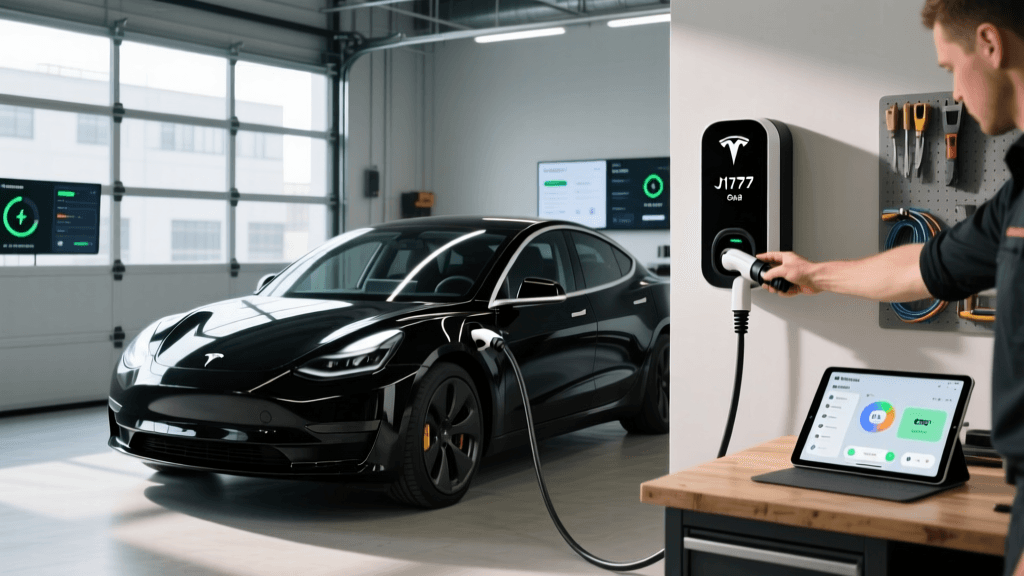
The Tesla Mobile Connector with a standard 120V NEMA 5-15 adapter is the definition of plug-and-play. The hardware cost is roughly $200, and in many cases, it is bundled with the vehicle or the mobile connector kit. The installation cost is effectively zero, as it utilizes existing household outlets. However, it delivers a maximum of 12 amps at 120 volts, yielding about 1.4 kW of power. This translates to roughly 3 to 5 miles of range per hour of charging.
Level 2: The 240V Upgrade
The ChargePoint Home Flex is a powerhouse Level 2 charger capable of delivering up to 50 amps (12 kW) when hardwired, or 40 amps (9.6 kW) when plugged into a NEMA 14-50 receptacle. The hardware costs between $500 and $700. The installation, which requires a licensed electrician to run a 240V circuit (often 50-amp or 60-amp), typically ranges from $500 to $2,000 depending on your electrical panel's capacity and the distance from the panel to your garage. While the upfront cost is steep, the value proposition reveals itself in daily use.
The Daily Charging Scenario: 40-Mile Commute
To accurately compare the daily charging experience, let us look at a standard 40-mile round-trip commute, which aligns closely with the average American daily driving distance.
Level 1: The Slow and Steady Trickle
Replenishing 40 miles of range on a 120V Level 1 charger will take approximately 10 to 13 hours. If you arrive home at 6:00 PM and leave at 7:00 AM, you have exactly 13 hours available. While this technically covers the daily commute, it leaves zero margin for error. If you take a longer weekend trip or forget to plug in immediately upon returning home, you will start the next day with a deficit. Furthermore, Level 1 charging does not provide enough power to run the vehicle's cabin heater while charging in the winter, meaning your battery will drain to keep you warm, further extending charging times.
Level 2: The Rapid Replenishment
Replenishing that same 40-mile commute on a 240V Level 2 charger like the ChargePoint Home Flex takes just 1.5 to 2 hours. You can arrive home, plug in, and by the time you are done making dinner, your vehicle is already fully topped off. This abundance of speed provides immense psychological comfort and practical flexibility, allowing you to easily handle unexpected detours, road trips, and extreme weather conditions without range anxiety.
Electricity Costs and the Efficiency Penalty
One of the most overlooked factors in the Level 1 vs Level 2 debate is charging efficiency. EVs have onboard computers, battery management systems (BMS), and thermal loops that must remain active during charging. When charging at 120V (Level 1), these systems consume a fixed amount of power over a much longer period, leading to significant overhead losses.
The Environmental Protection Agency (EPA) notes that EV efficiency is heavily dependent on how power is delivered and managed. Independent tests have shown that Level 1 charging can result in efficiency losses of 15% to 20% from the wall to the battery, whereas Level 2 charging typically operates at 85% to 92% efficiency. Over five years, paying for 20% more electricity to achieve the same amount of range adds a hidden cost to the "cheap" Level 1 charger.
5-Year Total Cost of Ownership (TCO) Breakdown
The following table illustrates the estimated 5-year costs for a driver covering 12,000 miles annually (40 miles daily), assuming an average electricity rate of $0.16 per kWh and accounting for charging efficiency losses.
| Category | Level 1 (Tesla Mobile 120V) | Level 2 (ChargePoint Flex 240V) |
|---|---|---|
| Hardware Cost | $200 | $600 |
| Installation Cost | $0 | $1,000 (Avg) |
| Charging Efficiency | ~82% | ~90% |
| 5-Year Electricity Cost | $3,512 | $3,200 |
| 5-Year Total Cost | $3,712 | $4,800 |
| Value of Time Saved | N/A (Baseline) | ~2,500 hours saved |
The Hidden Value of Smart Features and Preconditioning
Beyond raw charging speed, Level 2 smart chargers unlock software features that Level 1 chargers simply cannot support effectively. The ChargePoint Home Flex integrates with home solar systems, allowing you to charge exclusively when your panels are producing excess power. It also offers robust scheduling to take advantage of Time-of-Use (TOU) utility rates, ensuring you only draw power when electricity is cheapest (often late at night).
Furthermore, modern EVs utilize battery preconditioning. If you schedule a departure time, a Level 2 charger provides enough amperage to warm the battery to its optimal operating temperature using wall power, rather than draining the battery itself. As highlighted in various EPA green vehicle resources, maintaining optimal battery temperatures is crucial for longevity and efficiency, especially in cold climates. A 120V outlet simply does not have the wattage to run the battery heater and charge the pack simultaneously.
Resale Value and Home Appraisal
When evaluating the cost of a Level 2 installation, it is vital to consider home equity. A professionally installed 240V NEMA 14-50 outlet or a hardwired EV charger is increasingly viewed as a permanent home upgrade, similar to a gas line for a premium stove. Real estate data suggests that homes with dedicated EV charging infrastructure are selling faster and at a premium in suburban markets. While the Tesla Mobile Connector can be tossed in the trunk when you move, the $1,000 you spent on electrical panel upgrades and 240V wiring remains with the house, potentially recouping a significant portion of your initial investment.
Final Verdict: Which Offers the Best Value?
If your daily commute is under 20 miles, you live in a mild climate, and you are renting a home where electrical upgrades are prohibited, the Tesla Mobile Connector on a 120V circuit offers undeniable upfront value. It is cheap, portable, and sufficient for light-duty topping off.
However, from a holistic Cost & Value Breakdown perspective, the ChargePoint Home Flex (or any quality Level 2 charger) is the undisputed winner for the majority of EV owners. When you factor in the electricity lost to Level 1 inefficiencies, the immense value of the thousands of hours saved over a five-year period, the ability to precondition your battery in winter, and the added resale value to your home, the $1,600 combined cost of hardware and installation pays for itself in convenience and capability. Level 1 is a stopgap; Level 2 is the true EV experience.