Introduction: Why Weather Durability Matters for EV Chargers
Transitioning to an electric vehicle (EV) is an exciting milestone, but for many beginners, the home charging setup can feel like uncharted territory. When shopping for a Level 2 EV charger, most new owners focus entirely on charging speeds, cable length, and smart app features. However, if you live in a region prone to harsh environmental conditions—be it the freezing blizzards of the Midwest or the scorching, sun-baked summers of the Southwest—weather durability is arguably the most critical factor in your purchasing decision.
An EV charger is essentially an outdoor appliance that handles high-voltage electricity. Exposure to extreme temperatures, UV radiation, heavy rain, and ice can lead to thermal throttling (where the charger slows down to prevent overheating), brittle cables, and catastrophic electrical failures. According to the U.S. Department of Energy, ensuring your home charging infrastructure is rated for local environmental conditions is vital for long-term safety and reliability. In this beginner’s complete guide, we are putting the Grizzl-E Smart Charger under the microscope to see if its legendary reputation for extreme weather survivability holds up.
Meet the Grizzl-E Smart: Built in Canada, Built for the Elements
The Grizzl-E Smart is manufactured by United Chargers, a company based in Canada. This geographic origin is no coincidence; the charger was engineered from the ground up to survive some of the most unforgiving winters on the planet. While many consumer electronics are designed for the mild, climate-controlled environments of a garage, the Grizzl-E is built to live on the exterior of your house, exposed to the elements, year-round.
At its core, the Grizzl-E Smart delivers up to 40 amps of continuous current (requiring a 50-amp circuit), offering a maximum output of 9.6 kW. This translates to roughly 30 to 40 miles of range per hour of charging, which is more than enough to replenish any daily commute overnight. But beyond the raw power, it is the physical enclosure and internal componentry that set this unit apart in the extreme weather category.
Deep Dive: Grizzl-E’s Extreme Weather Durability
Conquering the Deep Freeze (-40°F / -40°C)
Cold weather is the natural enemy of EV infrastructure. Standard PVC charging cables become stiff, unwieldy, and prone to cracking when temperatures drop below freezing. The Grizzl-E Smart combats this by utilizing a specialized Thermoplastic Elastomer (TPE) cable jacket. This material remains highly flexible even at -40°F, meaning you won't be wrestling with a rigid, frozen hose when you return home from work in a blizzard.
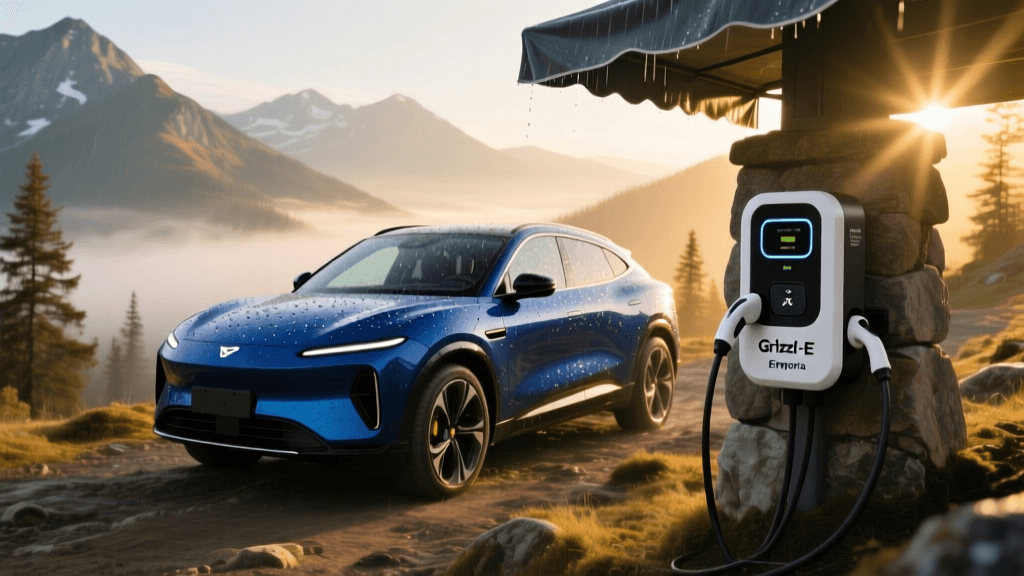
Furthermore, the internal relays and circuit boards are potted and sealed to prevent condensation from forming and shorting out the system. When ice storms coat the exterior of the charger, the Grizzl-E’s robust housing prevents moisture ingress, ensuring your car charges reliably even when the world outside is frozen solid.
Enduring the Summer Scorch (122°F / 50°C)
While cold weather makes cables brittle, extreme heat causes electrical resistance and triggers thermal throttling. Many popular smart chargers on the market will intentionally reduce their amperage output if their internal sensors detect excessive heat, effectively doubling your charging time. The Grizzl-E Smart features an advanced thermal management system and an aluminum-backed polycarbonate enclosure that dissipates heat efficiently. It is rated to operate continuously in ambient temperatures up to 122°F (50°C) without throttling its 40-amp output, making it a dependable workhorse in desert climates.
Decoding IP67 and NEMA 4X Ratings
For beginners, the alphabet soup of weatherproofing ratings can be confusing. The Grizzl-E boasts two major certifications:
- IP67 (Ingress Protection): The '6' means the unit is completely dust-tight. The '7' means it can withstand temporary submersion in water up to 1 meter deep. If a flash flood hits your driveway, the Grizzl-E’s internal components will survive.
- NEMA 4X: As outlined by the National Electrical Code (NFPA 70) standards for outdoor enclosures, NEMA 4X indicates that the charger is protected against windblown dust, rain, splashing water, and hose-directed water. The 'X' specifically denotes corrosion resistance, ensuring the exterior won't rust or degrade when exposed to coastal salt air or winter road-salt spray.
Head-to-Head: Grizzl-E vs. Competitors in Harsh Climates
How does the Grizzl-E Smart stack up against other industry heavyweights when the weather turns hostile? Below is a comparison chart tailored for extreme environment performance.
| Feature | Grizzl-E Smart | ChargePoint Home Flex | Tesla Wall Connector |
|---|---|---|---|
| Operating Temp Range | -40°F to 122°F | -22°F to 122°F | -22°F to 122°F |
| Weather Rating | IP67 / NEMA 4X | IP55 / NEMA 3R | IP55 / NEMA 3R |
| Cable Material | TPE (Stays flexible in extreme cold) | Standard PVC (Stiffens in freezing temps) | Standard PVC (Stiffens in freezing temps) |
| Enclosure Material | Polycarbonate w/ Aluminum Backplate | Plastic / Metal hybrid | Glass / Plastic front |
| Best For | Deep freeze, heavy rain, coastal salt | Mild climates, indoor/garage use | Mild climates, Tesla ecosystem |
As the data illustrates, while competitors like the ChargePoint Home Flex and Tesla Wall Connector are excellent devices for standard use, their IP55 and NEMA 3R ratings mean they are only protected against low-pressure water jets and falling rain. They are not designed to handle the extreme sub-zero temperatures or potential submersion that the Grizzl-E can easily shrug off.
Smart Features That Shine in Bad Weather
The 'Smart' in Grizzl-E Smart refers to its OCPP 1.6J (Open Charge Point Protocol) connectivity. For beginners, OCPP means the charger isn't locked into a single proprietary app ecosystem. You can connect it to the United Chargers app, or integrate it with third-party energy management systems.
Why does this matter in extreme weather? Smart scheduling allows you to adapt to environmental conditions. In the winter, you can use the app to delay charging until the warmest part of the afternoon, which can slightly improve battery chemistry efficiency. In the summer, you can schedule charging for the dead of night to avoid peak grid heat and high utility rates. Furthermore, Over-The-Air (OTA) firmware updates ensure that the charger's thermal management algorithms are always up to date, protecting your investment against future software-related vulnerabilities.
According to the Alternative Fuels Data Center, utilizing smart charging infrastructure not only protects the hardware but also helps stabilize the local electrical grid during peak seasonal demands, making OCPP-compliant chargers like the Grizzl-E a forward-thinking choice.
Installation Best Practices for Extreme Weather Zones
Even the most durable charger can fail if installed incorrectly. If you are mounting the Grizzl-E Smart outdoors in a harsh climate, follow these beginner-friendly installation rules:
- Hardwire Over Plug: While the Grizzl-E is available with a NEMA 14-50 plug, extreme weather zones heavily favor a hardwired connection. Outdoor receptacles are prone to moisture accumulation, ice buildup, and corrosion. Hardwiring eliminates the receptacle entirely, removing a major point of failure.
- Drip Loop Creation: Ensure your electrician leaves a 'drip loop' in the conduit or wiring before it enters the charger's enclosure. This prevents rainwater and melting snow from traveling down the wire and directly into the electrical housing.
- Mounting Height: Install the unit high enough to avoid snowdrift burial, but low enough that you aren't stretching the cable taut. A height of 48 to 54 inches from the ground is generally ideal for accessibility and snow clearance.
- Cable Management: Use the included holsters and cable organizers. Keeping the cable off the ground prevents it from being buried in snow, submerged in puddles, or run over by snowplows and tires.
Final Verdict: Is Grizzl-E the Ultimate All-Weather Charger?
For EV owners living in regions with volatile, extreme, or unforgiving weather, the Grizzl-E Smart is arguably the most resilient Level 2 charger on the market. Its Canadian engineering shines through in every detail, from the sub-zero flexible TPE cable to the IP67 sealed, corrosion-resistant enclosure. While its smart app ecosystem may not be as polished as some of its Silicon Valley competitors, its adherence to the universal OCPP standard more than makes up for it by offering long-term software flexibility.
If you are a beginner looking to install an outdoor charger and want absolute peace of mind that your equipment will survive a polar vortex, a desert heatwave, or a coastal hurricane season, the Grizzl-E Smart is a heavy-duty investment that will not let you down. It proves that when it comes to outdoor EV charging, brute-force durability is just as important as smart technology.