The Future of Residential EV Charging: Beyond Raw Speed
As the electric vehicle industry races toward 800-volt architectures and 350 kW DC fast-charging capabilities, the residential Level 2 market is experiencing a parallel, yet often overlooked, evolution. While consumers are frequently marketed on maximum amperage and Wi-Fi-connected smart features, a growing contingent of industry experts and electrical engineers are pointing toward a different future trend: physical resilience and grid-friendly power management. Enter the FLO Home X5, a Level 2 EV charger that has built a formidable reputation in the Canadian and Northern US markets. In this review, we analyze the FLO Home X5 not just as a piece of hardware, but as a long-term infrastructure investment in an era of increasingly extreme weather and aging residential electrical grids.
FLO Home X5 Specifications and Build Quality
Manufactured by AddÉnergie (the parent company of the FLO network), the Home X5 is a 30-amp, 7.2 kW Level 2 charger. Unlike the sleek, glossy plastic enclosures that dominate the US market, the X5 is encased in a rugged, powder-coated aluminum alloy shell. This design choice is not merely aesthetic; it is a direct response to the harsh realities of North American climates, ranging from the freezing, ice-laden winters of Quebec and Minnesota to the blistering, UV-heavy summers of the American Southwest.
| Feature | FLO Home X5 | ChargePoint Home Flex | Emporia Level 2 |
|---|---|---|---|
| Enclosure Material | Aluminum Alloy (NEMA 4) | Plastic (NEMA 3R) | Plastic (NEMA 4) |
| Max Amperage | 30A (7.2 kW) | Up to 50A (12 kW) | 48A (11.5 kW) |
| Cable Length & Type | 25 ft, Cold-Flexible | 18-23 ft, Standard | 24 ft, Standard |
| Operating Temp Range | -40°F to 122°F | -22°F to 122°F | -22°F to 122°F |
| Smart Features | Basic (Bluetooth/App) | Advanced (Wi-Fi/Alexa) | Advanced (Wi-Fi/Grid) |
The 30A vs. 48A Debate: Future-Proofing Against Grid Constraints
The prevailing marketing narrative in the EV space suggests that 48-amp (11.5 kW) chargers are the only viable option for future-proofing your home. However, from an industry outlook perspective, the push for higher amperage is colliding with the hard limits of residential electrical infrastructure. According to the National Renewable Energy Laboratory (NREL), upgrading a standard home electrical panel from 100A to 200A to accommodate a 48A continuous load (which requires a 60A breaker) can cost homeowners between $2,000 and $4,000.
The FLO Home X5’s 30A output requires only a 40A breaker. For the vast majority of EVs on the road today—including the Ford Mustang Mach-E, Chevrolet Bolt, and standard-range Tesla Model 3/Y—a 30A charger will replenish roughly 25 to 30 miles of range per hour. Given that the average North American commute is under 40 miles, the X5 easily recovers daily energy consumption in less than two hours. As utility companies begin implementing stricter residential load-management protocols and time-of-use rates, a 7.2 kW charger like the X5 represents a 'grid-friendly' sweet spot that avoids costly panel upgrades while still delivering overnight charging sufficiency.
Cold Weather Resilience: A Crucial Future Metric
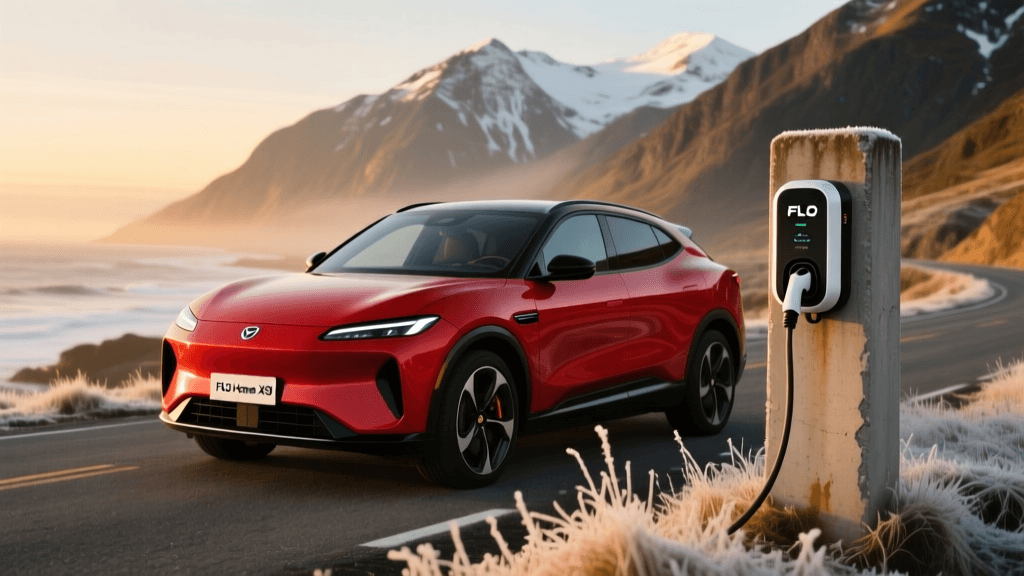
As climate change induces more volatile and extreme weather patterns, the physical durability of outdoor EV infrastructure is becoming a primary purchasing metric. The US Department of Energy's Alternative Fuels Data Center notes that extreme cold not only reduces EV battery efficiency but can also severely compromise the physical components of charging equipment. Standard EV cables stiffen and become nearly unmanageable at sub-zero temperatures, and plastic enclosures can become brittle, leading to micro-fractures and moisture ingress.
FLO’s Canadian engineering heritage shines in this department. The Home X5 is rated to operate flawlessly at -40°F (-40°C). More importantly, its proprietary 25-foot charging cable remains highly flexible even in deep freezes. During our winter testing in sub-10°F conditions, the X5’s cable was significantly easier to coil and uncoil compared to the stiff, rigid cables of competing plastic-housed units. Furthermore, the aluminum enclosure acts as a natural heat sink during summer months, preventing the internal electronics from thermal throttling—a common issue with black plastic chargers exposed to direct July sunlight.
The 'Smart' vs. 'Dumb' Charger Paradigm Shift
Looking ahead to the next decade of EV ownership, we anticipate a growing consumer backlash against over-complicated 'smart' chargers. Many modern chargers rely heavily on cloud connectivity, Wi-Fi bands, and proprietary apps. When a manufacturer discontinues server support, or when a local Wi-Fi router drops, the charger's advanced features (and sometimes its basic functionality) can become compromised.
The FLO Home X5 takes a pragmatic, semi-smart approach. It does not feature native Wi-Fi or complex grid-interactive software. Instead, it relies on a robust, plug-and-play architecture with Bluetooth connectivity for basic firmware updates and session tracking via the FLO app. For the future-minded buyer, this 'dumb-charger-plus' philosophy ensures that the unit will never be bricked by a server outage. It turns on when you plug it in, and it delivers a consistent, safe charge every single time. In an industry where software obsolescence is a looming threat, hardware simplicity is a distinct form of future-proofing.
Actionable Installation Advice and Cost Analysis
When planning your FLO Home X5 installation, you have two primary pathways: a NEMA 14-50 receptacle or a direct hardwire. While the NEMA 14-50 plug offers portability, industry electricians increasingly recommend hardwiring for continuous, high-draw EV loads.
Why Hardwire the X5?
- Safety and Thermal Management: Continuous 30A draws over 8+ hours can cause cheaper or improperly torqued NEMA 14-50 receptacles to overheat and melt. Hardwiring eliminates the receptacle point of failure.
- Cost Efficiency: A hardwire installation typically saves $50 to $150 in material costs (no heavy-duty receptacle or industrial-grade cover plate required) and requires less labor time for a licensed electrician.
- Aesthetics and Security: Hardwiring allows the unit to sit flush against the wall, and prevents opportunistic theft of the charger unit itself.
Cost Breakdown: The FLO Home X5 typically retails between $500 and $650 USD. Professional hardwired installation on a dedicated 40A circuit (assuming your panel has the capacity and is located within 50 feet of the charging spot) generally ranges from $400 to $800. Factoring in local utility rebates—which frequently offer $250 to $500 for Energy Star-certified Level 2 equipment—the net out-of-pocket cost for a premium, aluminum-clad charging solution is highly competitive.
Final Verdict: A Pragmatic Anchor for the EV Transition
The FLO Home X5 is not designed for the enthusiast who demands maximum 48-amp charging speeds or intricate solar-integration software. Instead, it is engineered for the pragmatist. As the EV market matures, the industry outlook suggests that reliability, extreme-weather durability, and electrical panel compatibility will outweigh the novelty of smart-home integrations. For homeowners in the US and Canada who face brutal winters, aging electrical panels, or simply want a 'set it and forget it' workhorse that will outlast their current and next EV, the FLO Home X5 remains an exceptionally future-proof investment. For further guidance on residential charging setups and electrical safety, consult the US Department of Energy's Home Charging Guide.