The electric vehicle (EV) charging landscape is undergoing a seismic shift, moving beyond the constraints of heavy cables, manual plug-ins, and static infrastructure. For commercial fleet operators, depot planners, and smart-driving technology integrators, monitoring new charging technology breakthroughs and patent filings is no longer just an R&D exercise—it is a critical component of long-term capital planning. Recent patent filings from major automakers and specialized tech firms reveal a clear trajectory toward automated, wireless, and high-efficiency charging systems that will fundamentally alter how vehicles are energized.
In this expert guide, we break down the most impactful recent patents in wireless magnetic resonance and robotic conductive charging. More importantly, we provide actionable best practices to future-proof your EV infrastructure today, ensuring your facility is ready for the next generation of charging technology without requiring a complete teardown in five years.
The Shift from Cables to Coils: Understanding Recent Patent Filings
Over the past 24 months, the United States Patent and Trademark Office (USPTO) and international equivalents have seen a surge in filings related to automated and wireless EV charging. The primary goal of these patents is to remove human intervention from the charging process, a necessary step for autonomous vehicle (AV) fleets and high-turnover commercial logistics hubs.
Two dominant technological pathways have emerged from these patent filings:
- Magnetic Resonance Wireless Charging: Pioneered by companies like WiTricity and heavily backed by automakers like Toyota, this technology uses oscillating magnetic fields to transfer power across an air gap. Unlike older inductive charging patents that required millimeter-perfect alignment, recent magnetic resonance patents focus on spatial freedom, allowing vehicles to charge even if parked slightly off-center.
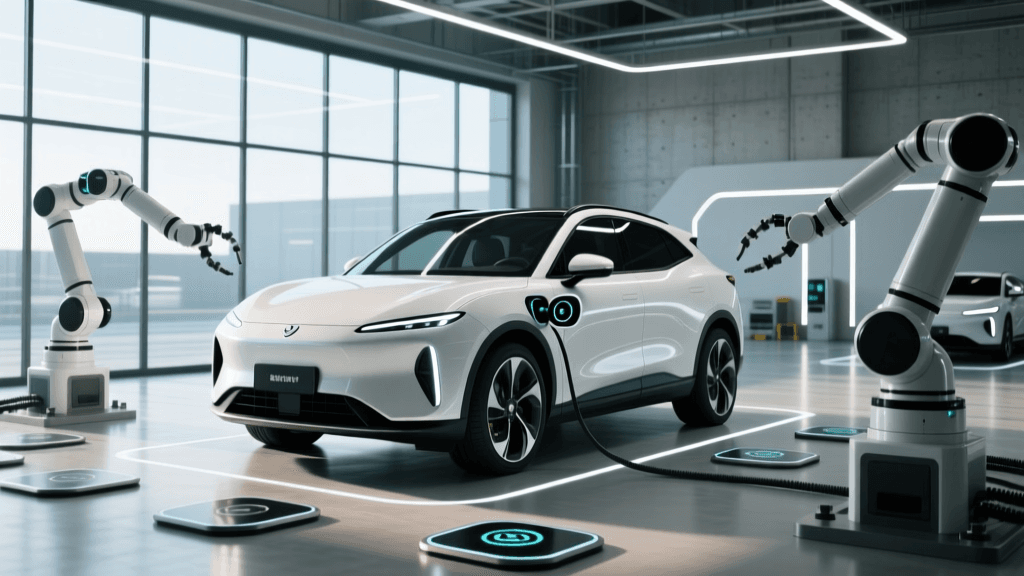
- Robotic Conductive Arms: Patents from Tesla (often referred to as the 'snake-bot' charger) and Volkswagen's mobile charging robot focus on automated physical connections. These systems use machine vision and articulated robotic arms to locate the vehicle's charge port and insert a high-voltage connector autonomously.
According to the SAE J2954 wireless charging standard, the industry is actively harmonizing these wireless protocols to ensure interoperability across different vehicle platforms, signaling that commercialization is imminent.
Comparing Emerging Charging Technologies
Before retrofitting a depot, it is essential to understand the operational differences between the technologies currently moving through the patent-to-pilot pipeline.
| Technology Type | Mechanism | Efficiency | Infrastructure Needs | Best Use Case |
|---|---|---|---|---|
| Magnetic Resonance (Wireless) | Oscillating magnetic fields via ground and chassis coils | 90% - 93% | Embedded ground pads, fiberglass rebar, high-frequency inverters | Autonomous fleets, transit buses, premium consumer garages |
| Robotic Conductive Arm | Machine-vision guided physical plug insertion | 95% - 98% | Clearance zones, OCPP 2.1 network comms, reinforced mounting pillars | High-density robotaxi depots, automated logistics hubs |
| Traditional CCS / NACS | Manual human plug-in | 95% - 99% | Standard trenching, pedestal mounts, cable management | Public retail, manual commercial fleets, residential |
Expert Tips: How to Future-Proof Your Fleet Depot Today
While fully autonomous wireless charging may still be a few years away from widespread commercial deployment, the concrete you pour and the conduits you lay today will dictate your ability to adopt these technologies tomorrow. Here are the best practices for preparing your facility.
1. Upgrade Concrete Pads for Inductive Coil Embedding
If you are currently pouring concrete for new charging stalls or depot expansions, you must alter your material specifications to accommodate future wireless ground pads. Traditional EV charging requires surface-mounted pedestals, but wireless charging requires embedding the transmitter coil flush with or slightly below the ground surface.
The Expert Fix: Standard concrete reinforcement uses steel rebar. However, steel is ferromagnetic and will absorb magnetic fields, creating massive eddy current heating and destroying the efficiency of a wireless charging pad. When pouring pads designated for future wireless charging, you must specify fiberglass rebar (GFRP) in the top 4 inches of the concrete slab. This non-ferrous reinforcement maintains structural integrity while allowing magnetic resonance fields to pass through unimpeded. Furthermore, design the pad with a removable or breakable top-layer trench to allow for the 2-to-3-inch embedding depth required by WiTricity's magnetic resonance technology without compromising the entire slab.
2. Pre-Wire for High-Bandwidth OCPP 2.1 and ISO 15118
Automated charging systems—whether robotic arms or wireless pads—require complex, bidirectional communication between the vehicle, the charger, and the grid. A simple Cat5e ethernet drop or basic cellular connection will not suffice for the data density required by automated plug-and-charge and dynamic load balancing.
The Expert Fix: Install shielded Cat6a cabling or fiber-optic lines to every charging zone. You must prepare your network infrastructure for OCPP 2.1 (Open Charge Point Protocol), which supports advanced security, smart charging profiles, and ISO 15118-20 integration. ISO 15118-20 is the latest vehicle-to-grid (V2G) communication standard that allows the vehicle to automatically negotiate power levels, authorize payments, and even push power back to the grid without human input. Ensuring your depot's local area network (LAN) can handle low-latency, high-bandwidth telemetry is critical for robotic arm machine-vision processing and wireless pad alignment verification.
3. Allocate Space for Robotic Arm Clearance Zones
If your long-term strategy involves robotic conductive chargers, spatial planning is your biggest hurdle. Robotic arms require a specific geometric envelope to operate safely without colliding with curbs, bollards, or adjacent vehicles.
The Expert Fix: When striping parking spaces and installing wheel stops, add a minimum 3-foot lateral clearance zone on the driver-side or passenger-side (depending on your fleet's standardized charge port location). Do not install standard 6-inch concrete curbs or high bollards within this envelope, as they will obstruct the robotic arm's articulation path. Instead, use flush-mounted magnetic guide tape or low-profile wheel stops that allow the robotic arm's base to pivot freely. Additionally, ensure overhead lighting is positioned to eliminate harsh shadows on the vehicle's charge port, as machine vision systems rely on consistent illumination to identify the NACS or CCS port geometry.
Navigating Patent Thickets and Licensing Costs
One of the most significant barriers to adopting new charging technology is the complex web of intellectual property. Major players have filed defensive patents covering everything from the shape of the magnetic coil shielding to the specific algorithms used to align a robotic arm via LiDAR.
For fleet operators, this means you are unlikely to buy hardware directly from the patent holder. Instead, you will purchase from licensed integrators. When evaluating RFPs (Request for Proposals) for next-generation charging hardware, demand transparency regarding SAE and ISO licensing. Ensure the vendor guarantees that their hardware complies with the U.S. Department of Energy's EV charging infrastructure guidelines and that they hold the necessary cross-licensing agreements to operate in North American markets without exposing your fleet to patent infringement liabilities.
Cost Implications and ROI Timelines
Preparing a depot for wireless and automated charging requires a higher upfront CAPEX (Capital Expenditure). Fiberglass rebar, advanced networking, and specialized spatial planning can increase initial site preparation costs by 15% to 20%. However, the OPEX (Operational Expenditure) savings are substantial. Automated systems eliminate cable wear-and-tear, reduce the need for human charging attendants, and optimize charging schedules via AI-driven V2G arbitrage.
Fleet managers should view these preparatory steps as an insurance policy. By spending an extra $5,000 per stall today on non-ferrous concrete prep and advanced conduit, you avoid the $25,000 per stall cost of jackhammering and re-trenching when wireless charging becomes the industry standard for commercial logistics in the late 2020s.
Conclusion
The patents filed today are the blueprints for tomorrow's charging infrastructure. By understanding the physical and digital requirements of magnetic resonance wireless charging and robotic conductive arms, fleet operators can make informed, forward-looking decisions. Upgrading your concrete specifications, future-proofing your network bandwidth, and rethinking spatial clearance will ensure your depot remains a cutting-edge asset in the rapidly evolving EV ecosystem.