The Great Charging Network Schism: NACS Alliance vs. IONNA
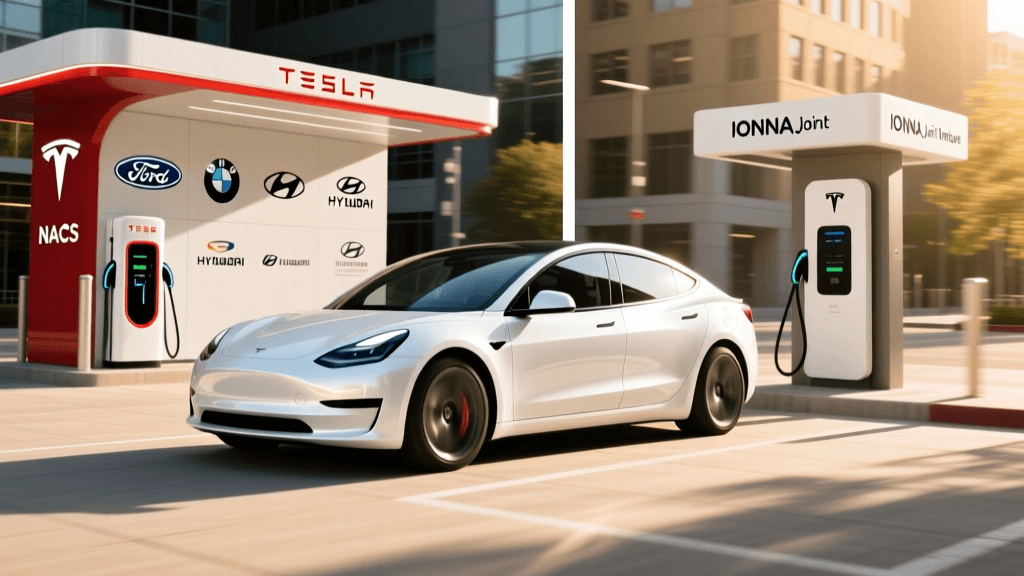
In the rapidly evolving electric vehicle industry, the most critical 'product' isn't always the car itself—it is the charging ecosystem that supports it. Over the past year, the North American EV market has fractured into two massive, competing coalitions. On one side, we have the Tesla North American Charging Standard (NACS) Alliance, a sprawling network of automakers integrating with Tesla's Supercharger network. On the other, we have IONNA, a powerful joint venture backed by seven global automotive giants determined to build a premium, next-generation charging network from the ground up.
For EV buyers, fleet managers, and industry analysts, this isn't just a battle over plug shapes; it is a head-to-head showdown over infrastructure dominance, user experience, and long-term reliability. In this comprehensive tracker and comparison, we pit the established might of the Tesla NACS partnerships against the ambitious, ground-up engineering of the IONNA joint venture to determine which charging ecosystem truly delivers the best product for the end user.
Contender 1: The Tesla NACS Integration Partnership
The Tesla NACS integration partnership is less of a traditional joint venture and more of an aggregator model. Spearheaded by Ford and General Motors in mid-2023, this movement saw nearly every major automaker—including Rivian, Volvo, Polestar, Mercedes-Benz, and Nissan—abandon the CCS1 standard in favor of Tesla's proprietary NACS connector. The 'product' here is access: automakers are essentially purchasing wholesale access to Tesla's industry-leading Supercharger network, which boasts unparalleled uptime and geographic coverage.
The rollout occurs in phases. Current CCS-equipped EVs from these automakers require a bulky, active adapter to access Tesla's V3 and V4 Superchargers. However, starting in 2025, new vehicles from the NACS Alliance will feature the native NACS port, eliminating the adapter and unlocking seamless Plug-and-Charge functionality. According to the Alternative Fuels Data Center, Tesla's network already represents the largest and most reliable fast-charging footprint in North America, making this partnership an immediate win for drivers who prioritize route flexibility over premium station amenities.
Contender 2: The IONNA Joint Venture
If the NACS Alliance is about leveraging existing infrastructure, IONNA is about building the future. Announced in July 2023, IONNA is a joint venture between BMW, General Motors, Honda, Hyundai, Kia, Mercedes-Benz, and Stellantis. As reported by Reuters, this coalition was formed to deploy at least 30,000 high-powered chargers across North America by 2030.
IONNA's product proposition is fundamentally different from Tesla's. While Superchargers are often placed in grocery store parking lots or highway rest stops with minimal amenities, IONNA stations are designed to be premium destinations. The joint venture promises ultra-fast 400kW+ charging hardware, renewable energy sourcing, and amenities like Wi-Fi lounges, restrooms, and food service. Furthermore, IONNA is heavily leveraging federal funding through the Joint Office of Energy and Transportation to ensure these stations are placed in both urban centers and underserved highway corridors, directly addressing the 'charging desert' problem.
Head-to-Head Comparison Chart
| Feature | Tesla NACS Alliance (Supercharger Network) | IONNA Joint Venture |
|---|---|---|
| Founding Automakers | Tesla, Ford, GM, Rivian, Volvo, Nissan, etc. | BMW, GM, Honda, Hyundai, Kia, Mercedes, Stellantis |
| Current NA Station Count | ~2,500+ stations (20,000+ stalls) | 0 (First stations opening late 2024/2025) |
| Target Network Size | Continuous expansion (tens of thousands) | 30,000 chargers by 2030 |
| Max Charging Speed | 250 kW (V3) / 325+ kW (V4 rollout) | 350 kW to 400kW+ (Liquid-cooled) |
| Connector Standard | NACS (Native & via CCS Adapter) | CCS1 & NACS (Dual-cable stalls) |
| Station Amenities | Basic (Relies on adjacent retail) | Premium (Lounges, Wi-Fi, Restrooms, Canopies) |
| Payment / UX | Tesla App / Magic Dock / Native Plug & Charge | ISO 15118 Plug & Charge / Open Payment |
Network Scale and Immediate Availability
When evaluating a charging network as a product, immediate availability is paramount. The Tesla NACS Alliance wins this category by a landslide. Because Tesla has spent over a decade building its Supercharger network, partners like Ford and GM can offer their customers immediate access to over 20,000 fast chargers today. For fleet managers routing vehicles across rural or interstate corridors right now, the NACS Alliance is the only viable option for guaranteed uptime.
IONNA, conversely, is a long-term play. While their 30,000-charger target is massive, the reality of permitting, grid interconnection, and construction means that IONNA's footprint will remain sparse until at least 2026. Early adopters of IONNA-backed vehicles will still need to rely on third-party networks like Electrify America or EVgo in the interim.
Hardware, Speeds, and the 'Magic Dock'
Hardware is where IONNA aims to leapfrog the NACS Alliance. Tesla's ubiquitous V3 Superchargers are capped at 250 kW, which is sufficient for current EVs but bottlenecked for the next generation of 800V+ architectures found in vehicles like the Hyundai Ioniq 5 or Porsche Taycan. While Tesla is rolling out V4 cabinets with higher speeds, IONNA is standardizing 350 kW to 400kW+ liquid-cooled cables across its entire network from day one.
Furthermore, the physical connector debate is nuanced. The NACS connector is universally praised for being lightweight, compact, and elegant. However, the transition period requires CCS vehicles to use heavy, cumbersome adapters, which are prone to being lost or damaged. IONNA sidesteps this entirely by committing to dual-cable stalls, offering both CCS1 and NACS connectors natively at every pedestal, ensuring zero hardware friction for any driver pulling into a bay.
The User Experience: Plug-and-Charge vs. App Friction
Tesla's user experience is legendary for its own vehicles, but opening the network to the NACS Alliance has introduced friction. Non-Tesla EVs using the built-in 'Magic Dock' or carrying adapters often face software handshake failures, requiring drivers to initiate sessions via the Tesla app. IONNA is building its network on the ISO 15118 standard, enabling true, universal Plug-and-Charge. An IONNA-backed vehicle will simply plug in, authenticate via the cloud, and begin billing automatically, regardless of whether it uses a CCS or NACS plug.
Actionable Advice for Fleet Managers and EV Buyers
- For Immediate Fleet Deployment (2024-2025): If your commercial fleet operates on interstate routes today, prioritize vehicles from the Tesla NACS Alliance (e.g., Ford F-150 Lightning, Tesla Model Y, Rivian EDV). The sheer density and 99% uptime of the Supercharger network will minimize vehicle downtime and driver frustration.
- Adapter Management: If purchasing CCS-equipped vehicles that rely on the NACS adapter, treat the adapter as a critical vehicle component. Fleet managers should implement a check-in/check-out log for adapters and budget for replacements, as losing one effectively strands the vehicle from the largest network in the country.
- Depot and Urban Charging Strategy: Monitor IONNA's urban deployment maps. Because IONNA stations will feature premium amenities and ultra-high throughput, they are ideal targets for rideshare drivers and urban delivery fleets that require 10-minute top-ups and driver comfort during shifts.
- Future-Proofing Purchases: For consumer buyers planning to keep their EV past 2027, the physical plug matters less than the software integration. Ensure the automaker you choose has a confirmed, native Plug-and-Charge agreement with their respective network partner to avoid app-based payment headaches in the future.
The Verdict: Which Partnership Strategy Wins?
The head-to-head showdown between the Tesla NACS Alliance and the IONNA Joint Venture reveals two distinct philosophies. The Tesla NACS Alliance wins on immediate scale, geographic dominance, and proven reliability. It is the undisputed champion for drivers who need to get from Point A to Point B today without range anxiety. However, it carries the baggage of a proprietary legacy network that is currently struggling with the growing pains of adapter integration and non-Tesla software handshakes.
The IONNA Joint Venture wins on hardware specifications, user experience design, and long-term vision. By committing to dual-cable 400kW+ stalls and premium amenities, IONNA is building the 'gas station of the future.' While it cannot compete with Tesla's current footprint, IONNA represents the superior product architecture for the 800V EV era. Ultimately, the consumer wins: the fierce competition between these two automotive coalitions guarantees that the dark ages of broken, fragmented public charging are finally coming to an end.