The Dawn of Next-Gen Charging: Patents to Production
The electric vehicle industry is no longer just iterating on existing technology; it is fundamentally reimagining how electrons move from the grid to the battery. For commercial fleet operators, early adopters, and infrastructure planners, keeping a close eye on recent patent filings and technology breakthroughs is no longer optional—it is a critical survival strategy. Over the past eighteen months, the United States Patent and Trademark Office (USPTO) and international equivalents have seen a massive surge in patents related to Megawatt Charging Systems (MCS) and high-power inductive (wireless) charging.
While consumer EVs are largely settled on the NACS and CCS standards for the near future, the heavy-duty, commercial, and autonomous sectors are driving a new wave of innovation. Understanding these patent trends allows site hosts and fleet managers to make informed civil engineering and electrical decisions today, preventing premature obsolescence and avoiding catastrophic retrofit costs tomorrow.
Expert Insight: The patents filed today dictate the civil engineering requirements of tomorrow. Ignoring MCS and inductive charging trends guarantees premature obsolescence for commercial depots built in 2024.
Megawatt Charging System (MCS): Beyond the 350 kW Ceiling
Current DC fast-charging networks are largely capped at 350 kW, a limit that severely bottlenecks heavy-duty commercial fleets, electric semi-trucks, maritime vessels, and eVTOL (electric vertical takeoff and landing) aircraft. Enter the Megawatt Charging System (MCS). Spearheaded by organizations like CharIN, MCS is designed to deliver up to 3.75 MW of power (1250 Amps at 3000 Volts).
Recent patent filings from major automotive and energy conglomerates have focused heavily on thermal management systems for the charging cables and advanced liquid-cooling connectors required to handle this immense electrical load. Without the micro-channel liquid cooling architectures detailed in recent 2023 and 2024 patent applications, an MCS cable would be too heavy for a human operator to lift and would melt under its own electrical resistance.
Expert Tip: Conduit and Switchgear Future-Proofing
If you are currently trenching and laying conduit for a new fleet depot, designing strictly for 150 kW or 350 kW chargers is a costly mistake. The transition to MCS is inevitable for Class 8 electric trucks and regional delivery fleets.
- Actionable Advice: Upgrade your primary switchgear and transformer pads to accommodate a minimum of 2 MW per charging island.
- Civil Prep: Specify 4-inch to 6-inch PVC conduits instead of the standard 2-inch, and ensure your utility service agreement includes a documented pathway to 5 MW+ site capacity.
- Footprint Planning: MCS connectors are larger and require specialized holsters with active cooling fluid connections. Ensure your concrete pads are poured with reinforced anchors to support the physical weight and torque of heavy-duty cable management systems.
Inductive Wireless Charging: The SAE J2954 Standard and Beyond
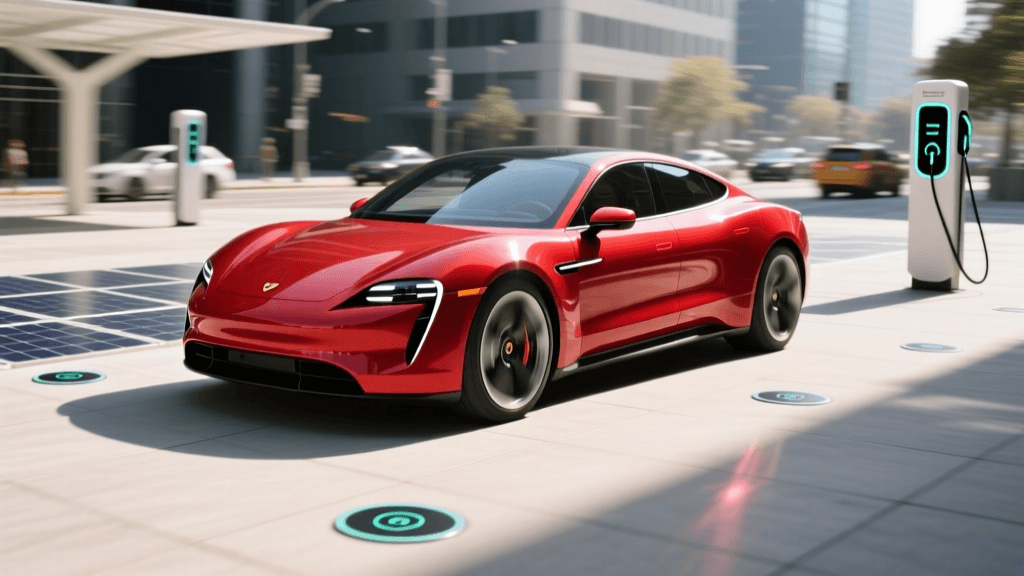
While MCS tackles raw power, wireless charging tackles operational friction. Patent filings surrounding magnetic resonance inductive charging have accelerated, particularly concerning dynamic alignment and foreign object debris (FOD) detection. The SAE J2954 standard has laid the groundwork for light-duty wireless charging, but recent patents are pushing the boundaries into heavy-duty, automated, and robotic fleet environments.
Companies are patenting robotic arms that deploy charging pads from the ceiling, as well as ground-embedded pads that can communicate with a vehicle's autonomous parking systems to ensure millimeter-perfect alignment. The efficiency gap between plugged-in and wireless charging is rapidly closing, with recent laboratory breakthroughs demonstrating over 93% grid-to-battery efficiency at the 11 kW to 50 kW transfer levels, and patents aiming for 500 kW inductive transfers for autonomous robotaxis.
Expert Tip: Preparing Depot Flooring for Inductive Pads
Wireless charging requires precise ground clearances, typically between 100 mm and 250 mm, and is highly sensitive to the materials between the transmitter and receiver coils.
- Actionable Advice: When pouring concrete for new fleet parking stalls, embed high-strength, non-metallic conduit networks just below the surface in designated 'wireless-ready' zones.
- Material Selection: Avoid using standard steel rebar meshes with high iron content directly beneath the proposed pad locations. This can cause eddy current heating, which drastically reduces charging efficiency and poses a thermal risk to the concrete.
- Best Practice: Specify fiberglass rebar (GFRP) in the top mat of the concrete slab where inductive pads will eventually be cored and installed. This allows for future retrofitting without destroying the structural integrity of the depot floor.
Solid-State Battery Synergies and Ultra-Fast Charging Profiles
You cannot separate charging infrastructure patents from battery chemistry patents. The recent explosion in solid-state battery (SSB) patents fundamentally changes the charging curve profile. Traditional lithium-ion batteries require an aggressive taper in charging speed after reaching 80% state of charge (SoC) to prevent lithium plating and thermal runaway.
Solid-state architectures, however, can theoretically accept peak charging rates for a much longer duration. This means that future charging station software and hardware must be designed to sustain peak 500 kW+ outputs for 20 to 30 minutes continuously, rather than the 5 to 10 minutes typical of today's fast chargers. Site planners must account for sustained thermal loads on the local utility grid, necessitating on-site battery energy storage systems (BESS) to buffer the draw.
Technology Comparison and Infrastructure Planning Matrix
To help fleet managers and site hosts visualize the transition, we have compiled a comparison matrix of current versus next-generation charging technologies based on recent patent trends and standardization roadmaps.
| Technology | Current State | Patent/Future Trend | Infrastructure Impact |
|---|---|---|---|
| CCS (DC Fast) | Up to 350 kW | Advanced liquid-cooled cable patents | Heavier cables, standard trenching |
| MCS (Megawatt) | Standardization phase | 3.75 MW thermal management | Massive switchgear, 5MW+ utility feeds |
| Inductive (Wireless) | SAE J2954 (11 kW) | Dynamic alignment, 500kW+ heavy duty | GFRP concrete, floor-coring prep |
| Solid-State Sync | Tapered charging curves | Sustained peak-rate patents | Larger utility buffers, BESS integration |
Cost Implications of Future-Proofing
Many fleet operators balk at the upfront capital expenditure (CapEx) required to prepare for technologies that are still in the patent or standardization phase. However, the cost of retrofitting is exponentially higher. According to data from the Alternative Fuels Data Center, utility interconnection upgrades and secondary civil work often represent the largest bottlenecks in EV infrastructure deployment.
Spending an additional $15,000 per stall on oversized conduit, GFRP rebar, and upgraded transformer pads during initial construction is a fraction of the $75,000+ it would cost to tear up cured concrete, re-trench, and renegotiate utility interconnection agreements three years from now when MCS and high-power wireless chargers become commercially available.
Strategic Takeaways for Infrastructure Planners
- Audit Your Utility Interconnection: Do not sign a 5-year utility contract that caps your site at 2 MW if you plan to operate Class 8 electric trucks. Negotiate scalable capacity clauses.
- Monitor the Dockets: Assign a team member or consultant to monitor CharIN, SAE, and IEEE working groups. The patents filed today become the mandatory compliance standards of tomorrow.
- Pilot Modular Infrastructure: Utilize modular DC power cabinets that allow you to swap out 50 kW power blocks for 100 kW or 200 kW blocks as vehicle battery architectures evolve to accept higher continuous charge rates.
Conclusion
The EV charging landscape is shifting from a focus on basic connectivity to extreme power delivery and seamless automation. By analyzing the patent filings surrounding Megawatt Charging Systems and advanced inductive wireless charging, commercial fleet operators can bridge the gap between today's limitations and tomorrow's capabilities. Future-proofing your infrastructure through strategic civil engineering, smart material selection, and scalable electrical design is the ultimate best practice for maintaining a competitive edge in the rapidly electrifying transportation sector.