The Bottleneck of Zero-Emission Freight
The transition to zero-emission commercial freight is no longer hindered by a lack of electric vehicle models. Manufacturers like Tesla, Daimler, Volvo, and TRATON are actively producing Class 8 electric semi-trucks. The true bottleneck lies in the physics of energy transfer. A typical long-haul electric truck possesses a battery capacity ranging from 500 kWh to over 1,000 kWh. Using current mainstream CCS2 fast-charging standards, which peak around 350 kW, fully replenishing a 1,000 kWh battery would take nearly three hours. For commercial fleet operators where driver hours-of-service and vehicle utilization dictate profitability, a three-hour dwell time is economically unviable. Enter the Megawatt Charging System (MCS).
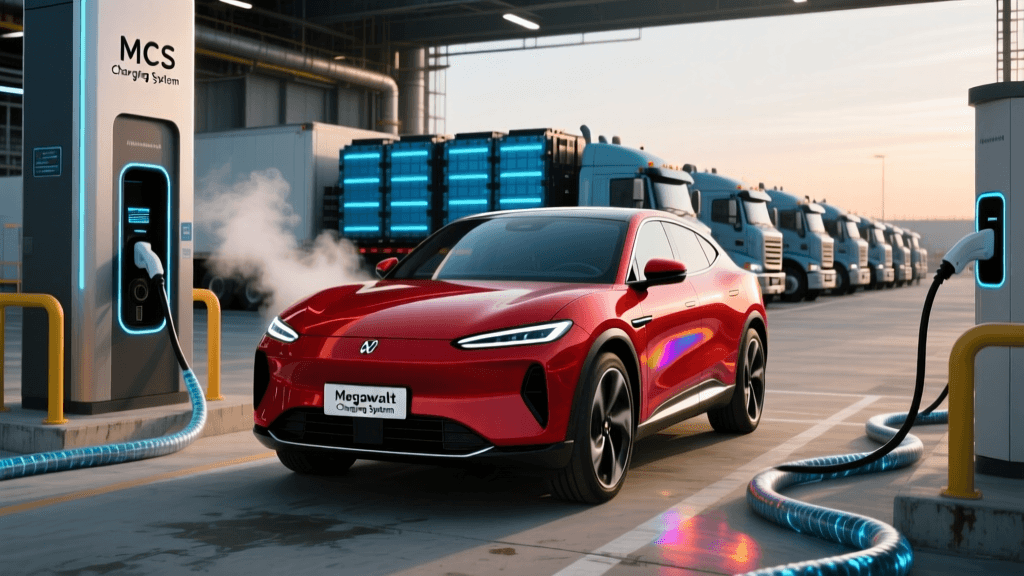
Developed under the SAE J3105 standard, the MCS is purpose-built to deliver massive electrical loads safely and efficiently. According to CharIN's Megawatt Charging System task force, the architecture is designed to support power levels up to 3.75 megawatts (3,750 kW). This deep dive explores the engineering, thermal dynamics, and infrastructure realities of MCS technology.
The Technical Architecture: Pushing the Limits of Physics
To achieve charging speeds that can add 200 miles of range in under 20 minutes, the MCS pushes electrical parameters to the edge of current material science limits. The standard defines a maximum voltage of 1,250V DC and a maximum current of 3,000 Amps. Multiplying these figures yields the theoretical peak of 3.75 MW.
Why cap the voltage at 1,250V? Engineers had to balance the need for high power with the realities of insulation breakdown, arcing risks, and the weight of dielectric materials. Pushing beyond 1,250V DC requires exponentially thicker insulation and wider clearance distances within the connector, which would make the plug too bulky and heavy for human operation. Conversely, pushing current beyond 3,000A introduces severe thermal management challenges and the "skin effect," where high-frequency alternating currents (or rapid DC transients) travel only on the outer surface of a conductor, drastically increasing resistance and heat generation.
Connector Design and the Necessity of Liquid Cooling
The physical MCS connector is a marvel of industrial design. It features a distinctive triangular shape with a specific pin layout: four large power pins (two for positive, two for negative to distribute the massive current) and three smaller pins for grounding, proximity detection, and communication signaling.
However, the most critical component of the MCS ecosystem is not the plug itself, but the liquid cooling system that supports it. According to basic electrical principles, running 3,000 Amps through a standard uncooled copper cable would require a conductor thickness resembling a human arm, weighing well over 150 pounds. To keep the cable manageable and flexible enough for a truck driver to handle, the copper cross-section must be drastically reduced. This is achieved by circulating a dielectric coolant (often a water-glycol mixture) through tubes integrated directly into the charging cable and the connector pins. This active thermal management absorbs the intense ohmic heating generated during a 3 MW+ charging session, keeping the external cable temperature safe to the touch and preventing thermal degradation of the copper.
Charging Standards Comparison
Understanding where MCS fits in the broader EV ecosystem requires comparing it to existing light and medium-duty standards. Below is a technical breakdown of the primary DC fast-charging architectures:
| Feature | CCS2 (Heavy Duty) | NACS (Light/Medium) | MCS (Class 8) |
|---|---|---|---|
| Max Power | 350 kW (up to 500 kW) | 250 kW - 1 MW | 1 MW - 3.75 MW |
| Max Voltage | 1000V DC | 1000V DC | 1250V DC |
| Max Current | 500A | 615A - 900A | 3000A |
| Cooling | Passive / Active | Passive / Active | Mandatory Liquid |
| Target Use | Regional / Vans | Passenger / Step Vans | Long-Haul Class 8 |
Onboard Truck Architecture: Receiving the Megawatt
Delivering 3.75 MW to a charging pad is only half the battle; the truck must be engineered to accept it without triggering a catastrophic thermal runaway. Heavy-duty EV manufacturers are shifting from legacy 400V architectures to 800V, 900V, and even 1000V battery pack configurations. Higher onboard voltage allows the truck to accept massive power while keeping internal current (and therefore internal heat) lower.
Furthermore, the battery management system (BMS) and onboard thermal loops must pre-condition the battery cells before the charging session begins. If the cells are too cold, lithium plating can occur at high charge rates; if they are too warm, the BMS will throttle the charging speed to protect the pack. The truck's liquid cooling system essentially acts as a massive heat exchanger, pulling heat away from the battery modules and dissipating it through the vehicle's radiators or transferring it to the charging station's cooling loop via the connector's thermal pins.
Grid Impact and Infrastructure Economics
The deployment of MCS infrastructure represents one of the most significant electrical engineering challenges of the decade. A single en-route charging plaza featuring ten MCS dispensers operating at 1.5 MW each requires a continuous power draw of 15 Megawatts. To put this into perspective, the U.S. Department of Energy's Alternative Fuels Data Center (AFDC) notes that heavy-duty charging demands are equivalent to powering a small town or a large sports stadium.
This immense load requires dedicated high-voltage transmission lines, massive step-down transformers, and complex switchgear. The cost to build a single MCS-ready stall, including utility interconnection, trenching, liquid cooling pumps, and the dispenser itself, can easily exceed $750,000 to $1.2 million. Because utility grid upgrades can take 24 to 48 months to complete, fleet operators and charging networks must engage in "make-ready" infrastructure planning years before the first electric truck arrives at the depot.
To mitigate astronomical peak demand charges from utility companies, many MCS depots are integrating co-located Battery Energy Storage Systems (BESS). A BESS can slowly trickle-charge from the grid overnight and then discharge rapidly to support multiple trucks charging simultaneously during the day, effectively shaving the peak power draw from the utility grid.
Actionable Advice for Fleet Managers
For fleet managers and logistics companies preparing for the MCS era, immediate strategic action is required:
- Initiate Utility Dialogues Early: Do not wait for truck delivery dates. Contact your local utility provider 24 to 36 months in advance to begin the interconnection queue process and assess substation capacity near your depots.
- Design for Modularity: When trenching and laying conduit, oversize your infrastructure. Laying conduit for 3 MW capacity while initially installing 350 kW CCS chargers saves millions in future excavation costs.
- Leverage State and Federal Grants: Monitor funding opportunities aggressively. Programs like the California Energy Commission's ZEV infrastructure programs and federal NEVI formula funds are increasingly allocating specific carve-outs for heavy-duty and freight-charging corridors.
- Implement Smart Charging Software: Invest in depot management software that integrates with your fleet's telematics. AI-driven load balancing can stagger charging sessions based on upcoming route dispatch times, drastically reducing peak demand charges.
The Road Ahead
The Megawatt Charging System is not just an incremental upgrade; it is a fundamental paradigm shift in electrical distribution and commercial logistics. While the hardware—liquid-cooled cables, high-voltage switchgear, and advanced battery packs—is largely proven in pilot environments, the true race is now against the clock to upgrade the aging electrical grid. As pilot projects from Portland to Rotterdam prove the viability of 15-minute Class 8 truck charging, the industry's focus will shift entirely to execution, permitting, and scaling the grid to support the megawatt era of zero-emission freight.