The Bottleneck of Class 8 Electrification
The transition to zero-emission commercial transport is no longer a question of if, but when. However, as fleet operators begin integrating Class 8 electric trucks into their logistics networks, a glaring bottleneck has emerged: charging speed. While passenger EVs benefit from a rapidly expanding network of 350 kW DC fast chargers, heavy-duty trucks require vastly more energy. A typical Class 8 electric semi-truck boasts a battery capacity between 500 kWh and 1,000 kWh to support long-haul routes and heavy payloads.
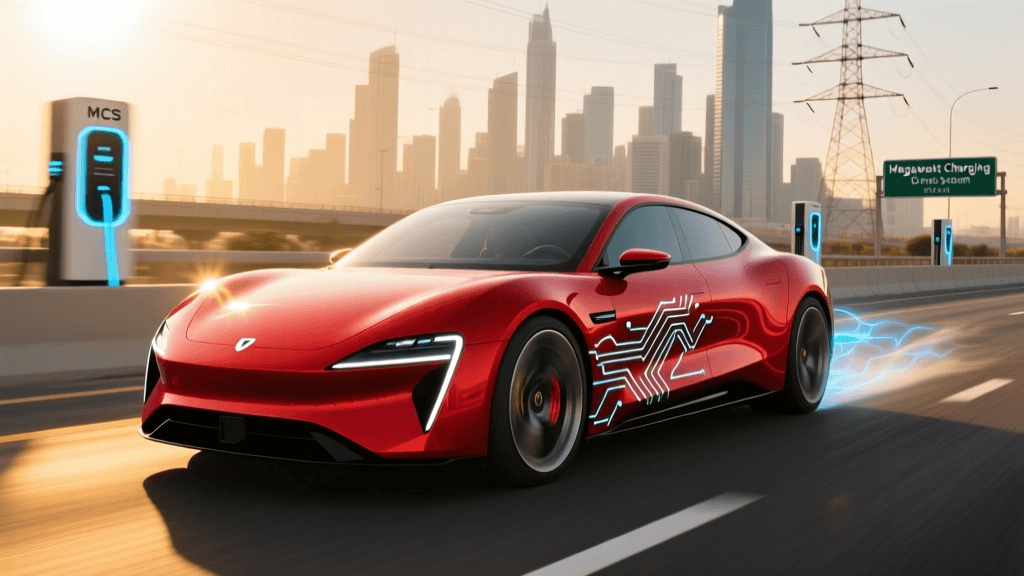
Charging a 1,000 kWh battery on a standard 350 kW Combined Charging System (CCS) connector would take nearly three hours. This far exceeds the 30-to-45-minute rest breaks mandated by the Federal Motor Carrier Safety Administration (FMCSA) Hours of Service regulations, making standard CCS inadequate for long-haul trucking. To solve this critical infrastructure gap, the industry has developed the Megawatt Charging System (MCS), a high-power charging standard designed explicitly for heavy-duty commercial vehicles, aviation, and maritime applications.
What is the Megawatt Charging System (MCS)?
The Megawatt Charging System is a next-generation DC fast-charging standard engineered to deliver power levels ranging from 1.25 megawatts (MW) up to an astonishing 3.75 MW. To put this into perspective, 3.75 MW is enough power to supply electricity to roughly 2,500 average American homes simultaneously. According to research from the National Renewable Energy Laboratory (NREL), achieving these extreme power transfer rates requires a fundamental rethinking of charging architecture, specifically regarding voltage limits, current capacity, and advanced thermal management.
By pushing power levels into the megawatt range, an electric truck with a 1,000 kWh battery can achieve an 80% state of charge in roughly 20 to 30 minutes. This aligns perfectly with mandatory driver rest breaks, effectively eliminating charging downtime as a barrier to electric freight adoption.
Technical Specifications and Liquid-Cooled Architecture
The MCS standard targets a maximum voltage of 1,250 V DC and a maximum continuous current of 3,000 Amperes. Pushing 3,000 Amps through a standard solid copper cable would generate immense resistive heat and require a cable so thick and heavy that it would be physically impossible for a human operator to maneuver safely.
To solve this, MCS relies entirely on advanced liquid-cooled charging cables. By circulating a specialized dielectric coolant through the core of the cable, engineers can drastically reduce the required copper cross-section. This keeps the cable lightweight, flexible, and safe to handle while maintaining high-flow power transfer. The physical MCS connector also features a unique, shielded design that prevents water ingress, mitigates electromagnetic interference (EMI), and ensures safe high-voltage mating in harsh environmental conditions.
CCS vs. MCS: A Technical Comparison
| Feature | CCS (Combined Charging System) | MCS (Megawatt Charging System) |
|---|---|---|
| Target Vehicle Class | Light-Duty, Medium-Duty | Class 8 Heavy-Duty, Aviation, Maritime |
| Maximum Power Output | ~500 kW (Typically 350 kW) | Up to 3.75 MW (3,750 kW) |
| Maximum Voltage | 1,000 V DC | 1,250 V DC |
| Maximum Current | 500 Amperes | 3,000 Amperes |
| Cable Cooling | Passive / Optional Liquid | Mandatory Liquid-Cooled |
| Estimated Charge Time (1MWh Battery) | ~2.5 to 3 Hours | ~20 to 30 Minutes |
Grid Integration and Infrastructure Realities
The most significant hurdle to MCS deployment is not the truck or the charger itself, but the electrical grid. A single 3.75 MW charging stall requires a dedicated medium-voltage utility feed. A fleet depot with just ten MCS chargers operating concurrently would demand up to 37.5 MW of power—equivalent to the electrical load of a small manufacturing plant or a large residential neighborhood. The Alternative Fuels Data Center notes that securing this level of grid capacity often requires utilities to build entirely new substations, a complex process that can take anywhere from 18 to 36 months of planning and construction.
Furthermore, the capital expenditure for MCS infrastructure is substantial. A single megawatt charging plaza, including the switchgear, liquid cooling pumps, transformers, and civil works, can easily exceed $1 million per stall. To mitigate utility demand charges and bypass local grid constraints, fleet operators are increasingly pairing MCS infrastructure with on-site Battery Energy Storage Systems (BESS).
The Role of Battery Energy Storage Systems (BESS)
A BESS acts as a massive buffer between the local power grid and the MCS chargers. The stationary batteries can slowly trickle-charge from the grid over a 24-hour period, avoiding peak utility demand charges. When an electric truck plugs in, the BESS discharges at megawatt speeds, effectively decoupling the charging speed from the grid's instantaneous capacity. This allows fleets to deploy 3 MW chargers even in areas where the local utility can only provide a 1 MW feed.
Standardization and the Road Ahead
The Charging Interface Initiative (CharIN) has been the driving force behind the MCS standard, bringing together automakers, charging networks, and utilities to finalize the physical connector design and communication protocols. MCS utilizes the ISO 15118-20 communication standard, which enables advanced Plug & Charge capabilities. This means a truck driver simply plugs in, and the system automatically authenticates the vehicle, initiates billing, and optimizes the charging curve without the need for RFID cards or mobile apps.
Additionally, ISO 15118-20 supports Vehicle-to-Grid (V2G) integration. Because Class 8 trucks possess massive battery packs and often sit parked at depots or loading docks for extended periods, they can act as mobile power plants. During peak grid demand hours, parked electric trucks can discharge power back into the grid, providing grid stabilization services and generating additional revenue streams for fleet operators.
Actionable Deployment Guide for Fleet Operators
For fleet managers and logistics companies planning to electrify their heavy-duty operations, preparing for MCS requires immediate, strategic action. Here is a practical guide to future-proofing your fleet depot:
- Initiate Utility Upgrades Early: Do not wait for trucks to arrive before engaging your local utility. Submit load interconnection requests 24 to 36 months in advance. Request a medium-voltage feed and discuss the potential need for dedicated pad-mounted transformers or new substations.
- Design for BESS Integration: Even if your initial budget does not include stationary storage, allocate physical space and conduit pathways for a future Battery Energy Storage System. This will allow you to scale your charging power without requiring a secondary utility upgrade.
- Standardize Depot Layouts for Pull-Through Lanes: Unlike passenger cars, Class 8 trucks with 53-foot trailers cannot easily back into standard parking stalls. Design your MCS charging plaza with pull-through lanes to accommodate long-haul configurations without requiring drivers to unhitch their trailers.
- Plan for Liquid Cooling Maintenance: MCS cables rely on active liquid cooling systems. Ensure your maintenance team or third-party service provider is trained to monitor coolant levels, check for dielectric fluid leaks, and service the pumping stations integrated into the charging pedestals.
- Leverage Government Funding: Utilize federal and state incentives to offset infrastructure costs. Programs like the EPA's Clean Ports Program and various state-level zero-emission freight vouchers can cover significant portions of MCS hardware and BESS installation costs.
Conclusion
The Megawatt Charging System represents the critical missing link in the heavy-duty electrification puzzle. By delivering up to 3.75 MW of continuous power, MCS ensures that Class 8 electric trucks can meet the rigorous demands of long-haul freight without sacrificing operational uptime. While the grid integration challenges and capital costs are substantial, strategic planning, early utility engagement, and the integration of battery storage will allow forward-thinking fleets to capitalize on the undeniable economic and environmental benefits of zero-emission trucking. As standardization finalizes and pilot corridors expand, MCS will inevitably become the backbone of the global commercial freight network.