The EV Charging Infrastructure Market: A Trillion-Dollar Horizon
The transition to electric mobility is no longer a niche environmental movement; it is a massive global industrial shift. At the heart of this transformation is the EV charging infrastructure market, which is experiencing explosive growth. According to the International Energy Agency's Global EV Outlook, the demand for public and private charging infrastructure is scaling rapidly to meet the influx of new electric vehicles hitting the roads. Industry forecasts project the global EV charging market size to surge from approximately $25 billion in 2022 to well over $150 billion by 2030, representing a Compound Annual Growth Rate (CAGR) of nearly 25 percent.
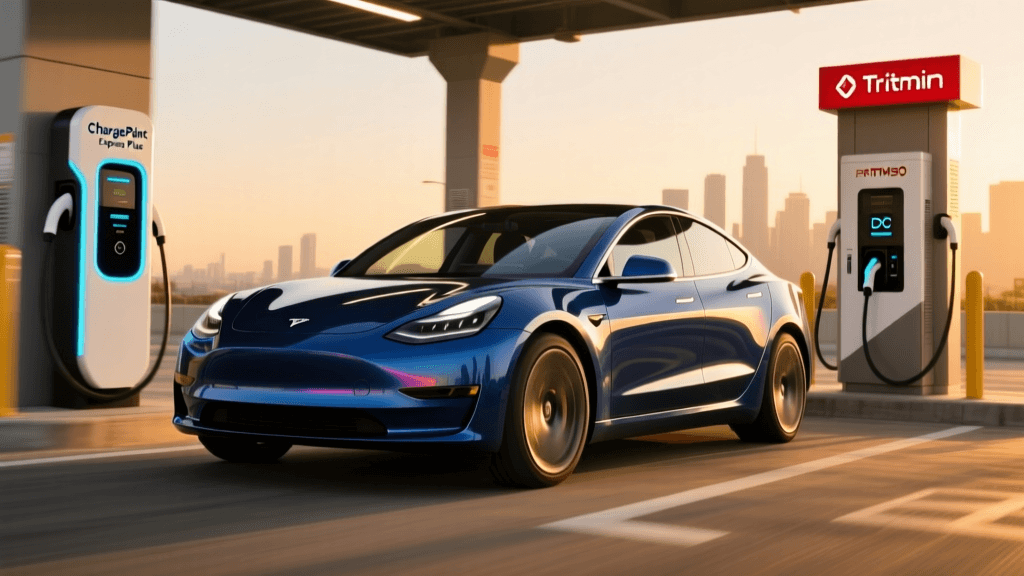
For Charge Point Operators (CPOs), fleet managers, and commercial real estate developers, capturing this market growth requires strategic hardware investments. Deploying the wrong equipment can lead to stranded assets, while choosing the right technology ensures scalability and profitability. In this head-to-head product showdown, we compare two industry-leading DC fast charging platforms: the ChargePoint Express Plus and the Tritium RTM50. We will analyze how each product is engineered to capture specific vectors of the projected market growth, comparing their technical specifications, deployment costs, and alignment with future infrastructure demands.
Contender 1: ChargePoint Express Plus (The Modular Heavyweight)
The ChargePoint Express Plus is a modular, scalable DC fast charging platform designed primarily for high-throughput environments like highway corridors, large fleet depots, and major retail hubs. Its defining feature is its modularity. The system utilizes independent power blocks that can be daisy-chained to deliver up to 240 kW to a single vehicle, or split across multiple dispensers to charge several vehicles simultaneously at lower speeds.
From a market growth perspective, the Express Plus is engineered for 'future-proofing.' As EV battery architectures evolve to accept higher charging rates (such as 800V systems capable of 350 kW+ charging), CPOs can add power blocks to existing Express Plus cabinets without ripping and replacing the entire dispenser. This aligns perfectly with long-term market forecasts that predict a steady increase in average DCFC power outputs over the next decade. According to ChargePoint's DC Fast Charging portfolio data, the Express Plus platform reduces initial capital expenditure by allowing operators to deploy only the power they need on day one, scaling up as local EV adoption rates climb.
Contender 2: Tritium RTM50 (The Urban Space-Saver)
On the other side of the showdown is the Tritium RTM50, a compact, liquid-cooled 50 kW DC fast charger. While it lacks the sheer brute force and modularity of the Express Plus, the RTM50 is a masterclass in spatial efficiency and urban deployment. Its liquid-cooling technology allows for a significantly smaller physical footprint and quieter operation compared to traditional air-cooled 50 kW units.
The RTM50 is positioned to capture a different, yet equally lucrative, segment of the market growth forecast: urban destination charging and retail environments. In dense city centers where real estate is at a premium and grid capacity is constrained, deploying massive 240 kW cabinets is often physically or financially impossible. The RTM50 thrives in environments where dwell times are naturally 30 to 60 minutes, such as grocery stores, gyms, and workplaces. Data from the U.S. Department of Energy's Alternative Fuels Data Center indicates a massive surge in non-corridor, destination-based DCFC deployments, a trend that heavily favors compact, easily integrated units like the RTM50.
Head-to-Head Hardware Comparison
To understand how these two platforms stack up against each other, we must look at the hard data. Below is a structured comparison of their core specifications and market positioning.
| Feature | ChargePoint Express Plus | Tritium RTM50 |
|---|---|---|
| Max Power Output | Up to 240 kW (per vehicle) | 50 kW (continuous) |
| Cooling System | Air-cooled (power blocks), liquid-cooled cables | Fully liquid-cooled (electronics and cables) |
| Physical Footprint | Large (requires separate power cabinet and dispensers) | Ultra-compact (single integrated pedestal) |
| Modularity | Highly modular (add power blocks post-install) | Standalone unit (non-modular) |
| Estimated Hardware Cost | $70,000 - $120,000+ (depending on configuration) | $30,000 - $45,000 |
| Ideal Market Segment | Highway corridors, heavy-duty fleets, high-turnover hubs | Urban retail, workplaces, constrained grid locations |
Aligning Hardware with Market Growth Vectors
The EV charging market is not a monolith; it is splitting into two distinct growth vectors. Understanding these vectors is critical for buyers looking to maximize their return on investment.
Vector 1: The Highway and Corridor Expansion
Government mandates and consumer range anxiety are driving a massive build-out of highway corridor charging. In the United States, the National Electric Vehicle Infrastructure (NEVI) Formula Program mandates that federally funded corridor chargers must deliver at least 150 kW per vehicle and feature a minimum of four ports. In this arena, the ChargePoint Express Plus is the undisputed winner. Its ability to dynamically allocate power and scale up to 240 kW makes it NEVI-compliant and capable of serving next-generation electric trucks and long-range SUVs. If your market growth strategy relies on capturing highway traffic and securing government grants, the Express Plus is the required tool.
Vector 2: The Urban and Destination Densification
As EV adoption moves from early adopters to the mass market, the bulk of new charging demand will shift to urban centers and multi-family housing where home charging is difficult. Here, the grid is often maxed out, and physical space is limited. The Tritium RTM50 captures this growth vector perfectly. A commercial property owner can install two RTM50 units in the space required for a single Express Plus cabinet, effectively doubling the number of vehicles served during peak retail hours without requiring a multi-million-dollar utility substation upgrade.
Actionable Deployment Advice for CPOs and Fleets
If you are planning to deploy DC fast charging infrastructure in the next 12 to 24 months, follow these actionable steps to align your hardware purchases with market forecasts:
- Audit Your Grid Capacity Early: Before purchasing an Express Plus, consult with your local utility. Upgrading a site to support 300 kW+ of total power can cost upwards of $150,000 and take 12 to 18 months. If your utility timeline does not match your deployment goals, pivot to multiple RTM50 units which can often run on existing commercial 480V three-phase service.
- Leverage Modular Scaling: If you are building a fleet depot for delivery vans that currently only accept 50 kW of charge, but you plan to transition to 150 kW-capable trucks in three years, buy the ChargePoint Express Plus architecture now. Install only the necessary power blocks today, and purchase additional blocks when the new fleet vehicles arrive. This prevents stranded capital.
- Factor in Software and Maintenance: Hardware is only half the battle. ChargePoint requires enrollment in their Assure protection plan for long-term warranty coverage, while Tritium offers flexible, network-agnostic operation. Calculate the 5-year Total Cost of Ownership (TCO), including network fees, cellular connectivity, and preventative maintenance, before signing a purchase order.
- Target the Right Dwell Time: Do not install 240 kW chargers at a movie theater or a sit-down restaurant. The premium paid for high-power hardware is wasted if the vehicle is parked for two hours. Match the Tritium RTM50 to 45-minute dwell times (grocery, gym) and the Express Plus to 15-minute dwell times (convenience stores, highway rest stops).
Final Verdict
The EV charging industry market size forecasts guarantee immense opportunities, but success depends entirely on right-sizing your hardware to your specific environment. The ChargePoint Express Plus is a powerhouse designed for high-speed, high-capacity corridor and fleet applications, offering the modularity needed to keep pace with rapidly advancing EV battery technologies. Conversely, the Tritium RTM50 is the ultimate urban infiltrator, providing a highly reliable, space-saving, and grid-friendly solution for destination charging.
Ultimately, the 'winner' of this showdown is not a single product, but the strategic deployment of both. As the market expands toward that projected $150 billion valuation, the most successful Charge Point Operators will be those who utilize the Express Plus to capture high-speed transit traffic, while leveraging the RTM50 to dominate the dense, high-volume urban retail sector.