The Business Case for Workplace EV Charging
As electric vehicle (EV) adoption accelerates, the workplace has emerged as a critical hub for charging infrastructure. For commercial property managers, corporate campus directors, and small business owners, installing Level 2 EV chargers is no longer just a sustainability checkbox; it is a strategic investment in employee retention, customer dwell time, and corporate ESG (Environmental, Social, and Governance) goals. However, transitioning from a residential mindset to a commercial installation requires a deep understanding of complex electrical infrastructure, networking software, and heavy-duty hardware. This comprehensive cost and value breakdown will dissect the financial realities of deploying commercial Level 2 EVSE (Electric Vehicle Supply Equipment) at your workplace.
Commercial Level 2 Hardware Options and Pricing
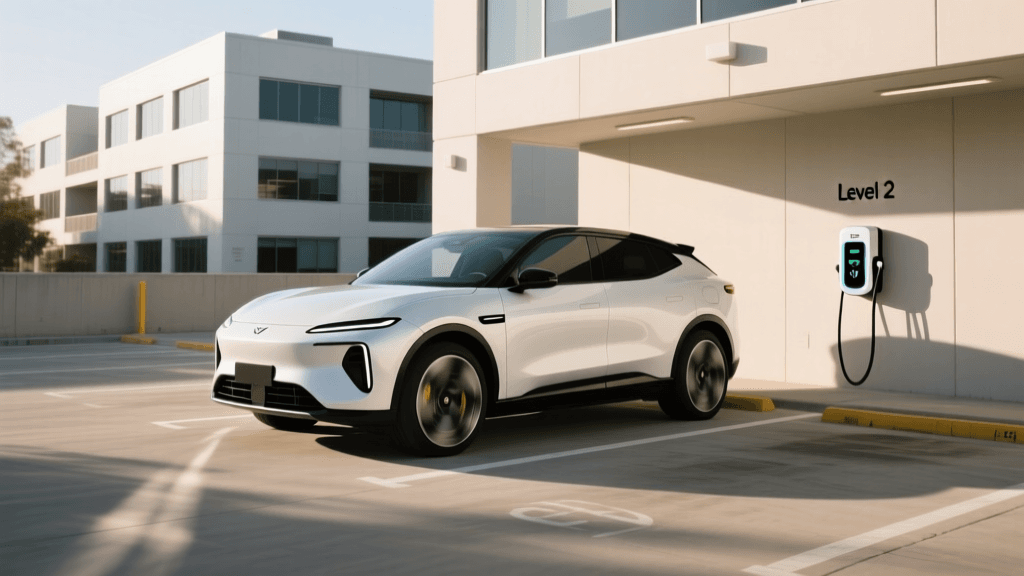
Unlike residential chargers, commercial Level 2 stations must be built to withstand outdoor elements, physical impacts, and high-frequency usage. They also require integrated payment processing, access control, and network connectivity. The industry standard for workplaces is the dual-port pedestal station, which maximizes parking real estate by serving two vehicles simultaneously.
Top Commercial Hardware Contenders
- ChargePoint CT4021 Dual-Port: The undisputed market leader in commercial deployments. Known for its rugged design, integrated cable management, and robust ChargePoint Cloud software. Estimated Hardware Cost: $6,500 - $7,500 per station.
- Enel X Waypilot (formerly JuiceBox Pro Commercial): A highly competitive option offering dynamic load balancing and a slightly lower entry price point, making it ideal for multi-unit deployments where panel capacity is constrained. Estimated Hardware Cost: $5,500 - $6,200 per station.
- Blink HQ Dual-Port: Features a sleek, modern interface with a built-in 15-inch LCD screen for custom advertising and messaging, adding a unique revenue or internal communication stream. Estimated Hardware Cost: $6,000 - $6,800 per station.
Electrical Infrastructure and Site Preparation Costs
The most significant variable in commercial EV charger installation is the electrical infrastructure. While a home charger simply plugs into a 240V NEMA 14-50 outlet or hardwires to a residential sub-panel, commercial buildings typically operate on 480V 3-phase power. Level 2 chargers require 208V or 240V single-phase power. This discrepancy necessitates a step-down transformer, which is a major capital expense.
Key Infrastructure Cost Drivers
- Step-Down Transformers: Sizing a transformer (e.g., 30 kVA to 75 kVA) to handle multiple dual-port stations safely. Cost: $4,000 - $9,000.
- Trenching and Conduit: Running underground PVC or rigid metal conduit from the electrical room to the parking lot. Asphalt and concrete cutting, trenching, and backfilling typically cost $75 to $150 per linear foot.
- Dynamic Load Management (DLM) Software: To avoid expensive utility demand charges and costly main service panel upgrades, DLM software monitors the building's real-time power usage and throttles the chargers during peak building load. Cost: $1,500 - $3,000 for gateway hardware and licensing.
Labor, Permitting, and Soft Costs
Commercial installations require licensed, bonded, and insured electrical contractors, often alongside civil engineering firms for site surveys. Soft costs can account for 20% to 30% of the total project budget.
- Engineering and Site Surveys: Load studies, civil drawings, and single-line electrical diagrams required by the municipality. Cost: $2,500 - $5,000.
- Permitting and Utility Interconnection: Municipal electrical permits, ADA (Americans with Disabilities Act) compliance grading, and utility approval for new meters or service upgrades. Cost: $1,500 - $4,000.
- Commercial Electrician Labor: Union or commercial-rate electricians charging $125 to $250 per hour. A standard 4-station (8-port) installation can take 80 to 120 man-hours. Cost: $10,000 - $25,000.
Upfront Installation Cost Breakdown
To provide a realistic financial picture, the table below outlines the estimated upfront costs for a standard workplace deployment of four dual-port stations (8 total charging ports), assuming a moderate 100-foot trenching run and the need for a new 45 kVA transformer.
| Cost Category | Description | Estimated Cost (4 Dual-Port Stations) |
|---|---|---|
| Hardware | 4x ChargePoint CT4021 Pedestals | $28,000 |
| Electrical Infrastructure | 45 kVA Transformer, Panels, Wiring | $18,500 |
| Civil & Site Prep | 100 ft Trenching, Concrete Pads, Striping | $12,000 |
| Labor | Commercial Electrical & Civil Installation | $16,000 |
| Soft Costs | Engineering, Permitting, ADA Compliance | $5,500 |
| Total Estimated Upfront Cost | Turnkey Installation | $80,000 |
Ongoing Network and Maintenance Fees
The financial commitment does not end at installation. Commercial chargers must be networked to process payments, manage access, and report uptime. Furthermore, physical maintenance is required to ensure compliance and user satisfaction.
- Network Software Subscriptions: Essential for billing, dashboard analytics, and firmware updates. Expect to pay $25 to $45 per port, per month. For 8 ports, this is roughly $2,400 to $4,320 annually.
- Cellular Connectivity: Many stations require dedicated 4G/5G SIM plans to communicate with the cloud if Wi-Fi or hardwired ethernet is unavailable in the parking lot. Cost: $10 - $15 per station/month.
- Warranty and Maintenance Plans: Extended warranties (e.g., ChargePoint Assure) cover parts, labor, and proactive monitoring. Cost: $400 - $600 per port annually after the first year.
Maximizing ROI: Incentives, Rebates, and Tax Credits
The raw sticker price of commercial EVSE can be daunting, but the net cost is rarely what appears on the initial invoice. Federal, state, and utility-level incentives are designed to aggressively subsidize workplace charging.
The Federal 30C Tax Credit
The Inflation Reduction Act revitalized the Alternative Fuel Vehicle Refueling Property Credit (30C). According to the official IRS guidelines on the 30C credit, commercial properties located in eligible census tracts can claim a tax credit of up to 30% of the total cost of hardware and installation, capped at $100,000 per single item of property (per charging station). This can instantly slash your hardware and labor costs by nearly a third.
Utility Make-Ready Programs
Many investor-owned utilities (IOUs) offer "Make-Ready" programs. In these scenarios, the utility company pays for 100% of the electrical infrastructure costs (trenching, conduit, transformers, and panel upgrades) up to the stub-out of the charger. The business owner is only responsible for purchasing and mounting the actual EVSE hardware. This can reduce the $80,000 project outlined above to under $35,000.
State and Local Incentives
State legislatures frequently offer supplemental point-of-sale rebates. The National Conference of State Legislatures (NCSL) EV infrastructure database tracks these dynamic programs, which can provide an additional $3,000 to $5,000 per port installed, particularly in disadvantaged communities or multi-family dwelling zones.
5-Year Total Cost of Ownership (TCO) vs. Value Analysis
To understand the true value proposition, facility managers must look at the 5-year Total Cost of Ownership (TCO) weighed against the tangible and intangible benefits generated by the infrastructure.
| 5-Year Financial Metric | Estimated Cost / Value (8 Ports) | Notes |
|---|---|---|
| Net Upfront Cost (After 30% 30C Credit) | $56,000 | Assumes federal tax credit eligibility |
| 5-Year Network & Maintenance Fees | $18,000 | $300/mo network + $1,200/yr maintenance |
| Electricity Costs (Net) | $0 - $12,000 | Offset by user charging fees ($0.25/kWh) |
| 5-Year Net TCO | $62,000 - $74,000 | Average $8,500 per port over 5 years |
| Value: Employee Retention & Recruiting | $45,000+ | Saving just 2 mid-level employees from leaving covers TCO |
| Value: ESG Reporting & LEED Points | Priceless | Required for corporate sustainability mandates |
| Value: Fleet Electrification Readiness | High | Future-proofs corporate fleet transitions |
Final Verdict: Is the Investment Worth It?
When evaluating the cost and value of commercial Level 2 charger installation for workplaces, the math extends far beyond the price of copper wire and charging pedestals. While the gross upfront costs for a multi-station deployment can easily exceed $80,000, the aggressive layering of the IRS 30C tax credit, utility Make-Ready infrastructure subsidies, and state-level rebates can drive the net capital expenditure down to a highly palatable level.
From a value perspective, workplace chargers transition from a mere employee perk to a critical operational asset. They serve as the foundational infrastructure for corporate fleet electrification, provide verifiable data for ESG reporting, and act as a powerful magnet for top-tier talent who already own or plan to purchase electric vehicles. For forward-thinking businesses, the question is no longer whether they can afford to install workplace EV chargers, but whether they can afford the competitive disadvantage of ignoring the electric mobility revolution. To explore federal funding and infrastructure grants further, businesses should also consult the U.S. Department of Energy's Clean Cities Campaign for localized coalition support and technical guidance.