Why Workplace EV Charging Stations Matter in 2026
With over 30% of US commuters expressing interest in switching to an EV within the next two years, workplace EV charging stations have shifted from a perk to a retention and recruitment tool. For fleet managers, property developers, and HR directors evaluating an installation, the challenge isn't whether to offer charging—it's understanding the electrical requirements, connector landscape, real-world charging speeds, and total cost of deployment.
This guide breaks down everything you need to spec, install, and operate workplace chargers, from the difference between kW (power) and kWh (energy) to the exact equipment models we recommend based on output, durability, and smart features.
Charging Levels Explained: What Speeds Actually Look Like
Before evaluating equipment, you need clarity on the three charging tiers available and what each delivers in practical terms. The most common confusion among first-time buyers is mixing up kW (kilowatts, a measure of power or flow rate) with kWh (kilowatt-hours, a measure of energy capacity, like gallons in a tank). A 48 kW charger delivers energy at 48 kW into a battery measured in kWh. Keep these units straight and the rest of the math falls into place.
| Level | Voltage | Power (kW) | Miles Added per Hour | Typical Use Case |
|---|---|---|---|---|
| Level 1 | 120V AC | 1.0–1.9 kW | 3–5 mi/hr | Overnight home trickle; rarely used at workplaces |
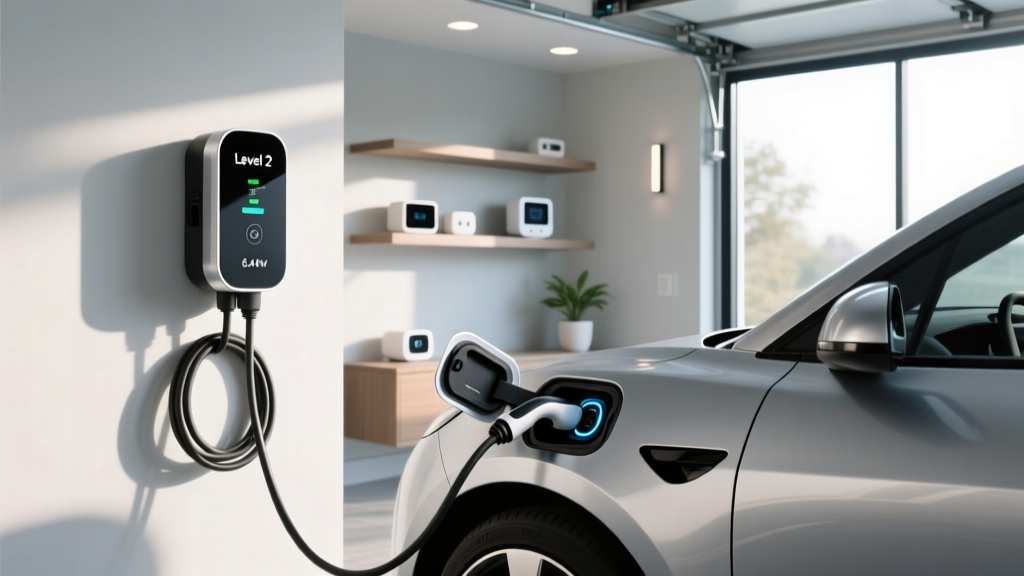
| Level 2 | 208–240V AC | 3.3–19.2 kW | 12–75 mi/hr | Workplace, residential, destination charging |
| DC Fast (Level 3) | 400–800V DC | 50–350+ kW | 150–1,000+ mi/hr | Highway corridors, fleet depots, quick-turnaround sites |
For most workplace installations, Level 2 at 7.2 kW to 19.2 kW is the sweet spot. An employee parking 8 hours can add 96–150+ miles of range—enough to fully replenish most commuter EVs. DC Fast Charging at a workplace is viable only for fleet operations or high-turnover lots where vehicles need a 10–80% charge in 18–30 minutes.
Electrical Requirements and Installation Costs
A Level 2 workplace charger requires a dedicated 208V or 240V circuit. The amperage depends on the charger's output:
- 7.2 kW charger: 30A dedicated circuit (240V)
- 11.5 kW charger: 50A dedicated circuit (240V)
- 19.2 kW charger: 80A dedicated circuit (240V)
Commercial installations frequently use 208V three-phase power, which slightly reduces output on some chargers (a 48A unit rated for 11.5 kW at 240V may deliver ~10 kW at 208V). Your electrician will confirm voltage availability during a site survey.
Workplace Installation Cost Breakdown
| Component | Cost Range (per station) | Notes |
|---|---|---|
| Level 2 charger hardware | $500–$2,500 | Varies by power output, smart features, cable length |
| Electrical labor (licensed electrician) | $1,500–$6,000 | Depends on conduit run distance, trenching, panel proximity |
| Permit and inspection fees | $100–$500 | Varies by municipality |
| Electrical panel upgrade (if needed) | $2,000–$10,000+ | Older buildings may need service upgrades from 200A to 400A+ |
| Networking/software subscription | $15–$50/month per port | For access control, billing, and load management |
| Total per station (typical) | $3,000–$8,000 | Without panel upgrade; add $2K–$10K+ if service upgrade required |
Panel upgrade reality check: Many commercial buildings built before 2010 have electrical panels sized for lighting and HVAC loads, not continuous EV charging. Adding four 11.5 kW chargers draws ~192A of continuous load (NEC requires circuits to be rated at 125% of continuous load, so ~240A of panel capacity). If your building has a 400A service and it's already 60% utilized, you'll need a service upgrade or a load management system that dynamically throttles charger output to stay within the panel's capacity. Smart load management can save $5,000–$15,000 versus a full panel upgrade.
The federal §30C Alternative Fuel Vehicle Refueling Property Credit covers up to 30% of hardware and installation costs (capped at $100,000 per item for commercial property), provided the installation is in an eligible census tract. Consult a tax professional to confirm eligibility for your specific location and tax year.
Connector Compatibility: NACS, CCS, and CHAdeMO
The connector landscape has consolidated significantly since Tesla opened its Supercharger network and licensed the North American Charging Standard (NACS). As of 2026, here's what workplace planners need to know:
| Connector | Brands Using It Natively | Adapter Required? |
|---|---|---|
| NACS (Tesla/J3400) | Tesla, Ford, GM, Rivian, Volvo, Polestar, Fisker, Mercedes (2025+) | CCS vehicles need a NACS-to-CCS adapter (~$150–$250) |
| CCS1 | Hyundai, Kia, BMW, VW, Audi, Porsche, Stellantis, legacy models | NACS vehicles need a CCS-to-NACS adapter |
| CHAdeMO | Nissan Leaf (legacy), Mitsubishi Outlander PHEV | Largely discontinued; no adapter to NACS/CCS |
Workplace recommendation: Install chargers with J1772 connectors (the standard Level 2 plug) for maximum compatibility. Every EV sold in the US since 2011 has a J1772 inlet or ships with a J1772-to-NACS adapter. Tesla vehicles include a J1772 adapter in the glovebox. This means a single J1772-equipped Level 2 station can serve virtually any EV on the road without requiring employees to carry adapters.
If you're also installing DC Fast Chargers, spec units with both NACS and CCS1 cables (dual-hose stations) to serve the widest range of vehicles. CHAdeMO is effectively end-of-life and should not be prioritized for new installations.
Charging Time Examples: What Employees Actually Experience
Charging time depends on battery size (measured in kWh), the charger's power output (kW), and the vehicle's onboard charger limit. Here are realistic scenarios for common workplace battery sizes:
| Battery Size | 7.2 kW Charger (10–80%) | 11.5 kW Charger (10–80%) | 19.2 kW Charger (10–80%) |
|---|---|---|---|
| 60 kWh (e.g., Tesla Model 3 RWD) | ~5.8 hours | ~3.7 hours | ~2.2 hours* |
| 77 kWh (e.g., Ford Mustang Mach-E ER) | ~7.5 hours | ~4.7 hours | ~2.8 hours* |
| 84 kWh (e.g., Hyundai Ioniq 5 Long Range) | ~8.2 hours | ~5.1 hours | ~3.1 hours* |
| 100 kWh (e.g., GMC Sierra EV, Rivian R1T Max) | ~9.7 hours | ~6.1 hours | ~3.6 hours* |
*Many vehicles have onboard charger limits of 11.5 kW or 9.6 kW, meaning a 19.2 kW station won't charge them faster than their onboard limit. Check the vehicle's spec sheet before overspecifying charger power.
For an 8-hour workday, a 7.2 kW station adds roughly 58 kWh—enough to take a 77 kWh battery from 10% to ~85%. For most commuter patterns (30–50 miles round trip), even 7.2 kW is more than sufficient to fully replenish daily driving.
Cost to Charge: Workplace vs. Gas per Mile
One of the strongest selling points for workplace charging is the dramatic per-mile cost advantage over gasoline. Here's how the numbers stack up across different charging scenarios:
| Scenario | Cost per kWh | Efficiency | Cost per Mile |
|---|---|---|---|
| Home charging (off-peak utility rate) | $0.08–$0.14 | 3.5 mi/kWh (avg EV) | $0.02–$0.04 |
| Workplace charging (commercial rate) | $0.10–$0.18 | 3.5 mi/kWh | $0.03–$0.05 |
| Public Level 2 (network pricing) | $0.25–$0.49 | 3.5 mi/kWh | $0.07–$0.14 |
| DC Fast Charging (public) | $0.30–$0.55 | 3.5 mi/kWh | $0.09–$0.16 |
| Gasoline (28 MPG avg, $3.40/gal) | — | 28 mi/gal | $0.12 |
| Gasoline (22 MPG truck/SUV, $3.40/gal) | — | 22 mi/gal | $0.15 |
Even at commercial electricity rates, workplace Level 2 charging costs $0.03–$0.05 per mile—roughly one-quarter to one-third the cost of gasoline for an average car. Employers who offer free workplace charging effectively provide a $1,500–$2,500 annual fuel benefit to employees driving 15,000 miles/year.
Many workplaces use networked chargers with billing software to pass through electricity costs to employees (typically $0.15–$0.25/kWh), generating modest revenue while still undercutting public charging networks. Data from the EPA's fueleconomy.gov tool can help employees calculate their personal savings based on their specific EV model and local utility rates.
Equipment Recommendations: Workplace Chargers That Deliver
After evaluating durability, smart features, power output, and total cost, here are our top picks for workplace Level 2 installations in 2026:
ChargePoint CT4000 Series
- Power Output: 7.2 kW (30A) or 19.2 kW (80A) dual-port
- Connector: Dual J1772 cables (25 ft standard)
- Smart Features: Cloud management, RFID access, load balancing, usage analytics, customizable pricing
- Price: $2,200–$3,500 (hardware only)
- Best For: Medium-to-large offices wanting robust fleet management and employee billing
Emporia Level 2 EV Charger (Commercial)
- Power Output: 11.5 kW (48A)
- Connector: J1772 (24 ft cable)
- Smart Features: Wi-Fi connected, app scheduling, energy monitoring, solar integration
- Price: $550–$750 (hardware only)
- Best For: Small businesses or satellite offices wanting a budget-friendly, reliable unit
Enel X JuiceBox Pro 48 (Commercial Config)
- Power Output: 11.5 kW (48A)
- Connector: J1772 (25 ft cable)
- Smart Features: Ethernet/Wi-Fi, load sharing across multiple units, OCPP 1.6J protocol, access control
- Price: $800–$1,200 (hardware only)
- Best For: Multi-station deployments needing load management without panel upgrades
Autel MaxiCharger AC Wallbox (Commercial)
- Power Output: 19.2 kW (80A)
- Connector: J1772 (25 ft cable, optional NACS)
- Smart Features: 4G/Wi-Fi, RFID, OCPP 2.0.1, dynamic load management, integrated payment terminal
- Price: $1,800–$2,400 (hardware only)
- Best For: High-throughput workplaces with large-battery EVs and premium service expectations
Safety, Code, and Compliance Considerations
Workplace EV charger installations must comply with the National Electrical Code (NEC Article 625) and local building codes. Key requirements include:
- Dedicated circuit: Each Level 2 charger requires its own dedicated breaker—no sharing with other loads
- GFCI protection: NEC 2023+ requires ground-fault circuit interrupter protection for all EV supply equipment; most commercial chargers have built-in GFCI
- Outdoor rating: Outdoor installations require NEMA 4-rated (weatherproof) enclosures; indoor units need NEMA 1 minimum
- Cable management: OSHA and ADA compliance require cables to be retracted or routed to prevent trip hazards; retractable cable management systems add $200–$500 per station
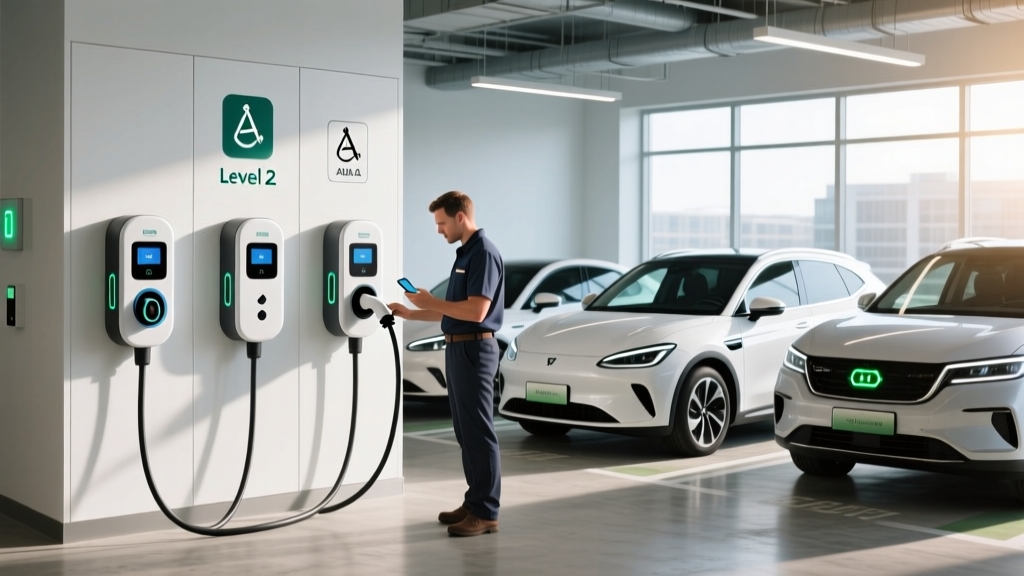
- ADA accessibility: At least one charging space must be accessible-compliant with proper signage, reach ranges, and path-of-travel clearance per ADA Section 502
- Ventilation: Indoor installations in garages may require ventilation assessments per NEC 625.50, particularly for older lead-acid battery-equipped vehicles (rare in modern EVs)
Always hire a licensed electrician experienced with EVSE (Electric Vehicle Supply Equipment) installations. Per the National Highway Traffic Safety Administration (NHTSA), improperly installed charging equipment poses fire and shock risks that void equipment warranties and create liability exposure.
Frequently Asked Questions
How much does it cost to install a workplace EV charger?
A single Level 2 workplace station typically costs $3,000–$8,000 installed (hardware + electrician + permit), assuming no panel upgrade is needed. Multi-station deployments benefit from economies of scale—shared conduit runs and load management systems reduce per-station costs. The federal §30C credit can offset 30% of costs (up to $100,000 per item for commercial installations) in eligible census tracts.
How fast will each charging level add range?
Level 1 (120V) adds 3–5 miles per hour—impractical for workplaces. Level 2 (240V) adds 12–75 miles per hour depending on power output (7.2 kW to 19.2 kW). DC Fast Charging adds 150–1,000+ miles per hour, with 10–80% charges in 18–40 minutes depending on battery size and peak kW capability.
Which connector is compatible with my employees' EVs?
Install J1772-equipped Level 2 stations. Every EV sold in the US since 2011 has a J1772 inlet or ships with an adapter (Tesla includes one standard). This single connector type covers 100% of the current EV fleet without requiring employees to carry adapters.
How much does workplace charging cost per mile versus gas?
At commercial electricity rates of $0.10–$0.18/kWh and average EV efficiency of 3.5 mi/kWh, workplace charging costs $0.03–$0.05 per mile. A comparable gas car at 28 MPG and $3.40/gallon costs $0.12 per mile. Employees save $0.07–$0.09 per mile, or roughly $1,050–$1,350 annually at 15,000 miles/year.
What electrical upgrades might my building need?
Older buildings (pre-2010) may need a panel upgrade from 200A to 400A+ service, adding $2,000–$10,000+ to the project. Alternatively, a smart load management system ($500–$2,000) can dynamically distribute available panel capacity across multiple chargers, avoiding the upgrade entirely. A licensed electrician's site survey will determine your building's headroom.