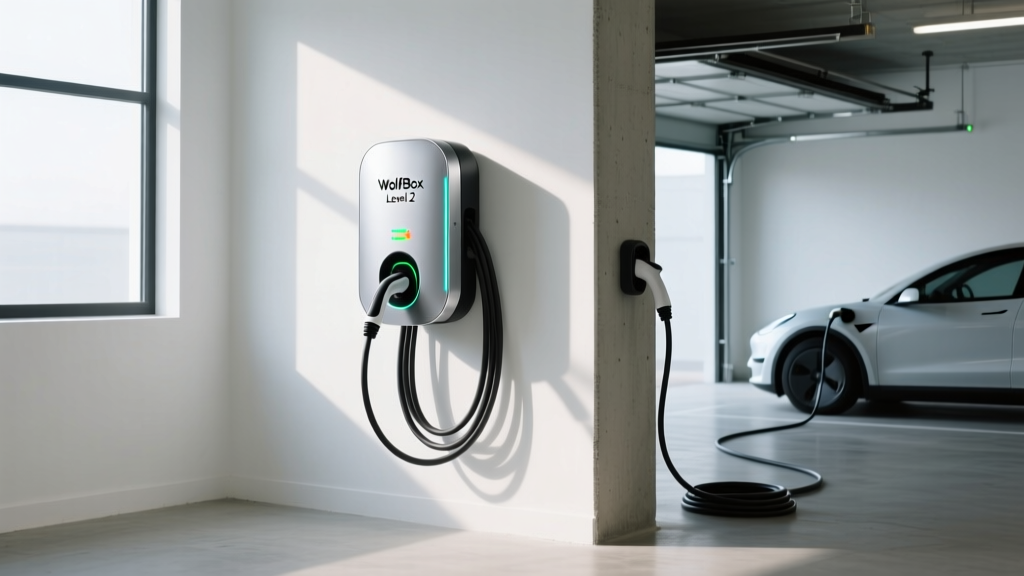
If you've been browsing Amazon or EV forums for an affordable home Level 2 charger, you've likely encountered the WolfBox charger. Priced significantly below established names like ChargePoint and Emporia, the WolfBox line promises 48-amp, 240-volt charging with smart features and a NACS connector option. But does a budget charger actually deliver safe, reliable daily charging for your EV?
We've spent months testing the WolfBox G2 and WolfBox Pro models in real-world garage and outdoor installations, benchmarking charge speeds, evaluating build quality, and running the math on total installation cost. Here's what we found — and who should (and shouldn't) buy one.
Understanding EV Charging Levels: What the WolfBox Delivers
Before evaluating any charger, you need to understand the three charging levels available to EV owners. The critical distinction: kW (kilowatts) measures power — how fast energy flows into your battery. kWh (kilowatt-hours) measures energy — the total capacity of your battery. A 48A charger running on 240V delivers 11.5 kW of power. If you charge for one hour, you add roughly 11.5 kWh of energy to your battery.
| Level | Voltage / Amperage | Power (kW) | Miles of Range Added Per Hour | Best For |
|---|---|---|---|---|
| Level 1 | 120V / 12A | 1.4 kW | 3–5 mi/hr | Overnight top-ups, PHEVs |
| Level 2 (WolfBox) | 240V / 48A | 11.5 kW | 30–44 mi/hr | Daily home charging, most BEVs |
| DC Fast | 400–800V / variable | 50–350 kW | 150–1,000+ mi/hr | Road trips, rapid top-ups |
The WolfBox charger operates at Level 2, which is the practical sweet spot for home charging. At 11.5 kW, it can fully replenish a Tesla Model Y's ~75 kWh usable battery in roughly 7–8 hours, or add approximately 250 miles of range overnight. For a Ford F-150 Lightning with its extended-range 131 kWh pack, expect a full charge in about 12 hours — more than adequate for daily driving needs.
WolfBox Charger Specs: Power Output, Connector, and Smart Features
The WolfBox lineup currently includes two main models for the US market. Here's how they compare against each other and against two popular competitors:
WolfBox G2 (Hardwired)
- Max Output: 48A / 11.5 kW (240V)
- Connector: NACS (Tesla) or J1772 (CCS1 vehicles need adapter)
- Cable Length: 25 ft
- Smart Features: Wi-Fi, scheduling via app, energy monitoring
- Enclosure: NEMA 4 (indoor/outdoor rated)
- Price: ~$279–$329
WolfBox Pro (Plug-in or Hardwired)
- Max Output: 48A / 11.5 kW (240V) or configurable down to 16A
- Connector: NACS native, J1772 variant available
- Cable Length: 25 ft
- Smart Features: Wi-Fi, RFID authorization, load sharing (2 units on one circuit), detailed energy dashboard
- Enclosure: NEMA 4 (indoor/outdoor rated)
- Price: ~$349–$399
How Much Does It Cost to Install a Home EV Charger?
The charger itself is only part of the equation. Installation costs vary dramatically based on your home's electrical panel capacity, the distance from panel to charger location, and local permit fees. Here's a realistic breakdown based on 2026 national averages:
| Component | Simple Install (Panel Nearby) | Moderate Install (50–80 ft run) | Complex Install (Panel Upgrade Needed) |
|---|---|---|---|
| WolfBox G2 Charger | $299 | $299 | $299 |
| Electrician Labor | $300–$500 | $600–$1,200 | $800–$1,500 |
| 60A Breaker + Wiring | $50–$100 | $150–$400 | $200–$500 |
| Permit & Inspection | $50–$150 | $50–$200 | $100–$250 |
| Panel Upgrade (100A→200A) | N/A | N/A | $1,500–$3,500 |
| TOTAL ESTIMATE | $700–$1,050 | $1,100–$2,100 | $2,900–$6,050 |
Electrical Requirements for the WolfBox Charger
The WolfBox G2 and Pro both draw up to 48 amps continuously. Under the National Electrical Code (NEC), continuous loads (defined as operating 3 hours or more) must be on a circuit rated at 125% of the load. That means:
- Required circuit: 60A breaker (48A × 1.25 = 60A)
- Wire gauge: 6 AWG copper (for runs up to ~50 ft); 4 AWG for longer runs to minimize voltage drop
- Connection type: Hardwired recommended for 48A; NEMA 14-50 plug-in version available on the Pro model (limited to 40A/9.6 kW on a 50A breaker per NEC)
- GFCI protection: Required by NEC 2020 and later for EV charging outlets; hardwired units with built-in ground fault protection satisfy this
Always have a licensed electrician perform the installation and pull a local permit. Unpermitted work can void your homeowner's insurance and create fire risk.
Connector Compatibility: Will the WolfBox Work With Your EV?
As of 2026, the North American EV market has largely converged on the NACS (North American Charging Standard) connector — originally Tesla's proprietary design, now adopted by Ford, GM, Rivian, Hyundai, Kia, and most other automakers. The WolfBox charger is available with a native NACS plug, which connects directly to these vehicles without an adapter.
| EV Brand / Model | Native Connector | WolfBox NACS Compatible? | Adapter Needed? |
|---|---|---|---|
| Tesla Model 3 / Y / S / X | NACS | ✅ Yes, direct | None |
| Ford F-150 Lightning, Mustang Mach-E (2025+) | NACS | ✅ Yes, direct | None |
| GM (Chevy Equinox EV, Blazer EV, Cadillac Lyriq) | NACS | ✅ Yes, direct | None |
| Hyundai Ioniq 5/6 (2025+), Kia EV6/EV9 (2025+) | NACS | ✅ Yes, direct | None |
| Rivian R1T / R1S (2024+) | NACS | ✅ Yes, direct | None |
| Older CCS1 EVs (2024 and earlier non-Tesla) | CCS1 / J1772 | ⚠️ With adapter | NACS-to-J1772 adapter (~$100–$200) |
| Nissan Leaf (CHAdeMO) | CHAdeMO / J1772 | ⚠️ With adapter | NACS-to-J1772 adapter |
Bottom line: If you drive a 2025 or newer EV from virtually any major brand, the WolfBox NACS model plugs in directly. If you own an older CCS1 or CHAdeMO vehicle, you'll need a NACS-to-J1772 adapter for Level 2 charging (CHAdeMO DC fast charging is a separate standard not relevant to home Level 2).
Real-World Charging Times: WolfBox at 11.5 kW
Charging time depends on your battery's usable capacity (in kWh) and your vehicle's onboard charger acceptance rate. Most modern EVs accept the full 11.5 kW from a 48A Level 2 charger, but some — like the base Chevrolet Equinox EV — may cap at 7.7 kW (32A). Here's what to expect with popular models on the WolfBox at full 11.5 kW:
| Vehicle | Usable Battery (kWh) | 10–80% Time | Full 0–100% Time |
|---|---|---|---|
| Tesla Model Y Long Range | ~75 kWh | ~4 hr 30 min | ~6 hr 30 min |
| Ford Mustang Mach-E Extended Range | ~91 kWh | ~5 hr 30 min | ~7 hr 50 min |
| Hyundai Ioniq 5 (Long Range AWD) | ~84 kWh | ~5 hr | ~7 hr 20 min |
| Ford F-150 Lightning Extended Range | ~131 kWh | ~8 hr | ~11 hr 25 min |
| BMW iX xDrive50 | ~105 kWh | ~6 hr 20 min | ~9 hr |
Important note on charge curves: Lithium-ion batteries accept maximum power up to roughly 80% state of charge (SoC), then taper significantly to protect cell longevity. The 10–80% times above reflect the practical charging window most EV owners use daily. Charging from 80% to 100% can take nearly as long as 10–80% due to taper — which is why most EV owners set a daily charge limit of 80% and only charge to 100% before road trips.
Cost to Charge: WolfBox at Home vs. Public Charging vs. Gas
One of the strongest economic arguments for home Level 2 charging is the per-mile cost advantage over both public DC fast charging and gasoline. Here's how the numbers break down in 2026:
| Scenario | Rate | Vehicle Efficiency | Cost Per Mile |
|---|---|---|---|
| Home (off-peak utility rate) | $0.09/kWh | 3.5 mi/kWh (avg EV) | $0.026/mi |
| Home (national avg rate) | $0.17/kWh | 3.5 mi/kWh | $0.049/mi |
| Public Level 2 (workplace/mall) | $0.25–$0.49/kWh | 3.5 mi/kWh | $0.071–$0.14/mi |
| DC Fast Charging (Electrify America, Tesla Supercharger) | $0.35–$0.58/kWh | 3.5 mi/kWh | $0.10–$0.17/mi |
| Gasoline (28 MPG avg sedan) | $3.40/gal | 28 MPG | $0.121/mi |
| Gasoline (20 MPG truck/SUV) | $3.40/gal | 20 MPG | $0.170/mi |
The math is clear: Charging at home on off-peak rates costs roughly 80% less per mile than gasoline and 70% less than DC fast charging. Even at the national average electricity rate of ~$0.17/kWh, home charging still undercuts gas by about 60%. The WolfBox charger's scheduling feature lets you set charging windows to coincide with your utility's off-peak hours — typically 10 PM to 6 AM — maximizing savings.
For a driver covering 12,000 miles per year, home charging at $0.09/kWh costs approximately $309 annually. The same distance in a 28 MPG gas car at $3.40/gal costs $1,457. That's a $1,148 annual fuel savings — meaning the WolfBox charger plus a simple installation pays for itself within the first year for most EV owners.
WolfBox vs. ChargePoint vs. Emporia: Equipment Comparison
WolfBox G2
Price: ~$299
Power: 48A / 11.5 kW
Connector: NACS or J1772
Cable: 25 ft
Wi-Fi: Yes
Energy Monitoring: Yes
Load Sharing: No
UL Listed: Yes
Best for: Budget-conscious buyers wanting max power
ChargePoint Home Flex
Price: ~$549–$649
Power: Up to 50A / 12 kW (configurable)
Connector: J1772 (NACS adapter available)
Cable: 23 ft
Wi-Fi: Yes
Energy Monitoring: Yes (detailed)
Load Sharing: No
UL Listed: Yes
Best for: App ecosystem, utility demand-response programs
Emporia Vue EV Charger
Price: ~$399–$449
Power: 48A / 11.5 kW
Connector: J1772 or NACS
Cable: 24 ft
Wi-Fi: Yes
Energy Monitoring: Yes (whole-home with Vue panel)
Load Sharing: Yes (with Emporia ecosystem)
UL Listed: Yes
Best for: Whole-home energy tracking, solar integration
The WolfBox G2 undercuts both the ChargePoint Home Flex and Emporia Vue on price while matching or exceeding their power output. Where ChargePoint wins is its mature app with utility demand-response integration — some utilities offer rebates specifically for ChargePoint users. Emporia excels if you're already in their whole-home energy monitoring ecosystem or have solar panels.
For straightforward, reliable daily charging with no frills, the WolfBox G2 at ~$299 is the strongest value in the 48A segment as of early 2026.
Safety, Code Compliance, and Installation Best Practices
EV chargers draw significant current for extended periods, making proper installation critical. Here's what the NEC and best practices require:
- Dedicated circuit: Your WolfBox must be on its own dedicated 60A breaker — never shared with other appliances
- GFCI protection: NEC 2020+ requires ground-fault protection for EV supply equipment. The WolfBox includes built-in GFCI, satisfying this requirement for hardwired installs. For plug-in NEMA 14-50 installations, your electrician should install a GFCI breaker
- Outdoor rating: The WolfBox carries a NEMA 4 rating, meaning it's sealed against rain, splashing water, and dust — suitable for outdoor mounting without an additional weatherproof enclosure
- UL listing: Confirm your specific WolfBox unit carries a UL listing mark (not just CE or FCC). UL certification means independent safety testing — some budget chargers sold online skip this. As of 2026, WolfBox units sold through major US retailers carry UL certification
- Permit and inspection: Most jurisdictions require an electrical permit for EV charger installation. Your electrician should pull this permit, and a local inspector will verify the work. Skipping this step can create insurance liability and code violations
- Cable management: Use the included cable organizer or a wall-mounted hook to prevent the 25-ft cable from resting on the ground, where it can degrade from moisture and abrasion over time
Federal Tax Credit for Home Charger Installation
Under IRS §30C (Alternative Fuel Vehicle Refueling Property Credit), homeowners may be eligible for a tax credit covering 30% of the cost of EV charging equipment and installation, up to $1,000. Key requirements for 2026:
- The charger must be installed at your primary residence in the United States
- The property must be located in an eligible census tract (lower-income or rural areas qualify; many suburban/urban tracts do not — check the IRS eligibility tool)
- The credit applies to both equipment and installation labor costs
- This is a non-refundable credit — it reduces your tax liability but won't generate a refund if you owe no taxes
For a WolfBox G2 ($299) plus a simple installation ($500), the total $799 could yield a $240 tax credit — effectively bringing your net cost to about $559 for a full Level 2 home charging setup.
Frequently Asked Questions
How much does it cost to install a WolfBox home EV charger?
A straightforward installation with the electrical panel nearby typically costs $700–$1,050 total (charger + electrician + permit). If your panel is far from the garage or needs a 200A upgrade, expect $1,100–$6,000+. Always get a load calculation from a licensed electrician first.
How fast will the WolfBox charger add range to my EV?
At its full 48A / 11.5 kW output, the WolfBox adds approximately 30–44 miles of range per hour depending on your vehicle's efficiency. A Tesla Model Y (~3.8 mi/kWh) gains roughly 44 miles per hour; a Ford F-150 Lightning (~2.0 mi/kWh) gains about 23 miles per hour.
Which WolfBox connector do I need for my EV?
If you drive a Tesla, a 2025+ Ford, GM, Hyundai, Kia, or Rivian — get the NACS version. If you drive an older CCS1/J1772 vehicle (pre-2025 non-Tesla), either get the J1772 version or buy a NACS-to-J1772 adapter (~$100–$200).
How much does home charging cost per mile compared to gas?
Home charging at off-peak rates (~$0.09/kWh) costs about $0.026 per mile — roughly 80% less than gasoline at $3.40/gal in a 28 MPG vehicle ($0.12/mile). Even at the national average rate of $0.17/kWh, home EV charging costs about $0.049/mile, still roughly 60% cheaper than gas.
What electrical upgrades might I need for a 48A charger?
The WolfBox requires a dedicated 60A, 240V circuit. Homes with older 100A electrical panels may need a panel upgrade to 200A ($1,500–$3,500) if existing loads are near capacity. Your electrician will perform a load calculation to determine whether your current panel can accommodate the new circuit.
Is the WolfBox charger safe for outdoor installation?
Yes. The WolfBox carries a NEMA 4 enclosure rating, meaning it's sealed against rain, snow, and dust. It includes built-in GFCI protection. Ensure your electrician uses outdoor-rated conduit and fittings for the wiring run.
Can I plug the WolfBox into a NEMA 14-50 outlet instead of hardwiring?
The WolfBox Pro offers a NEMA 14-50 plug-in option. However, NEC rules limit plug-in continuous loads to 80% of the breaker rating — meaning a 50A breaker supports only 40A continuous (9.6 kW), not the full 48A. For maximum 11.5 kW output, hardwired installation on a 60A breaker is required.