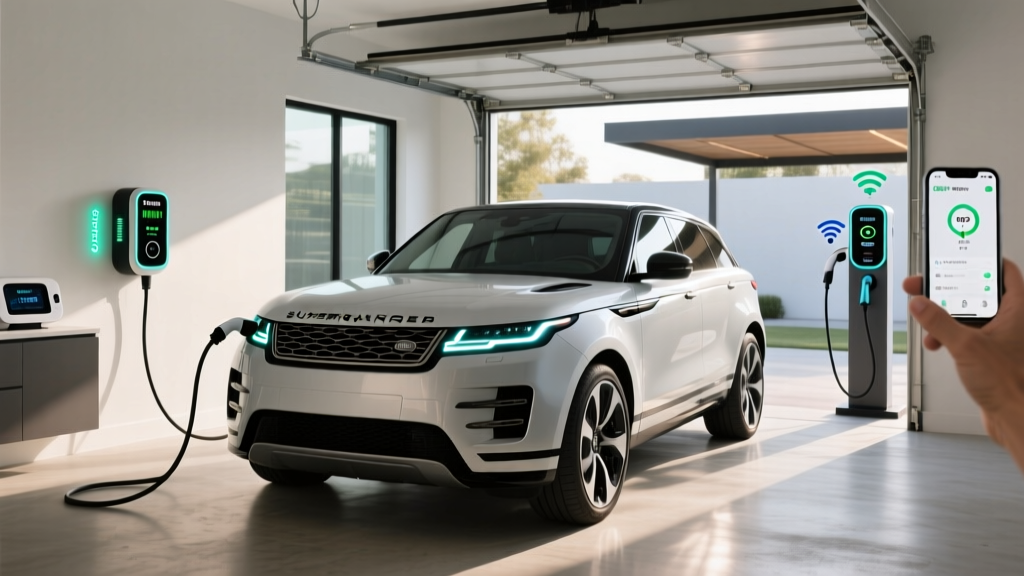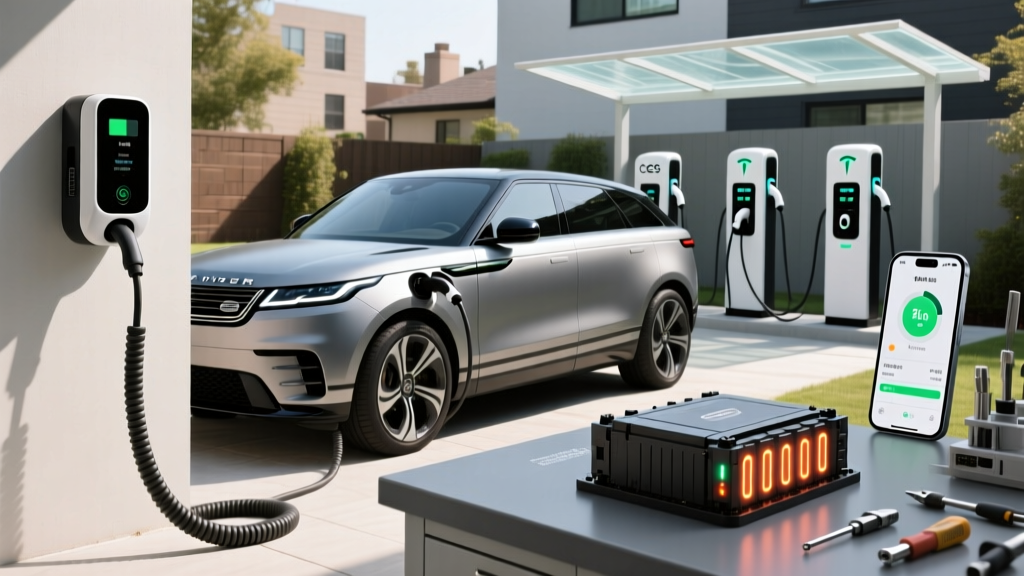
The 2016 Jaguar XJL Supercharged remains a striking luxury sedan — a 5.0L supercharged V8 pushing 470 horsepower, 0-60 mph in about 4.7 seconds, and a cabin that still turns heads. But with gasoline prices fluctuating and EV infrastructure maturing in 2026, owners and cross-shoppers are asking a fair question: how does fueling and maintaining this flagship Jaguar compare to switching to a modern electric vehicle? This guide breaks down the real numbers — from what it costs to charge an EV at home versus filling the XJL's 22.5-gallon tank, to the exact electrical work required for a Level 2 home charger installation.
The 2016 Jaguar XJL Supercharged: Fueling Cost Baseline
Before comparing charging infrastructure, we need hard numbers on what the XJL Supercharged actually costs to drive. The EPA rates the 2016 XJL Supercharged (rear-wheel drive) at 15 mpg city / 23 mpg highway / 18 mpg combined on premium unleaded (91+ octane). With a 22.5-gallon fuel tank, total range sits around 405 miles on a good day.
At the 2026 national average of roughly $4.10 per gallon for premium, filling the tank from near-empty costs approximately $92. Per-mile fuel cost at the combined 18 mpg:
- Cost per mile (fuel only): ~$0.228
- Annual fuel cost (12,000 miles): ~$2,733
- Monthly fuel cost: ~$228
These figures come from fueleconomy.gov and assume mixed driving. Heavy city or performance driving will push real-world consumption to 14 mpg or lower, raising per-mile costs closer to $0.29.
EV Charging Levels Explained: Speeds, Power, and Range Added
Understanding EV charging requires distinguishing between kW (kilowatts), which measures power flow rate, and kWh (kilowatt-hours), which measures total energy stored. Think of kW as how fast water flows through a hose, and kWh as the total gallons in the bucket. A 100 kWh battery charged at 10 kW takes 10 hours; at 100 kW, roughly one hour (minus taper at high state of charge).
| Level | Voltage | Power (kW) | Miles of Range Added Per Hour | Typical Use Case |
|---|---|---|---|---|
| Level 1 | 120V AC | 1.0–1.4 kW | 3–5 miles/hr | Overnight top-up, PHEVs, low-mileage drivers |
| Level 2 | 240V AC | 3.3–19.2 kW | 12–75 miles/hr | Home daily charging, workplace, destinations |
| DC Fast Charge | 400–800V DC | 50–350+ kW | 150–1,000+ miles/hr (peak) | Road trips, highway corridors, quick top-ups |
A few critical real-world notes on these figures:
- Level 2 at 11.5 kW (48A) is the sweet spot for most homes — it adds roughly 40-45 miles of range per hour, easily replenishing a daily commute overnight.
- DC fast charging peaks early, then tapers. A vehicle rated for 250 kW peak may only sustain that rate from 10-30% state of charge (SoC), then progressively slow. A "10-80% in 18 minutes" claim assumes ideal battery temperature and a capable charger.
- Cold weather reduces charging speed. Without preconditioning the battery, DC fast charging in sub-40°F conditions can be 30-50% slower.
Home EV Charger Installation: Electrical Requirements, Permits, and Real Costs
Installing a Level 2 home charger is the single biggest infrastructure decision an EV buyer makes. Here is the full scope of what is involved, including the panel-upgrade scenario that catches many older-home buyers off guard.
Electrical Requirements
A typical Level 2 home charger requires a dedicated 240V circuit, similar to what an electric dryer or oven uses. The most common configurations:
- 40A circuit / 32A continuous charge (7.7 kW): Sufficient for most daily driving. Requires 6-gauge copper wire.
- 50A circuit / 40A continuous charge (9.6 kW): Faster replenishment, ideal for larger batteries (100+ kWh). Requires 6-gauge or 4-gauge wire depending on run length.
- 60A circuit / 48A continuous charge (11.5 kW): Maximum practical home speed for most EVs. Requires 4-gauge copper wire.
Electrical code (NEC Article 625) requires that continuous loads not exceed 80% of circuit rating. A 48A charger therefore demands a 60A breaker — not 48A.
Panel Upgrade: The Hidden Cost
Many homes built before 2000 have 100A or 150A electrical panels. Adding a 50-60A EV circuit may exceed the panel's capacity, especially if the home already runs electric heat, a dryer, and an oven. A licensed electrician will perform a load calculation (NEC Article 220) to determine available headroom.
If a panel upgrade is needed — typically from 100A to 200A — expect costs of $1,500 to $4,000 depending on utility coordination, meter base replacement, and local labor rates. Homes with 200A or larger panels usually have sufficient capacity.
| Component | Low-End Cost | High-End Cost | Notes |
|---|---|---|---|
| Level 2 Charger (Equipment) | $350 | $700 | Hardwired or NEMA 14-50 plug; smart WiFi models cost more |
| Electrician Labor | $500 | $2,000 | Depends on run length, wall type, conduit needs |
| Electrical Permit | $50 | $250 | Required in most jurisdictions; varies by municipality |
| Panel Upgrade (if needed) | $1,500 | $4,000 | 100A to 200A service upgrade; not always required |
| Total (no panel upgrade) | $900 | $2,950 | Most homes with 200A panels fall here |
| Total (with panel upgrade) | $2,400 | $6,950 | Older homes or high-load homes |
The IRS Residential Clean Energy Credit (IRC §25C) covers up to $1,000 (30% of cost) for EV charger equipment and installation through 2032, subject to income and census-tract eligibility. Check irs.gov for current-year rules and the DOE's census-tract lookup tool.
Connector Compatibility: NACS, CCS, and CHAdeMO in 2026
The North American charging connector landscape has consolidated significantly. As of 2026, the NACS (North American Charging Standard) — originally Tesla's proprietary connector, now standardized as SAE J3400 — is the dominant connector for new EVs. Here is where each standard stands:
| Connector | Brands Using It | DC Fast Charge Availability | Adapter Needed? |
|---|---|---|---|
| NACS (SAE J3400) | Tesla, Ford, GM, Rivian, Volvo, Polestar, Hyundai/Kia (2025+), most new models | Tesla Supercharger network + NACS-equipped public stations | CCS-to-NACS adapters available (~$200) for legacy CCS vehicles |
| CCS1 (Combo) | Legacy models: VW ID.4 (pre-2025), BMW i4/iX (pre-2026), older Hyundai/Kia | Electrify America, EVgo, ChargePoint DC stations | NACS-to-CCS adapter for Tesla Supercharger access (~$250) |
| CHAdeMO | Nissan Leaf (discontinued 2025), Mitsubishi Outlander PHEV (older) | Limited and declining infrastructure | No widely available adapter to NACS/CCS |
For home Level 2 charging, all EVs use the same J1772 connector (or NACS, which includes J1772 signaling). Every EV sold in the US comes with a Level 1 cord that plugs into a standard 120V outlet. Most home Level 2 chargers include a J1772 plug or NACS plug — choose based on your vehicle. Adapters are available in both directions.
Cost Per Mile: EV Charging vs. the Jaguar XJL Supercharged
This is where the comparison becomes stark. Let us model three common EVs against the XJL Supercharged using 2026 electricity and fuel prices:
| Vehicle / Scenario | Energy Source | Cost Per Unit | Efficiency | Cost Per Mile |
|---|---|---|---|---|
| 2016 Jaguar XJL Supercharged | Premium gasoline | $4.10/gallon | 18 mpg combined | $0.228 |
| Tesla Model Y LR (home, off-peak) | Level 2, $0.13/kWh | $0.13/kWh | 3.5 miles/kWh | $0.037 |
| Hyundai Ioniq 5 (home, off-peak) | Level 2, $0.13/kWh | $0.13/kWh | 3.3 miles/kWh | $0.039 |
| Tesla Model Y LR (public DC fast) | DC fast, $0.40/kWh | $0.40/kWh | 3.5 miles/kWh | $0.114 |
| Ford F-150 Lightning (home) | Level 2, $0.13/kWh | $0.13/kWh | 2.0 miles/kWh | $0.065 |
| Any EV (peak utility rate) | Level 2, $0.28/kWh | $0.28/kWh | 3.3 miles/kWh | $0.085 |
Key takeaway: Home-charged EVs cost roughly 83-85% less per mile than the XJL Supercharged on fuel alone. Even at expensive public DC fast-charging rates ($0.40/kWh), the EV still undercuts the Jaguar by about 50%. Over 12,000 miles per year, the fuel savings range from $1,365 (exclusive DC fast charging) to $2,290 (home off-peak charging).
However, context matters. The XJL Supercharged is a $75,000+ luxury sedan (when new) with depreciation largely absorbed by now (2026 used values hover around $18,000-$28,000 depending on mileage and condition). A comparable luxury EV — say, a BMW i5 or Mercedes EQE — starts at $60,000-$75,000 new. The fuel savings are real, but they offset only a fraction of the purchase-price gap between a depreciated XJL and a new EV.
Charging Time Examples: How Long Does It Really Take?
Battery size determines charging time as much as charger power. Here are real-world charging time estimates for common EV battery capacities, assuming the vehicle can accept the charger's full output:
- 60 kWh battery (e.g., base Tesla Model 3, Chevy Equinox EV):
- Level 1 (1.4 kW): ~43 hours for a full charge — impractical except for PHEV-sized batteries
- Level 2 at 11.5 kW: ~5.2 hours (0-100%)
- DC fast at 150 kW peak: ~18 minutes (10-80%), ~28 minutes (10-90%)
- 82 kWh battery (e.g., Tesla Model Y LR, Hyundai Ioniq 5 LR):
- Level 2 at 11.5 kW: ~7.1 hours (0-100%)
- DC fast at 250 kW peak: ~16 minutes (10-80%), ~25 minutes (10-90%)
- 100 kWh battery (e.g., Ford F-150 Lightning Extended, Rivian R1S):
- Level 2 at 11.5 kW: ~8.7 hours (0-100%)
- DC fast at 200 kW peak: ~28 minutes (10-80%), ~40 minutes (10-90%)
- 131 kWh battery (e.g., GMC Hummer EV, F-150 Lightning Max):
- Level 2 at 11.5 kW: ~11.4 hours (0-100%)
- DC fast at 350 kW peak (if supported): ~25 minutes (10-80%)
Real-world charging curve reality: DC fast chargers do not deliver peak power for the full session. Most EVs charge at peak kW only between roughly 10-40% SoC, then taper progressively. The final 80-100% is dramatically slower — often at Level 2 speeds. This is why manufacturers quote 10-80% times rather than 0-100%. Always plan road-trip stops around the 10-80% window for efficiency.
Recommended Home Level 2 Chargers (2026)
The home charger market is mature, with reliable options across price ranges. Here are three well-regarded units with specific specs:
ChargePoint Home Flex
- Power Output: Up to 12 kW (50A circuit, 40A continuous) — configurable down to 16A
- Connector: J1772 (NACS adapter available) or native NACS version
- Cable Length: 23 feet
- Smart Features: WiFi, app scheduling, energy tracking, Alexa integration
- Price: ~$549 (J1772) / ~$599 (NACS)
- Best For: Flexible amperage for older panels; robust app ecosystem
Tesla Wall Connector (Gen 4)
- Power Output: Up to 11.5 kW (60A circuit, 48A continuous)
- Connector: NACS native; includes J1772 adapter in box
- Cable Length: 24 feet
- Smart Features: WiFi, OTA updates, power sharing (link multiple units on one circuit), load management
- Price: ~$475
- Best For: Tesla owners and NACS-equipped vehicles; excellent value; power sharing for multi-EV households
Emporia Vue Level 2 Charger
- Power Output: Up to 11.5 kW (60A circuit, 48A continuous)
- Connector: J1772 (NACS version available)
- Cable Length: 24 feet
- Smart Features: WiFi, real-time energy monitoring via Emporia Vue panel integration, solar-aware charging, time-of-use scheduling
- Price: ~$399
- Best For: Budget-conscious buyers; homes with solar panels (can charge on solar excess only)
All three units are UL-listed (or ETL-listed to UL standards), Energy Star certified, and eligible for the federal charger tax credit where applicable. Hardwired installation is recommended over NEMA 14-50 plug installations for reliability — outlets can loosen over time and thermal events at high-amperage receptacles have been documented by NHTSA and EV communities.
Safety and Code Considerations
EV charging involves sustained high-current draw — often 8-10 hours at 32-48 amps. This is more demanding than most household circuits experience. Key safety requirements:
- Dedicated circuit: The EV charger must be on its own breaker. Sharing a circuit with other appliances is a code violation and a fire risk.
- GFCI protection: NEC 2020 and later requires GFCI (Ground Fault Circuit Interrupter) protection for outdoor receptacles used for EV charging. Hardwired units may have GFCI built in; confirm with your electrician.
- Outdoor rating: If the charger is installed outdoors or in an unenclosed carport, it must carry a NEMA 4 (or IP65+) rating for weather resistance. All three chargers above meet this standard.
- Wire gauge: Undersized wire causes voltage drop and heat. Your electrician will size wire per NEC Table 310.15 based on circuit amperage, run length, and ambient temperature.
- Permit and inspection: Most jurisdictions require an electrical permit for new 240V circuits. The inspection verifies wire gauge, breaker rating, grounding, and GFCI compliance. Skipping the permit risks insurance denial in the event of an electrical fire.
Should a Jaguar XJL Owner Consider Switching to an EV?
The 2016 XJL Supercharged occupies a specific niche: supercharged V8 character, handcrafted British luxury, and a depreciated purchase price that makes it accessible. No current EV replicates the sound and feel of that 5.0L AJ-V8. But the ownership math tells a clear story:
- Fuel savings of $1,400-$2,300/year with a home-charged EV
- Elimination of premium gasoline dependency and exposure to oil-price volatility
- Reduced maintenance: No supercharger belt, no 8-speed ZF transmission fluid changes, no spark plugs, no oil changes — EV powertrains have dramatically fewer wear items
- Home fueling convenience: Plug in at night, wake up to a full "tank" every morning — no gas station visits
However, the XJL's current used-market value ($18,000-$28,000) makes it one of the most affordable ways into supercharged V8 luxury. A comparable new luxury EV costs $55,000-$80,000. The fuel savings alone will not close that gap in a typical ownership cycle. The switch makes financial sense if you are already planning a new-vehicle purchase and value the total-cost-of-ownership reduction, daily convenience, and performance characteristics (instant torque, one-pedal driving, lower center of gravity) that EVs provide.
Frequently Asked Questions
How much does it cost to install a home EV charger?
Expect $900 to $2,950 for a standard installation (equipment, electrician labor, and permit) in a home with an adequate 200A electrical panel. If your home requires a panel upgrade from 100A to 200A, add $1,500-$4,000, bringing the total to $2,400-$6,950. The federal §25C credit may offset up to $1,000 of this cost.
How fast will each charging level add range?
Level 1 (120V) adds 3-5 miles per hour. Level 2 (240V, 11.5 kW) adds roughly 40-45 miles per hour — enough to fully replenish most EVs overnight. DC fast charging can add 150-300+ miles in 15-25 minutes, depending on peak power, battery size, and state of charge.
Which connector and charger is compatible with my EV?
In 2026, most new EVs use the NACS (J3400) connector. Older models (pre-2025) from VW, BMW, and Hyundai/Kia use CCS1. Nissan Leaf used CHAdeMO. For home Level 2 charging, all vehicles accept J1772 or NACS — adapters are available in both directions. Check your vehicle's charge port before purchasing a home charger.
How much does EV charging cost per mile vs. gas?
Home-charged EVs cost $0.03-$0.07 per mile depending on local electricity rates and vehicle efficiency. The 2016 Jaguar XJL Supercharged costs approximately $0.23 per mile on premium gasoline. That is a 70-85% reduction in per-mile fueling cost with an EV charged at home.
What electrical upgrades might I need for a home charger?
The most common upgrade is a panel upgrade from 100A to 200A service, required when the existing panel lacks capacity for a new 50-60A dedicated circuit. Your electrician will perform an NEC Article 220 load calculation to determine if this is necessary. Homes with existing 200A+ panels typically need no upgrade — just a new breaker, wire run, and the charger itself.