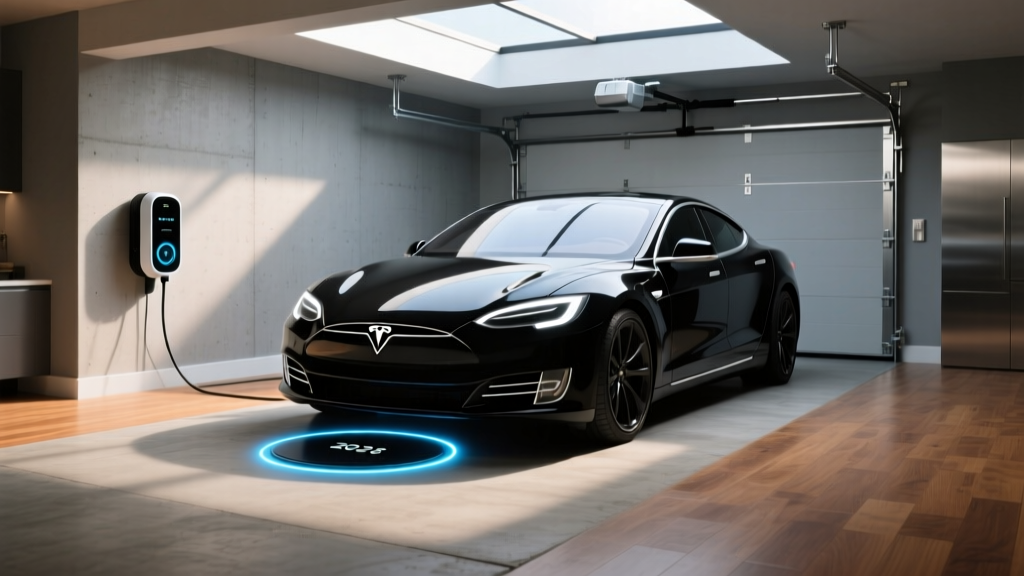
If you've searched for a wireless charger for Tesla expecting a pad you park over and walk away, the short answer in 2026 is: the technology exists, but it isn't a mainstream, Tesla-supported product yet. Inductive (wireless) EV charging is real and deployed in limited commercial and fleet applications, but for Tesla owners charging at home, a hardwired Level 2 wall connector remains faster, cheaper, more efficient, and universally compatible. This guide explains exactly where wireless EV charging stands today, what it costs, how it compares to plug-in charging across all levels, and what your home electrical system actually needs.
How Wireless (Inductive) EV Charging Actually Works
Wireless EV charging uses electromagnetic induction — the same principle as a wireless phone charger, scaled up to deliver kilowatts (kW) of power to a vehicle's traction battery. A transmitter pad embedded in your garage floor or driveway creates an alternating magnetic field. A receiver pad mounted under the car converts that field back into electricity, which the onboard charger manages into the battery.
The key numbers that define any charging system — wireless or wired — are kW (kilowatts), the rate of power delivery, and kWh (kilowatt-hours), the total energy stored in your battery. A Tesla Model Y Long Range has roughly 75 kWh of usable battery capacity. If a wireless pad delivers 7 kW continuously, a full charge from empty would take over 10 hours — and wireless systems typically lose 5–15% of that energy as heat in the air gap between pads, making them less efficient than a direct cable connection.
Current-generation wireless EV charging systems from companies like WiTricity and Plugless Power have targeted 3.6 kW to 11 kW for home use. However, as of 2026, no major automaker — Tesla included — offers a factory-integrated wireless charging receiver on consumer vehicles sold in the U.S. Aftermarket receiver pads exist for limited applications, but they add weight (25–50 lbs under the car), cost $3,000–$6,000 for the vehicle-side hardware alone, and require precise parking alignment to maintain efficiency.
Charging Levels Explained: Speeds, Power, and Range Added
Whether you're considering wireless or sticking with a cable, understanding the three charging levels is essential. Here's how they compare in real-world terms for a Tesla Model Y (consuming roughly 28 kWh per 100 miles, per EPA data on fueleconomy.gov):
| Level | Voltage | Max Power (kW) | Miles of Range Added per Hour | Typical Use Case | Wireless Equivalent? |
|---|---|---|---|---|---|
| Level 1 (120V) | 120V AC | 1.4 kW | ~3–5 mi/hr | Overnight trickle, emergency | No |
| Level 2 (240V) | 240V AC | 7.2–19.2 kW | ~25–65 mi/hr | Daily home/workplace charging | Yes, 3.6–11 kW pads available |
| DC Fast Charge | 400–800V DC | 50–350 kW | ~150–1,000+ mi/hr | Road trips, highway corridors | Experimental only, not consumer-available |
For context, a Tesla Wall Connector hardwired at 48 amps delivers up to 11.5 kW, adding roughly 44 miles of range per hour to a Model Y. A wireless pad at 7.2 kW would add about 26 miles per hour — and after efficiency losses, you might see closer to 22–24 effective miles per hour. That's the trade-off: convenience of no plug, at the cost of speed and energy waste.
Home Installation Requirements and Costs: Wireless Pad vs. Wall Connector
Whether you install a wireless charging pad or a Tesla Wall Connector, the electrical infrastructure in your home is largely the same. Both require a dedicated 240-volt circuit from your main electrical panel. Here's what that involves and what it costs.
Electrical Requirements
A standard Level 2 home charger — wired or wireless — needs:
- 240V dedicated circuit: Typically 40A, 50A, or 60A depending on charger amperage (the circuit must be rated 125% above the continuous load per NEC Article 625)
- Sufficient panel capacity: A 200-amp main panel is standard in modern homes; older homes with 100A service may need a panel upgrade
- Proper wire gauge: 6 AWG copper for 50A circuits, 4 AWG for 60A
- GFCI protection: Required by the 2020 NEC (and 2023/2026 updates) for all EV charging outlets; hardwired units with integrated ground-fault protection also comply
- Permit and inspection: Required in nearly all U.S. jurisdictions for new EV circuits
Installation Cost Breakdown
| Component | Tesla Wall Connector (Wired) | Wireless Charging Pad System |
|---|---|---|
| Equipment cost | $400–$500 | $2,500–$4,500 (pad + control unit) |
| Vehicle-side receiver | N/A (built into car) | $3,000–$6,000 (aftermarket, if available) |
| Electrician labor (standard install) | $500–$1,500 | $1,500–$3,500 (includes pad embedding, trenching if outdoor) |
| Permit and inspection | $100–$300 | $150–$400 |
| Panel upgrade (if needed, 100A→200A) | $1,500–$3,500 | $1,500–$3,500 |
| Total (no panel upgrade) | $1,000–$2,300 | $7,150–$14,400 |
| Total (with panel upgrade) | $2,500–$5,800 | $8,650–$17,900 |
Connector Compatibility: NACS, CCS, and Where Wireless Fits
One of the strongest arguments for a plug-in Tesla Wall Connector over any current wireless system is connector compatibility. Tesla vehicles use the NACS (North American Charging Standard) connector, which Tesla opened to the industry in late 2022. By 2026, NACS is the dominant light-duty EV connector in North America, adopted by Ford, GM, Rivian, Hyundai, and most other major brands.
| Connector | Used By | Max AC Level 2 Power | Max DC Fast Power | Wireless Compatible? |
|---|---|---|---|---|
| NACS (Tesla) | Tesla, Ford, GM, Rivian, Hyundai, Kia, Volvo, most 2025+ EVs | 19.2 kW | 350+ kW | No — wireless pads bypass connectors entirely |
| CCS1 | Legacy VW, BMW, some older EVs (phasing out in U.S.) | 19.2 kW | 350 kW | No |
| CHAdeMO | Nissan Leaf (legacy), Mitsubishi | 6.6 kW | 100 kW | No |
Wireless charging systems don't use any physical connector — the energy transfers across an air gap. In theory, this makes them universal. In practice, the vehicle must have a compatible receiver pad installed, and as of 2026, no Tesla model ships with one from the factory. Aftermarket retrofit kits are extremely limited and not certified by Tesla, meaning installation could affect your vehicle's warranty and ground clearance.
Cost to Charge: Home Electricity vs. Gas Per Mile
Regardless of whether you plug in or park over a pad, the cost of the electricity is what matters for your wallet. Here's how home EV charging compares to gasoline on a cost-per-mile basis for a Tesla Model Y Long Range (28 kWh/100 mi EPA combined):
| Scenario | Rate | Cost per Mile (Tesla Model Y) | Equivalent Gas Vehicle (30 MPG combined) |
|---|---|---|---|
| Home off-peak (utility time-of-use) | $0.08–$0.12/kWh | $0.022–$0.034 | $0.12/mi at $3.50/gal |
| Home standard rate | $0.14–$0.18/kWh | $0.039–$0.050 | $0.12/mi at $3.50/gal |
| Public Level 2 (ChargePoint, etc.) | $0.25–$0.40/kWh | $0.070–$0.112 | $0.12/mi at $3.50/gal |
| DC Fast Charging (Supercharger / EA) | $0.30–$0.50/kWh | $0.084–$0.140 | $0.12/mi at $3.50/gal |
Even with wireless charging's 10–15% efficiency penalty, home off-peak charging at $0.10/kWh would cost roughly $0.027–$0.038 per mile — still dramatically cheaper than gasoline. The savings erode at public DC fast chargers, where rates can match or exceed gas on a per-mile basis in some markets.
Charging Time Examples: 10–80% by Battery Size
Most EV owners charge between 10% and 80% state of charge (SoC) for daily use — this range preserves battery longevity and avoids the slow taper that occurs above 80%. Here's how long that takes at various power levels for common Tesla battery sizes:
| Vehicle (Usable Battery kWh) | Level 1 (1.4 kW) | Level 2 Wired (11.5 kW) | Wireless Pad (7.2 kW effective ~6.3 kW) | DC Fast (250 kW peak, tapered) |
|---|---|---|---|---|
| Tesla Model 3 RWD (~57 kWh) | ~28 hours | ~3.5 hours | ~5.4 hours | ~25 min (10–80%) |
| Tesla Model Y LR (~75 kWh) | ~37 hours | ~4.6 hours | ~7.1 hours | ~28 min (10–80%) |
| Tesla Model S (~95 kWh) | ~47 hours | ~5.8 hours | ~9.0 hours | ~35 min (10–80%) |
For overnight home charging, even the slower wireless pad can replenish a Model Y from 20% to 80% in about 7 hours — sufficient for most daily commutes. However, if you return home with a low battery and need a full charge before morning, the wired 11.5 kW Wall Connector finishes the job nearly 40% faster.
Equipment Recommendations: What to Actually Buy in 2026
Since no Tesla-approved wireless charging system is available for consumers as of 2026, here are the best hardwired Level 2 options for Tesla owners, along with the most notable wireless system for those willing to experiment:
Tesla Wall Connector (Best Overall)
- Power: Up to 11.5 kW (48A, hardwired 60A circuit)
- Connector: NACS (native Tesla)
- Cable length: 24 ft
- Smart features: Wi-Fi, OTA updates, Power Sharing (link up to 6 units on one circuit), Tesla app integration
- Price: ~$450 (unit only)
- Best for: Tesla owners wanting maximum speed and seamless integration
ChargePoint Home Flex (Best Universal)
- Power: Up to 12 kW (50A, configurable 16A–50A)
- Connector: NACS or J1772 (select at purchase); NACS version native for Tesla
- Cable length: 23 ft
- Smart features: Wi-Fi, scheduling, Alexa, detailed energy tracking via app
- Price: ~$550–$650
- Best for: Multi-EV households or those wanting detailed usage data
Emporia Vue Level 2 (Best Value)
- Power: Up to 11.5 kW (48A)
- Connector: J1772 with NACS adapter included
- Cable length: 24 ft
- Smart features: Wi-Fi, solar integration, energy monitoring, scheduling
- Price: ~$350–$400
- Best for: Budget-conscious buyers with solar panels
WiTricity Halo (Wireless — Fleet/Commercial Only)
- Power: 3.6–11 kW (vehicle-dependent)
- Connector: N/A (inductive pad)
- Cable length: N/A
- Smart features: Fleet management integration, alignment assist
- Price: $4,000–$7,000+ (system); vehicle receiver sold separately
- Best for: Fleet operators; not recommended for individual Tesla owners in 2026
Safety, Code, and the Wireless Question
All EV charging installations in the U.S. must comply with NEC Article 625 (Electric Vehicle Charging System Equipment). Key requirements include:
- Dedicated circuit: Your EV charger must be on its own breaker — no sharing with other appliances
- GFCI protection: Required for receptacle-based (plug-in) chargers; hardwired units with listed ground-fault protection also qualify
- Outdoor rating: If installing outside, the unit must carry a NEMA 4 or IP65 rating for weather resistance
- Cable management: NEC requires that charging cables not be routed across walkways or create trip hazards
- Wireless-specific codes: The 2023 NEC added provisions for inductive charging pads, requiring them to be listed by a recognized testing laboratory (UL, ETL) and installed per manufacturer specifications, including foreign-object detection (FOD) to prevent metal debris from heating on the pad
For wireless pads specifically, safety concerns center on the electromagnetic field in the air gap. Current systems include living-object protection (LOP) that shuts down the pad if a person or animal is detected near the field. However, the lack of Tesla-certified aftermarket receiver pads means any wireless installation on a Tesla would be unlisted and uninspected — a significant liability and insurance risk.
Frequently Asked Questions
Does Tesla sell a wireless charger for home use?
No. As of 2026, Tesla does not manufacture or sell a wireless (inductive) charging system for consumer vehicles. Tesla's official home charging product is the Wall Connector, a hardwired Level 2 unit delivering up to 11.5 kW via the NACS connector. Tesla has demonstrated wireless charging prototypes, but no production vehicle or retail product has been released.
How much does it cost to install a home EV charger?
A standard Tesla Wall Connector installation with an existing 200A panel and a 60A circuit typically costs $1,000–$2,300 total (equipment + electrician + permit). If your home needs a panel upgrade from 100A to 200A, add $1,500–$3,500. Wireless pad systems, where available for other vehicles, run $7,000–$14,000+ for the full setup.
How fast will each charging level add range to my Tesla?
Level 1 (120V) adds roughly 3–5 miles per hour. Level 2 at 11.5 kW (Tesla Wall Connector) adds about 44 miles per hour to a Model Y. A 7.2 kW wireless pad would add approximately 22–26 miles per hour after efficiency losses. DC fast charging at a Tesla Supercharger (250 kW) can add up to 200 miles in 15 minutes, though the charge curve tapers significantly above 80% SoC.
Which connector is compatible with my Tesla?
All Tesla vehicles sold in the U.S. use the NACS (North American Charging Standard) connector natively. The Tesla Wall Connector, Tesla Superchargers, and an expanding network of third-party chargers (Ford, GM, and Electrify America locations adding NACS cables) all connect directly. If you have a non-Tesla charger with a J1772 connector, Tesla includes a J1772-to-NACS adapter with every vehicle.
How much does charging cost per mile compared to gas?
Charging a Tesla Model Y at home on an off-peak rate of $0.10/kWh costs roughly $0.028 per mile. At the national average gas price of ~$3.50/gallon, a comparable 30 MPG gas vehicle costs about $0.12 per mile — roughly 4x more. Even public DC fast charging at $0.40/kWh ($0.112/mile) remains competitive with gasoline.
What electrical upgrades might I need for a home charger?
The most common upgrade is a panel capacity increase from 100A to 200A, required when your electrician's load calculation shows the existing panel can't safely support a new 50A or 60A circuit. Other potential upgrades include replacing outdated wiring (aluminum or knob-and-tube), adding a sub-panel for a detached garage, or upgrading your utility service drop. Your electrician will perform a load calculation per NEC Article 220 before recommending any work.
Is wireless EV charging coming to Tesla vehicles?
Tesla acquired wireless charging startup Wiferion in 2023 and has demonstrated inductive charging concepts, but no production timeline has been announced as of early 2026. Industry analysts expect Tesla may integrate wireless charging for future robotaxi fleet vehicles (where autonomous parking alignment makes pad positioning trivial), but consumer availability remains speculative. For now, the Tesla Wall Connector remains the definitive home charging solution. Per IRS guidelines on irs.gov, the §30D federal tax credit for new clean vehicles does not currently cover standalone home charging equipment under the vehicle credit — however, the separate Alternative Fuel Vehicle Refueling Property Credit (§30C) may cover up to 30% of home charger installation costs (up to $1,000) if you live in an eligible census tract. Consult a tax professional for your specific eligibility.