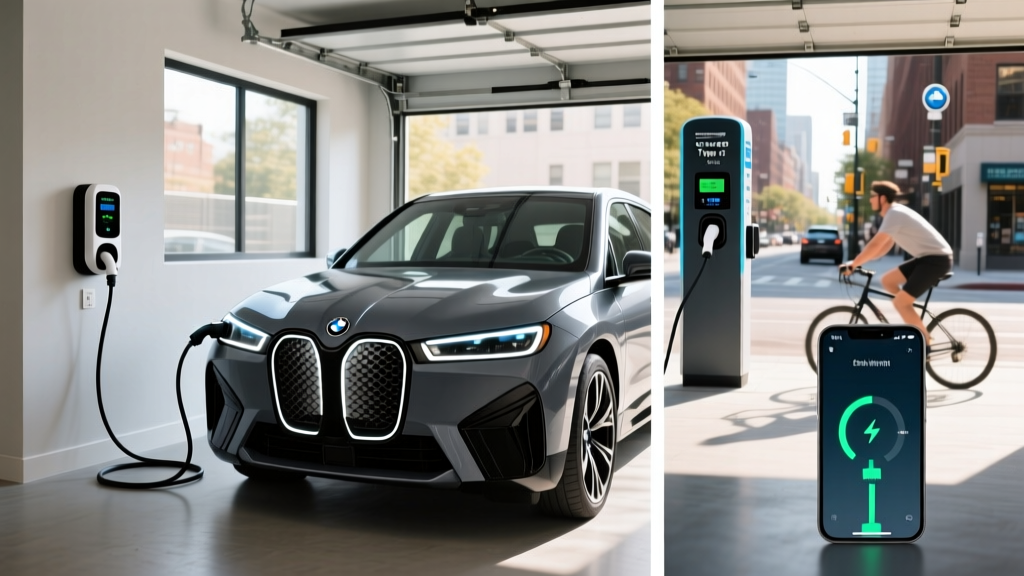
The 2026 BMW iX is a luxury electric SUV with a massive battery and impressive DC fast-charging capability — but getting the most out of it requires understanding your charging options, from a basic 120V wall outlet to a 200 kW DC fast charger. This guide breaks down every charging scenario for the iX, with exact numbers on speed, cost, and home installation requirements.
2026 BMW iX Battery and Charging Specs at a Glance
Before diving into charging levels, here's what you're working with. The 2026 BMW iX xDrive50 carries a usable battery capacity of approximately 105.2 kWh (NMC chemistry), while the performance-oriented M60 variant uses a similar pack tuned for higher output. The EPA rates the xDrive50 at up to 324 miles of range, though real-world highway driving at 70+ mph typically yields 260–290 miles, and cold weather can reduce that further by 15–25%.
| Specification | iX xDrive50 | iX M60 |
|---|---|---|
| Usable Battery | ~105.2 kWh (NMC) | ~105.2 kWh (NMC) |
| EPA Range | Up to 324 mi | Up to 296 mi |
| Max DC Fast Charge Rate | 200 kW | 200 kW |
| DC 10–80% Time | ~31 minutes | ~31 minutes |
| AC Level 2 Max Acceptance | 11 kW (single-phase) / 22 kW (three-phase) | 11 kW / 22 kW |
| Charging Port | CCS1 (J1772 + DC pins) | CCS1 |
| 0–60 mph | 4.4 sec | 3.6 sec |
| Horsepower | 516 hp | 610 hp |
| Base MSRP | ~$87,250 | ~$111,500 |
Charging Levels Explained: How Fast Will Each Add Range?
EV charging happens at three levels, each with dramatically different speeds. The critical distinction: kW (kilowatts) measures the rate of power delivery — how fast energy flows into the battery — while kWh (kilowatt-hours) measures the total energy stored. Think of kW as the flow rate of a hose and kWh as the size of the bucket.
| Level | Voltage / Amperage | Power (kW) | Miles of Range Added per Hour | 0–100% Full Charge Time |
|---|---|---|---|---|
| Level 1 (120V household) | 120V / 12A | ~1.4 kW | ~3–4 mi/hr | 75+ hours |
| Level 2 (240V home/public) | 240V / 48A | ~11.5 kW | ~28–32 mi/hr | ~9.5 hours |
| DC Fast Charging | 400V+ / up to 500A | Up to 200 kW (peak) | ~450+ mi/hr (at peak) | 10–80% in ~31 min |
Level 1 is essentially an emergency trickle for the iX. Plugging into a standard 120V outlet overnight adds perhaps 30–40 miles — barely enough to replenish a day's commute. It's fine for topping off a PHEV with a small battery, but wholly impractical as a primary charging method for a 105 kWh pack.
Level 2 is the workhorse. A properly installed 240V/48A home charger delivers roughly 11.5 kW to the iX (matching its onboard charger limit on single-phase power). That means a full overnight charge from near-empty in about 9–10 hours. Most iX owners will plug in each evening and wake up to a full battery every morning.
DC Fast Charging bypasses the onboard charger entirely, sending DC current straight to the battery. The iX peaks at 200 kW, but — and this is critical — that peak is not sustained. The charging curve is steep at low state of charge (SoC) and tapers significantly above 50–60%. You'll see 200 kW only briefly around 10–20% SoC; by 60% you're likely at 100–120 kW, and above 80% the rate drops to under 50 kW. This is why the industry standard metric is 10–80% time: ~31 minutes for the iX.
Home Charger Installation: Electrical Requirements and Costs
Installing a Level 2 home charger for the BMW iX requires a dedicated 240V circuit. For a 48A continuous-draw charger (the most common high-power home unit), the National Electrical Code requires the circuit to be rated at 125% of the continuous load — meaning you need a 60-amp breaker on a dedicated circuit.
Electrical Panel Considerations
Most modern homes with a 200-amp electrical panel can accommodate a 60A EV circuit without a panel upgrade. However, if your home has an older 100-amp panel (common in homes built before the 1990s), or if your panel is already near capacity with existing loads (electric range, dryer, HVAC), you'll likely need a panel upgrade to 200A — a significant added cost.
A licensed electrician will perform a load calculation to determine if your panel has headroom. Don't skip this step: overloading a panel is a fire hazard and will fail inspection.
Installation Cost Breakdown
| Cost Component | Low End | High End | Notes |
|---|---|---|---|
| Level 2 Charger (Equipment) | $400 | $750 | 48A smart charger, 25ft cable |
| Electrician Labor | $500 | $1,500 | Depends on run length, wall type |
| Electrical Permit | $50 | $200 | Varies by municipality |
| Panel Upgrade (if needed) | $1,500 | $3,500 | 100A → 200A service upgrade |
| Total (no panel upgrade) | $950 | $2,450 | Most common scenario |
| Total (with panel upgrade) | $2,450 | $5,950 | Older homes |
Shorter cable runs from the panel to the garage (under 20 feet, same wall) keep costs near the low end. Longer runs through finished walls, crawlspaces, or to a detached garage push costs higher. Always get at least two quotes from licensed electricians, and verify they pull a permit — unpermitted work can void homeowners insurance and cause issues at resale.
Which Connector Is Compatible with the 2026 BMW iX?
The 2026 BMW iX uses the CCS1 (Combined Charging System) connector standard in North America. This is the J1772 AC connector with two additional DC fast-charging pins below it. It's the dominant standard among non-Tesla EVs, though the industry is shifting toward NACS (Tesla's connector) by 2025–2026.
| Connector Type | Used For | iX Native Support? | Adapter Needed? |
|---|---|---|---|
| J1772 (Type 1 AC) | Level 1 & Level 2 AC charging | Yes (top portion of CCS1) | No |
| CCS1 | DC Fast Charging | Yes | No |
| NACS (Tesla) | Tesla Superchargers | No (native) | Yes — CCS-to-NACS adapter (~$200–$300) |
| CHAdeMO | Legacy DC (Nissan Leaf, older stations) | No | Not available; avoid |
The NACS adapter question matters. BMW has committed to adopting NACS on future models, and as of 2025, BMW EVs can access Tesla Supercharger stations using an approved CCS-to-NACS adapter. This significantly expands the iX's road-trip charging network, since Tesla's Supercharger network is the most reliable and widespread DC fast-charging infrastructure in the U.S. Check BMW's official site for the latest adapter availability and approved models.
Recommended Home Chargers for the BMW iX
Since the iX accepts up to 11 kW on single-phase 240V AC, you want a charger that can deliver at least 48A (11.5 kW) to fully utilize its onboard charger. Here are three proven options:
ChargePoint Home Flex
- Power: Up to 50A (12 kW) — configurable via DIP switches
- Connector: J1772 (NACS version also available)
- Cable Length: 23 feet
- Smart Features: Wi-Fi, app scheduling, energy tracking, Alexa
- Price: ~$550–$650
- Best For: Flexibility — adjustable amperage lets you match your circuit
Emporia Level 2 EV Charger
- Power: 48A (11.5 kW)
- Connector: J1772
- Cable Length: 24 feet
- Smart Features: Wi-Fi, real-time energy monitoring, integrates with Emporia home energy system
- Price: ~$400–$450
- Best For: Budget-conscious buyers who still want smart features
Wallbox Pulsar Plus
- Power: 48A (11.5 kW)
- Connector: J1772
- Cable Length: 25 feet
- Smart Features: Wi-Fi + Bluetooth, Power Sharing (two chargers on one circuit), compact design
- Price: ~$550–$650
- Best For: Two-EV households (Power Sharing balances load)
All three chargers are UL-listed, support scheduled charging (useful for off-peak electricity rates), and work with the iX's CCS1/J1772 inlet. Hardwired installation is recommended over plug-in (NEMA 14-50) for 48A+ chargers — many jurisdictions require hardwired connections for circuits above 40A, and it eliminates a potential failure point.
Charging Cost: What You'll Spend Per Mile vs. Gas
The economics of charging the iX depend heavily on where and when you charge. Here's a realistic breakdown using the iX xDrive50's efficiency of approximately 2.5 miles per kWh (roughly 87 MPGe combined, per fueleconomy.gov):
| Charging Scenario | $/kWh | Cost Per Mile (iX) | Comparable Gas SUV (22 MPG, $3.50/gal) |
|---|---|---|---|
| Home — Off-Peak (utility rate) | $0.08–$0.12 | $0.03–$0.05 | $0.16 |
| Home — Standard Rate | $0.14–$0.18 | $0.06–$0.07 | $0.16 |
| Public Level 2 (ChargePoint, etc.) | $0.20–$0.35 | $0.08–$0.14 | $0.16 |
| DC Fast (Electrify America, EVgo) | $0.35–$0.55 | $0.14–$0.22 | $0.16 |
The takeaway: home charging on an off-peak rate is dramatically cheaper than gas — roughly one-third to one-quarter the per-mile cost. However, exclusive reliance on DC fast charging at public stations can actually cost more per mile than a comparable gasoline SUV. The iX owner who charges at home 80% of the time and uses DC fast only on road trips will see the strongest savings.
For a driver covering 12,000 miles per year with 80% home charging at $0.15/kWh and 20% DC fast charging at $0.45/kWh, annual fuel cost comes to approximately $1,150. A gas SUV at 22 MPG and $3.50/gallon would cost about $1,910 — a savings of roughly $760 per year with the iX.
Public DC Fast Charging: Networks and Road-Trip Strategy
The iX's 200 kW peak charge rate makes it one of the faster-charging EVs on the road, but your actual experience depends on the network. Major U.S. DC fast-charging networks compatible with the iX (via CCS1) include:
- Electrify America: Many stations offer 150–350 kW chargers. The iX will peak around 200 kW on a 350 kW unit. Reliability varies by location — check PlugShare reviews before relying on a specific station.
- EVgo: Growing network of 100–350 kW chargers. Partnership with BMW provides some complimentary charging for new iX buyers (check current promotions).
- Tesla Supercharger (with adapter): V3 Superchargers deliver up to 250 kW; the iX will draw up to its 200 kW limit. Adapter required (CCS-to-NACS).
- ChargePoint Express: Found at retail locations and highway corridors, typically 50–125 kW.
Safety, Code, and Best Practices for Home Charging
Installing a Level 2 charger involves real electrical work and must comply with the National Electrical Code (NEC) and local building codes. Key requirements:
- Dedicated circuit: Your EV charger must be on its own dedicated breaker — not shared with other appliances.
- GFCI protection: NEC 2020 and later require GFCI (Ground Fault Circuit Interrupter) protection for all EV charging outlets. Hardwired chargers with built-in GFCI compliance satisfy this requirement.
- Outdoor rating: If your charger is installed outdoors (carport, driveway), it must be rated for outdoor use (NEMA 4 or equivalent). All three chargers recommended above carry outdoor ratings.
- Permit and inspection: Most jurisdictions require an electrical permit and post-installation inspection. This protects you legally and ensures the work meets code. Budget $50–$200 for the permit fee.
- Wire gauge: A 60A circuit typically requires 6 AWG copper wire (or 4 AWG aluminum). Your electrician will size this based on run length and local code.
Never attempt to install a 240V circuit yourself unless you are a licensed electrician. The voltages involved are lethal, and improper installation is a serious fire risk.
Frequently Asked Questions
How much does it cost to install a home EV charger for the BMW iX?
Expect $950–$2,450 for a standard installation (equipment, electrician labor, and permit) if your electrical panel has capacity. If you need a panel upgrade from 100A to 200A, total costs can reach $2,450–$5,950. Most modern homes with 200A panels won't need an upgrade.
How fast will each charging level add range to the iX?
Level 1 (120V) adds roughly 3–4 miles per hour — impractical for daily use. Level 2 (240V/48A) adds about 28–32 miles per hour, fully replenishing the battery overnight. DC fast charging at peak rate can add over 450 miles per hour, though the rate tapers significantly above 60% state of charge.
Can I charge the 2026 BMW iX at a Tesla Supercharger?
Yes, with a CCS-to-NACS adapter (sold separately, ~$200–$300). BMW has enabled Supercharger access for its EVs via approved adapters. This dramatically expands your road-trip charging options, as Tesla operates over 6,000 Supercharger stalls in North America.
How much does charging the iX cost compared to gas?
Home charging on a standard utility rate costs roughly $0.06–$0.07 per mile — about one-third the cost of a comparable gas SUV at $0.16/mile. Exclusive DC fast charging at public rates ($0.35–$0.55/kWh) can cost $0.14–$0.22 per mile, which approaches or exceeds gas costs.
What electrical upgrades might I need for a Level 2 charger?
You'll need a dedicated 60-amp, 240V circuit with appropriate wire gauge (typically 6 AWG copper). If your home has a 100-amp panel or your panel is near capacity, a service upgrade to 200A will be required — adding $1,500–$3,500 to the project. A licensed electrician's load calculation will determine this before work begins.
Does the BMW iX support 800V ultra-fast charging like the Porsche Taycan?
No. The 2026 iX uses a 400V battery architecture, which caps its DC fast-charge rate at 200 kW. Vehicles with 800V architectures (Taycan, Ioniq 5, Lucid Air) can accept 270–350 kW on compatible chargers. The iX's 200 kW peak is still competitive and delivers a practical 10–80% time of ~31 minutes.
Should I precondition the battery before fast charging?
Yes — always. The iX can precondition its battery automatically when you enter a DC fast-charging station into the navigation system. This warms the battery to its optimal charging temperature, allowing it to hit peak kW rates immediately. Without preconditioning, especially in cold weather, charging speeds can be 30–50% slower for the first 10–15 minutes of the session.