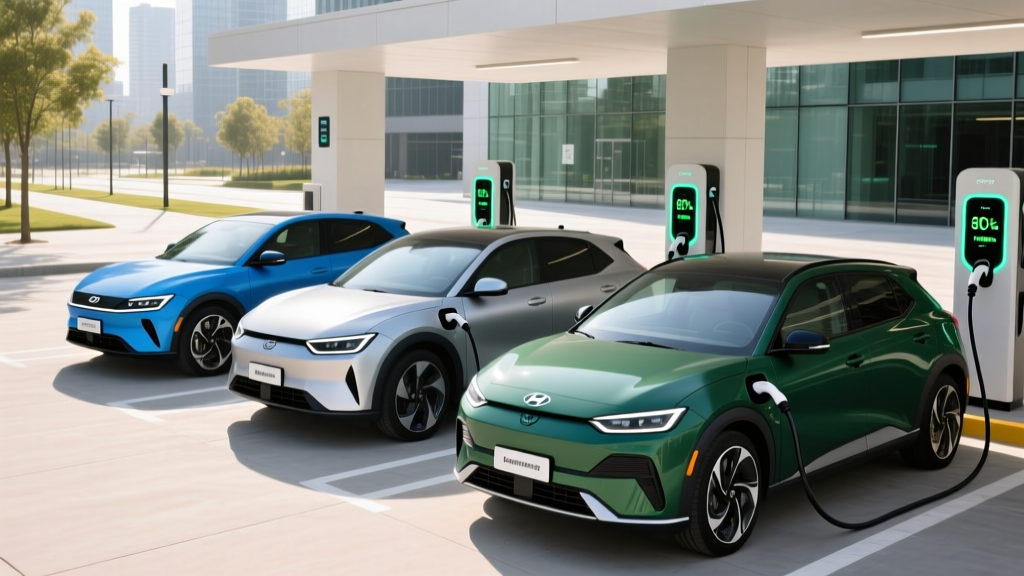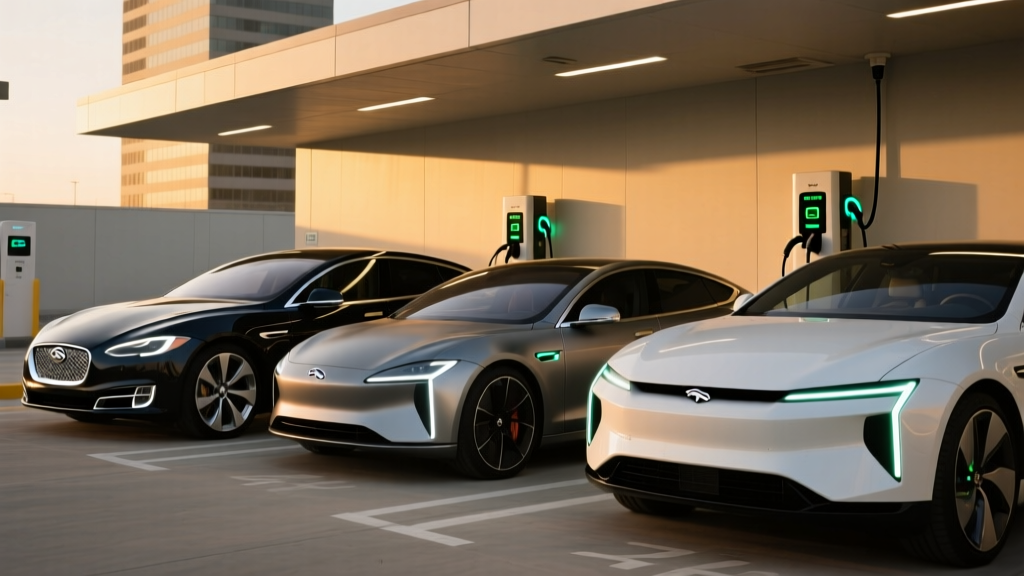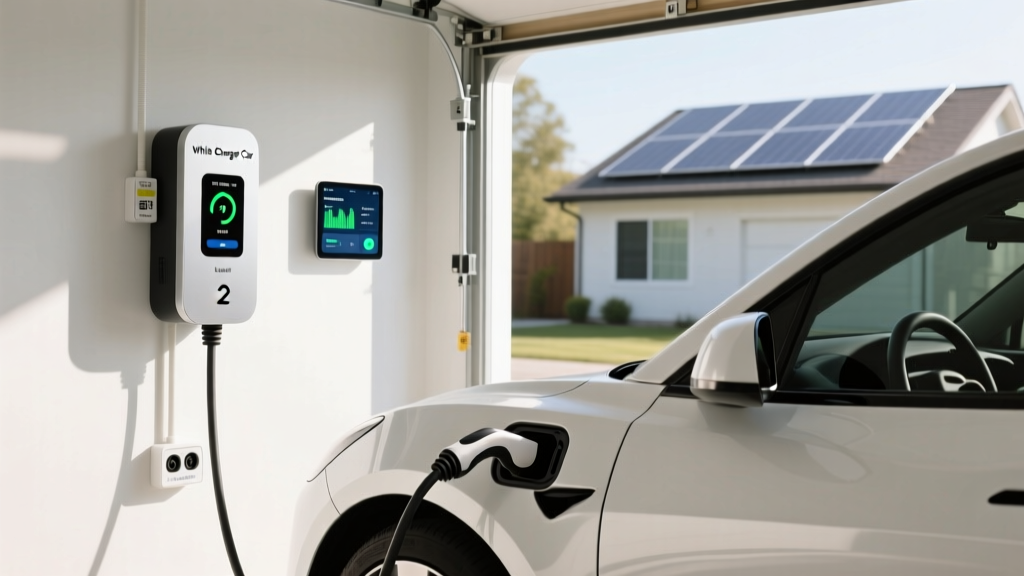
If you've searched for a white charger car aesthetic — pairing a sleek white electric vehicle with a matching white Level 2 wallbox — you're not alone. White EVs like the Tesla Model Y, Hyundai Ioniq 5, and Ford Mustang Mach-E consistently rank among the most popular color choices, and owners increasingly want a clean, integrated look in their garage. But aesthetics are only the starting point. The real questions are: How fast will it charge? What will installation cost? And which equipment actually delivers reliable, daily performance?
This guide breaks down everything you need to wire up a proper home charging station, understand public charging options, and pick equipment that matches your EV's onboard charger capacity. Every figure below reflects current 2026 model-year specs and pricing.
Charging Levels Explained: Level 1, Level 2, and DC Fast Charging
The single most important distinction in EV charging is between kW (kilowatts), which measures power or charge rate, and kWh (kilowatt-hours), which measures energy or battery capacity. Think of kW as how fast water flows from a hose, and kWh as the size of the bucket you're filling. A 80 kWh battery charged at 11.5 kW takes roughly 7 hours from empty; that same battery at 150 kW DC fast charging reaches 80% in about 25 minutes.
| Charging Level | Voltage | Power (kW) | Miles of Range Added per Hour | Typical Use Case |
|---|---|---|---|---|
| Level 1 (Standard Outlet) | 120V | 1.0–1.4 kW | 3–5 mi/hr | Overnight top-up, PHEVs, emergencies |
| Level 2 (Home/Public AC) | 240V | 3.3–19.2 kW | 12–75 mi/hr | Daily home charging, workplace, shopping centers |
| DC Fast Charging (Level 3) | 200–800V DC | 50–350 kW | 150–800+ mi/hr (peak) | Road trips, highway corridors, rapid top-ups |
Real-world context: A Level 1 outlet adds roughly 40 miles of range over a 10-hour night — adequate for a Toyota RAV4 Prime PHEV (42 miles EPA electric range) but woefully slow for a full BEV like the Chevrolet Equinox EV (319 miles EPA). Most EV owners install Level 2 as their daily backbone and rely on DC fast charging for road trips.
How Much Does It Cost to Install a Home EV Charger?
The installed cost of a Level 2 home charging station depends on three variables: the charger hardware itself, the complexity of the electrical run, and whether your panel can handle the additional load. Here's a realistic 2026 breakdown based on national averages:
| Cost Component | Simple Install (Panel Adjacent) | Moderate Install (50–80 ft Run) | Complex Install (Panel Upgrade Needed) |
|---|---|---|---|
| Level 2 Charger Hardware | $350–$700 | $350–$700 | $350–$700 |
| Electrician Labor | $300–$600 | $600–$1,200 | $800–$1,500 |
| Materials (Conduit, Wire, Breaker) | $50–$150 | $150–$400 | $200–$500 |
| Permit & Inspection | $50–$150 | $50–$200 | $50–$200 |
| Electrical Panel Upgrade (if needed) | — | — | $1,500–$3,500 |
| Total Estimated Cost | $750–$1,600 | $1,150–$2,500 | $2,900–$6,400 |
Panel upgrade reality: Homes built before 2000 often have 100-amp electrical service. A 48-amp Level 2 charger draws roughly 57 amps continuously (NEC code requires circuits rated at 125% of continuous load, so you need a 60-amp breaker). Adding that to an already-loaded 100-amp panel may require upgrading to 200-amp service — a $1,500–$3,500 expense that surprises many buyers. Have an electrician evaluate your panel's spare capacity before committing to equipment.
Federal incentive note: The IRS §30C Alternative Fuel Vehicle Refueling Property Credit offers up to $1,000 (30% of equipment and installation cost) for home charger installations placed in service through 2032, subject to census-tract eligibility. This is separate from the §30D new-vehicle credit. Confirm eligibility with a tax professional.
Electrical Requirements: What Your Home Needs
A proper Level 2 installation requires a dedicated 240-volt circuit — the same voltage your electric dryer or oven uses. Key specifications:
- Circuit amperage: Matched to your charger. A 40-amp charger requires a 50-amp breaker (125% rule). A 48-amp charger requires a 60-amp breaker.
- Wire gauge: Typically 6 AWG copper (THHN in conduit) for 40–50 amp circuits; 4 AWG for 60-amp circuits. Longer runs may need upsizing to prevent voltage drop.
- NEMA outlet vs. hardwired: A NEMA 14-50 outlet ($15–$30 part) gives you portability — unplug the charger if you move. Hardwired connections avoid the GFCI breaker nuisance-tripping issues that plague some NEMA 14-50 installations and are required by code in some jurisdictions for continuous loads above 40 amps.
- GFCI protection: NEC 2020 and later require GFCI protection for EV receptacles in garages. Some chargers have built-in GFCI; confirm with your electrician to avoid double-GFCI conflicts that cause false trips.
- Outdoor rating: If your charger mounts outside, it must carry a NEMA 4 or NEMA 4X weather rating. All recommended units below meet this standard.
- Permit and inspection: Most municipalities require a permit ($50–$200) and a post-installation inspection. Skipping this risks insurance denial if an electrical fire occurs and violates local code.
Connector Compatibility: NACS, CCS1, and CHAdeMO in 2026
The North American charging connector landscape has consolidated dramatically. Tesla's NACS (North American Charging Standard) is now the dominant plug, adopted by Ford, GM, Rivian, Hyundai/Kia, Volvo, BMW, and most major automakers for 2025–2026 models. CCS1 remains on older vehicles and some 2024–2025 models. CHAdeMO is effectively legacy, found only on the Nissan Leaf (discontinued after 2025).
| Connector | Vehicles Using It (2026) | Home Charger Availability | Public DC Network Access |
|---|---|---|---|
| NACS (Tesla) | Tesla (all years), Ford, GM, Rivian, Hyundai/Kia, Volvo, BMW, Mercedes, most new 2025+ EVs | Tesla Wall Connector, ChargePoint Home Flex (NACS), Emporia Level 2 | Tesla Supercharger (17,000+ stalls), Electrify America (adding NACS) |
| CCS1 | Older VW ID.4, some 2023–2024 models, legacy BMW/VW/Hyundai | ChargePoint Home Flex (CCS), Grizzl-E Smart | Electrify America, EVgo, ChargePoint DC network |
| CHAdeMO | Nissan Leaf (discontinued 2025) — legacy only | Very limited home options | Declining; some Electrify America and EVgo stalls |
Adapter options: If you own a CCS1 vehicle and want Supercharger access, Ford and GM include NACS adapters with 2025+ models. Tesla sells a CCS-to-NACS adapter ($250) for non-Tesla Superchargers. For home charging, most Level 2 wall connectors now ship with NACS or offer it as a configuration option. If you're buying new in 2026, NACS is the connector to plan around.
Charging Time Examples: How Long Does 10–80% Take?
EV charging isn't linear. Batteries accept peak power only at lower states of charge (typically 10–50% SoC), then the charge rate tapers significantly above 80% to protect cell health. This is why manufacturers quote "10–80%" times rather than 0–100%. Here's what that looks like for common 2026 EVs at different charging levels:
| Vehicle (2026) | Battery (kWh usable) | Level 2 at 11.5 kW | DC Fast Peak Rate | DC Fast 10–80% |
|---|---|---|---|---|
| Tesla Model Y Long Range | ~75 kWh (NMC) | ~6.5 hrs | 250 kW | ~22 min |
| Hyundai Ioniq 5 (Std Range) | ~58 kWh (NMC) | ~5 hrs | 175 kW | ~24 min |
| Ford Mustang Mach-E Extended | ~91 kWh (NMC) | ~8 hrs | 150 kW | ~38 min |
| Chevrolet Equinox EV | ~85 kWh (NMC) | ~7.5 hrs | 150 kW | ~35 min |
| Toyota RAV4 Prime (PHEV) | ~18.1 kWh (NMC) | ~2.5 hrs at 6.6 kW | N/A (no DC fast) | N/A |
Cold-weather note: Lithium-ion batteries charge significantly slower when cold. At 20°F, expect DC fast charge times to increase 20–40% unless your vehicle has battery preconditioning (Tesla, Hyundai/Kia E-GMP, and GM Ultium all include this). Home Level 2 charging in a garage is largely unaffected because the charge rate is gentle enough that the battery's thermal management keeps pace. Source: fueleconomy.gov EV technology overview.
Cost to Charge: Per-Mile Comparison vs. Gas
The economics of EV charging depend heavily on where and when you charge. Home charging on a time-of-use (TOU) plan is dramatically cheaper than public DC fast charging, which itself is often cheaper than gasoline on a per-mile basis.
| Charging Scenario | Typical Cost ($/kWh) | Cost per Mile (3.5 mi/kWh avg) | Annual Cost (12,000 mi) |
|---|---|---|---|
| Home Off-Peak (TOU Plan) | $0.08–$0.12 | $0.023–$0.034 | $275–$410 |
| Home Standard Rate | $0.13–$0.18 | $0.037–$0.051 | $445–$615 |
| Public Level 2 (Workplace/Retail) | $0.20–$0.35 | $0.057–$0.10 | $685–$1,200 |
| DC Fast Charging (Public) | $0.35–$0.55 | $0.10–$0.157 | $1,200–$1,885 |
| Gas Vehicle (28 MPG, $3.40/gal) | — | $0.121 | $1,455 |
The takeaway: An EV owner who charges primarily at home off-peak spends roughly $300–$400/year on electricity for 12,000 miles — about 70–75% less than a comparable gas vehicle. Even exclusive DC fast charging roughly matches or slightly undercuts gasoline. The savings gap widens further when you factor in zero oil changes, no transmission fluid, and reduced brake wear from regenerative braking.
Best Home EV Chargers for 2026: Equipment Picks
These wall connectors lead the market in reliability, smart features, and value. All are NEMA 4 rated for outdoor use and support NACS (native or configurable) for 2026 compatibility.
Tesla Wall Connector (Gen 4)
- Power Output: Up to 11.5 kW (48 amps on 60-amp circuit)
- Connector: NACS native
- Cable Length: 24 ft
- Smart Features: Wi-Fi, OTA firmware updates, power sharing (link two units on one circuit), Tesla app scheduling, load management
- Price: ~$475
- Best For: Tesla owners and NACS-equipped EVs; cleanest white aesthetic match
ChargePoint Home Flex (2nd Gen)
- Power Output: Up to 12 kW (50 amps, configurable down to 16A for lower-capacity panels)
- Connector: Available in NACS or CCS1
- Cable Length: 23 ft
- Smart Features: Wi-Fi, ChargePoint app, Alexa/Google Home integration, detailed energy reporting, scheduling, amperage adjustment via app
- Price: ~$550–$650
- Best For: Multi-EV households, flexible amperage for older panels
Emporia Vue Level 2 EV Charger
- Power Output: Up to 11.5 kW (48 amps)
- Connector: NACS or J1772 (with adapter)
- Cable Length: 24 ft
- Smart Features: Wi-Fi, Emporia app, integrates with Emporia Vue energy monitor for whole-home load tracking, solar-aware charging, scheduling
- Price: ~$399
- Best For: Budget-conscious buyers, solar homes, energy monitoring enthusiasts
Grizzl-E Smart
- Power Output: Up to 10 kW (40 amps)
- Connector: NACS or J1772
- Cable Length: 24 ft
- Smart Features: Wi-Fi, OCPP compatibility, adjustable amperage (16/24/32/40A), extreme cold rated to -40°F
- Price: ~$450
- Best For: Cold-climate owners, Canadian-built durability, OCPP fleet applications
Editor's note: Avoid chargers that don't list their maximum amperage and power output clearly. Some budget units cap at 32 amps (7.7 kW) — adequate for overnight charging but slower than your vehicle may support. Match your charger's output to your EV's onboard charger capacity: the Hyundai Ioniq 5 accepts 10.9 kW AC, the Tesla Model Y accepts 11.5 kW, and the Ford Mach-E accepts 10.5 kW. A 48-amp (11.5 kW) charger covers all of these.
Safety, Code, and Installation Best Practices
EV chargers draw substantial continuous current for hours at a time — far longer than most household appliances. This makes proper installation non-negotiable:
- Use a licensed electrician. DIY 240V work carries serious arc-flash and fire risk. Most jurisdictions legally require a licensed professional for EV circuit installation.
- Dedicated circuit only. Never share a Level 2 circuit with other appliances. The continuous load demands exclusive breaker space.
- Torque-specify all connections. Loose terminal connections are the leading cause of melted NEMA 14-50 receptacles. Your electrician should use a torque screwdriver on all terminations.
- Consider hardwired over plug-in. For 48-amp+ chargers, hardwiring eliminates the receptacle as a failure point and satisfies NEC continuous-load requirements without GFCI nuisance trips.
- Surge protection. A whole-home surge protective device ($150–$300 installed) guards your charger and EV's onboard electronics against voltage spikes — especially valuable in lightning-prone regions.
- Document for insurance. Keep your permit, inspection certificate, and electrician invoice on file. Some insurers require proof of permitted installation before covering EV-related electrical claims.
Frequently Asked Questions
Can I just plug my EV into a regular household outlet?
Yes, but slowly. A standard 120V outlet (Level 1) delivers 1.0–1.4 kW, adding 3–5 miles of range per hour. For a PHEV with 30–42 miles of electric range, this is sufficient for overnight replenishment. For a full BEV with 250+ miles of range, Level 1 requires 40–60+ hours for a full charge — impractical for daily use except as an emergency backup.
Do I need a Tesla Wall Connector if I don't own a Tesla?
No, but it's still an option. The Gen 4 Tesla Wall Connector outputs NACS natively, which is now the standard on most 2025–2026 EVs from Ford, GM, Hyundai, Rivian, and others. If your EV has a NACS port, the Tesla Wall Connector works seamlessly. If your EV still uses CCS1, choose a ChargePoint Home Flex in CCS configuration or use a NACS-to-CCS adapter.
What if my electrical panel is full?
If your panel has no spare breaker slots, an electrician can install a tandem breaker (two circuits in one slot, if your panel allows it) or a sub-panel. If your service is maxed out amperage-wise — common in older homes with 100-amp service — you'll need a panel upgrade to 200 amps ($1,500–$3,500). Some utilities offer panel-upgrade rebates; check with your provider before proceeding.
Is public DC fast charging bad for my battery?
Occasional DC fast charging has minimal impact on battery health. However, exclusive reliance on high-power DC charging (150+ kW) over hundreds of cycles can accelerate degradation slightly compared to Level 2 charging. Most manufacturers recommend Level 2 for daily use and DC fast charging for road trips. Modern battery management systems (BMS) actively protect cells during fast charging by managing temperature and tapering power above 80% SoC. Battery warranties typically guarantee 70% capacity retention for 8 years or 100,000 miles (source).
How do I find my utility's off-peak charging rate?
Visit your utility's website and search for "EV rate plan" or "time-of-use" (TOU) rates. Many utilities now offer dedicated EV TOU plans with off-peak rates between $0.06–$0.12/kWh overnight (typically 10 PM–6 AM) versus $0.18–$0.30/kWh during peak afternoon hours. Your smart charger can be scheduled via its app to charge only during off-peak windows automatically.
Will a white charger match my white EV aesthetically?
Both the Tesla Wall Connector and ChargePoint Home Flex are available in white or silver finishes that pair well with white vehicles like the Model Y, Ioniq 5, or Mach-E. The Tesla unit's slim profile and integrated cable management provide the cleanest garage aesthetic. If visual integration matters, consider painting the conduit run to match your garage walls and mounting the charger at vehicle-port height (typically 44–48 inches from the floor) to minimize cable droop.
Whether you're outfitting a garage for a new NACS-equipped EV or upgrading an older CCS1 vehicle's home charging, the fundamentals remain the same: size your circuit correctly, choose a charger that matches your onboard charger's capacity, and never skip the permit. The result is a reliable, fast, and cost-effective fueling setup that costs pennies per mile and starts every morning with a full battery.