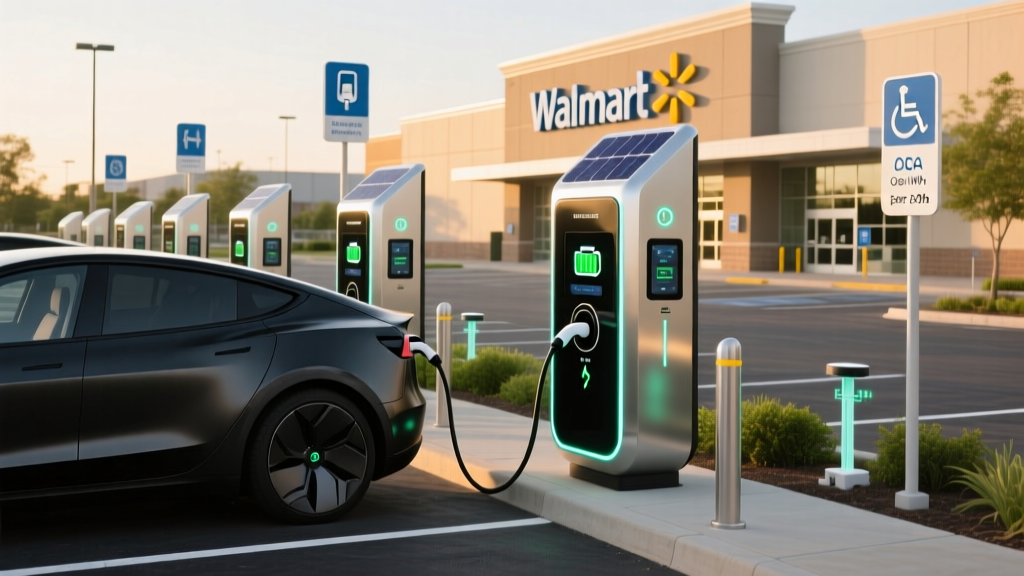
If you've ever scrolled through a charging app while running errands, you've likely noticed a familiar name on the map: Walmart. The retail giant has partnered with multiple charging networks to install DC fast chargers at hundreds of Supercenter and Sam's Club locations nationwide. But what are you actually getting when you pull up to a Walmart EV charging station? The answer depends heavily on which network operates the stall, what connector your car uses, and whether you're topping up for 15 minutes or plugging in for a full session.
This guide covers the current state of Walmart's EV charging footprint in 2026 — including the networks involved, real-world charging speeds, connector availability, per-kWh pricing, and how public fast charging at retail locations stacks up against installing a Level 2 charger at home. If you're weighing whether Walmart's chargers can serve as a regular part of your charging routine or just an occasional road-trip backup, the numbers below will tell you exactly where it fits.
Which Networks Power Walmart EV Charging Stations?
Walmart does not operate its own proprietary charging network. Instead, the company has signed agreements with several major providers, and the chargers you find at any given store depend on that location's contract. As of 2026, the primary networks at Walmart properties include:
- Electrify America: The most common partner, with CCS1 and NACS connectors at most Supercenter locations. Stations typically feature 150 kW and 350 kW cabinets.
- Tesla Superchargers: Select Walmart and Sam's Club locations now host Supercharger stalls. Initially Tesla-connector-only, many of these have been upgraded to include NACS-native access or Magic Dock CCS adapters.
- EVgo: Found at a smaller subset of Walmart stores, particularly in the Midwest and Southeast. Typically 50–100 kW CCS units, with some newer 350 kW installations.
- ChargePoint: Mostly Level 2 units (7.2–19.2 kW) at Sam's Club locations, intended for longer dwell-time shopping trips rather than quick top-ups.
The key takeaway: check your charging app before you drive. A Walmart in one city might have four 350 kW Electrify America stalls with NACS and CCS1 connectors, while another might only offer a pair of 50 kW EVgo units. Location-level detail matters.
Charging Speeds: What to Expect at Each Level
Understanding the three charging levels is essential whether you're using a Walmart fast charger or planning a home install. Power is measured in kW (kilowatts) — this is the rate of energy flow, like water pressure from a hose. Energy is measured in kWh (kilowatt-hours) — this is the total amount stored in your battery, like gallons in a tank. Never confuse the two: a 150 kW charger delivers power at that rate; your 75 kWh battery holds energy.
| Level | Voltage | Max Power (kW) | Miles of Range Added per Hour | Typical Use Case |
|---|---|---|---|---|
| Level 1 | 120V AC | 1.4 kW | 3–5 miles | Overnight trickle; PHEV top-up |
| Level 2 | 240V AC | 7.2–19.2 kW | 20–60 miles | Home daily charging; workplace; retail dwell |
| DC Fast | 400–800V DC | 50–350 kW | 150–1,000+ miles (peak) | Road trips; quick top-ups at Walmart, highway rest stops |
At a Walmart Electrify America station with 350 kW cabinets, a vehicle capable of accepting that rate — such as the Hyundai Ioniq 5 (800V architecture, peak ~240 kW sustained) or the Porsche Taycan (peak ~270 kW) — can add roughly 60–80 miles of range in a 10-minute session. However, most mainstream EVs peak between 150 and 200 kW, so your real-world 10–80% session will typically take 20–35 minutes at a 150 kW or 350 kW stall.
Real-world caveat: DC fast chargers do not sustain peak power for the entire session. This is called the charge curve taper. A charger rated at 150 kW may deliver that rate only between 10% and 40% State of Charge (SoC), then progressively reduce power to protect battery health. Expect your average charging rate across a 10–80% session to be 60–75% of the peak kW rating. Cold batteries further reduce acceptance rates — preconditioning your battery via the car's navigation system before arrival is critical in winter.
Connector Compatibility: NACS, CCS1, and CHAdeMO
The connector landscape has consolidated significantly since Tesla opened the North American Charging Standard (NACS) to other automakers. Here's what you'll encounter at Walmart stations in 2026:
| Connector | Vehicles That Use It | Availability at Walmart |
|---|---|---|
| NACS (Tesla) | Tesla (all), Ford F-150 Lightning/Mustang Mach-E (2025+), Rivian (2025+), GM Ultium vehicles (2025+), Hyundai/Kia (2026 models) | Widely available via Tesla Superchargers at select Walmarts and Electrify America NACS-equipped stalls |
| CCS1 | Hyundai/Kia (pre-2026), VW ID.4, BMW iX, most legacy non-Tesla EVs | Standard on Electrify America, EVgo, and ChargePoint DC fast units at Walmart |
| CHAdeMO | Nissan Leaf (legacy) | Very limited; some older Electrify America stalls still carry one CHAdeMO cable |
Adapter needs: If you drive a newer Ford, GM, or Rivian with a NACS port and arrive at a CCS-only Electrify America stall, you'll need a CCS-to-NACS adapter (several are available from Lectron, A2Z, and Tesla's official adapter for ~$200–$250). Conversely, Tesla owners visiting a CCS-only station need Tesla's CCS adapter. Always carry the appropriate adapter on road trips — not every Walmart station has both connector types.
How Much Does Charging at Walmart Cost?
Public DC fast charging is the most expensive way to fuel an EV — but it's still often cheaper per mile than gasoline. Pricing varies by network, location, and time of day:
| Scenario | Typical $/kWh | Cost per Mile (at 3 mi/kWh efficiency) | Cost to Add 200 Miles |
|---|---|---|---|
| Home Level 2 (off-peak utility rate) | $0.08–$0.14 | $0.03–$0.05 | $5.30–$9.30 |
| Home Level 2 (standard rate) | $0.14–$0.20 | $0.05–$0.07 | $9.30–$13.30 |
| Walmart Electrify America (EA Pass member) | $0.33–$0.43 | $0.11–$0.14 | $22–$29 |
| Walmart Electrify America (guest pricing) | $0.48–$0.56 | $0.16–$0.19 | $32–$38 |
| Walmart EVgo (Plus plan) | $0.29–$0.39 | $0.10–$0.13 | $19–$26 |
| Gasoline comparison (25 MPG, $3.40/gal) | — | $0.14 | $27.20 |
Electrify America's Pass+ subscription ($4/month) reduces per-kWh rates by roughly 20–25%, making it worthwhile if you use public DC fast charging more than twice a month. EVgo's Plus membership works similarly. Guest pricing — paying without a subscription — carries a steep premium.
For a concrete comparison: a Hyundai Ioniq 6 (EPA 360-mile range, ~3.5 mi/kWh) adding 200 miles at a Walmart Electrify America station with Pass+ pricing (~$0.38/kWh) would cost approximately $21.70 for a ~57 kWh session. That same 200 miles in a Toyota Camry getting 32 MPG combined at $3.40/gallon costs $21.25. The EV is essentially at parity on the road — but at home, the same 200 miles costs $7–$10.
Charging Time Examples for Common Battery Sizes
How long you'll spend at a Walmart DC fast charger depends on your battery capacity (kWh), your vehicle's maximum charge acceptance rate (kW), and the stall's output. Here are realistic 10–80% session times:
- Tesla Model Y (75 kWh battery, peak ~250 kW): ~18–22 minutes at a 350 kW EA stall; ~25–30 minutes at a 150 kW stall.
- Hyundai Ioniq 5 (77.4 kWh, peak ~240 kW, 800V): ~18 minutes at 350 kW; ~28 minutes at 150 kW. The Ioniq 5 sustains high charge rates longer than most competitors due to its 800V architecture.
- Ford F-150 Lightning Extended Range (131 kWh, peak ~160 kW): ~38–45 minutes at 150 kW; ~30–35 minutes at 350 kW (capped by truck's acceptance rate).
- Chevrolet Equinox EV (85 kWh, peak ~150 kW): ~30–35 minutes at 150 kW; same at 350 kW (vehicle-limited).
- Nissan Leaf (62 kWh, CHAdeMO, peak ~50 kW): ~55–65 minutes at a 50 kW CHAdeMO stall. CHAdeMO's speed ceiling makes it impractical for road-trip fast charging.
Home Level 2 Charging: Installation Costs and Electrical Requirements
While Walmart's DC fast chargers are useful for road trips and occasional top-ups, the backbone of practical EV ownership is a Level 2 home charger. Here's what's involved in getting one installed.
Electrical Requirements
A Level 2 home charger requires a dedicated 240V circuit, similar to what powers an electric dryer or oven. Common configurations:
- 40-amp circuit / 32-amp continuous (7.7 kW): Suitable for most EVs; adds ~25 miles of range per hour.
- 50-amp circuit / 40-amp continuous (9.6 kW): Ideal for larger batteries (F-150 Lightning, Rivian R1T); adds ~32 miles per hour.
- 60-amp circuit / 48-amp continuous (11.5 kW): Maximum common residential; adds ~38 miles per hour. Requires substantial panel capacity.
The National Electrical Code (NEC) requires that continuous loads (including EV chargers) not exceed 80% of the circuit breaker rating. A 40A breaker supports 32A continuous draw — this is why a "40-amp charger" actually needs a 50-amp circuit. Always match the charger's amperage to the correct breaker size.
Panel Upgrade Considerations
This is the cost that catches many homeowners off guard. If your home has a 100-amp electrical panel (common in homes built before 2000), adding a 40–60 amp dedicated EV circuit may exceed your panel's capacity. A panel upgrade to 200 amps typically costs $1,500–$3,000. Homes with 200-amp panels usually have sufficient headroom, but a licensed electrician must perform a load calculation to confirm.
Some utilities and states now offer rebates for panel upgrades when paired with EV charger installation — check with your local utility before proceeding.
Installation Cost Breakdown
| Component | Low Estimate | High Estimate | Notes |
|---|---|---|---|
| Level 2 Charger Equipment | $300 | $700 | Quality smart chargers from Emporia, ChargePoint, Wallbox |
| Electrician Labor (standard install) | $400 | $1,200 | Depends on run length from panel to garage/carport |
| Electrical Permit | $50 | $250 | Varies by municipality; some jurisdictions waive for EV installs |
| Panel Upgrade (if needed) | $1,500 | $3,000 | Required for older 100A panels; not needed for most 200A panels |
| Conduit, Wiring, Misc. | $100 | $500 | Longer runs (50+ ft) increase material costs |
| Total (no panel upgrade) | $850 | $2,650 | Most homeowners land in the $1,200–$1,800 range |
| Total (with panel upgrade) | $2,350 | $5,650 | Less common; mostly pre-2000 homes |
Always hire a licensed electrician and pull a permit. Unpermitted electrical work can void your homeowner's insurance and create a fire hazard. The installation should include a dedicated circuit with a properly rated breaker, and outdoor-rated (NEMA 4) equipment if the charger is mounted outside.
Federal Tax Credit for Home Charging Equipment
The IRS §30C Alternative Fuel Vehicle Refueling Property Credit covers 30% of home EV charger equipment and installation costs, up to $1,000. However, this credit is only available for installations in qualifying census tracts (low-income or non-urban areas). Check your eligibility at the IRS §30C page before counting on this incentive. As with all tax matters, consult a tax professional for your specific situation.
Recommended Home Level 2 Chargers
Based on build quality, smart features, connector options, and price, these are the chargers we recommend for home installation in 2026:
Emporia Vue Smart Charger
- Power: 48A (11.5 kW) max, configurable down to 16A
- Connector: J1772 (NACS adapter included in 2026 kit)
- Cable: 24 ft
- Smart Features: Wi-Fi, scheduling, solar integration via Emporia Vue energy monitor, load management
- Price: ~$399
- Best For: Budget-conscious buyers who want smart scheduling and energy monitoring
ChargePoint Home Flex
- Power: Up to 50A (12 kW), configurable via DIP switch
- Connector: J1772 or NACS (select at purchase)
- Cable: 23 ft
- Smart Features: Wi-Fi, Alexa integration, detailed session history, flexible amperage
- Price: ~$649 (J1772) / ~$699 (NACS)
- Best For: Buyers wanting a proven brand with NACS-native option
Wallbox Pulsar Plus
- Power: 40A (9.6 kW)
- Connector: J1772 or NACS
- Cable: 25 ft
- Smart Features: Wi-Fi + Bluetooth, Power Sharing (daisy-chain two units on one circuit), compact form factor
- Price: ~$549
- Best For: Two-EV households needing dual charging on a single 60A circuit
Tesla Wall Connector
- Power: 48A (11.5 kW)
- Connector: NACS native; J1772 adapter available separately
- Cable: 24 ft
- Smart Features: Wi-Fi, OTA updates, Power Sharing, integrated cable management
- Price: ~$475
- Best For: Tesla owners or multi-EV households with NACS-equipped vehicles
All four chargers are hardwired (no plug) for maximum amperage and require a dedicated circuit. Hardwired installations eliminate the need for a NEMA 14-50 outlet, which itself requires a $50–$100 receptacle and a GFCI breaker (now required by code in most jurisdictions for EV outlets). Hardwired connections are generally more reliable and avoid the GFCI nuisance-tripping issues that plague some NEMA 14-50 installations.
Safety, Code, and Best Practices for Public and Home Charging
Whether you're plugging in at a Walmart Electrify America station or charging in your garage, follow these safety principles:
Public Charging Safety
- Inspect the cable and connector before plugging in. Look for cracked housing, exposed wires, or damaged pins. Report damaged equipment through the network's app immediately.
- Don't rely on extension cords or adapters not rated for DC fast charging. CCS-to-NACS adapters must be specifically rated for the DC voltage and current of fast charging — not all adapters are.
- Park considerately. Walmart charging spots are limited. Don't idle in a charging spot after your session ends — many networks now charge idle fees of $0.20–$0.50/minute.
- Precondition your battery by setting the charger as your navigation destination. This warms the battery to optimal charging temperature and can reduce your session time by 20–30% in cold weather.
Home Charging Safety and Code
- Dedicated circuit required: EV chargers must be on their own circuit — never share with other appliances.
- GFCI protection: Required for outdoor receptacles (NEMA 14-50) per NEC 2020+. Hardwired installations may or may not require GFCI depending on local code — your electrician will determine this.
- Outdoor rating: If your charger is mounted outside, it must carry a NEMA 4 (or IP54+) weather resistance rating. All four chargers recommended above meet this standard.
- Load management: If your panel is near capacity, consider a smart charger with load-sensing capability (like the Emporia Vue with its energy monitor) that dynamically adjusts charging amperage to prevent tripping the main breaker.
- Permit and inspection: Always pull an electrical permit and schedule the required inspection. This protects your home insurance coverage and ensures the work meets code.
Walmart vs. Home Charging: The Decision Framework
Use Walmart DC Fast Chargers When:
- You're on a road trip and need a 20–30 minute top-up while grabbing groceries
- You live in an apartment or condo without access to home charging
- Your home electrical panel cannot support a Level 2 install without an expensive upgrade
- You need a quick charge before a long drive and your home charger didn't complete overnight
Install a Home Level 2 Charger When:
- You have a garage or dedicated parking spot with electrical access
- You want the lowest possible cost per mile ($0.03–$0.07 vs. $0.11–$0.19 public)
- You want the convenience of waking up to a full battery every morning
- You drive more than 30 miles daily and want to minimize public charging dependency
- Your electrical panel has capacity for a 40–60A dedicated circuit (most 200A panels do)
For most EV owners, the ideal setup is a home Level 2 charger for daily use supplemented by DC fast charging at Walmart and other public stations for road trips and emergencies. The economics strongly favor home charging: over 12,000 miles of annual driving, a home-charged EV saves $800–$1,400 per year compared to exclusive public DC fast charging, and $1,000–$1,800 compared to gasoline at 25 MPG.
Frequently Asked Questions
How much does it cost to install a home EV charger?
A typical home Level 2 charger installation costs $1,200–$1,800 all-in (equipment, electrician labor, permit, wiring) for homes with an adequate 200-amp electrical panel. If your home requires a panel upgrade from 100A to 200A, add $1,500–$3,000, bringing the total to $2,700–$4,800. The federal §30C credit may cover 30% of costs up to $1,000 if your home is in a qualifying census tract.
How fast will each charging level add range?
Level 1 (120V) adds 3–5 miles per hour — adequate only for PHEVs or very low daily mileage. Level 2 (240V, 32–48A) adds 20–40 miles per hour, fully recharging most EVs overnight. DC fast charging (150–350 kW) can add 150–300+ miles in a 20-minute session, though actual speed depends on your vehicle's charge acceptance rate and the state of charge.
Which connector/charger is compatible with my EV?
Tesla vehicles and 2025+ Ford, GM, Rivian, and 2026+ Hyundai/Kia EVs use the NACS connector. Most other EVs from 2018–2025 use CCS1. The Nissan Leaf uses CHAdeMO. Check your vehicle's charge port or owner's manual. For home chargers, purchase the connector that matches your vehicle natively — adapters add cost and a potential point of failure.
How much does charging cost per mile vs. gas?
Home Level 2 charging costs $0.03–$0.07 per mile depending on your electricity rate. Public DC fast charging at Walmart (Electrify America or EVgo) costs $0.10–$0.19 per mile. Gasoline at 25 MPG and $3.40/gallon costs $0.14 per mile. Home-charged EVs are the cheapest option by a wide margin; public DC fast charging is roughly on par with gasoline for efficient vehicles but more expensive for large SUVs and trucks.
What electrical upgrades might I need?
If your home has a 200-amp electrical panel (standard in most homes built after 2000), you likely need no upgrade — just a dedicated 40–60A circuit. Homes with 100-amp panels may require a panel upgrade to 200A ($1,500–$3,000). A licensed electrician will perform a load calculation per NEC Article 220 to determine your panel's available capacity. Some utilities offer managed-charging programs that allow you to install a charger on a smaller panel by capping amperage during peak hours.
Are Walmart EV charging stations reliable?
Reliability varies by network and location. Electrify America stations at Walmart have improved significantly since 2023, with uptime rates now reported above 90% at most locations. EVgo reliability is comparable. Tesla Superchargers remain the gold standard at ~99% uptime. Always have a backup charging option mapped in your app before relying on a single station — check real-time availability and user-reported status in the network's app or on PlugShare before you drive.
Sources: fueleconomy.gov (EPA efficiency data), IRS §30C credit guidelines, Electrify America and EVgo network pricing pages (accessed 2026).